Typical MOQ for Cotton T-Shirts in Bangladesh (and How to Negotiate It Down)
No official typical MOQ exists for cotton T-shirts in Bangladesh. This guide explains what sets the minimum per style and how buyers negotiate it down.
Short answer
There is no single typical MOQ for cotton T-shirts in Bangladesh that an official source publishes. Each factory sets its own minimum for a style, colour and size range, based on fabric, trims, machinery setup and the minimums its own suppliers impose. Buyers lower the figure by simplifying the specification, consolidating colours and sizes, accepting a higher unit price on a smaller run, or committing to repeat orders.
On this page
Key takeaways
No official source publishes a single typical MOQ for cotton T-shirts in Bangladesh; each factory sets its minimum per style, colour and size range.
A quoted MOQ is the highest of several stacked minimums from fabric, trims, print and sewing setup.
Each added colour carries its own minimum, so consolidating colours cuts the total commitment without changing the factory minimum.
Buyers negotiate MOQ down by simplifying the specification, offering a higher unit price on a smaller run, phasing delivery, or committing to repeat orders.
Always confirm whether the MOQ is per order, per style or per colour, and get that basis in writing on the quote.
If you are sourcing cotton T-shirts from Bangladesh, the minimum order quantity (MOQ) is often the first number that decides whether an order is workable. A minimum order quantity is the smallest number of units a supplier or manufacturer will agree to produce or sell in a single purchase order.1 For cotton T-shirts, no official body publishes a single typical figure for Bangladesh, and any list that gives one number without naming the style, fabric, colours and sizes behind it leaves out the facts that set the number.
This guide explains what sets the MOQ for a cotton T-shirt order, how factories quote it, and the steps buyers use to negotiate it down without asking a factory to run a loss-making order.
Why is there no single typical MOQ for cotton T-shirts?
There is no single typical MOQ because the quoted figure is rarely one number. A minimum order quantity is the smallest run a manufacturer will produce for a given specification, and the quote is the highest of several minimums stacked on top of each other, including the minimums set by the fabric supplier, the trim supplier and the printer.2 Change the specification and the stack changes.
A plain T-shirt in one colour, cut from fabric the factory already holds, sits on a short stack. The same shirt in four colours, with a chest print and branded packaging, sits on a much taller one, because each colour needs its own dyeing and cutting run and each trim carries a purchase minimum from a different supplier. Two factories can therefore quote very different MOQs for what looks like the same shirt. The useful question is not what the typical MOQ is, but what is driving the MOQ in your quote. See the MOQ glossary entry and what MOQ stands for.
What drives the MOQ for a cotton T-shirt order?
Suppliers establish MOQs primarily to ensure the economic viability of a production run, because manufacturing involves fixed costs such as machine setup, specialised tooling and initial labour training, which must be covered before production is profitable.1 Manufacturers also face minimum purchase requirements from raw material vendors, so the factory minimum must let it buy fabric and trims in the quantities its own suppliers require.1
Driver | How it raises or lowers the MOQ |
|---|---|
Fabric | Stock fabric in a standard weight and colour needs no new dyeing run. Custom-dyed or custom-knitted fabric adds the dye house minimum on top of the sewing minimum. |
Colours per style | Each colour is a separate dyeing, cutting and sewing setup. More colours multiply the total commitment, even when the per-colour minimum stays the same. |
Sizes per colour | Sizes share the colour run, but a wide range increases cutting complexity and leftover-stock risk in slow sizes. |
Print, embroidery or wash | Each decoration method adds setup and its own supplier minimum. A plain shirt has none of this. |
Trims and packaging | Custom labels, tags, polybags and cartons come from separate suppliers, each with a purchase minimum that can exceed the garment quantity on a small order. |
Factory size and order book | A factory set up for long runs has higher fixed costs to spread. A smaller factory with a free slot may accept less, at a higher unit price. |
The diagram below shows how those drivers stack into one quoted figure.
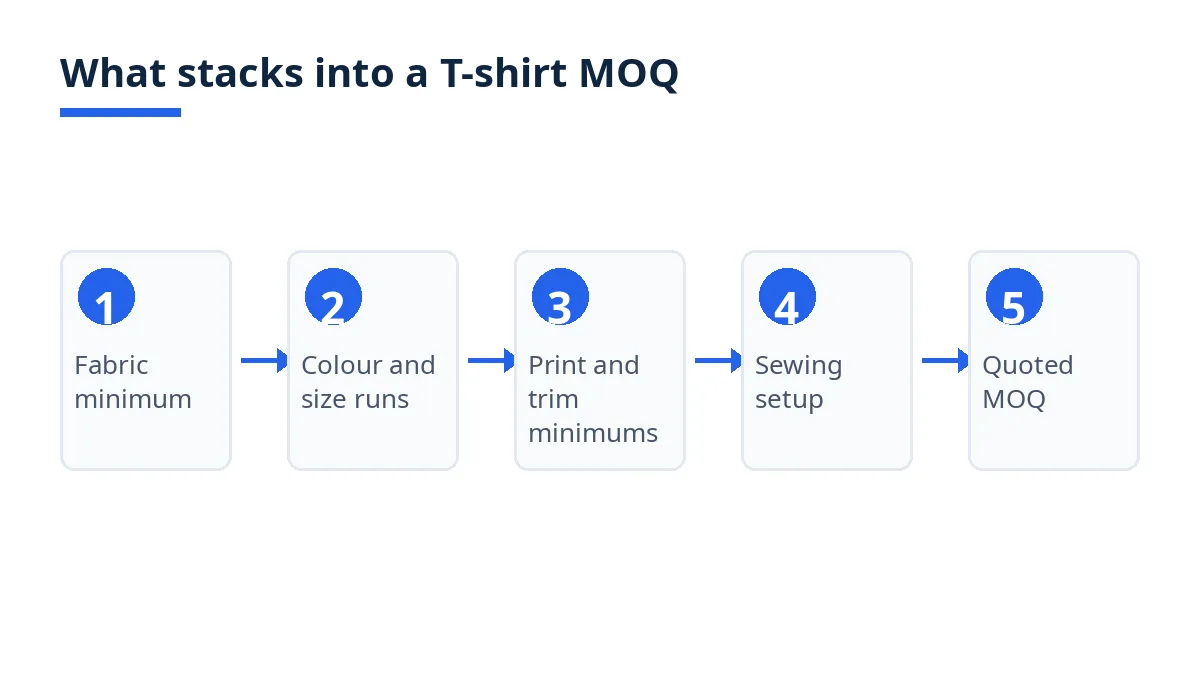
One pattern matters more than the rest. Five shades or five flavours means five changeovers, five component sets and five minimums, not one order split five ways, and the same logic applies to five T-shirt colours in one style.2 Splitting a modest quantity across many colours turns one small order into several minimum orders added together.
How is MOQ usually quoted: per style, per colour or per order?
Always ask which unit the MOQ applies to. A minimum quoted per order is the easiest to meet, since several styles or colours can count toward it. A minimum per style is stricter, and a minimum per colour per style is the strictest common form for dyed garments, because each colour run must stand on its own. Some suppliers instead set a minimum order value, where the total monetary worth of the purchase must meet a set amount regardless of units, and trial orders usually carry a substantially higher unit price to compensate for the inefficiency of a short run.1 Get the MOQ basis in writing on the quotation, next to the price.
Step-by-step: how to negotiate the MOQ down
Buyers who get movement on an MOQ do not simply ask for a smaller number. They give the manufacturer a reason the economics still work at the lower quantity.2
Ask which minimum is binding. Ask the factory to name the line that sets the MOQ: the fabric, a trim, the print setup or its own sewing minimum. Once you know whether the constraint is the fabric batch or a component vendor, you know which one to solve.2
Quote the same specification at three volumes. Ask for prices at your minimum, your target and a stretch volume. The curve tells you where the real price breaks are and where the fixed costs sit.2
Simplify the specification. Use a stock fabric colour instead of a custom dye, one print position instead of two, and standard trims instead of custom-made items. Each removal takes a minimum off the stack.2 Reducing complexity, such as avoiding custom tooling for logos or packaging, also makes a small run more appealing to the manufacturer.1
Consolidate colours and sizes. Launch with fewer colours and add colours once the first colour sells. Launching narrow and extending later is the simplest way to keep the first commitment down.2
Offer a higher unit price for the smaller run. Proposing a higher unit price for a smaller volume run helps the supplier cover fixed setup and labour costs, and shows a willingness to meet its margin requirement even when the volume threshold is not met.1 A short-run surcharge is often cheaper than the working capital tied up in a full MOQ you cannot sell.
Split delivery, not production. Phased ordering means agreeing to the full MOQ while scheduling delivery and payment across multiple smaller shipments over several months.1 A related route is to buy components at volume and finish in stages, where storage allows, so you get the volume price without the finished-goods risk.2
Commit to the follow-on order. Present a forecast that shows a clear path to meeting or exceeding the standard MOQ in later orders, because suppliers are often willing to make a one-time concession on the initial order when securing a reliable, high-volume buyer.1 A smaller first run against a contracted second run is a different conversation from a one-off order.2
Use stock and overruns where they fit. Purchasing a supplier's existing stock or excess inventory from another run can bypass the MOQ, because those units have already absorbed the fixed production costs.1 Check shade, fabric weight and labelling carefully first.
Worked example: consolidating colours
Example figures: these numbers are illustrative only, not a quote or a typical MOQ. Suppose a factory quotes 1,200 pieces per colour for a printed cotton T-shirt, and you planned four colours at a target total of 2,400 pieces. Per colour, that plan needs 4,800 pieces, twice your target. Launch with two colours, and the same minimum needs 2,400 pieces, matching your target with no change to the factory minimum. Keeping four colours leaves three levers: a higher unit price on a smaller per-colour run, a stock fabric that removes the dyeing minimum, or phased delivery. The lesson is the arithmetic, not the figures.
Bangladesh-specific rules and tips
Cotton T-shirts are knitwear, the larger half of Bangladesh garment exports by value. Knitwear exports rose 6.88 per cent to $5,963.76 million in the first quarter of fiscal 2026-27, while woven exports grew 5.11 per cent to $4,614.80 million, according to data released by the Export Promotion Bureau (EPB) and reported by The Financial Express.3
The European Union remained the largest destination for Bangladeshi garments in the same quarter, accounting for $4.9 billion, or 46.36 per cent of total exports, while exports to the United States rose 10.4 per cent to $2.22 billion.4
Product development is the other Bangladesh-specific lever. BGMEA notes that garment factories in Bangladesh usually tend to get the design from the brands and buyers and replicate it, and that having own product development capacity helps better in terms of negotiation and profitability, while lead time of production is also one of the major impediments for the industry.5 A buyer who arrives with a complete technical pack and approved samples removes development work from the factory side, which strengthens the case for a smaller first run. BGMEA also notes that modern software for fabric cutting optimisation, 3D sampling and pattern making is being used in the global fashion industry to make processes faster.5
Costs, timelines and documents
This guide states no typical T-shirt price and no typical lead time, because neither can be verified from an official source and both move with fabric, decoration and the factory order book. What can be stated is how cost is built. As order volume increases past the MOQ threshold, unit cost decreases because fixed costs are spread across more items, and manufacturers pass those savings on through tiered pricing where the cost per unit drops at volume milestones.1 Ask every supplier to quote on the same basis, and compare landed cost, which includes unit cost, shipping, duties and internal holding costs, rather than a factory price alone.1 2
Bangladesh Bank rules shape what a factory can accept. Under the revised instructions reported in September 2025, exporters must have an irrevocable letter of credit (LC) or contract to execute shipments, demonstrate satisfactory past performance and show sufficient capacity to fulfil the order, and advance payments must remain interest-free.6 The same instructions waived the requirement to keep back 10 per cent of advance remittances, so banks may now release the full advance to an exporter, subject to due diligence.6 Practical points:
Agree whether the order runs under an LC or a sales contract before discussing final quantities.
Keep the tech pack, purchase order, pro forma invoice and approved sample record together, so the MOQ basis can be checked against the order documents.
If an export is not executed, including failure to issue an EXP Form against an advance payment, refunds follow the Bangladesh Bank route through the Exporters' Retention Quota account and then Taka accounts.6
Read how supplier verification works on Exportain before paying a deposit.
For the ordering sequence around samples and shipping, read how to import cotton T-shirts from Bangladesh.
Mistakes and red flags
Comparing quotes with different MOQ bases. One quote may be per order and another per colour. Convert both to total pieces and landed cost before comparing prices.
Splitting a small total across many colours and sizes. Each colour carries its own changeovers and minimums, so a broad first range multiplies the commitment.2
Buying to a price break you cannot sell through. A lower unit price on inventory that does not sell is not a saving. Model the volume you can sell first, then negotiate around that number.2
Treating the first quote as final. The first MOQ is an opening position built on assumptions you have not yet challenged, including fabric, trims and delivery pattern.2
Accepting a very low MOQ with no explanation. A minimum far below the factory's own fabric and trim minimums can mean substituted fabric or a shared run. Ask which minimum was waived and how.
Leaving reorder terms unwritten. If the first run is a concession, record the reorder price, reorder MOQ and lead time in the same agreement.
Checklist: before you accept or challenge an MOQ
The MOQ basis is written on the quote: per order, per style, per colour, or a minimum order value.
The factory has named the binding minimum: fabric, trim, print or sewing.
The specification uses stock fabric and standard trims where the design allows.
Colours and sizes are consolidated to the first selling season.
Prices are quoted at three volumes on the same specification and packing.
Any smaller-run agreement states the unit price or surcharge that replaces the volume.
Delivery phasing, reorder MOQ, reorder price and lead time are in the order.
Payment runs under an LC or a contract, with the order documents held on file.
FAQs
What should I know first about cotton t-shirts?
Know the specification before you ask about quantity. Fabric composition and weight, colours, size range, print, trims and packing decide the stack of minimums behind the quote, and a factory cannot give a firm MOQ without them.2 Cotton T-shirts are knitwear, the larger segment of Bangladesh garment exports by value, with knitwear at $5,963.76 million in the first quarter of fiscal 2026-27 on EPB data.3
What are the typical costs and timelines?
There are no verified typical cost or timeline figures in this guide, because prices and lead times are set per factory, per specification and per season, and no official source publishes a standard figure. Unit cost falls as volume rises past the MOQ because fixed costs are spread across more units and pricing is tiered at volume milestones.1 Lead time is named by BGMEA as one of the major impediments for the industry, so treat the delivery date as a negotiated term with a written buffer.5
Which documents are needed?
On the Bangladesh side, the order needs an irrevocable letter of credit or a sales contract for the exporter to execute the shipment, and advance payments must remain interest-free under the Bangladesh Bank instructions.6 Keep the purchase order, pro forma invoice, technical pack and approved sample record with the order, and be ready for the EXP Form process that applies to export declarations and to refunds when an export against an advance payment is not executed.6 Add the documents your own customs entry requires, confirmed with your broker before production starts.
What are the most common mistakes?
The most common mistakes are splitting a small order across too many colours, comparing quotes that use different MOQ bases, and arguing about the headline MOQ before identifying which minimum in the stack is binding.2 Buyers also over-order to reach a price break they cannot sell through, and accept a low first-order MOQ without written reorder terms.
Next steps on Exportain
Browse suppliers for cotton T-shirt makers, compare how each states its MOQ, and post your specification through RFQs so factories quote on the same fabric, colours and sizes. Apply the negotiation steps above to the quotes that come back, and confirm the MOQ basis in writing before the first order.
Sources
- What is an MOQ? Minimum Order Quantity Explained. Climb the Ladder (accessed )
- MOQ and Manufacturing Volume: What Actually Matters. Product Management Group, (accessed )
- RMG exports rise 6.10pc to US$10.58b in July-Sept of FY27. The Financial Express, (accessed )
- RMG exports grow 6.1% in Q1. The Business Standard, (accessed )
- BGMEA launches Go Human, Go Green with 7 Pledges to make difference to RMG industry and workers. BGMEA (accessed )
- BB eases rules to support exporters. The Financial Express, (accessed )
About the author
Sourcing from Bangladesh?
Post a request for quotation and suppliers on Exportain can send you their quotes directly.
Post an RFQ