MOQ Full Form: Practical Guide
MOQ full form explained in practice: what Minimum Order Quantity means, why factories set minimums, how MOQs vary by product, and how to work with them when sourcing from Bangladesh.
Short answer
MOQ stands for Minimum Order Quantity, the smallest quantity a supplier will produce or sell in one order. In practice, MOQ sets whether a product is testable at your budget, because factories spread fixed setup, material, and packing costs across the run, so a smaller order usually means a higher unit price or fewer customization options.
On this page
Key takeaways
MOQ means Minimum Order Quantity, the lowest quantity a supplier will accept for one order, product, or variant.
Always confirm what the MOQ applies to: per product, per color, per size, per design, per order, or per shipment.
MOQ exists because of material minimums, machine setup, labor, quality control, and packing costs that do not scale down with a small run.
A lower quantity is sometimes possible, but it usually changes the unit price, materials, customization, or delivery time.
Put the agreed quantity and variant breakdown in writing before payment to prevent definition disputes.
If you are sourcing products for the first time, you will meet the moq full form in almost every supplier reply. MOQ stands for Minimum Order Quantity, the smallest quantity a supplier is willing to produce or sell in a single order.1 This guide explains what MOQ means in practice, why factories set minimums, how MOQs differ by product, and how buyers sourcing from Bangladesh can work with them clearly and fairly.
Understanding MOQ early saves time. A buyer who states a realistic quantity in the first enquiry gets faster, more accurate quotations, and a seller who explains the reason behind a minimum can keep a smaller buyer interested. MOQ is a production and costing boundary that becomes a useful planning tool once you understand what drives it. For the short definition on its own, see the MOQ minimum order quantity definition.
Key takeaways: moq full form at a glance
MOQ means Minimum Order Quantity, the lowest quantity a supplier will accept for one order, one product, or one variant, depending on how the supplier defines it.
Always confirm what the MOQ applies to: per product, per color, per size, per design, per order, or per shipment. The same number can mean very different things.
MOQ exists because of real costs: raw material purchase minimums, machine set-up, labor planning, quality control, and packing.
A lower quantity is sometimes possible, but it usually changes something else, such as the unit price, the available materials, the customization options, or the delivery time.
Put the agreed quantity and variant breakdown in writing before payment. Most MOQ disputes are definition disputes that clear paperwork would have prevented.
Why this matters for buyers and sellers
For buyers, MOQ decides whether a product idea is testable. If the minimum is higher than the test budget allows, the buyer must find a supplier whose model fits smaller runs, choose a product made from stock materials, simplify the design, or combine variants into one larger order. None of those choices is visible until the buyer asks about MOQ in the first enquiry.
For sellers, MOQ protects the economics of production. Suppliers set MOQs so that each run reaches a volume that keeps it workable, because fixed costs such as machinery setup and raw material procurement form a significant part of production expense.1 Many inputs are themselves bought in minimum quantities, including yarn, fabric, leather, packaging, labels, and chemicals.
MOQ also affects quality. A supplier who accepts an order far below a workable minimum may substitute materials, rush set-up, or fit the job into gaps between larger orders, which can affect consistency and delivery. Treat MOQ as information about how a factory is organized.
Why do factories set an MOQ?
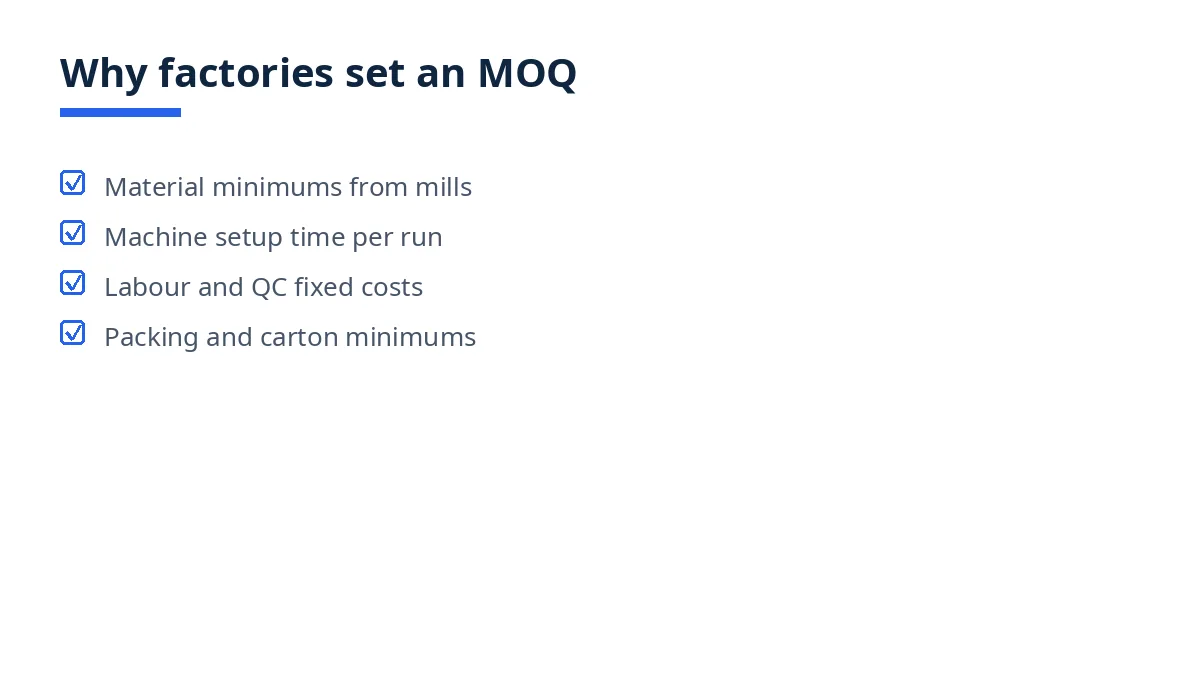
Factories set an MOQ because setup and preparation costs stay largely fixed whether the run that follows is short or long. The driver is usually fixed costs, set-up time, raw material batch sizes, and logistics breaks.2 Shipbots lists the same drivers in practical terms: setup and changeover cost, raw material lots such as fabric rolls, packaging constraints, quality control overhead on small batches, and freight economics.2
A manufacturer still has to source materials, prepare patterns, schedule labor, set up equipment, and manage quality control even for a small run, and if the order is too small those fixed costs can outweigh the value of the project.3 In apparel, fabric is purchased in bulk rolls, pattern-making and cutting setup take the same labor regardless of run size, and quality control and packing labor are largely fixed per run.4
Step-by-step: how it works
Step 1: State your quantity in your enquiry. In your first message or request for quotation (RFQ), give the quantity you expect to order, the product, the material or specification if you know it, and your destination market. See how to write an RFQ for how a complete enquiry is structured. Vague enquiries get vague answers, and MOQ is often left unclear until late in the discussion.
Step 2: Ask what the MOQ applies to. Reply with one direct question: does this minimum apply per product, per color, per size, per design, or to the total order value? An MOQ can be unit based, variant based, or value based.2 For garments, a total order quantity may be acceptable while each color and size breakdown still needs to be workable for cutting and sewing. For printed or customized goods, the minimum may be driven by the printing or embroidery set-up for each distinct design.
Step 3: Ask what drives the MOQ. A polite question, "What sets this minimum: material purchase, set-up, or packing," tells you where flexibility might exist. If the driver is a stock material the supplier already holds, a smaller run may be possible. If the driver is a custom-dyed material that must be ordered in bulk, flexibility is limited unless you accept a stock color instead. A supplier MOQ is based on setup costs, raw material purchasing thresholds, and production run efficiency.5
Step 4: Compare like with like. Compare unit price at your quantity, what the MOQ applies to, sample policy, customization, packing, and lead time. The lowest stated MOQ is not automatically the cheapest or safest at your quantity.
Step 5: Negotiate the trade-off, not just the number. If your quantity is below the MOQ, propose a specific alternative: a slightly higher unit price for a smaller run, a mix of sizes or colors within one design, a trial order followed by a larger repeat order, or stock materials and standard packing. Effective tactics address the supplier margin concern directly, for example offering a higher unit price for a smaller batch, committing to repeat orders, asking about stock materials or standard components, or offering to cover the setup cost directly.1 Suppliers also respond to splitting a minimum across multiple products, combining orders through a sourcing agent, or building a track record first and renegotiating after an initial order.5
Step 6: Confirm everything in writing. Before payment, the proforma invoice should state product, specification, total quantity, breakdown by variant, unit price, packing, delivery terms, and timeline. Read the quantity lines carefully.
Step 7: Plan the repeat order. If the first order was a negotiated trial, agree at the outset how a repeat would be handled. A small first order paid on time is the strongest argument for better terms next time.
Costs, timelines and documents
MOQ and cost are linked through fixed costs. Set-up, sampling, pattern or tooling preparation, material handling, and inspection take roughly similar effort for a short run and a longer run. A factory setup cost is roughly the same whether the order is for a smaller or a larger quantity, so spread across more units that setup cost becomes a smaller share of each unit price, and spread across fewer units it either reduces the factory margin or is passed to the buyer as a higher per-unit cost.4 This is why unit prices normally fall as quantity rises, and why a supplier asked to halve the quantity will often raise the unit price rather than simply refuse.
Timelines connect to MOQ in two ways. First, materials: suppliers purchase raw materials in bulk and face their own minimum requirements from their vendors, and the MOQ they pass to buyers partly reflects those upstream constraints.5 An order using stock materials can usually move faster than one needing specially purchased materials. Second, scheduling: a clearly defined order is easier to schedule than one whose quantity keeps changing, so lock the breakdown early.
The documents are straightforward. The RFQ states your intended quantity, the quotation states the MOQ and price at that quantity, the proforma invoice confirms the agreed quantity and breakdown, and after shipment the commercial invoice and packing list record what was supplied. Keep them consistent, line by line.
Samples are not production orders and are handled separately, sometimes for a fee with courier costs paid by the buyer. Do not assume a supplier who made a sample will accept a production order of any size. Confirm the production MOQ separately, in writing.
How does MOQ differ by product?
MOQ differs because products differ in material minimums, complexity, and setup. A simple product made from stock material usually carries a lower minimum than a customized product that needs dyed fabric, special trims, or new tooling. Product design matters: a simple item usually has a different MOQ than a complex, multi-panel product with branded hardware and a longer construction process, and custom colors, specialty finishes, or custom hardware can raise the minimum.3
Example figures, from one apparel manufacturer published guide to typical ranges per style, illustrate the spread in clothing only and are not a general rule for other products:4
Manufacturer type, apparel | Typical MOQ per style, example figures |
|---|---|
Large overseas mass-production factories | 1,000 to 5,000 or more pieces |
Mid-size overseas manufacturers | 300 to 1,000 pieces |
Startup-friendly manufacturers | 50 to 300 pieces |
Domestic small-batch cut-and-sew shops | 25 to 100 pieces |
Print-on-demand suppliers | 1 piece, at a higher per-unit cost |
Use this only as a starting point. Only a quotation against a clear specification confirms your real minimum. For shipping contexts, see MOQ meaning in shipping.
Bangladesh-specific rules and tips
Bangladesh is a major sourcing destination for ready-made garments and other products including home textiles, leather goods, jute products, footwear, and processed foods. Production models differ widely. Large export factories are typically organized around substantial runs, while smaller factories and stock-based suppliers may be set up for shorter runs. Match your order size to the supplier model. Start with find suppliers in Bangladesh.
Describe your product precisely. For garments, that means fabric type and composition if known, construction, sizes, colors, labeling, and packing. Each variant adds set-up considerations. If you are flexible on fabric or color, say so, because flexibility on stock inputs is often where smaller orders become possible.
Discuss the size and color breakdown early. A comfortable total quantity can become difficult if split into many small combinations, each requiring separate cutting and handling. Fewer colors and a focused size range can make an order workable without increasing the total. Compare several suppliers against the same specification, so differences in MOQ, price basis, and lead time are visible side by side.
Mistakes and red flags
The most common mistake is asking for a price before stating a quantity. Price without quantity is meaningless in made-to-order production, and quotations for an assumed larger quantity will disappoint when the real, smaller quantity is revealed. State your quantity first, even as an estimate.
The second mistake is assuming MOQ means the same thing everywhere. One minimum may be per order; another may be per color per size. Buyers who do not ask compare numbers that are not comparable.
A third mistake is treating a negotiated exception as permanent. If a supplier accepts a smaller trial order, confirm whether the standard MOQ returns on a repeat order.
Red flags include a supplier who will not explain what an MOQ applies to, quotations with no quantity basis, and pressure to pay before quantity and specification are confirmed in writing. A price that ignores quantity altogether also deserves careful checking, because made-to-order costs change with quantity.
Checklist
Before you place an order, confirm each of the following:
The product, material, and specification are described in writing.
Your intended quantity is stated, and the supplier MOQ is confirmed.
You know exactly what the MOQ applies to: product, color, size, design, order, or shipment.
The unit price is quoted at your actual quantity, not an assumed larger one.
The variant breakdown, sizes, colors, and designs, is agreed and workable.
Sample terms are confirmed separately from production terms.
Any negotiated exception is written down, including whether it applies to repeat orders.
The proforma invoice quantity lines match what you agreed.
Packing, labeling, delivery terms, and timeline are confirmed alongside the quantity.
You have compared more than one supplier against the same specification where possible.
If any line is unclear, clarify it before payment.
How Exportain helps
Exportain is a B2B export marketplace based in Dhaka, Bangladesh. Buyers find Bangladeshi suppliers, exporters, and trade service providers, post RFQs, receive quotations, message suppliers, and place orders. A single structured RFQ lets you state quantity and specification once and receive comparable responses, supplier profiles help you judge whether a production model fits your order size, and written exchanges create a record of what was agreed.
Exportain is not a party to the contract for goods, and it does not inspect goods, book freight, or clear customs. Trust badges are reviews of documents and photos, not factory inspections or guarantees.
FAQs
What should I know first about MOQ?
MOQ stands for Minimum Order Quantity, and the number alone is not enough. You must also know what it applies to. Ask whether the minimum is per product, per color, per size, per design, or per total order, and confirm the unit price at the exact quantity you intend to order. Those two questions, asked at the start, prevent most MOQ misunderstandings.
What are the typical costs and timelines?
There is no single typical figure, because cost and timeline depend on the product, materials, customization, and quantity involved. In general, smaller quantities carry a higher cost per unit because set-up and preparation are spread across fewer items, and orders that need specially purchased materials take longer than orders made from stock materials. The reliable way to learn the costs and timeline for your product is to request quotations against a clear specification and stated quantity, and compare the responses.
Which documents are needed?
The core documents are the enquiry or RFQ stating your quantity and specification, the supplier quotation stating the MOQ and the price at your quantity, and the proforma invoice confirming the agreed quantity and variant breakdown before payment. After shipment, the commercial invoice and packing list record what was supplied. Sample agreements, where relevant, should be confirmed separately from production documents.
What are the most common mistakes?
The most common mistakes are asking for a price before stating a quantity, assuming an MOQ applies to the total order when it actually applies per color or size, and assuming a one-off negotiated exception will apply to every future order. All three are avoided the same way: state your quantity early, ask what the minimum applies to, and put the agreed terms in writing.
Next steps on Exportain
Browse Bangladeshi suppliers by category to find production models that fit your quantity, then post an RFQ that states your quantity, specification, and variant breakdown in the first message. See how to buy on Exportain for the buying process from first inquiry to confirmed order.
Sources
- The Meaning of MOQ - Minimum Order Quantity: How to calculate and optimise it. Quivo (accessed )
- What Is Minimum Order Quantity (MOQ)?. Shipbots (accessed )
- Why Do Factories Have Minimum Order Quantity (MOQ)?. Softline Brand Partners, (accessed )
- Minimum Order Quantity: How to Negotiate MOQ as a Small Brand. Fashion Soul International (accessed )
- MOQ Meaning | What Is Minimum Order Quantity. Selery Fulfillment (accessed )
About the author
Sourcing from Bangladesh?
Post a request for quotation and suppliers on Exportain can send you their quotes directly.
Post an RFQ