

Power Transformers Lead Time From Bangladesh: Production and Shipping Timeline
No single lead time fits a power transformer from Bangladesh: read the dated gates from specification freeze to testing and shipping, and how to compare supplier schedules gate by gate.
Short answer
There is no single lead time for a power transformer from Bangladesh. The delivery date is set by a chain of dated gates: specification freeze, drawing approval, material reservation, build stages, testing and shipment booking. Compare suppliers only on the same specification, test scope and delivery term, with each gate dated in writing.
On this page
Key takeaways
Ask for a dated gate schedule, not a single figure: specification freeze, drawing approval, material reservation, build, testing, packing and shipment.
Longest variables are usually material availability, design approval rounds and test booking, not final assembly alone.
A type test, witness test or site condition outside the standard range can each add a gate; agree them before the order.
Compare quotations only on the same specification, test scope and term.
Bangladesh export loading requires an approved export declaration; start that paper trail while testing is still running.
A power transformer order rarely slips because one factory worked slowly. It slips because a gate was left open: a drawing unapproved, a material unreserved, a test slot unbooked, or a vessel booked before the factory acceptance test passed. Lead time is not a single number to compare across quotations; it is a chain of dated gates, and the weakest gate sets the delivery date.
Each unit is built to a rating, voltage ratio, cooling method and site environment. This guide shows how to read a supplier timeline gate by gate, and which documents and delivery terms change the date. It does not replace a supplier quotation: every duration below is a planning shape to be replaced by the supplier's dated gates.
Why this matters for buyers and sellers
For the buyer, the transformer often sits on the critical path of a substation, plant or renewable project. A late unit delays energization, and financing, civil works and commissioning are sequenced from that date; a gate schedule tells you which decision to make, and by when.
For the seller, the same gates protect the build. Winding before vector group, impedance or losses are frozen risks rework, and reserving core steel or copper before the rating is fixed risks holding the wrong material.
Market reporting for 2026 shows why a single figure misleads: medium-voltage units are reported at 12 to 24 months from large manufacturers and 7 to 14 months from agile custom manufacturers for comparable units, while large power units are frequently reported at 24 to 48 months.1 Those are global reports, not a Bangladesh promise; rating and factory load can move the date by months.
Step-by-step: how it works
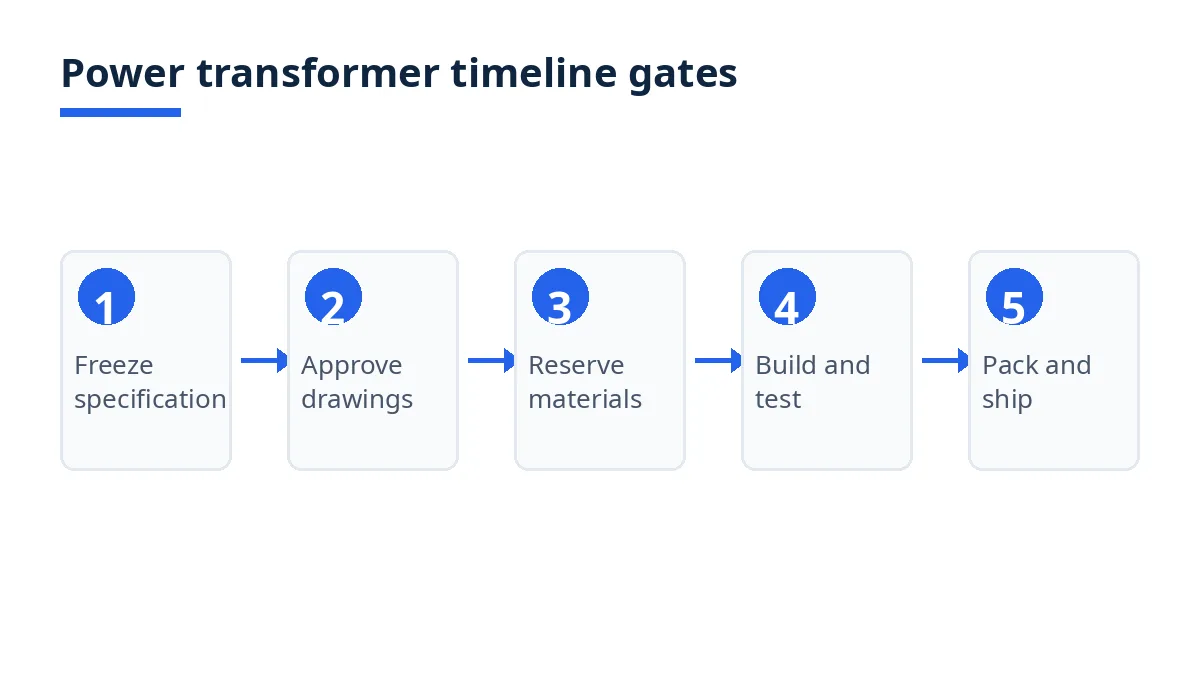
Freeze the specification in writing. State rated power, voltages, frequency, impedance range, vector group, cooling, standards, environment, accessories and target date. Market guidance on accurate quotes lists exactly these inputs.1 A quotation on a partial specification is a placeholder, not a schedule.
Agree the design and drawing gate. Ask who approves the outline drawing, rating plate data, terminal arrangement and accessory list, and by what date, and how many approval rounds are included.
Confirm material reservation, not just material type. Ask which materials are stocked, which are ordered for your unit, and on what date each is confirmed: core steel, conductor, insulation, oil, bushings, tap changer and tank parts. "Available" but unreserved is not a date.
Track the build by stage, not by percentage. Ask for stage dates: core assembly, winding, core-and-coil assembly, tanking, drying and oil filling, and final assembly. "60 percent complete" does not say which stage holds the next gate.
Book testing before the build finishes. Routine tests and many type tests can be performed in-house at factories with their own test facilities, avoiding external laboratory queues.1 Ask which tests are routine, type or special under your contract. To witness the factory acceptance test, book the witness slot and procedure approval date at order stage.
Close the test gate in writing. A passed test report, with losses, impedance, ratio and vector group against agreed values, triggers packing. A failed test is a correction loop with its own date; agree in advance who pays for a retest and how it affects shipment.
Pack, document and book transport as a parallel track. Heavy and oversize units need a transport and lifting plan agreed before the test passes. Confirm packing type, weight, dimensions, loading point, and whether freight booking is provisional or confirmed.
Read the sequence backwards from your site date, through transit, packing, testing, build, material reservation and drawing approval. If any gate has no date, that gate is the schedule risk.
Costs, timelines and documents
What are the typical costs and timelines?
There is no typical cost or timeline a guide can state as fact, because rating, voltage class, losses, cooling, accessories, test scope and delivery term change all three. Treat every duration here as a planning shape, to be replaced by the supplier's dated gates.
Gate | What to ask for | What usually stretches it |
|---|---|---|
Specification freeze | Dated, signed specification | Late rating, voltage or impedance changes |
Drawing approval | Approval date, included rounds | Unanswered queries, repeated redesign |
Material reservation | Reservation date per item | Core steel, copper or bushing allocation |
Build | Stage dates, not a percentage | Rework after late design change |
Testing and witness | Test scope, procedure, witness date | Laboratory queues, failed tests |
Packing and shipment | Packing, weight, dimensions, booking | Oversize transport, unconfirmed vessel |
Transit and site readiness | Transit route, unloading plan | Import clearance, site works not ready |
For costs, ask for the price broken into the same gates: unit price, test charges, packing, inland transport, freight and insurance as the term allocates them, and destination charges that fall to you. A lump sum hiding test scope or packing cannot be compared with another, and two quotations can differ widely yet describe the same unit if one includes a type test, witness attendance and export packing and the other does not.
The delivery term decides which journey costs sit inside the price and where risk passes. Under Incoterms 2020 "C" terms, the seller contracts and pays for carriage to the destination, but delivery and risk pass earlier, at handover to the carrier or loading on board at origin.2 Under "D" terms, delivery and risk pass at the destination.2 Under CIF and CIP, the seller must also arrange cargo insurance to the destination; under other "C" terms, the seller arranges none for the buyer.2 Read the Incoterms for shipments from Bangladesh guide before comparing a freight-included price with a factory-gate price.
Which documents are needed?
The order set and the export set are different, and both must be ready before shipment. Order documents: signed specification sheet, approved drawings, quotation and purchase order with the gate schedule, test scope and procedure, factory acceptance test report, and packing list with weights and dimensions.
Export documents for Bangladesh: goods may not be loaded or shipped unless an export declaration, the Bill of Export or Shipping Bill, is submitted to Customs and approved.3 Enclosed documents include the export letter of credit or, where there is none, the contract, purchase order or bank-approved guarantee, the signed invoice, packing list, EXP form certified by an authorized dealer, and certificate of origin issued by the Export Promotion Bureau or a Chamber of Commerce and Industry.3 The declaration names goods, value, exporter, buyer and operator.3 Start the EXP form and certificate of origin during testing.
Heading 8504 covers electrical transformers, static converters and inductors.4 Within liquid dielectric transformers, 8504.21 covers units not exceeding 650 kVA, 8504.22 covers units exceeding 650 kVA but not exceeding 10,000 kVA, and 8504.23 covers units exceeding 10,000 kVA, while other transformers fall under 8504.31 to 8504.34 by capacity and parts under 8504.90.4 Confirm the full national code for the destination before filing. See the HS code for power transformers guide.
Bangladesh-specific rules and tips
Start the export declaration early. No approved declaration, no loading.3 Ask at order stage who prepares the Bill of Export, certifies the EXP form, and obtains the certificate of origin, with dates for each.
Match the delivery term to the real handover. Transformers are heavy, often oversize, and frequently handed to a carrier at a yard or terminal before loading on board. A sea-only term assuming direct on-board delivery can misdescribe that handover, while an any-mode term may describe it correctly. Under "C" terms delivery and destination places differ, while under "D" terms they are the same.2 Choose the term from the actual handover, then write the named place in full.
Check site conditions against the standard service range before you order. Normal service conditions under IEC 60076 Part 1 include altitude not exceeding 1,000 metres, ambient air from minus 25 to 40 degrees Celsius, an approximately sinusoidal supply voltage, and an approximately symmetrical three-phase supply.5 Further cooling limits apply to oil-immersed units under IEC 60076-2 and dry-type units under IEC 60076-11.5 A site above 1,000 metres, in hotter air, or in a high-pollution or seismic environment needs a design adjustment, and that adjustment is a schedule item if discovered after the order. Declare site conditions in the first enquiry.
Plan the heavy leg separately from the ocean leg. Inland movement, crane capacity, road limits and vessel capacity are separate bookings; a confirmed sailing does not move a unit that cannot reach port.
Keep one name and one specification across every paper. Exporter, buyer, goods description, quantity, weight and HS heading should match across quotation, purchase order, invoice, packing list, EXP form and Bill of Export. A mismatch queried by Customs is a delay no freight booking can absorb.
Mistakes and red flags
What are the most common mistakes?
Comparing headline weeks across different specifications. A shorter time on a standard rating, different cooling, smaller test scope or different term is a different offer. Compare only replies to the same specification, test scope and term.
Treating a week count as a guaranteed date. A week count without gate dates, drawing approval and test booking is an estimate. Ask which gate would break first.
Leaving the test scope to the end. Type tests, special tests and witness attendance need procedure approval and a booked slot. A witness requirement raised after the build adds a queue, not a check.
Changing the specification after material reservation. A rating, impedance or loss change after material is reserved can mean new material, design and test scope. Change it only by written variation with a revised gate schedule.
Booking transport before the test passes. A provisional booking is prudent; a confirmed booking assuming a pass is a cost risk. Agree booking status at each gate, and who bears the cost if a retest moves the sailing.
Reading a profile as a capacity guarantee. A supplier profile is a starting point for enquiries. It does not prove a factory can build your rating, hold your test slot or meet your site date; the gate schedule, drawings and test reports are the evidence.
Ignoring site readiness. A unit arriving before plinth, cable terminations or unloading crane are ready waits at cost. Align the shipment gate with a site readiness date.
Checklist
Before you confirm, answer every line.
Specification frozen and signed: rating, voltages, frequency, impedance, vector group, cooling, standards, environment, accessories, date.
Drawing approval date agreed, with included rounds and effect of a change.
Material reservation dates confirmed for core steel, conductor, oil, bushings and tap changer.
Build stage dates agreed, not a percentage figure.
Test scope agreed: routine, type and special tests, procedure approval and witness booking.
Retest and correction procedure agreed, with its effect on the shipment date.
Packing method, weight, dimensions and loading plan confirmed.
Delivery term and named place in full, freight and insurance split clear.2
Export set owner and dates agreed: Bill of Export, invoice, packing list, EXP form, certificate of origin.3
HS heading confirmed for the destination tariff.4
Transit route, inland booking and unloading plan aligned with the shipment gate.
How Exportain helps
On Exportain, browse suppliers and post your specification summary, target date and delivery term on the RFQ board, so replies can be compared on the same inputs. Registered suppliers are shown with trust badges on rows that have earned them.6 Open buying leads on the RFQ board are requirements posted by buyers, and registered suppliers can submit a quotation against them.7 Ask each reply for its gate schedule, not only its total weeks, and record drawing approval, material reservation, test scope and booking status before you accept it.
Keep the signed specification, drawing revision, test report and export set on one file after acceptance, and check each gate date as it passes.
FAQs
What should I know first about power transformers?
A power transformer is built to order, not picked from stock, and its lead time is a chain of gates rather than a single figure. Specification freeze, drawing approval, material reservation, build stages, test scope and shipment booking each carry a date, and the latest gate sets the delivery date. Global 2026 reporting puts medium-voltage units at 12 to 24 months from large manufacturers and 7 to 14 months from agile custom manufacturers, with large power units frequently at 24 to 48 months.1 Treat those as market context only, and demand a dated gate schedule.
What are the typical costs and timelines?
There are no typical figures a guide can state as fact, because rating, voltage class, losses, cooling, accessories, test scope and delivery term change both cost and time. Cost drivers are specification, material set, test scope, packing, and the freight and insurance split under the delivery term.2 Timeline drivers are drawing approval, material reservation, build stages, test booking and transport booking. Ask for both as itemized, dated lines, on identical specification, test scope and term.
Which documents are needed?
Order documents are the signed specification, approved drawings, quotation and purchase order with the gate schedule, test scope and factory acceptance test report, and the packing list. The Bangladesh export set is the Bill of Export, signed commercial invoice, packing list, EXP form certified by an authorized dealer, and certificate of origin issued by the Export Promotion Bureau or a Chamber of Commerce and Industry, with the export letter of credit or, where there is none, the contract, purchase order or bank-approved guarantee.3 Goods may not be loaded unless the Bill of Export is submitted and approved.3
What are the most common mistakes?
The most common mistakes are comparing headline weeks across different specifications or terms, treating a week count without gate dates as a guaranteed date, leaving test scope and witness booking until the build is finished, changing the specification after material reservation, and booking transport before the test passes. The checklist above catches all five before confirmation.
Next steps on Exportain
Browse suppliers, then post your specification summary, target date and delivery term on the RFQ board so replies arrive against the same inputs. Before you confirm, read the Incoterms for shipments from Bangladesh guide and the how to import power transformers from Bangladesh guide, and compare each reply gate by gate.
Sources
- Transformer Lead Times in 2026: How Custom Manufacturers Are Helping Projects Stay on Schedule. Dinghong Transformer (accessed )
- Incoterms® 2020 C rules vs D rules: Risk transfer explained. ICC Academy (accessed )
- Customs Clearance Procedures for Export. Bangladesh Customs, National Board of Revenue (accessed )
- HS, 2017 - Code 8504. United Nations Statistics Division (accessed )
- What are the normal service condition requirements for power distribution transformers?. Schneider Electric (accessed )
- Bangladeshi Manufacturers & Exporters. Exportain (accessed )
- RFQs & Buying Leads from International Buyers. Exportain (accessed )
- buyer guide
- customs clearance
- importing from Bangladesh
- Bangladesh sourcing
- Electrical equipment
- Power transformers
- Lead time
About the author
Sourcing from Bangladesh?
Post a request for quotation and suppliers on Exportain can send you their quotes directly.
Post an RFQ


