

Quality Control Checklist for Porcelain Dinner Sets From Bangladesh
A numbered QC checklist for porcelain dinner sets from Bangladesh: set completeness, whiteness and translucency, glaze and crazing, lead and cadmium limits, decal and gold-trim durability, heat claims, labels and packing, with fixes for common failures.
Short answer
Use this porcelain dinner sets quality control checklist to check set completeness, whiteness and translucency, shape and stacking, glaze and crazing, rim chips, lead and cadmium results against your destination market, decal and gold-trim durability, heat and washing claims, and labels and packing on dinner sets from Bangladesh before shipment. Agree tolerances, test methods and acceptance numbers in the purchase order.

On this page
Key takeaways
Judge the set as a set: count place settings and serving pieces, and check whiteness, pattern and glaze match across every setting, not only on one plate.
Check porcelain on its own terms: translucency at a thin edge, one white across the set, and rims that stay smooth after stacking.
Judge lead and cadmium results against the destination market, not one global figure, and require a report naming the same shapes, colors, glaze and decoration.
Hold any lot whose food-contact report does not match the lot, and re-inspect after sorting or rework rather than shipping on a promise.
If you buy porcelain dinner sets from Bangladesh, judge the set as a set, not as a pile of plates. A set fails when a place setting is short, a serving bowl does not match the dinner plates, or one plate is whiter than the rest.
Use it at final inspection, on a random sample across settings, serving pieces and cartons, never on pieces the factory selects. ISO 2859-1 specifies an acceptance sampling system for inspection by attributes, indexed by acceptance quality limit (AQL), for lot-by-lot inspection.1 Write every tolerance, test method and acceptance number into the purchase order before production.
Why this checklist matters
A dinner set combines several risks in one carton. Food-contact safety depends on the glaze and decoration on every piece that touches food. Appearance depends on whiteness and translucency matching across the set. Completeness matters too: a missing soup bowl or a platter from a different glaze batch is a set failure even when the piece itself looks sound.
Porcelain differs from general ceramic and stoneware. Its dense, vitreous body should show light at a thin edge, with a smooth glaze that does not craze under heat change and rims that stay smooth after stacking. On porcelain, a gray cast, a dull patch or a visible pinhole is a defect.
Before you start
Do not begin until the references are complete: an approved full-set sample, the purchase order and specification, the set-content list, the size and capacity chart, the glaze and decoration specification, the test list for each market, and the packing specification. Agree the sampling plan in advance,1 and draw the sample at random.
Confirm each lot's market first: results are judged against destination-market limits, not a single global figure. Under Regulation (EC) No 1935/2004, food-contact materials must be made in line with good manufacturing practice so that, under normal or foreseeable use, they do not transfer constituents to food in quantities that could endanger human health, change the composition of the food, or harm its taste and smell.2 Ask the laboratory to name the test method on every report, such as ISO 6486-1 for lead and cadmium release.3
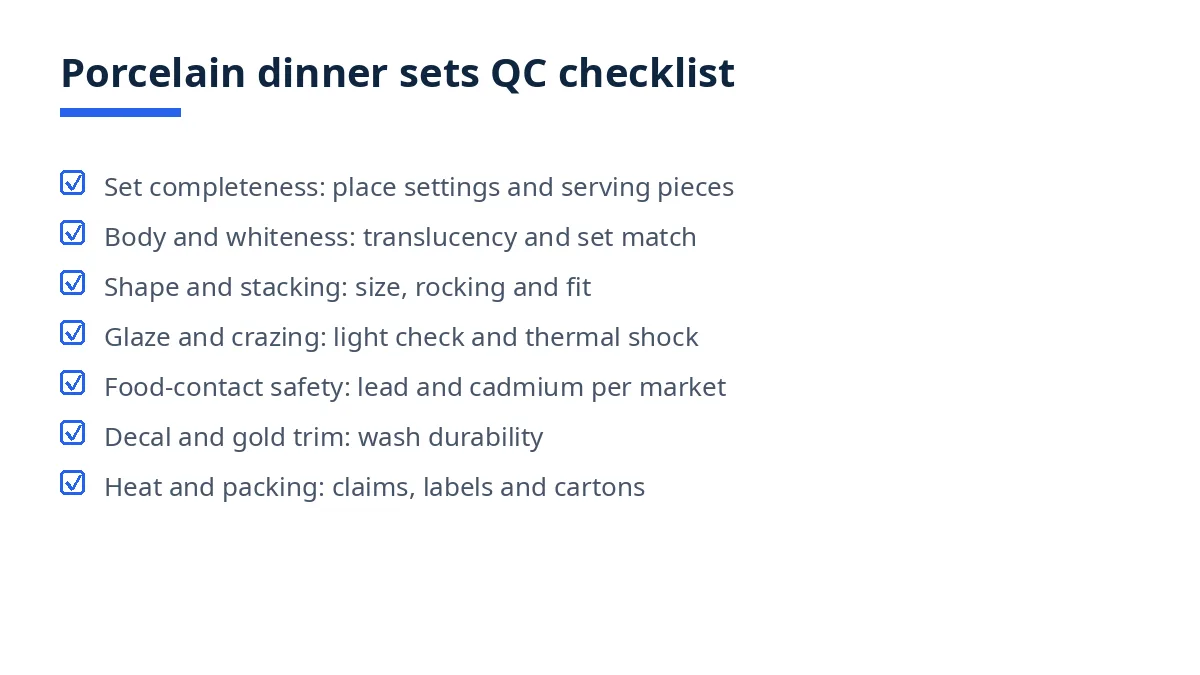
The full checklist (numbered, printable)
Set completeness and place settings
Count every sampled set against the set-content list; record any short, extra or substituted piece as a set failure.
Check each place setting holds the same pieces in the same sizes, and each serving piece is present.
Check lids sit flat with the same pattern as their base, and cups sit steady in matching saucers.
Record pattern name, color code and glaze batch, and confirm the factory keeps the artwork and color standard.
Porcelain body, whiteness and translucency
Hold a thin edge to strong light: porcelain should show light at the thin edge.
Check whiteness across the set under the same light, against the approved sample.
Check unglazed areas for a clean, even body color, and tap pieces lightly: a clear ring points to a sound body.
Check body thickness at rim, wall and base against the specification.
Shape, size, fit and stacking
Measure diameter, height and depth per piece type against tolerance, and record actual values.
Check hollowware capacity at the fill level, set pieces on a flat surface, and stack sampled settings.
Check handles for size, position and grip, spouts for a clean pour, and set pieces for matching shape.
Glaze, crazing and surface defects
Turn each piece under strong light and check for crazing, body cracks, pinholes, blisters and bare patches.
Feel rims, handle joins and foot rings for sharp edges and drips, and check the finish against the sample.
Where crazing resistance is tested, confirm the method and result in advance. ASTM C554 covers crazing resistance of fired glazed ceramic whitewares by a thermal shock method, with failure defined as the temperature at which crazing is observed.4
Check for warping by sighting along rims and bases, and by the flat-surface test in item 10.
Rims, chips and edge strength
Inspect every rim, spout tip, handle edge and foot ring for chips, turning each piece fully.
Handle sampled pieces as a buyer would, pull each handle gently, and record chip location and size.
Food-contact safety: lead and cadmium
Confirm the destination market and its limits, and confirm the report names the same market, shapes, colors, glaze and decoration.
The method based on ISO 6486-1 fills the article with a 4% acetic acid solution, covers it, and lets it stand for 24 hours at 22 degrees Celsius, plus or minus 2 degrees, before analysis.3
Under the United Kingdom regulations, the limits by category are: articles that cannot be filled, and articles that can be filled with an internal depth of 25 mm or less, 0.8 mg per square decimetre for lead and 0.07 mg per square decimetre for cadmium; all other articles that can be filled, 4.0 mg per liter for lead and 0.3 mg per liter for cadmium; and cooking ware and storage vessels over three liters, 1.5 mg per liter for lead and 0.1 mg per liter for cadmium.5
For the United States, the FDA lead guideline by category is: flatware, averaged over six units, 3.0 micrograms per milliliter; small hollowware other than cups and mugs, any one of six units, 2.0; cups and mugs, any one of six units, 0.5; large hollowware other than pitchers, any one of six units, 1.0; and pitchers, any one of six units, 0.5.6
Confirm the report category definitions match the pieces: under the FDA guideline, flatware has an internal depth of 25 mm or less, hollowware greater than 25 mm, and small hollowware a capacity under 1.1 liters.6
Check every report names the glaze, decoration and color tested, and treat a food-use piece without a matching report as a failure.
Decal, print and gold-trim durability
Check decoration against the artwork on every piece type, and check it does not sit where lips will touch it unless covered by the specification and report.
Check pattern alignment: the same motif in the same place on every plate, unbroken borders, and matching serving pieces.
Rub sampled decoration firmly by hand and, where specified, check the named wash test.
Check gold bands for width, lines, adhesion, rim wear and matching color, and check trimmed pieces after washing.
Heat, washing and use claims
Wash sampled pieces by the specified method, then check for water marks, decoration loss and glaze dulling.
Where dishwasher, microwave or oven use is claimed, check claim, care label and test evidence all name the same use.
Where a thermal-shock check is agreed, confirm procedure, temperatures and pass rule in writing first, then inspect for crazing,4 and check care instructions in the market language.
Check no piece carries a use claim the set cannot support.
Labels, packing and cartons
Check labels are present, legible and correctly positioned, and hide no fault, and barcodes scan and match.
Check inner packing separates each piece so rims, handles, gold bands and decoration cannot rub.
Check carton strength, count, assortment and marks, weigh and measure sample cartons, and open cartons fully.
Common failures and how to fix them
The most frequent failure is an incomplete or mismatched set: a missing serving piece, a wrong-size salad plate, or a bowl from a different glaze batch. Stop, count a full sampled set, compare whiteness and pattern, and re-sort complete sets before packing.
Whiteness drift points to more than one body or glaze batch: re-sort by batch. Crazing after use usually means glaze and body do not fit or firing was uneven: compare the pieces with the sample, check the crazing evidence,4 and only then restart the line. Gold bands that fade in washing point to the wrong firing or wash method: re-check a washed sample first.
Rim and foot chips come from handling, stacking or packing without dividers: re-check packing on a full carton first. A report that does not match the lot must not be waved through: hold the lot until a matching report is supplied. Above the agreed level, options are re-inspection after sorting or rework, documented partial acceptance, or rejection.
Downloadable template / summary table
Copy the checklist into your inspection sheet, add tolerances, and record a result per set.
Section | Checks | Evidence |
|---|---|---|
Set completeness | Settings, serving pieces, lids | Set count |
Body and whiteness | Translucency, whiteness, defects | Light check |
Shape and stacking | Size, capacity, rocking, stacking | Measurements |
Glaze and crazing | Crazing, pinholes, finish, warping | Light check, report |
Rims and chips | Rims, feet, handles | Visual check, photos |
Food-contact safety | Lead, cadmium, report match | Lab report |
Decal and gold trim | Placement, alignment, wash | Artwork, wash check |
Heat and washing | Wash, heat claims, shock | Care label, evidence |
Packing | Labels, dividers, cartons | Packing list |
How Exportain helps
Exportain is a B2B marketplace connecting buyers with Bangladeshi suppliers of porcelain dinner sets, so the specifications behind this checklist can be agreed at enquiry stage. Browse suppliers, read the AQL acceptance quality limit explainer, and use inspection services when you plan the check. Supplier profiles show which document and photo checks have been recorded, not factory inspections, and Exportain does not inspect goods and is not a party to the goods contract.
FAQs
When should this checklist be used?
Use it at final inspection, when goods are finished and largely packed. For larger and first orders, also use it during production.
Who should complete it?
The buyer, a local agent or an independent inspector can complete it, using the approved full set and a randomly drawn sample. Food-contact testing is laboratory work, not sight.
What are the most common failures?
An incomplete or mismatched set, whiteness drift, crazing, rim chips, gold bands that fade in washing, and unmatched reports are the failures buyers find most often.
Can a third party do it?
Yes, if you share the approved set, tolerances and test list first. See the pre-shipment inspection guide.
Next steps on Exportain
Before production starts, agree your full set contents, tolerances, whiteness standard, glaze and decoration references, and the test list for each market, then read the AQL acceptance quality limit explainer and the pre-shipment inspection guide, and plan the check with inspection services. You can also post a free RFQ via RFQs.
Sources
- SIST ISO 2859-1:2003 - Sampling procedures for inspection by attributes, Part 1: Sampling schemes indexed by acceptance quality limit (AQL). International Organization for Standardization, (accessed )
- Regulation (EC) No 1935/2004 on materials and articles intended to come into contact with food. European Union (accessed )
- ISO 6486-1:2019 - Ceramic ware, glass-ceramic ware and glassware in contact with food - Release of lead and cadmium - Part 1: Test method. International Organization for Standardization (accessed )
- ASTM C554-93(2020) - Standard Test Method for Crazing Resistance of Fired Glazed Ceramic Whitewares by a Thermal Shock Method. ASTM International (accessed )
- The Ceramic Articles in Contact with Food (England) Regulations 2006 - Schedule 1: Maximum quantities of lead and cadmium which may be transferred from a ceramic article. Legislation.gov.uk (accessed )
- CPG Sec. 545.450 Pottery (Ceramics); Import and Domestic - Lead Contamination. U.S. Food and Drug Administration (accessed )
- pre-shipment inspection
- quality control
- importing from Bangladesh
- aql inspection
- Ceramic tableware
- Food-contact safety
About the author
Sourcing from Bangladesh?
Post a request for quotation and suppliers on Exportain can send you their quotes directly.
Post an RFQ


