Quality Control Checklist for Plastic Toys From Bangladesh
A numbered QC checklist for plastic toys from Bangladesh: age grading, small parts, breakage, sharp edges, cords, magnets, batteries, paint migration, labeling and packing, with fixes for common failures.
Short answer
Use this plastic toys quality control checklist to check age grading, small parts, breakage and sharp edges, cords, magnets, battery doors, paint adhesion and chemical migration, function, labels and warnings, and packing for plastic toys from Bangladesh before shipment, against limits agreed in the purchase order and lab reports for the production lot.
On this page
Key takeaways
Confirm the age grade and destination-market standard list before inspection, and draw the sample at random across styles, colors, mold cavities, and cartons.
Judge the toy after use and abuse, not only as received: pull, twist, and drop sampled toys, then check detached pieces against the small-parts cylinder and for new sharp edges.
Check paint and migration against lab reports for the production materials and colors, not another color or lot, and confirm which standard edition and limits the lab applied.
Treat warnings, the EU declaration of conformity, and battery-door security as pass-or-fail items: a CE mark alone, or a warning added afterwards, does not repair a failed check.
If you buy plastic toys from Bangladesh, this checklist gives you a toy-specific way to judge a shipment before it leaves the factory. A toy is judged after a child pulls, drops, and plays with it, because an attached part can become a hazard once it breaks off. Start from the age grade and the destination market, and use an agreed sampling plan rather than pieces the supplier selects. ISO 2859-1 defines a system of acceptance sampling plans for inspection by attributes, indexed by the acceptance quality limit (AQL).1
Why this checklist matters
Plastic toys concentrate risk in small, detachable, painted, and moving parts: a wheel that pulls off, a sharp mold line, a battery door that opens without a tool, or a paint that flakes can each turn a sound shipment into a rejected lot. Each market sets its own age, labeling, and chemical rules. Each point is checked against the approved sample, the specification, and the lab report, and recorded as pass, fail, or not applicable. Set acceptance numbers per defect class in the purchase order.1 See the AQL acceptance quality limit explainer.
Before you start
Do not begin until the references are complete: an approved sample per style and color, the purchase order and specification, the confirmed age grade, the market standard list, lab reports for the production materials and colors, and the packing specification. Agree the sampling plan in advance,1 and draw the sample at random across styles, colors, mold cavities, and cartons.
Confirm which market each lot is for first. Under the European Union Toy Safety Directive, toys are products designed or intended for use in play by children under 14, and importers must place on the market only toys that comply with all applicable safety requirements.2 A toy cannot be regraded for another market on packaging alone.
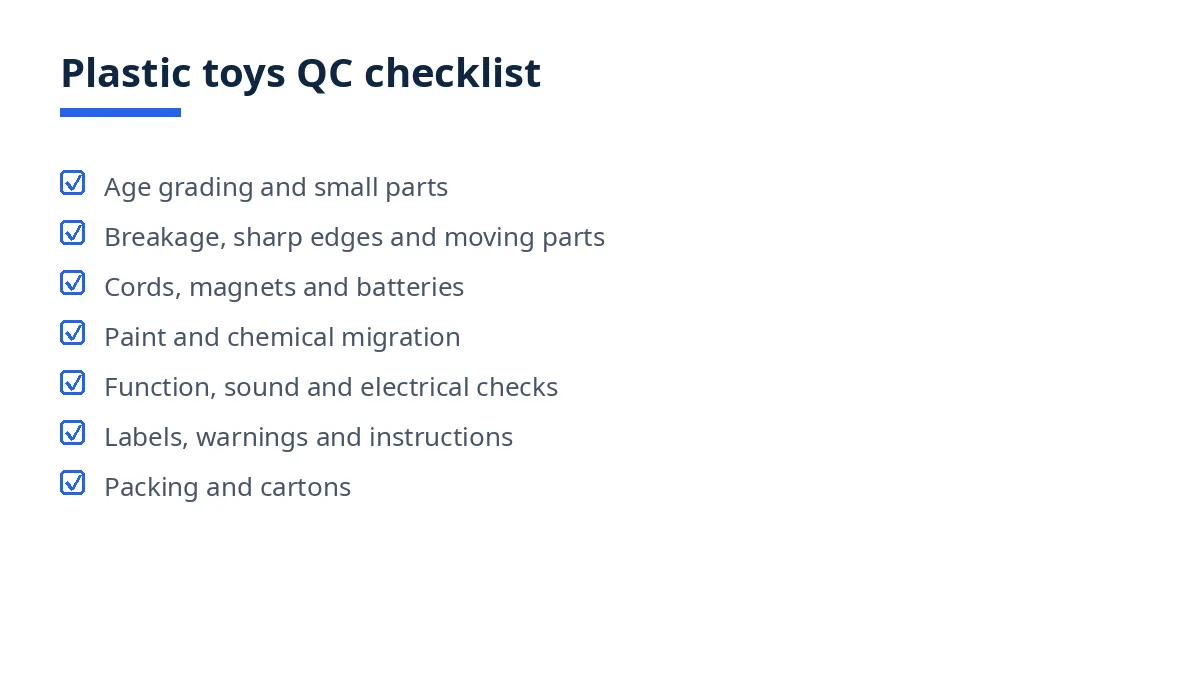
The full checklist (numbered, printable)
Age grading and small parts
Confirm the age grade, intended play, and age warning on the pack match the sample and purchase order.
For under-3 toys, check no part as received fits the small-parts cylinder (2.25 inches long, 1.25 inches wide, 16 CFR Part 1501.4); parts fitting completely do not pass.3
Note that 16 CFR Part 1501 bans under-3 toys containing small parts, because of choking and ingestion hazards.3 A warning label does not make such a toy acceptable.
Pull, twist, and drop sampled toys as a child would, then check detached pieces against the cylinder and for new sharp edges. ISO 8124-1 applies as first received and after foreseeable use and abuse.4
Check small balls, marbles, and balloons against market warning and age rules, including US warnings on the principal display panel.3
Check cords, strings, straps, and loops for strangulation risk against the specification and age grade. EN 71-1 covers cords,5 and ASTM F963 lists cords, straps, and elastics separately.6
Breakage, sharp edges, and moving parts
Check every molded edge, seam, and mold line by hand and eye for sharp edges, points, flash, and burrs.
Drop sampled toys from play height, then check for cracks, shards, and new sharp points. ISO 8124-1 sets criteria for shape, size, contour, and spacing, including small parts and sharp points and edges.4
Check hinges, folding parts, and sliding mechanisms for finger pinching, and confirm locks hold in use.
Pull wheels, axles, handles, and snap-fit parts firmly, and check axle ends are capped.
For ride-on toys, check stability, strength, steering, and braking where fitted. EN 71-1 gives ride-on toys detailed treatment.5
For projectile toys, check tip shape and softness, confirm the lab report covers projectiles, and record any hard-tipped projectile as a failure.
For sound-producing toys, compare loudness with the sample and confirm the lab report covers sound. ASTM F963 lists sound-producing toys separately.6
Magnets, batteries, and electrical parts
Check magnets are fully enclosed and secure, and none comes loose after pulling, dropping, and twisting. ASTM F963 lists magnets separately.6
Check battery doors need a tool to open, stay closed during drop and pull checks, and show polarity marking.6
Run battery toys through a full cycle, checking for overheating, leaking cells, and loose contacts, and check cables only where specified.
Materials, paint, and chemical migration
Check material and color against the specification and sample, and record any bulk substitution as a failure, even when it looks the same.
Check toys and materials are visually clean and free from contamination, as EN 71-1 requires.5
Check paint and coating adhesion by scratching and rubbing sampled areas, and record flaking paint as a failure on mouthable parts.
Check color and print consistency across the lot under the same light, against the sample, and check prints do not rub off in normal handling.
Review the migration lab report for the production materials and colors, not another color or lot. ISO 8124-3 sets maximum acceptable levels for eight elements: antimony, arsenic, barium, cadmium, chromium, lead, mercury, and selenium.7
For orientation, ISO 8124-3 gives 90 mg/kg for lead in general toy materials.7 Confirm with the lab which edition and limits apply to your market.
For soft plastic parts, confirm the lab report covers the market chemical requirements, and record any report omitting a soft part as incomplete.
For toys with accessible liquids or gels, check for leakage after shaking and squeezing, and confirm the liquid matches the specification.
Function, assembly, and workmanship
Test every function on each sampled toy: buttons, switches, lights, motors, and moving parts.
Check dimensions and weight against the specification and sample, and check interlocking parts fit as the sample does.
Check assembly completeness against the parts list: every part and accessory must be present and correctly fitted.
Check molding quality per sampled unit: short shots, warping, sink marks, burn marks, and excess flash.
Check no sampled toy carries a strong chemical odor the sample does not carry, and raise any such lot with the supplier and lab before acceptance.
Labels, warnings, and instructions
Check age, choking, and other warnings for wording, language, size, and placement against market rules and approved artwork. US warnings must appear on the principal display panel of the immediate container.3
Check EU toys carry an EU declaration of conformity and the CE mark, as the directive requires.2 Read the declaration and test reports behind the mark; the mark alone is no proof.
Check manufacturer and importer identification and batch marking, and confirm toy markings match pack markings.
Check instructions for assembly, use, supervision, and battery handling where needed, and confirm they match the toy supplied. EN 71-1 sets the warning and instruction framework.5
Check any pack claim matches the evidence on file, and record unsupported claims as failures.
Packing and cartons
Check the retail pack is complete, with seals intact and no transit damage.
Check plastic film and bags in and around the pack against market sheeting rules. EN 71-1 treats packaging as a safety issue, including sheeting and closing methods.5
Check carton contents, color and style ratios, barcodes, and markings against the packing list, and weigh sampled cartons where required.
Photograph failures, segregate failed units, and record sample IDs, results per item, and the lab report reference.
Common failures and how to fix them
The most frequent failure is a small part that comes off during drop or pull checks on an under-3 toy. Stop, check the detached piece against the small-parts cylinder,3 and trace the failure to the joint, fastener, or material before more units are packed. A warning label added afterwards does not repair it.
Sharp mold flash or a cracked part after dropping traces to molding or material quality: correct the mold or material, then re-check a fresh sample. Paint flaking, or a migration report for the wrong color, points to a coating or testing error: re-test the production color and hold the lot. Wrong age warnings, a CE mark without a matching declaration,2 or a battery door that opens without a tool are document and design failures: correct the artwork or design, re-check a fresh sample, then restart packing. Above the agreed acceptance level, options are re-inspection after sorting or rework, documented partial acceptance, or rejection.
Downloadable template / summary table
Copy the checklist into your inspection sheet, add tolerances and acceptance numbers, and record a result per toy.
Section | Checks | Evidence |
|---|---|---|
Age grading and small parts | Age grade, cylinder, cords | Cylinder result |
Breakage and moving parts | Edges, drop, hinges, wheels | Drop checks, photos |
Magnets and batteries | Magnet security, battery door | Pull checks, run test |
Materials and migration | Material, paint, lab report | Lab report per color |
Function and workmanship | Functions, dimensions | Function test |
Labels and instructions | Warnings, CE, declaration | Artwork check |
Packing | Retail pack, film, cartons | Packing list |
How Exportain helps
Exportain is a B2B marketplace connecting buyers with Bangladeshi suppliers of plastic toys and other products, so specifications can be agreed at the enquiry stage. Browse suppliers, see inspection services when you plan the check, and use the pre-shipment inspection guide to plan timing. Supplier profiles show which document and photo checks have been recorded, not factory inspections. Exportain is not a party to the goods contract and does not inspect goods.
FAQs
When should this checklist be used?
Use it at final inspection, when goods are finished and largely packed. For larger and first orders, also use it during production, while joints, paint, and battery doors can still be fixed.
Who should complete it?
The buyer, a local agent, or an independent inspector can complete it, using the approved sample, specification, age grade, and a random sample, plus lab reports.
What are the most common failures?
Detached small parts, sharp mold flash, cracked parts after dropping, flaking paint, wrong age warnings, battery doors that open without a tool, and migration reports for the wrong color or material.
Can a third party do it?
Yes, if you share the approved references, the age grade, the market standard list, the tolerances, and the acceptance levels first, and if the production lot lab reports are available.
Next steps on Exportain
Before production, agree your age grade, market standard list, test methods, and label wording, then read the AQL acceptance quality limit explainer and the pre-shipment inspection guide, and plan the check with inspection services. You can also post a free RFQ via RFQs.
Sources
- ISO 2859-1:2026 - Sampling procedures for inspection by attributes — Part 1: Sampling schemes indexed by acceptance quality limit (AQL) for lot-by-lot inspection. ISO (accessed )
- Ensuring the safety of toys in the European Union (summary of Directive 2009/48/EC on the safety of toys). European Union (accessed )
- Small Parts Regulations and Warnings in the United States: An Overview. Compliance Gate, (accessed )
- ISO 8124-1:2022 - Safety of toys — Part 1: Safety aspects related to mechanical and physical properties. International Organization for Standardization, (accessed )
- SIST EN 71-1:2026 - Safety of toys — Part 1: Mechanical and physical properties. Slovenian Institute for Standardization (SIST) (accessed )
- ASTM F963-23 - Standard Consumer Safety Specification for Toy Safety. ASTM International (accessed )
- ISO 8124-3:1997 - Safety of toys — Part 3: Migration of certain elements. International Organization for Standardization, (accessed )
- pre-shipment inspection
- quality control
- importing from Bangladesh
- Bangladesh sourcing
- aql inspection
- Plastic products
About the author
Sourcing from Bangladesh?
Post a request for quotation and suppliers on Exportain can send you their quotes directly.
Post an RFQ