

Quality Control Checklist for PET Bottles From Bangladesh
A numbered QC checklist for PET bottles from Bangladesh: preform, neck finish and cap, body and base, top-load, drop, leak and pressure tests, food-contact documents, labels and packing, with fixes for common failures.
Short answer
Use this PET bottles quality control checklist to check preform documents and weight, neck finish and cap seal, body dimensions, wall thickness, clarity, base seat, top-load, drop, leak and pressure performance, food-contact documents, and packing for PET bottles from Bangladesh before shipment, against limits agreed in the purchase order.
On this page
Key takeaways
Agree the bottle specification, neck drawing, cap, test methods and acceptance numbers before inspection, and draw the sample at random across sizes, colours, cavities and cartons.
Judge the bottle as a working container: neck finish and cap seal, wall distribution, base seat and filling-line fit matter as much as appearance.
Run the bottle-specific performance tests named in the specification — top-load, drop, leak and pressure — and compare each result with the agreed limit, not with a generic figure.
Collect destination-market food-contact documents before shipment, including the EU overall migration limit where the EU market applies and the FDA conditions for the United States.
If you buy empty PET bottles from Bangladesh, this checklist gives you a bottle-specific way to judge the shipment before dispatch. A PET bottle fails in ways a general plastic-goods check misses: a neck finish a fraction out of tolerance leaks under its cap, a thin wall panel buckles under a stacked pallet, and a bottle that looks clear on the line splits at the base on a filling line. Check the bottle as a working container, not as a shape.
Use an agreed sampling plan rather than pieces the supplier selects. ISO 2859-1 defines a system of acceptance sampling plans for inspection by attributes, with schemes indexed by the acceptance quality limit (AQL).1 Write every limit in this guide into the purchase order before production, because a check without an agreed limit is only an opinion.
Why this checklist matters
A PET bottle has four jobs at once: hold its stated volume, seal reliably, survive stacking and transport, and suit the contents it will carry. A fault in any one job reaches the buyer as a leak, a jammed filling line, or a rejected retail delivery. That is why this checklist separates the neck and cap, the body and base, the performance tests, and the food-contact documents, instead of treating the bottle as one visual item. Empty bottles are also bulky, so catching a neck, wall, or seal problem at the bottle factory, where sorting or rework is still possible, is cheaper than catching it after the bottles are filled.
Before you start
Do not begin until the references are complete: approved sample per size and colour, purchase order and specification, preform specification where separate, neck-finish drawing, cap specification, filling-line requirements, and packing specification. Agree the sampling plan in advance,1 and draw the sample at random across sizes, colours, cavities, and cartons — never from a single pallet the factory presents.
Confirm which contents the bottle is for before any test is chosen. A still-water bottle, a carbonated-drink bottle, and a hot-fill bottle are different products even when they look alike: carbonated bottles need pressure performance, hot-fill bottles need heat resistance, and food-contact bottles need migration documents for the destination market. For the EU, Regulation (EU) No 10/2011 sets an overall migration limit of 10 mg per square decimetre of food-contact surface.2 For the United States, polyethylene phthalate polymers may be used for food contact only under the prescribed conditions in 21 CFR 177.1630.3
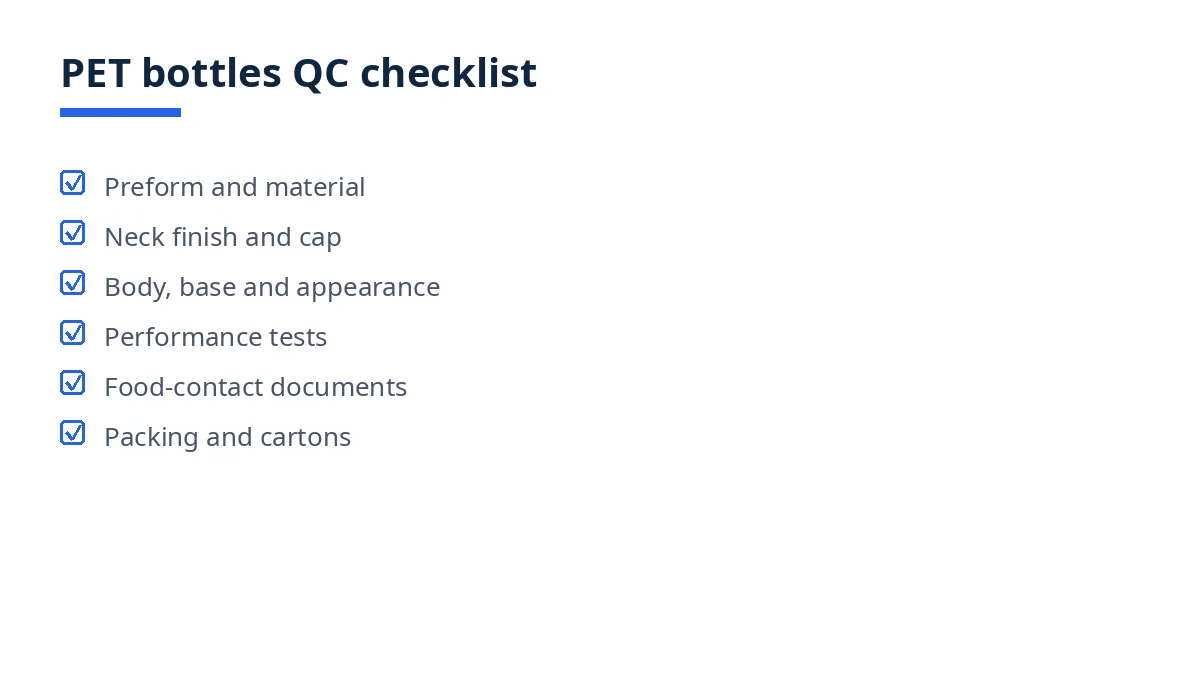
The full checklist (numbered, printable)
Preform and material
Check the certificate of analysis against the order: resin grade, preform weight, colour, and any intrinsic viscosity or acetaldehyde figures named in the specification.4
Weigh sampled preforms against the specification tolerance; uneven weight later becomes uneven bottle walls.
Check preform colour and clarity against the approved sample under the same light, noting yellowing, haze, gels, black specks, oil, or dust and their location.
Where a trial blow is specified, blow sampled preforms on the production mould and judge the bottles, not only the preforms.
Neck finish and cap
Measure the neck finish against the drawing: outside diameter, thread dimensions, tamper-evident band area, and neck height, using callipers or go/no-go gauges.
Check threads for damage, flash, short shots, and ovality; the cap must screw on straight and seat fully without cross-threading.
Fit the specified cap and check the seal by the method named in the specification, such as a leak or pressure-decay check, not by hand-tight feel alone.
Check cap removal: no excessive force or breakage, and any tamper-evident band must break cleanly at the intended point.
For carbonated contents, confirm the closure system was pressure-tested under the specified conditions, with the report naming the bottle, cap, and lot.
Body, base, and appearance
Measure height, body diameter, shoulder shape, and base diameter against the specification, recording actual values, not pass marks alone.
Check wall thickness at the shoulder, panel, and base named in the specification, looking for thin spots, not only an average. Non-destructive wall thickness testing is available.5
Where specified, cut and weigh neck, wall, and base sections by hot wire to show whether material is distributed evenly.5
Check clarity, colour, and surface across the whole bottle: haze, streaks, black specks, gels, scratches, dents, flash, and mould marks, inside and out.
Check the base seat: the bottle must stand upright without rocking, with no cracks, thin spots, or push-up defects.
Check print, label panel, and embossing against the approved artwork: position, spelling, legibility, and adhesion, with a flat label panel.
Fill sampled bottles to the specified fill height and check capacity and fill level with a graduated measure, not the mould name.
Performance tests
Run a top-load test against the specified limit. Top-load, also called buckling-load, testing finds the minimum top pressure a bottle bears without deforming.5
Run a drop test on filled, capped bottles from the specified height and onto the specified surface, checking for breakage, cracking, and leakage.5
Run a leak test on capped bottles by the specified method, inspecting neck, seal, and base afterwards; a visual check alone does not find micro-leaks.
Run a burst or internal-pressure test where the contents require it, against the specified limit.
Where specified, check stress and strain with a strain viewer, which uses changes in light passing through the material to reveal flaws the eye misses.5
For hot-fill bottles, check heat resistance at the specified fill temperature, hold time, and cooling, with no distortion, panel collapse, or leakage afterwards.
For automated filling lines, check line fit: neck handling, conveyor stability, capper compatibility, and labeller fit.
Food-contact documents and labelling
Collect the food-contact declaration for bottle and cap materials, naming the regulation relied on for the destination market — for the EU, Regulation (EU) No 10/2011,2 and for the United States, 21 CFR 177.1630.3
Where migration testing is required, confirm the report names the bottle, the simulants and conditions used, and the destination-market limit judged against.2
Where recycled PET is claimed, confirm it in writing: recycled content, source, and food-contact authorisation relied on, and record any undocumented claim as a failure.
Check every label, mould mark, and carton mark against the specification: bottle size, resin identification where required, origin, and handling marks, with spelling checked character by character.
Packing and cartons
Count bottles per bag, layer, and carton against the packing specification, confirming the size and colour assortment per carton matches the order.
Check inner packing: clean bags or liners, no loose bottles that can scuff or dent each other, and separators where specified.
Check carton strength, closure, and stacking: cartons must hold their shape under the specified pallet pattern, with no crushed corners on sampled cartons.
Weigh and measure sampled cartons, and check carton marks, pallet labels, and counts against the packing list.
Check loading protection: pallet wrapping, layer pads, and edge protection where specified, so strapping or neighbouring cartons do not damage bottles.
Photograph defects with the bottle, lot, and carton identified, and record every measurement, test result, and document reference in the report before the lot is released.
Common failures and how to fix them
The most frequent failure is a leaking neck: the cap fits by hand but the seal fails under pressure or after transport. Measure the neck finish against the drawing, then check the cap lot separately — a neck fault and a cap fault look identical on a filled bottle, and replacing one without checking the other repeats the failure.
Thin or uneven walls show as a panel that dents under stacking or a base that cracks on dropping. Compare sectional weights and wall readings; if one area is consistently thin, the blowing setup is the first place to look, since a mould or heating change affects every bottle the same way. A bottle that passes every bench test but jams on the filling line usually failed a line-fit check, so run a short trial on a matching line before bulk shipment. Cloudy or yellowed bottles point to material or drying problems at the preform stage: segregate the lot, check the certificate against the order, and never blend suspect bottles into a good lot to dilute the defect count.
Above the agreed acceptance level, the options are re-inspection after sorting or rework, documented partial acceptance, or rejection.
Downloadable template / summary table
Copy the checklist into your inspection sheet, add limits, tolerances, and acceptance numbers, and record a result per size and lot.
Section | Checks | Evidence |
|---|---|---|
Preform and material | Certificate, weight, colour, trial blow | Certificate, weigh records |
Neck and cap | Finish dimensions, seal, opening | Gauge readings, leak checks |
Body and base | Dimensions, wall, clarity, seat | Measurements, section weights |
Performance | Top load, drop, leak, pressure, heat | Test reports per lot |
Food-contact | Declaration, migration, recycled claim | Documents per market |
Packing | Counts, carton, pallet, marks | Packing list, photos |
How Exportain helps
Exportain is a B2B marketplace connecting buyers with Bangladeshi suppliers of plastic products, so the bottle specification, neck drawing, cap, and test requirements behind this checklist can be agreed at the enquiry stage. Supplier profiles show which document and photo checks have been recorded, not factory inspections. Exportain is not a party to the goods contract and does not inspect goods. When you plan the check, use inspection services to find providers, and read the AQL acceptance quality limit explainer and the pre-shipment inspection guide first.
FAQs
When should this checklist be used?
Use it at final inspection, when the bottles are finished and largely packed. For larger and first orders, also use it earlier, while preforms and first blown bottles can still be corrected.
Who should complete it?
The buyer, a local agent, or an independent inspector can complete it, using the approved sample, neck drawing, specification, and a random sample.
What are the most common failures?
Leaking necks and caps, thin or uneven walls, base cracking, cloudy or yellowed material, and bottles that jam on the filling line.
Can a third party do it?
Yes, if you share the approved references, tolerances, test methods, and acceptance levels first, and the inspector reports against your checklist rather than a generic plastic-goods form.
Next steps on Exportain
Before production starts, agree your bottle specification, neck drawing, cap, test methods, and acceptance numbers in writing, then read the AQL acceptance quality limit explainer and the pre-shipment inspection guide, and plan the check with inspection services.
Sources
- ISO 2859-1:2026 - Sampling procedures for inspection by attributes — Part 1: Sampling schemes indexed by acceptance quality limit (AQL) for lot-by-lot inspection. ISO (accessed )
- Commission Regulation (EU) No 10/2011 of 14 January 2011 on plastic materials and articles intended to come into contact with food. European Union (accessed )
- 21 CFR 177.1630 - Polyethylene phthalate polymers. United States Food and Drug Administration (accessed )
- A Complete PET Preform Acceptance Checklist: 7 Key Inspection Points For Purchasing Preforms, From Size To IV Value. iBottler (accessed )
- Mandatory Tests in PET Bottle Manufacturing & Bottling Industry. Presto Group (accessed )
- pre-shipment inspection
- quality control
- importing from Bangladesh
- Bangladesh sourcing
- aql inspection
- PET bottles
About the author
Sourcing from Bangladesh?
Post a request for quotation and suppliers on Exportain can send you their quotes directly.
Post an RFQ


