Pajamas and Sleepwear Price in Bangladesh: FOB Cost Breakdown for Buyers
No standard pajamas and sleepwear FOB price exists in Bangladesh. This guide breaks down the per-set cost build-up, fabric families, wash-durability testing, trims and embellishment, and set-versus-separates quoting, so buyers can compare supplier quotes on the same terms.
Short answer
There is no standard FOB price for pajamas and sleepwear from Bangladesh. Each supplier prices your fabric families, set or separates basis, size grading, trims and embellishment, wash testing and named FOB port. Ask for an itemized per-set build-up with the per-piece figure alongside, compare quotes only on the same specification, term and port, and approve washed samples before you confirm.
On this page
Key takeaways
There is no standard FOB price for pajamas and sleepwear from Bangladesh: each supplier prices your fabric families, set or separates basis, size grading, trims, embellishment, wash testing and named FOB port.
Restate every quote as a per-set price and a per-piece price before ranking: a two-piece set price divided by two is the per-piece price, and set packing may sit inside or apart from the unit price.
Ask for the FOB build-up in lines: fabric for both pieces, trims and embellishment, cut and sew, finishing and wash testing, set packing, and inland transport and export handling.
Sleepwear is washed often, so name the wash tests, cycles and pass limits in the tech pack and approve washed samples, including the largest size, before you confirm.
Exportain verification is a document and photo review, not a factory inspection, and a badge is not a guarantee.
Two quotations for the same pajama set can look easy to rank while ranking nothing: one may price a matched pair in one polybag, the other two separate garments sharing a print. Until both totals sit on the same basis, the cheaper figure may simply be the narrower offer.
This guide gives no standard FOB price for pajamas and sleepwear from Bangladesh, because no single figure could hold across fabrics, sizes, trims, and wash requirements. Instead it works through the per-set build-up line by line, covering fabric hand, wash behavior, grading across a matched pair, and trims that must survive the wash.
The sector context is knitwear: the Bangladesh Knitwear Manufacturers and Exporters Association (BKMEA), established in 1996, is the apex trade body for the knitwear sector and represents approximately 2,540 knitwear member factories.1 Classification comes before price: heading 6107 covers men's or boys' nightshirts, pyjamas, bathrobes, dressing gowns and similar articles, knitted or crocheted,2 while heading 6108 covers the women's or girls' equivalents, including nightdresses and pyjamas, with separate subheadings for cotton, man-made fibers and other textile materials.3 State gender, fiber shares, and construction in the first enquiry.
Why this matters for buyers and sellers
Behavior after repeated laundering. Nightwear is laundered far more often than occasion wear, so the cost of a set includes proving it still fits, feels, and looks right after washing. Shrinkage, spirality, pilling, color loss, and a roughened hand appear only after repeated cycles, so name the wash tests, cycles, and pass limits in the tech pack and test the largest size as well as the middle size.
Fabric families and hand. Sleepwear fabric is judged against the skin first and by weight second. Single jersey and interlock suit everyday sets, brushed flannel adds warmth with a raised surface, modal and viscose blends drape smoothly, and satin shows sheen while exposing stitching faults. Each family knits, dyes, and finishes differently, so a quote naming only "cotton" cannot be placed beside another. State family, fiber percentages, construction, and weight per piece, since the two pieces often use different cloth.
Set or separates basis. A set price buys two garments, one matching step, and one pack; a separates price buys one garment. Before any ranking, restate every reply as both a per-set price and a per-piece price, and write down which basis the supplier quoted.
Grading a matched pair. Grading sleepwear means grading two patterns that must still fit together at every size: a top graded wider while its bottom stays narrow produces pairs that do not match on the hanger or on the body. State the size range for each piece, the ratio between sizes, and whether the set is sold only as matched pairs or also as separates.
Trims and embellishment that must survive washing. Piping, buttons, a drawcord waist, lace edging, embroidery, and chest prints each add material, labor, and a possible failure point. Piping must match in color and width across both pieces, and buttons and lace must come through the wash intact. State each trim and whether its cost sits inside the unit price or on a separate line.
Step-by-step: how it works
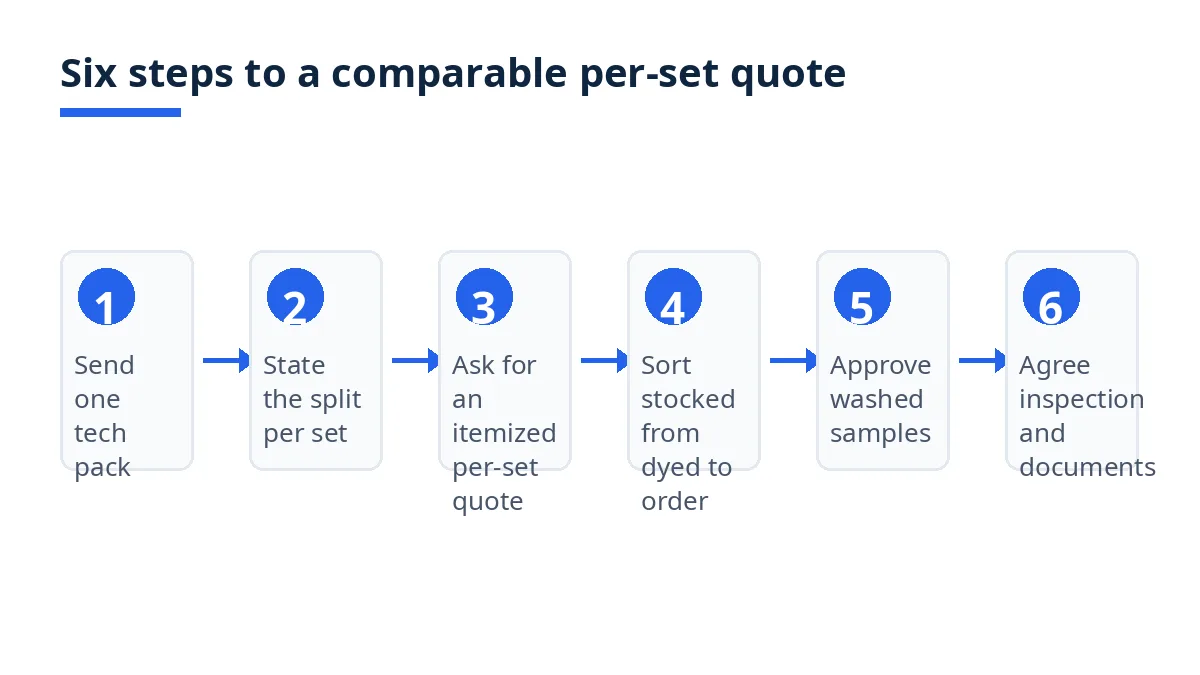
Put one tech pack in front of every candidate. Include the fabric family, fiber percentages, construction, and weight for each piece, the set or separates basis, the size range and ratio, the trim specification, the wash-test list with cycles and pass limits, the label and packing specification, and the FOB port.
Break the order down by set, color, and size. Give the quantity of sets, the quantity per color, and the size ratio for each piece. Dye lots, grading, and packing follow that breakdown, so a bare total cannot be priced with confidence.
Ask for the build-up in lines, per set. Request fabric, trims and embellishment, cut and sew for both pieces, finishing and wash testing, set packing, and inland transport and export handling as separate lines, with the FOB port and Incoterm stated, and the per-piece figure beside the per-set figure.
Record what is in stock and what is dyed to order. Note the status of each fabric color for each piece, and whether piping, buttons, drawcords, and labels are stock items. A dyed-to-order color on one piece can hold the whole set back.
Approve washed samples before confirming. Order a proto sample, then a pre-production sample in the actual fabrics, colors, trims, and embellishment for both pieces. Measure it, run it through the agreed wash cycles, and check that top and bottom still work as a pair.
Write inspection, documents, and delivery term into the purchase order. Put the inspection plan, wash-test evidence, document set, and FOB port and term on the same document, so nothing agreed in discussion is left off the record.
Costs, timelines and documents
Reading a per-set FOB build-up
No guide can state typical costs as fact: each factory prices your fabric families, set basis, size range, trims, embellishment, wash testing, and delivery term.4 Under the Incoterms 2020 rules, FOB means the seller delivers the goods on board the vessel at the named port of shipment, so an FOB quote is comparable only with another FOB quote for the same port. See the FOB guide for the term in full. The table below shows the structure to read any supplier quote against.
FOB cost component | What it covers | What shifts it |
|---|---|---|
Fabric, top and bottom | Cloth and dyeing, both pieces | Family, fiber percentages, weight, stocked or dyed to order |
Trims and embellishment | Piping, buttons, drawcord, lace, print, embroidery | Trim count, placement per piece, print colors, wash resistance |
Cut and sew | Cutting, sewing two garments, grading, matching | Size range, two patterns, matching work, seam types |
Finishing and wash testing | Pressing, checking, wash tests | Wash cycles, pass limits, quality standard |
Set packing | Folding as a set, polybag, hang tag, carton | Set or separates packing, carton print, pieces per carton |
Inland transport and export handling | Factory to port, port handling, loading | Distance to port, carton count, shipment timing |
Example figures, in US dollars per set: fabric for both pieces 2.85, trims and embellishment 0.70, cut and sew 1.20, finishing and wash testing 0.35, set packing 0.30, inland transport and export handling 0.40. The example figures add to 5.80 per set (2.85 + 0.70 + 1.20 + 0.35 + 0.30 + 0.40 = 5.80), or 2.90 per piece (5.80 / 2 = 2.90), since a set holds two pieces. For an order of 3,000 sets, the example figures give an order value of 17,400 dollars (3,000 x 5.80 = 17,400). These are example figures only, demonstrating the per-set arithmetic and set-to-piece conversion, not a market price or a price any supplier will offer.
Worked comparison, using example figures throughout: Supplier A quotes 5.80 per set; Supplier B quotes 2.60 per piece, or 5.20 per set, which looks 0.60 cheaper. That restatement does not settle the ranking, because B prices each garment in its own polybag and leaves wash testing off the unit price. Add set packing at 0.30 and wash testing at 0.35, and B reaches 5.85 per set, slightly above A. The ranking flipped once both sheets carried the same lines. When every line matches and one total still sits far below the rest, ask the supplier to name the step or material that is not in the price.
On timelines, ask for sampling, fabric-ready, production, wash-test, and inspection dates as separate lines rather than accepting one delivery week.
Papers to agree before production
The order papers are the tech pack, the itemized per-set quotation, and the purchase order, carrying the set basis, color and size split, wash-test list, and inspection plan. Agree the shipment papers before production: the Bill of Export or Shipping Bill, commercial invoice, packing list, EXP form, and certificate of origin.5 Add market label wording to the same agreement, so labeling is settled while the tech pack is still open.
Bangladesh-specific rules and tips
Treat a membership claim as a question to put to the association. A listing that names BKMEA membership tells you where to check; only the association itself can confirm whether the claim holds.1 Membership also says nothing about whether a factory sews matched sleepwear sets or single garments, so treat it as one shortlist check, never as evidence about price or capacity for your set.
Sort gender and fiber before the first price request. Men's and women's knitted sleepwear sit under different headings,2 3 and cotton, man-made fibers, and other textile materials sit under different subheadings within heading 6108.3 Run your blend past your customs broker for the subheading, because that line follows the goods into the import declaration and the duty calculation.
Put label wording on the tech-pack approval sheet. Settle this before production, not in a correction afterwards. For each blended sleepwear fabric, write every constituent fiber and its share on the approval sheet, heaviest first, and have the supplier confirm that the same wording will appear on the woven label and on the care label.6 Agree care-label lines for washing, drying, and ironing at the same stage. Agreeing it before cutting costs an approval; fixing it after production costs a relabeling run.
Give a children's style its own compliance line. In the United States, children's sleepwear that does not meet the definitions of an infant garment or a tight-fitting garment is subject to the flammability standards for children's sleepwear, 16 CFR part 1615 for sizes 0 through 6X and 16 CFR part 1616 for sizes 7 through 14.7 That testing, fit, and labeling work belongs in the quotation. Confirm with your compliance adviser which route your style falls under before asking for a price.
Mistakes and red flags
What are the most common mistakes?
Ranking totals that sit on different bases. A per-set figure and a per-piece figure cannot be ordered until both are converted to the same basis, and set packing may sit inside one unit price and outside another. Convert first, then rank.
Sampling only the middle size. A middle-size sample proves the middle size. Grading faults appear at the smallest and largest sizes, where a top and bottom graded apart stop working as a pair, so sample the ends of the range as well.
Leaving wash approval until bulk production. A set that measures correctly before washing and then shrinks, pills, or fades is a return waiting to happen. The pre-production sample is where shrinkage, pilling, color loss, and hand after washing are proven.
Adding trims after the price is set. Piping, buttons, lace, and prints settled after the unit price is agreed tend to arrive as extras, or get thinned out to fit the price. Name every trim and its wash resistance in the tech pack, and price it as its own line.
Working from a total with no lines. With only a total to look at, you cannot tell which part of the job changed when the total changes. Keep the build-up attached to the quotation and to the purchase order.
Letting a price agreed on a call stay off the paper. When a supplier agrees a lower total on a call, ask for a fresh quotation sheet showing the new total with its lines. A price that lives only in call notes will be read differently by the two sides at invoice time.
Treating a listing page as a capacity check. A supplier listing opens an enquiry. It does not show whether a factory can make your set at the quoted price, and a badge records checks already done rather than promising an outcome for your order.
Checklist
Do not confirm until each line below has a written answer.
Tech pack sent: fabric family, fiber percentages, weight per piece, set or separates basis, trims, wash tests, labels, packing.
Split stated per set, color, and size, with one size ratio per piece.
Per-set FOB quote in lines, per-piece figure alongside, FOB port and Incoterm named.4
Fabric status per color per piece: stocked or dyed to order.
Trim, label, tag, and carton minimums confirmed apart from the garment price.
Pre-production sample for both pieces measured, washed, approved in writing, top and bottom checked as a matched set.
Inspection plan and wash-test evidence in the purchase order.
Quotations compared on the same specification, set basis, term, and port.
Document set agreed: invoice, packing list, EXP form, certificate of origin, market label text.6 5
Payment terms, currency, and order value on the proforma invoice.
How Exportain helps
On Exportain, browse suppliers and post a request for quotation (RFQ) on the RFQ board with your tech pack summary, set basis, split, and FOB port. Ask each reply for its itemized per-set build-up with the per-piece figure alongside. The checks behind any badge are a document and photo review, not a factory inspection, so sample approval, wash testing, and inspection remain your work; see how supplier verification works on Exportain.8
FAQs
What should I know first about pajamas and sleepwear?
Start from the set itself: fabric family and hand for each piece, fiber percentages, set or separates basis, size range, trims and embellishment, and wash tests. Men's and women's knitted sleepwear sit under different headings,2 3 and the fiber split sets the subheading.
What are the typical costs and timelines?
There are no typical figures to rely on: price follows your fabric families, set basis, size range, trims, embellishment, wash testing, and delivery term,4 while timing follows sampling, dyeing, finishing, and trim delivery. Ask for the build-up in lines and the timeline in separate dates.
Which documents are needed?
The order papers are the tech pack, the itemized per-set quotation, and the purchase order. The shipment papers centre on the Bill of Export with the commercial invoice, packing list, EXP form, and certificate of origin enclosed,5 and label wording must follow your market rules, including Regulation (EU) No 1007/2011 for the European Union.6
What are the most common mistakes?
Ranking totals that sit on different bases, sampling only the middle size, leaving wash approval until bulk production, adding trims after the price is set, working from a total with no lines, letting a price agreed on a call stay off the paper, and reading a listing page as a capacity check.
Next steps on Exportain
Browse suppliers, then post your tech pack summary, set basis, and FOB port on the RFQ board for itemized per-set quotes. Before confirming, read the import guide, the HS code guide, and the quality control checklist.
Sources
- BKMEA at a Glance. BKMEA (accessed )
- Classification Detail — HS Code 6107. United Nations Statistics Division (accessed )
- Classification Detail — HS Code 6108. United Nations Statistics Division (accessed )
- Incoterms® 2020. International Chamber of Commerce (ICC) (accessed )
- Customs Clearance Procedures for Export. Bangladesh Customs, National Board of Revenue (accessed )
- Regulation (EU) No 1007/2011 on textile fibre names and related labelling and marking of the fibre composition of textile products. European Union, (accessed )
- Clothing Business Guidance. U.S. Consumer Product Safety Commission (accessed )
- Supplier verification: Earn trust badges buyers can see. Exportain (accessed )
About the author
Sourcing from Bangladesh?
Post a request for quotation and suppliers on Exportain can send you their quotes directly.
Post an RFQ