

Typical MOQ for Men's Woven Shirts in Bangladesh (and How to Negotiate It Down)
No single men's woven shirts MOQ in Bangladesh: how shirting rolls, dye lots, collar and cuff runs and size curves set the minimum per colour, and how to negotiate or structure a smaller order.
Short answer
There is no single typical MOQ for men's woven shirts from Bangladesh. Each factory sets its minimum per colour, per pattern and per size for your specification, driven by shirting roll widths, piece-dye and yarn-dye lots, collar and cuff component runs, button orders and the size curve. Ask for each floor in writing, then negotiate the structure: fewer colours, shared shirting, stocked inputs, or set-up paid as a separate line.
On this page
Key takeaways
There is no single typical MOQ for men's woven shirts from Bangladesh, because each factory sets its minimum per colour, per pattern and per size for your specification.
Shirting rolls, piece-dye lots, yarn-dye lots for checks and stripes, collar and cuff component runs, button orders and the size curve are the floors that set the minimum.
Ask for every floor in writing, with the binding line named for your split, and record whether each floor sits inside the garment minimum or beside it.
Negotiate the structure first: fewer colours, one shirting shared across shirts, stocked shirting and buttons, a simpler pattern, and set-up paid as a separate line.
Exportain verification is a document and photo review, not a factory inspection, and a badge is not a guarantee.
A men's woven shirt order is planned from the cloth outward. Before any shirt is sewn, a factory must buy shirting in full rolls, fill a dye vessel or dye warp yarns, set a press for one collar shape, and lay a marker across neck sizes and sleeve lengths. Each job has a smallest workable batch, and the order must clear all of them, colour by colour and size by size. The thinnest batch is the real minimum order quantity for your shirts.
Begin with cloth width and roll length. Woven shirting comes off the loom in a fixed width, and the marker must fit fronts, backs, sleeves, collars and cuffs inside that width. A short colour run can strand part of a roll that no other order can use, so find out how many rolls your specification consumes and what happens to leftover cloth. It may be held for a repeat, charged to the order, or shared across styles.
Colour reaches the cloth by two routes, and the route decides the batch. A solid colour is usually piece-dyed after weaving, so one dye vessel per colour sets the floor for that colour. A check or stripe is usually yarn-dyed: the warp yarns are dyed before weaving, one dyed lot for every colour woven into the pattern. A two-colour stripe therefore carries two warp lots plus the weaving run, so the smallest warp lot can bind long before the shirt quantity is considered. State the pattern, its colours, and the route for each.
The small parts carry their own batches too. Collars and cuffs are cut from the same shirting but fused, shaped and pressed as separate components, one press setting per collar shape. Buttons are ordered by colour and size, stays and interlining by collar shape, so a late collar change can move the minimum even when the body cloth is unchanged. Ask whether those batches sit inside the garment minimum or beside it.
The size grid is where many orders fail last. A shirt size pairs a neck measurement with a sleeve length, and factories cut to a ratio across that grid. A colour that clears its dye vessel can still fail when one neck size inside it is too thin to cut alone, so the binding floor is often one cell of the grid rather than the colour as a whole. Give the quantity for every colour and size, and name the ratio, so the factory can name the binding cell.
The Bangladesh Garment Manufacturers and Exporters Association (BGMEA) began with 12 members in the early 1980s and now has around 4,500 member factories, of which about 60 percent make woven garments, and its member factories account for 100 percent of the country's woven garment exports.1 Woven garment exports reached $4,614.80 million in July to September of fiscal year 2026-27, up 5.11 percent year on year, according to data released by the Export Promotion Bureau (EPB).2 For tariff classification, heading 6205 covers men's or boys' shirts, excluding knitted or crocheted shirts, nightshirts, singlets and other vests.3 Under EU labelling rules, the label must list every constituent fiber by name and weight percentage in descending order, matching the shirting ordered.4
Example figures: a buyer orders 1,440 shirts in six colours at 240 per colour, and each colour must clear its own dye vessel, collar and cuff pressing and size grid. The same 1,440 shirts in three colours at 480 per colour clear each batch more easily. Example figures: a roll of 120 meters at 1.4 meters of cloth per shirt yields 85 shirts, since 120 divided by 1.4 is 85.7, so a colour needing 90 shirts consumes two rolls and leaves most of the second roll unused. Both examples show structure only, not typical figures.
Why this matters for buyers and sellers
For a buyer, a shirt MOQ is a stock decision in disguise. It decides how many shirts of one colour, collar and neck size you must hold before you know whether that combination sells, and whether a first order can test a new collar, a new check or an unfamiliar size grid before repeating. When one colour cannot clear its dye vessel, the choice is to drop it, pay a surcharge for the short batch, or raise the quantity until the batch clears.
For a factory, the minimum protects work that cannot be transferred to another buyer. Shirting dyed in your colour, a warp woven for your check, collars fused to your shape and buttons matched to your colour have no second use, so their cost spreads across fewer shirts per colour. A factory flexible on the total can still hold firm on one colour.
Step-by-step: how it works
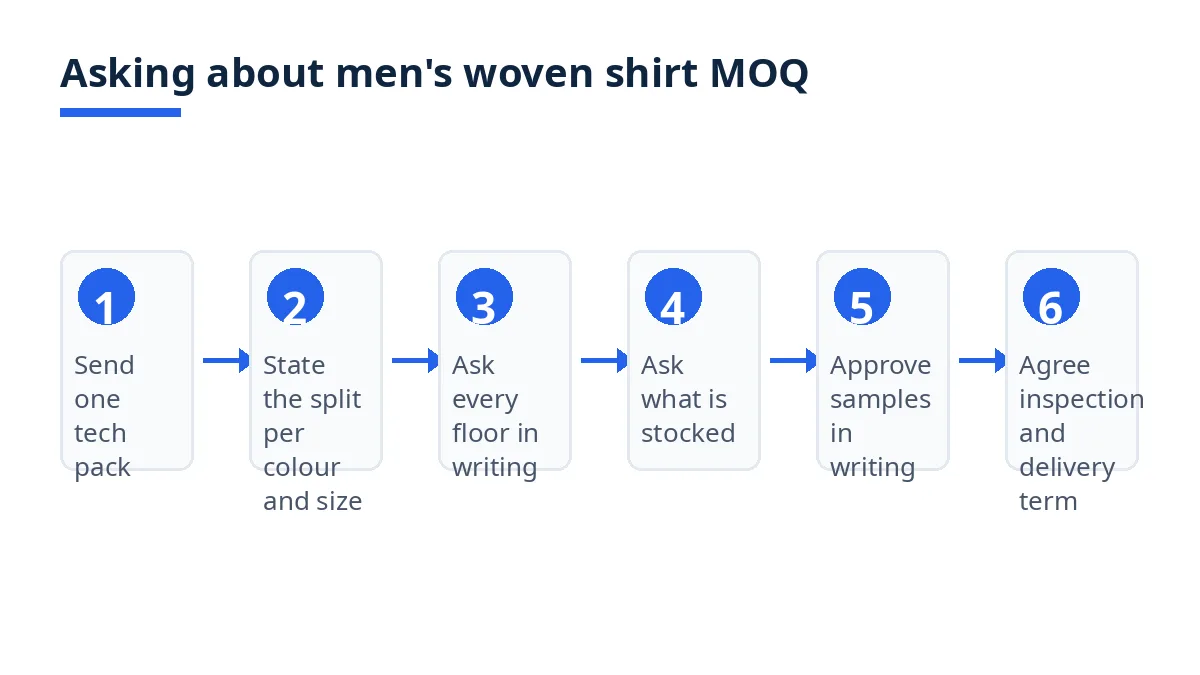
Send the same tech pack to every factory. Put shirting cloth and weight, collar shape, cuff style, button details, pattern and dye route, neck-and-sleeve chart, labels and packing into one pack, sent unchanged to each candidate.
Give the split, not just the total. State the quantity for every colour, pattern and size, because a total alone cannot show which colour or size cell binds.
Ask for every batch separately, and ask which one binds. Request the roll, dye vessel, warp lot, collar and cuff, button, label and carton batches, then ask the factory to name the batch that binds for your split.
Check what is already in stock before fixing colours. Record whether each shirting colour is held in stock or dyed for the order, and whether buttons, interlining and labels are stock items, since stocked inputs usually offer the lowest minimums.
Approve samples twice, in writing. Order a proto sample, then a pre-production sample in the final shirting, colour, collar shape and buttons. Measure it, wash it, check collar and cuff shape after washing, then approve it or list corrections in writing.
Set inspection and the delivery term before confirming. Put the inspection level and AQL values in the purchase order, following ISO 2859-1,5 and state one Incoterm with a named place on every quotation.6
Levers that move the floor
Cut a colourway and watch every batch grow. Each colour on the range adds its own dye vessel or warp lots, button order and size grid. Taking one colour off the range lifts the quantity in all the colours left, at the same order total, and that lift can carry a batch over its floor.
Combine the cloth quantity across styles. A formal shirt and a casual shirt in identical shirting and colour need not be treated as two separate cloth orders. One roll quantity, one dye vessel and one set of press settings can serve both, provided the factory counts the two styles together toward the cloth batch in the quotation.
Work from the factory's stock list. Before colours and collar shapes are fixed, ask which shirting colours, buttons and interlinings the factory already holds. Building the range around those held items takes the dye vessel out of the order and cuts the component set-up, which is where a smaller batch usually becomes possible.
Split set-up charges off the shirt price. A warp lot, a collar press setting or a label print run is a fixed job whether the run is short or long. Charged apart from the unit price, it stops inflating the minimum, and the repeat order reuses the set-up without paying for it again.
Simplify the pattern and price both versions. Removing one colour from a check removes a whole warp lot, and replacing a check with a solid removes the warp lots. Ask for the simplified version priced apart from the patterned version.
The men's woven shirts quality control checklist covers collar, cuff, button and stitch checks to run on the pre-production sample.
Costs, timelines and documents
Prices and lead times
No guide can state a standard price or lead time for men's woven shirts. Each factory prices your shirting, collar and cuff work, pattern route, button and label runs, finishing and packing, and the delivery term you choose.6 A yarn-dyed check is priced differently from a solid piece-dye, so two shirts at the same total can carry different prices and timelines. Sampling turns on shirting availability and correction rounds, while bulk production turns on dyeing or weaving, component runs and line capacity. Ask for sampling, cloth-ready, production and inspection dates separately.
Papers for the order and the shipment
The order papers are the tech pack, the itemized quotation and the purchase order, with the minimum per colour, pattern and size on both. For the shipment itself, see the Bangladesh Customs export clearance page.7
Bangladesh-specific rules and tips
Treat association membership as background, not proof. A factory may describe itself as a BGMEA member, and the association can confirm that description. Its member factories account for 100 percent of the country's woven garment exports,1 which places it in the woven sector. It does not show its minimum for your collar, check or size grid, so membership never replaces the tech pack, the sample or the inspection.
Make the shipment file agree with itself. Customs paperwork is built around the exporter and the buyer named on the declaration,7 so every other paper should repeat those names exactly: licence, quote, proforma invoice and payment account alike. One variant spelling is enough to stall a file that is otherwise ready, and the delay falls on a shipment the factory has already finished.
Find out which inputs arrive from elsewhere. Some buttons, interlining, stays and warp yarns are bought in for one specification, and that purchase can decide both the smallest batch and the first date cutting can start. Settle each colour's size ratio before cutting, and check shade match across rolls of one colour before bulk cutting.
Mistakes and red flags
Start from the split, not the total. The order total hides the batches that matter: one colour under its vessel, one pattern under its warp lots, one size under its cutting ratio. Any of those shortfalls brings a surcharge or forces the item off the order.
Pricing a check as if it were a solid. A check quoted on a single dye figure hides the warp lots behind it. Ask for the yarn-dye batch for every pattern colour before approving the range, or the first quotation understates the patterned minimum.
Compare like with like, or not at all. A quote built on stocked cloth, a plain collar and stock labels cannot sit beside a quote for dyed cloth, a shaped collar and printed labels, and neither can sit beside a quote on another delivery term. Hold the tech pack and the Incoterm6 fixed, and the minimums become comparable.
Put every concession on the order papers. If the factory agrees to a lower batch, a shared roll or a waived set-up charge, that agreement belongs on the quotation and the purchase order next to the split it covers. Anything left in messages alone is hard to rely on once cutting begins, so ask for a reissued quotation showing the revised batch before paying a deposit.
Treat a listing and a badge as an invitation to ask questions, not as findings about the factory floor. They say nothing about whether one collar press can hold your shape or one dye vessel can hold your colour, and they promise nothing about quality or delivery.8
Checklist
Do not commit to the order until you hold a written answer for every point below, from the tech pack and the split through to the clearance route.
One tech pack has gone to every factory, covering shirting, collar, cuff, pattern, dye route, buttons, labels, sizes and packing.
The quantity is stated for every colour, pattern and size, with one size ratio for each colour.
The minimum is confirmed for every colour and pattern, with the binding batch named.
The stock position of each shirting colour is recorded as stocked, piece-dyed or yarn-dyed.
Collar, cuff, button, label and carton batches are confirmed apart from the garment minimum.
Set-up costs are itemized apart from the unit price, with paid set-ups recorded.
The pre-production sample has been measured, washed and approved in writing.
The inspection level and AQL values are written in the purchase order.5
Quotations are compared only where they answer the same specification and the same Incoterm.6
The shipment clearance route has been confirmed through the Bangladesh Customs export clearance page.7
How Exportain helps
On Exportain, browse suppliers and post a request for quotation (RFQ) on the RFQ board with a tech pack summary, the split by colour and pattern, and the delivery term, so suppliers quote against the same specification. Ask each reply for its per-colour, per-pattern and per-size minimums and its binding batch.
Badges record document and photo reviews, not factory inspections, and a badge is not a guarantee.8 9 See how supplier verification works on Exportain for what each badge records.
FAQs
What should I know first about men's woven shirts?
There is no single figure to look up. The minimum is set colour by colour, pattern by pattern and size by size, by shirting rolls, dye vessels and warp lots, pressing batches, button orders and label print runs. Men's woven shirts sit under HS heading 6205, which covers men's or boys' shirts excluding knitted or crocheted shirts, nightshirts, singlets and other vests.3
What are the typical costs and timelines?
No buyer can rely on standard figures here, because each factory sets its price, minimum and lead time for one specification alone. Shirting, collar work, the pattern route and the delivery term move the price,6 while cloth availability, dyeing or weaving and component runs move the timeline.
Which documents are needed?
Three order papers carry the deal: the tech pack, the itemized quotation and the purchase order, and the quotation and order should both show the minimum per colour, per pattern and per size. For the shipment itself, see the Bangladesh Customs export clearance page.7
What are the most common mistakes?
Buyers most often go wrong by sending a total without the colour and size split, by letting a check be priced on one dye figure, by comparing quotes that rest on unlike cloth or terms,6 by trusting a spoken concession, by approving a range before the warp lots behind each pattern colour are priced, and by treating a badge as proof of capacity.8
Next steps on Exportain
Before posting anything, read the men's woven shirts manufacturers in Bangladesh guide and how to import men's woven shirts from Bangladesh for background. Then browse suppliers and post a tech pack summary, the split by colour and pattern, and the delivery term on the RFQ board, asking for minimums per colour and per size. When replies arrive, line them up on the same tech pack and term before judging the minimums.
Sources
- Bangladesh Garment Manufacturers and Exporters Association (BGMEA). Devex (accessed )
- RMG exports rise 6.10pc to US$10.58b in July-Sept of FY27. The Financial Express, (accessed )
- HS Code 6205 Men's or boys' shirts. Abrams Wiki (accessed )
- Regulation (EU) No 1007/2011 on textile fibre names and related labelling and marking of the fibre composition of textile products. European Union, (accessed )
- ISO 2859-1:2026 - Sampling procedures for inspection by attributes — Part 1: Sampling schemes indexed by acceptance quality limit (AQL) for lot-by-lot inspection. ISO (accessed )
- Incoterms® 2020. International Chamber of Commerce (ICC) (accessed )
- Customs Clearance Procedures for Export. Bangladesh Customs, National Board of Revenue (accessed )
- Trust & Safety Center. Exportain (accessed )
- Supplier verification: Earn trust badges buyers can see. Exportain (accessed )
- MOQ
- supplier verification
- buyer guide
- woven garments
- Bangladesh sourcing
- bangladesh garments
- Men's woven shirts
About the author
Sourcing from Bangladesh?
Post a request for quotation and suppliers on Exportain can send you their quotes directly.
Post an RFQ


