Top Men's Woven Shirts Manufacturers in Bangladesh: How to Find and Verify Them
Bangladeshi men's woven shirt supply is organised by factory type, not by ranking: seven types, what each controls, and the collar, cuff, cloth and grading checks that decide an order.
Short answer
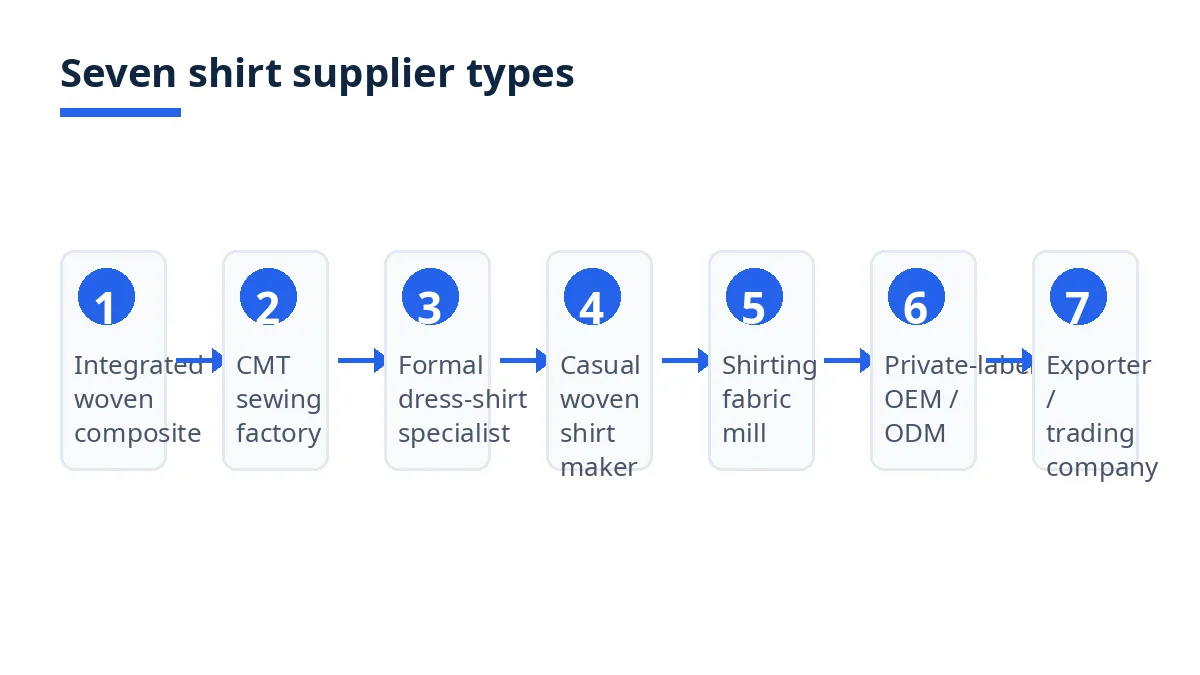
Men's woven shirts manufacturers in Bangladesh fall into seven types: integrated woven composites, CMT sewing factories, formal dress-shirt specialists, casual woven shirt makers, shirting fabric mills, private-label OEM and ODM suppliers, and exporters and trading companies. Match the type to your cloth, collar and cuff construction and order size, then test a washed and pressed sample and agree inspection terms before paying.
On this page
Key takeaways
Woven shirts are cut from warp-and-weft cloth, so collar and cuff construction, yarn count and weave decide quality more than sewing speed alone.
Woven garment exports earned US$4.614 billion in the first quarter of fiscal 2026-27, up 5.11 per cent year on year, within ready-made garment exports of US$10.578 billion, according to EPB data.
Men's or boys' shirts fall under heading 6205, with cotton shirts under 6205.20 and man-made fibre shirts under 6205.30.
Price and MOQ are set per style and colour: cloth, collar and cuff construction, washing and pressing, and packing move the quote more than location does.
Verification is a sequence the buyer runs: BGMEA member search, document review, a washed and pressed sample in production cloth, and an agreed AQL inspection before payment.
A men's woven shirt stands or falls at four points: the cloth, the collar, the cuff and the graded pattern. A stripe that breaks at the pocket, a collar point that curls after one wash, a cuff that twists the sleeve out of line, or a neck size that fits only in the middle of the range will each turn a good-looking sample into a returned shipment. None of those faults comes from sewing speed. They come from cloth that was never tested, a pattern that was never graded properly, or a pressing routine that suited the sample but not the bulk order. Sorting Bangladeshi suppliers by what each one actually controls is therefore the first job, ahead of any discussion of price.
Bangladesh ships woven garments at scale. In the first quarter of fiscal 2026-27, woven garments accounted for US$4.614 billion of the country's US$10.578 billion in ready-made garment exports, a year-on-year rise of 5.11 per cent in Export Promotion Bureau (EPB) figures.1 Buyers checking whether a company belongs to the sector trade body can use the member search on the Bangladesh Garment Manufacturers and Exporters Association (BGMEA) site.2 At the border, classification is straightforward: men's or boys' shirts sit under heading 6205, with cotton shirts at 6205.20 and man-made fiber shirts at 6205.30.3 Scale alone, however, says nothing about which supplier fits a particular shirt, so the profiles below sort the market by capability rather than by size.
The seven profiles describe types of supplier, not named companies, and no type outranks another. One company can cover two profiles at once, and a supplier can change profile for a single order by subcontracting a stage. Each entry states what the type handles, which orders it suits, and the check that matters most before committing. Read each check as a condition of the order, not a later follow-up.
The list
1. Shirting fabric mills and cloth-led suppliers
A mill of this kind weaves the shirting itself: poplin, twill, oxford, dobby and yarn-dyed stripes and checks, in cotton, cotton blends and man-made fibers. Some mills sell cloth only, leaving the buyer to place sewing elsewhere. Others sew through partner factories and quote a finished shirt, with the cloth as the selling point. Either way, the buyer's leverage sits at the loom, not at the sewing line: yarn count, weave, dye method and finish are fixed here, and no later stage corrects a cloth fault.
This type suits a buyer building a range around one cloth story, or a buyer who needs the same yarn-dyed stripe to match across several shirt styles and seasons. It also suits a buyer who wants shade and hand feel agreed before any pattern is cut. The decisive checks are numerical. Put fiber content, yarn count, weave, weight, width, dye method and finish in figures on the order, ask for a lab dip against your shade reference, and test the bulk cloth sample for shrinkage, color fastness and seam slippage. Where a mill sews through a partner, name that sewing factory in the order and judge its collar and cuff work on its own samples, since strong weaving says nothing about how a collar is finished.
2. Formal dress-shirt specialists
These factories spend their days on dress shirts: spread and cutaway collars, single and double cuffs, plain and pleated fronts, and yokes shaped to carry the shoulder. Their lines are arranged around collar and cuff work, with interlining, fusing and pressing routines tuned for a collar that must hold its shape through a working day and a laundry cycle. A general sewing factory can sew a dress shirt, but it does not live with collar roll and interlining bubbling the way a specialist does.
Office and occasion ranges belong here, as do uniform programs where every collar in a delivery must match a single standard. A specialist should be able to discuss interlining weight and collar construction from shirts currently on its lines. Before ordering, wash and press the sample, then check it again after a second wash: look for bubbling under the collar, a roll that was not in the unwashed sample, and any twist at the cuff. Published clothing construction standards call for collars that lie flat with matching sides and sharp points, and cuffs of even width with no undercuff showing.4 Grade the pattern across neck sizes as well, because a collar that sits well at a middle neck size can behave differently at either end of the range.
3. Casual woven shirt makers
Casual makers work with oxford, flannel, chambray, seersucker and brushed cotton, plus short-sleeve camp-collar and resort styles. Their cloth is heavier or more textured than dress shirting, their fits are looser, and their pressing is softer, so the shirt is expected to relax in the wash rather than hold a rigid shape. Hand feel after laundering is part of the product here, not an afterthought.
Seasonal casual ranges, workwear-inspired shirts and resort programs fit this type, especially where wash behavior matters more than a stiff collar. The approval routine must reflect that. Wash and press the sample twice and measure it after each wash, since shrinkage and softening only appear once the cloth has been laundered. Check stripe and check matching at the pocket, the placket and the yoke, and write down an agreed tolerance for pattern drift, because a shirt that looks correct laid flat can still pull at the side seam once the cloth relaxes. Ask how the maker handles cloth lots across a repeat order, since a casual cloth that varies in weight between lots will vary in fit too.
4. Cut, make and trim (CMT) sewing factories
A CMT factory cuts and sews shirts from cloth the buyer supplies, or buys cloth to the buyer's specification. Its strength is pattern work, sewing and pressing, and it carries no weaving or dyeing operation of its own. That narrow scope is the point: the buyer keeps control of the cloth, and the factory is judged purely on how it turns that cloth into shirts.
Smaller or mixed programs suit this type, as do buyers who already hold cloth stock, buyers testing a new style before committing to larger volumes, and buyers who want one cloth run spread across several shirt styles. The risk moves with the scope. Since cloth quality is the buyer's responsibility, inspect each lot before cutting and record shade, width and weaving faults lot by lot, so a fault found after cutting can be traced to a lot rather than argued about in general. Settle in advance who bears the cost if a lot fails once cutting has begun, and approve a pre-production sample cut from the bulk cloth and washed and pressed exactly as the shipment will be.
5. Integrated woven composite groups
These groups keep weaving or greige sourcing, dyeing and finishing, cutting, sewing, washing, pressing and packing under one management chain, so a shirt order moves from cloth to carton without changing company. The practical gain is traceability: shade, fabric lots and wash routines can be followed through one organization, which helps repeat programs where the same white, blue or yarn-dyed stripe must look identical next season.
Repeat formal and casual programs are the natural fit, particularly where shade consistency across seasons matters more than flexibility on small runs. The word to test is "integrated" itself. Ask, in writing, which stages the group runs in-house for your order and which it subcontracts, because a group that weaves but dyes elsewhere is not integrated for shade purposes, whatever its brochure says. Agree a shade band, a fabric width and a shrinkage tolerance before bulk cutting, and keep a sealed length of the approved cloth as the reference the shipment is judged against.
6. Private-label OEM and ODM shirt suppliers
Suppliers of this kind make shirts under the buyer's label. Under an original equipment manufacturer (OEM) arrangement, the supplier produces to the buyer's tech pack. Under an original design manufacturer (ODM) arrangement, the supplier offers its own shirt patterns and styles for the buyer to label. The distinction matters because it decides who owns the pattern, who fixes a construction fault, and how much development the buyer must do.
Brands and retailers needing their own labels, size sets, packaging and barcodes belong here, as do importers who want a ready shirt range without developing every pattern from scratch. For OEM work, send a full tech pack covering cloth, collar and cuff construction, interlining, button type and placement, stitch density, measurements with tolerances, and packing, then judge the counter-sample against that document line by line. For ODM work, confirm the offered patterns are the supplier's own and settle who owns the graded patterns if you move to another supplier later. In both cases, approve a graded sample set from smallest to largest, since shirt grading moves at the neck, the chest, the sleeve length and the cuff together.
7. Exporters and trading companies
An exporter or trading company sells shirts made in partner factories rather than on its own sewing lines, aggregating capacity across several factories and handling export documentation for the buyer. Its value is coordination: one contract and one contact across a mixed range, and capacity drawn from more than one factory when a single line cannot cover the order.
Buyers ordering several shirt types at once, buyers whose quantities are too small or too mixed for one factory, and buyers who want a single point of contact across a range fit this type. The check is direct: put the name of the factory sewing each style in the order document before any deposit is paid, and run the collar, cuff and washed-sample checks on that factory's work, not on the trading company's sales material. An export record shows that a company has shipped before; it does not show which sewing line made those shipments. Make the order name the producing factory, the cloth source and the inspection standard, so a fault can be traced to the stage that caused it.
Price and MOQ follow the specification, not the supplier's location. A shirt quote is built from cloth, cutting, sewing, washing and pressing, trims, packing and testing, so compare quotes part by part on an identical specification. Example figures: splitting one cloth across several colors can add a dye-lot charge per color, while adding a second collar style can add a separate pattern and interlining cost, and neither figure means anything unless the cloth, the construction and the packing are the same. For how minimum order quantity works across a range, read the guide to MOQ in the supply chain.
Summary table
Type | Suits | Decisive check |
|---|---|---|
Shirting fabric mill | Cloth-led ranges, matched yarn-dyed stripes | Numbered cloth specification and lab dip |
Formal dress-shirt specialist | Office, occasion and uniform shirts | Washed collar and cuff sample, graded neck sizes |
Casual woven shirt maker | Oxford, flannel and resort shirts | Twice-washed sample and pattern matching |
CMT sewing factory | Buyer-supplied cloth, smaller runs | Lot-by-lot cloth inspection before cutting |
Integrated woven composite | Repeat programs, shade consistency | Stages genuinely in-house, in writing |
Private-label OEM / ODM | Own-label brands and retailers | Tech pack match, graded set, pattern ownership |
Exporter / trading company | Mixed orders, one contract | Producing factory named before deposit |
How Exportain helps
On Exportain, buyers can search supplier profiles by keyword and category, filter by sample availability, MOQ and OEM or ODM capability, and send one shirt specification to several suppliers for quotation.5 Profiles carry a short note of what each badge stands for; read that note rather than assuming a badge covers factory capability, since Exportain's review covers documents and photos rather than a factory inspection.6 Keep the specification, the sample approvals and the inspection terms in the same message thread, so the agreed version is the one both sides can point to.
FAQs
What is the biggest mistake?
Ordering from a catalogue photo and a unit price, without a washed sample in the production cloth. A photo cannot show interlining bubbling, a collar that rolls after laundering, or a pattern that drifts at the pocket. By the time those faults appear in bulk, the cloth is cut and the order is difficult to rescue. The sample that matters is the one cut from bulk cloth, washed and pressed as the shipment will be, measured against the graded size set.
How can I avoid it?
Send every supplier the same written specification: cloth, weave and yarn count, collar and cuff construction, interlining, measurements with tolerances, washing and pressing, labels and packing. Name the producing factory and the cloth source in the order terms, approve the washed pre-production sample before bulk cutting, and write the inspection standard into the order. For the pre-shipment check, name an AQL sampling scheme from ISO 2859-1, so acceptance rests on a counted sample rather than a glance at a few cartons.7
Who is responsible?
Responsibility splits at the specification. The factory answers for making shirts to the agreed specification and the approved sample. The buyer answers for making that specification complete and checkable, and for inspecting against it before shipment. When a dispute starts, the side holding the written specification, the sealed sample and the inspection report is the side whose version carries weight.
Where can I get help?
Three checks outside Exportain cover most questions before payment: association registration through the BGMEA member search, confirmation of any audit or fiber claim with the body that issued it, and a pre-shipment check booked through an inspection provider.2 Inside Exportain, read what each profile badge covers before relying on it, and keep your questions in the supplier's profile thread so the answers stay attached to the order.6
Next steps on Exportain
Put the specification from this guide into a free request for quotation at Exportain RFQs, with cloth, quantity, destination and Incoterm stated, so suppliers quote on the same fields. The supplier listings let you narrow woven shirt sellers by MOQ and by OEM or ODM capability first. Before you commit, the article on how supplier verification works on Exportain explains what each badge does and does not cover.
Sources
- Merchandise exports rise 6.34pc to $13.09b in Q1 FY27: EPB. The Financial Express, (accessed )
- BGMEA | Home. Bangladesh Garment Manufacturers and Exporters Association (BGMEA) (accessed )
- Men's or boys' shirts - Northern Ireland Online Tariff. GOV.UK (accessed )
- Clothing Construction Standards. New Mexico State University (accessed )
- How to source and buy from Bangladesh. Exportain (accessed )
- Supplier verification: Earn trust badges buyers can see. Exportain (accessed )
- ISO 2859-1:2026 — Sampling for Inspection by AQL. American National Standards Institute (ANSI) (accessed )
- MOQ
- supplier verification
- importing from Bangladesh
- Men's woven shirts
- Private label apparel
- Woven apparel
About the author
Sourcing from Bangladesh?
Post a request for quotation and suppliers on Exportain can send you their quotes directly.
Post an RFQ