Quality Control Checklist for Medical Gowns From Bangladesh
A numbered QC checklist for medical gowns from Bangladesh: barrier level and fabric, seams, ties and cuffs, sizing, fluid resistance and linting reports, sterile seals and packing, labels, and lot traceability, with fixes for common failures.
Short answer
Use this medical gowns quality control checklist to check gown type and barrier level, fabric, seams, ties and cuffs, sizing, fluid resistance and linting reports, sterile seals and packing, labels, and lot traceability on gowns from Bangladesh before shipment. Agree the barrier claim, tolerances, test methods, and acceptance numbers in the purchase order, and draw the sample randomly.
On this page
Key takeaways
Agree the gown type, barrier level or performance class, tolerances, test methods, and acceptance numbers before inspection, and draw the sample randomly across sizes, colors, and cartons.
Check the barrier claim against the lot report, because a label stating a higher PB70 level or EN 13795 class than the report proves is the most frequent failure.
Inspect seams, ties, cuffs, and the back closure on worn and tied gowns, not only on folded pieces, since closures fail in use.
For sterile gowns, check every individual seal and keep sterile and non-sterile lots apart, and match the lot number across pack, carton, reports, and packing list.
If you import medical gowns, this quality control checklist gives you a practical way to check a shipment before it leaves Bangladesh. A tie that pulls loose, a sleeve seam that opens, a barrier level that does not match the label, or a sterile pack with a broken seal all show up when the gown is worn. This checklist is a buyer quality process for checking product conformity against an approved sample and a purchase order. It is not medical advice. A surgical gown is regulated by the FDA as a Class II medical device that requires a 510(k) premarket notification.1
Why this checklist matters
A medical gown concentrates risk in its barrier and its closures. Under ANSI/AAMI PB70, the critical zones of a surgical gown are at least the front panel and the lower sleeves, while for an isolation gown the whole garment is treated as a critical zone.2 A check that only looks at the folded gown from the outside will miss a weak tie attachment, a thin reinforced panel, or a cuff that will not stay put.
Each point is checked against the approved sample, the size chart, and the packing specification, and recorded as pass, fail, or not applicable. Agree the acceptance numbers per defect class in the purchase order, rather than deciding them during inspection. ISO 2859-1 specifies an acceptance sampling system for inspection by attributes, indexed in terms of the acceptance quality limit (AQL), applicable to end items.3
Before you start
Do not begin until the references are complete: an approved sample per gown type, size, and color, the purchase order and packing specification, the size chart with tolerances, the claimed barrier level or class, and the test reports that support it. Confirm whether the gowns are surgical or isolation gowns, single-use or reusable, and sterile or non-sterile, because each answer changes which checks apply. Draw the sample randomly across sizes, colors, and cartons, never from pieces the factory selects.
Check the barrier claim before bulk labels are printed. ANSI/AAMI PB70 defines four levels of liquid barrier performance, with Level 1 the lowest and Level 4 the highest.2 In ANSI/AAMI PB70:2003, Level 1 requires an AATCC 42 impact penetration result of 4.5 g or less, Level 2 adds an AATCC 127 hydrostatic pressure result of 20 cm or more, Level 3 raises that hydrostatic pressure result to 50 cm or more, and Level 4 requires a pass on the ASTM F1671 viral penetration test.4 For the European market, EN 13795 divides gowns into standard performance and high performance classes, with liquid penetration resistance of at least 20 cm H2O in the critical product area for standard performance and at least 100 cm H2O for high performance.2 The two systems use different test methods, so a PB70 level and an EN 13795 class are not interchangeable. Record the claimed level or class on the inspection sheet.
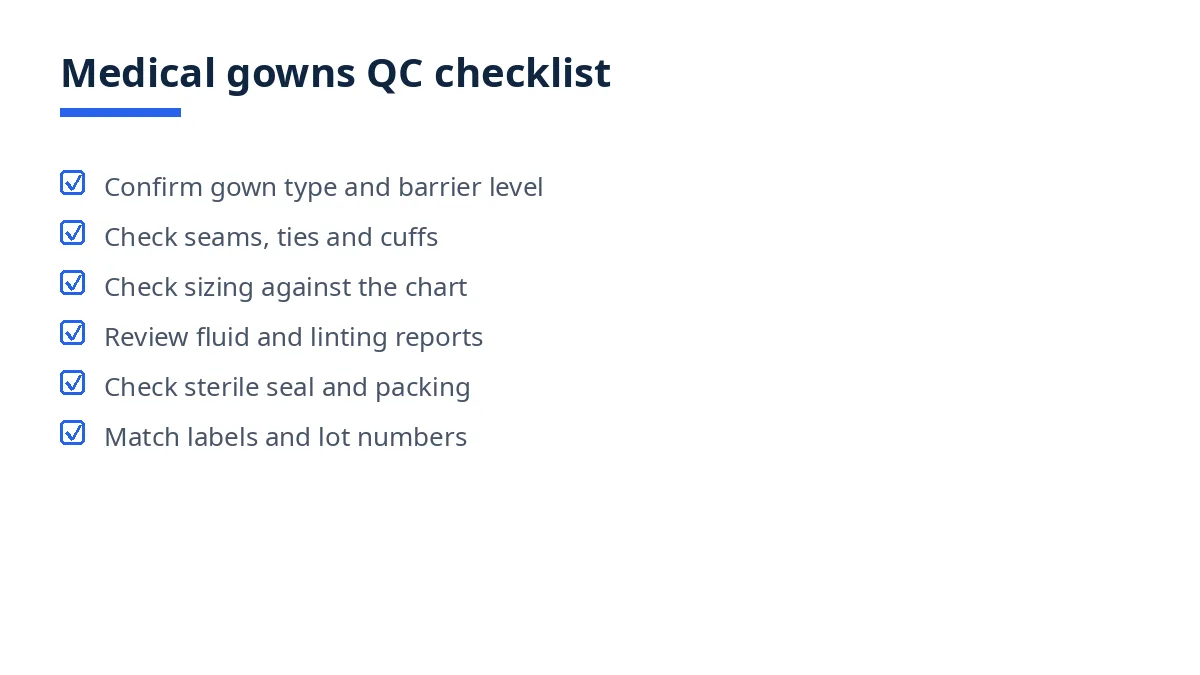
The full checklist (numbered, printable)
Gown type, barrier level, and fabric
Confirm the gown type on the sample matches the purchase order: surgical, isolation, surgical isolation, or non-surgical, and single-use or reusable.
Confirm the claimed barrier level or performance class on the label matches the purchase order and the test reports for this lot.
Check the fabric type named in the pack, such as SMS nonwoven, spunlace, or coated woven, against the approved sample, and record any substitution in bulk as a failure.
Check fabric weight and hand feel against the approved sample per color, and record any lot that feels thinner or stiffer.
Check reinforced panels on the chest and forearms, where the pack requires them, for full critical-zone coverage, secure bonding or stitching, and no lifting edges.
Check the fabric for holes, thin spots, tears, stains, oil marks, and foreign matter, panel by panel, front and back.
Check that the barrier report names the bulk fabric, the gown type, and this lot, and that its test method matches the claimed level or class.
Seams, closures, and fit
Check every seam, including sleeve seams and panel edges, for skipped or broken stitches, open sections, and uneven density, pulling each by hand.
Check ultrasonically sealed seams, where used, for complete sealing along the full length, with no gaps, burns, or delamination.
Check neck and waist ties for correct length, secure attachment, and no fraying, and tie and untie a sampled gown to confirm the closure holds.
Check hook-and-loop or snap closures, where used, for full engagement, secure attachment to the fabric, and no sharp edges.
Check cuffs for elastic recovery, secure sleeve attachment, and even width, and confirm the cuff stays put when pulled gently.
Check the back closure overlap on surgical gowns, so the back closes fully without a gap when tied.
Check sizing on every size in the sample: gown length, chest width, and sleeve length against the size chart tolerances, laid flat without stretching.
Fluid resistance, linting, and strength
Review the fluid resistance evidence for this lot against the claimed level or class, and confirm the report covers the critical zones, not only the plain fabric.
Check seam barrier evidence where the pack requires it, because a fabric that passes alone can still fail at a seam.2
Check linting visually on sampled gowns by shaking and handling each piece over a dark surface, and review the linting report where the pack requires one. EN 13795 requires linting, microbial cleanliness, and bursting and tensile strength to be tested for surgical gowns, and its introductory technical summary lists microbial penetration, particle release, and liquid penetration among the characteristics evaluated.5
Check bursting and tensile strength reports where required, and confirm the report names the bulk fabric and this lot.
For reusable gowns, check the reprocessing record and whether sampled gowns are within their rated wash and sterilization cycle count.
Sterility barrier and packaging
For sterile gowns, check that each individual pack is sealed, undamaged, and free of punctures, tears, and crushed corners, and that the sterile barrier shows no sign of moisture damage.
Check that the sterilization method on the pack matches the purchase order, and that any expiry date is present and legible.
Check that non-sterile gowns are not packed or labeled in a way that suggests sterility, and that the two lots are kept apart.
Check folding and packing against the specification: each gown folded as directed, individually packed where required, with no hard insert that can puncture the pack.
Check carton counts, markings, and packing ratios against the packing list, and weigh and measure sample cartons.
Labeling and batch traceability
Check that every pack and carton carries the gown type, size, barrier level or class, sterile status, single-use or reusable status, and lot number, all legible.
Check that the manufacturer name and origin on the pack match the purchase order, and that any market marking claimed matches the evidence held.
Check that the lot or batch number on the pack, the carton, the test reports, and the packing list all agree, so any failure can be traced to one lot.
Check barcodes, where used, scan and match the purchase order, size, and lot.
Retain one sealed sample per size and lot from the inspected shipment, labeled with the lot number and inspection date, for later comparison if a complaint arrives.
Common failures and how to fix them
The most frequent failure is a barrier claim the evidence does not support: the label states a higher PB70 level or EN 13795 class than the lot report proves, or the report covers a different fabric. Stop, compare the label, the purchase order, and the lot report side by side, and hold the lot until the claim matches the evidence. Next is a tie or cuff failure, usually from short ties, weak attachment, or uneven elastic tension: re-check the attachment on a sampled gown before more gowns are packed.
Seam openings cluster where a seam crosses a reinforced panel or a cuff: segregate those pieces and re-inspect them as their own group. Broken sterile seals usually trace to packing pressure or a sharp insert: change the insert and carton packing before more sterile packs are sealed. Mixed lots in one carton point to sorting at packing: re-sort complete cartons before shipment. Above the agreed acceptance level, options are re-inspection after sorting or rework, documented partial acceptance, or rejection.
Downloadable template / summary table
Copy the checklist into your inspection sheet, add the size chart, tolerances, barrier claim, and acceptance numbers, and record a result per gown.
Section | Checks | Evidence |
|---|---|---|
Type and barrier | Gown type, level or class, fabric | Label, lot reports |
Seams and closures | Seams, ties, cuffs, back closure | Pull checks, fit check |
Fluid and strength | Fluid resistance, linting, strength | Lab reports per lot |
Sterility and packing | Seal, method, folding, cartons | Pack inspection |
Labeling and traceability | Labels, lot match, barcodes | Pack, carton, reports |
How Exportain helps
Exportain is a B2B marketplace connecting buyers with Bangladeshi suppliers of medical gowns, so the gown type, barrier level, size chart, and packing specification behind this checklist can be agreed at the enquiry stage. When you plan the check, use inspection services and read the AQL acceptance quality limit explainer. Supplier profiles show which document and photo checks have been recorded. Exportain is not a party to the goods contract and does not inspect goods.
FAQs
When should this checklist be used?
Use it at final inspection, when goods are finished and largely packed. For larger and first orders, also use it in production, while seams, ties, and cuffs can still be corrected.
Who should complete it?
The buyer, a local agent, or an independent inspector can complete it, using the approved sample, size chart, barrier claim, and a random sample.
What are the most common failures?
A barrier claim the lot report does not support, loose ties or cuffs, seam openings at reinforced panels, broken sterile seals, and mixed lots in one carton are the failures buyers find most often.
Can a third party do it?
Yes, if you share the approved references, barrier claim, tolerances, and acceptance levels first, and require the lot number on every report.
Next steps on Exportain
Before production starts, agree your gown type, barrier level or performance class, size chart, tolerances, test methods, and label wording, then read the AQL acceptance quality limit explainer and the pre-shipment inspection guide, and plan the check with inspection services.
Sources
- Medical Gowns. U.S. Food and Drug Administration (accessed )
- Standards and Specifications for Healthcare Protective Clothing. Centers for Disease Control and Prevention (accessed )
- ISO 2859-1:1999 - Sampling procedures for inspection by attributes — Part 1: Sampling schemes indexed by acceptance quality limit (AQL) for lot-by-lot inspection. International Organization for Standardization (accessed )
- ANSI/AAMI PB70:2003, Liquid barrier performance and classification of protective apparel and drapes intended for use in health care facilities. Association for the Advancement of Medical Instrumentation (accessed )
- Surgical clothing and drapes EN 13795 — Intro Technical Sheets. Médecins Sans Frontières (MSF) Unicat (accessed )
About the author
Sourcing from Bangladesh?
Post a request for quotation and suppliers on Exportain can send you their quotes directly.
Post an RFQ