

Typical MOQ for LED Street Lights in Bangladesh (and How to Negotiate It Down)
No single LED street lights MOQ in Bangladesh: what sets the minimum per model and per wattage, and how to negotiate a smaller order.
Short answer
There is no single typical MOQ for LED street lights from Bangladesh. Each supplier sets its minimum per model and usually per wattage, for your exact combination of housing, optics, driver and controls. Ask for the minimum per model and per wattage in writing, then negotiate the split or the set-up costs.
On this page
Key takeaways
There is no single typical MOQ for LED street lights from Bangladesh, because each supplier sets its minimum per model and usually per wattage.
Housing batches, module and driver lots, optics batches, set-up and test runs are the drivers that set the floor, and the binding line is the one your split fails.
Ask for the MOQ per model, per wattage and per optics variant in writing, with set-up costs itemized apart from the unit price.
Negotiate the structure first: fewer wattages, a shared housing and driver platform, stocked models, a supplier carton, set-up paid as a separate line, or a staged order.
Ratings, lumen and energy claims are per-model verification items, and Exportain verification is a document and photo review, not a factory inspection.
Ask three suppliers for the LED street lights MOQ in Bangladesh for the same road programme and you will get three different answers. There is no single typical MOQ for LED street lights from Bangladesh, because each supplier sets its minimum per model and usually per wattage, for your exact combination of housing, optics, driver and controls. A total that looks large can still fail if one wattage or one optics variant falls below its own line.
The product itself explains why the minimum splits this way. IEC 60598-2-3 specifies requirements for luminaires for road, street lighting and other public outdoor lighting applications, and for column-integrated luminaires with a minimum total height above normal ground level of 2,5 m, for use with electrical lighting sources on supply voltages not exceeding 1 000 V.1 A street luminaire is therefore an outdoor unit built, sealed and tested as a complete model, not a loose lamp that can be swapped between housings. In the Harmonized System, heading 9405 covers lamps and lighting fittings, including searchlights and spotlights and parts, and subheading 9405.40 covers other electric lamps and lighting fittings.2 See the HS code for LED street lights guide and the MOQ definition guide.
Why this matters for buyers and sellers
For the buyer, the MOQ decides how much capital sits in poles and spares for one road programme, and whether a first order can prove a model before a larger repeat. A wattage, optics set and colour temperature chosen for one road class cannot simply be redeployed on another, so ordering above the real need is stock that may never be used. For the seller, the minimum protects runs that cannot be reused: a housing cast for your model, a driver bought for your wattage, optics cut for your distribution and cartons printed for your programme cannot be sold to another buyer, and a short run still uses the housing batch, the driver lot and the sealing and test set-up, so cost per luminaire rises as quantity per wattage falls.
The binding line is the one your split fails, not the headline total.
Driver | What sets the floor | State in your enquiry |
|---|---|---|
Model | Housing batch, sealing and test set-up per model | Model, datasheet, photometric file |
Wattage | Module and driver lot per wattage | Quantity per wattage |
Optics | Lens or reflector batch per distribution | Optics type and distribution |
Driver and controls | Driver platform and control option | Driver type, dimming or photocell option |
Housing and finish | Casting or forming batch and coating run | Housing material, finish, colour |
Mounting and packing | Bracket or spigot batch and carton run | Mounting type, spigot size, carton spec |
Example figures: a buyer orders 300 luminaires in total, split as 240 units at one wattage and 60 units at a second wattage with different optics. The total clears the supplier headline minimum, but the 60-unit wattage sits below its per-wattage module and driver line. The same 300 units split as 150 and 150 across two wattages that share one housing and driver platform can clear both lines. The example shows structure only, not a typical MOQ, price or lead time.
Step-by-step: how it works
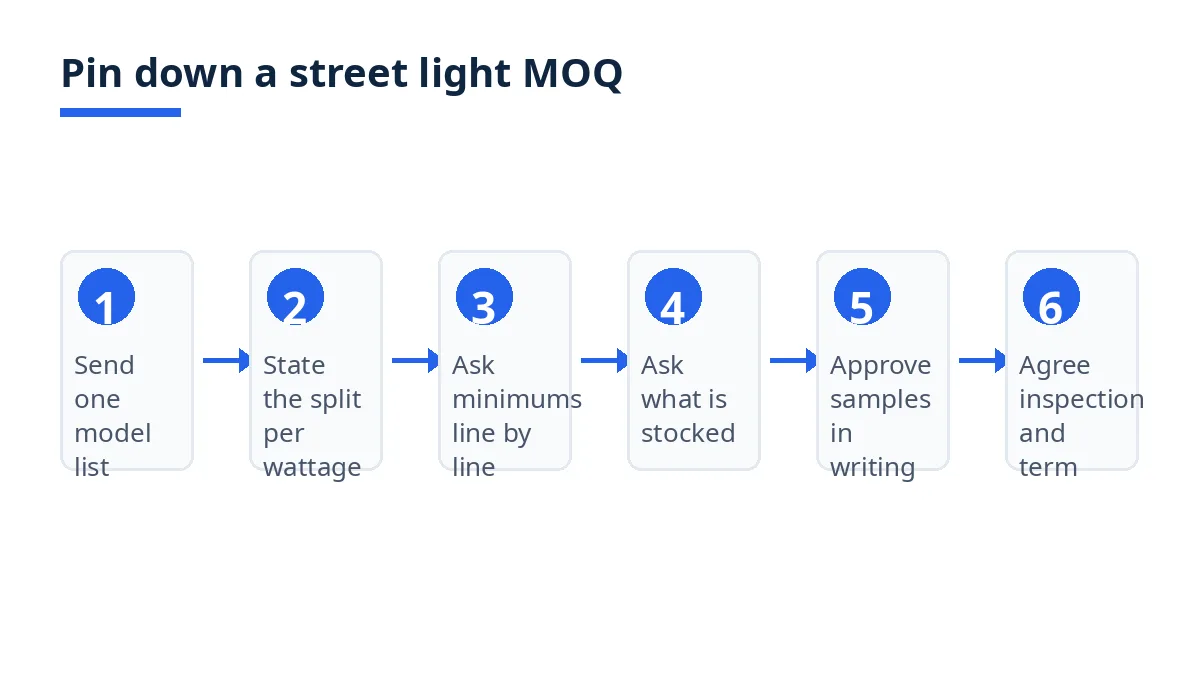
Send one model list to every candidate. State each model, wattage, luminous flux requirement, colour temperature, optics and distribution, housing material and finish, ingress protection requirement, driver type, surge protection where specified, control option, mounting and spigot size, labelling and packing, and the quantity per model and per wattage.
State the split, not only the total. Give the quantity per model, per wattage and per optics variant, plus spares. A total without a split cannot be answered with a usable MOQ.
Ask for the minimums line by line. Ask for the MOQ per model, per wattage, per optics variant and per driver platform, plus any separate housing, bracket, carton and label minimums, and which line binds for your split.
Ask what is stocked and what is made to order. Record whether each housing, module, driver and bracket is stocked or made for your model. Stocked inputs are where a lower minimum is most often possible. Ask separately which modules and drivers are bought in, since a bought-in driver can set both the minimum and the earliest production date.
Approve samples in writing. Order a development sample, then a pre-production sample built with the actual production module, driver, optics, housing and finish. Check output, colour, sealing, driver marking, control function and spigot fit, then approve or list corrections in writing and keep one sealed counter-sample per model.
Agree inspection and delivery term before you confirm. Write the inspection level and AQL values into the purchase order. ISO 2859-1 defines a system of acceptance sampling plans for inspection by attributes, indexed by acceptance quality limit (AQL) for lot-by-lot inspection,3 and AQL is the maximum average percentage of defective items considered acceptable during random sampling.3 State one Incoterm and named place for every quotation: the Incoterms 2020 rules give a clear allocation of cost, risk and obligations.4 Compare MOQs only on the same term.
Negotiation levers that move the floor
Negotiation works when you change the structure that creates the minimum. Get the result in writing on the quotation and the purchase order, with the split it applies to.
Reduce the number of wattages first. Wattages multiply module lots, driver runs and test set-ups. Aligning two road sections to one wattage raises the quantity per remaining wattage at the same total.
Share one housing and driver platform across wattages. Two wattages in the same housing on the same driver platform can sometimes share a batch. Ask whether the housing and platform minimum can be met across both wattages combined, in writing.
Use stocked models and stock brackets. A standard model in a stocked housing, with a stock bracket, removes part of the made-to-order run. Ask for the stock list before you finalise wattages and mounting.
Accept the supplier carton for the first order. A plain or supplier standard carton avoids a private-label print run. If your printed carton matters, price it apart and use the supplier carton for the first order.
Pay set-up as a separate line. Where the floor comes from a housing tool, a new optics batch or a test arrangement, ask for those costs apart from the unit price. The run can then be shorter, and the same set-up serves the repeat order.
Stage the order. If the supplier cannot move on the full model list, place a smaller first order in fewer wattages and optics variants, with a written repeat price and MOQ for the same specification. Do not drop sample approval, sealing checks or inspection.
Per-model verification items
Ratings, lumen and energy claims are per-model verification items, never a general claim about a supplier. For each model, ask for the datasheet figure and the report behind it, and check that the report names the exact model, wattage, module and driver combination you are buying. Verify per model: rated wattage and input power, luminous flux, colour temperature, optics and distribution, ingress protection rating, driver model and rating, surge protection where specified, housing and finish, mounting and spigot fit, and control function. On ingress protection, IEC 60529 classifies degrees of protection provided by enclosures, with the first characteristic numeral covering access to hazardous parts and solid foreign objects and the second covering ingress of water.5 Check the rating against the certificate and report scope, not the marking alone. See the LED street lights quality control checklist for housing, driver and sealing points.
Costs, timelines and documents
What are the typical costs and timelines?
There are no typical costs or timelines a guide can state as fact, for the same reason there is no typical MOQ. Each supplier prices your housing batch, module and driver lot, optics, sealing and finishing, controls, testing, packing and the delivery term you choose.4
For timelines, sampling depends on component availability and correction rounds, and bulk production on housing supply, driver delivery, assembly, sealing and testing capacity. Ask for sampling, component ready, production, inspection and packing dates as separate lines, not a single delivery week.
Which documents are needed?
For the order itself, the documents are the model list, itemized quotation with the MOQ per model and per wattage, sample approval record, and purchase order carrying the split, inspection level and AQL values, and delivery term.3 4 For export clearance in Bangladesh, goods may not be loaded unless an export declaration, the Bill of Export or Shipping Bill, is submitted to Customs and approved.6 Enclosed documents include the export contract or purchase order where there is no export letter of credit, the commercial invoice, the packing list, the EXP form certified by an authorized dealer, a certificate of origin issued by the EPB or a Chamber of Commerce and Industry, the VAT registration certificate and the Taxpayer Identification Number.6
Bangladesh-specific rules and tips
Keep one legal name across every paper. The export declaration names the exporter and the foreign buyer,6 so the name on the trade licence, quotation, proforma invoice and payment account should match.
Ask which inputs are bought in for your wattage. Modules, drivers and optics for a particular wattage may be procured for your order, and a bought-in driver can set both the minimum and the earliest assembly date. Agree the split before assembly starts, because a late wattage change can restart procurement.
Plan for bulk and weight in packing. Street luminaires are heavy and shaped, and brackets add awkward length, so packing and delivery to site deserve a line in the quotation. Confirm units per carton, carton dimensions and weight before you confirm, and keep the delivery term consistent across quotations.4
Mistakes and red flags
What are the most common mistakes?
Asking for a total MOQ only. The binding minimum is usually per model, per wattage or per optics variant. An order can clear the total and still fall below the per-wattage minimum for one road section.
Comparing MOQs on different models or terms. A lower minimum on a stocked model, a standard driver or a different term is a different offer. Compare only replies to the same model list on the same Incoterm.4
Accepting evidence for a different model. Ratings, lumen figures and protection ratings must match the exact model and wattage you are buying. Evidence for a neighbouring wattage does not cover yours.1 5
Accepting a verbal exception. Record any agreed lower minimum, shared housing batch or waived set-up on the quotation and purchase order, with the split it applies to.
Paying set-up twice. Keep the paid set-up lines from the first purchase order and attach them to the repeat enquiry, including any housing tool, optics batch or test arrangement already paid for.
Treating a profile or a badge as proof of capability. A profile is a starting point for enquiries. It does not test whether a supplier can build your model, and a badge is not a guarantee of capacity, quality or delivery.7
Skipping sealing checks or inspection to save time. Sampling under ISO 2859-1 checks a lot against an agreed AQL,3 the last control before the luminaires become your programme stock. A small order needs that control more, not less, because one faulty lot is a larger share of a small programme.
Checklist
Model list sent: model, wattage, flux, colour temperature, optics, housing, finish, protection rating, driver, controls, mounting, packing.
Split stated per model, per wattage and per optics variant, spares apart.
MOQ confirmed per model, per wattage and per optics variant; binding line named.
Stocked or made-to-order status recorded per housing, module, driver and bracket.
Bought-in inputs named, with a component ready date.
Carton, label, bracket and set-up minimums confirmed apart from the luminaire MOQ; paid set-ups recorded.
Pre-production sample in exact specification approved in writing; counter-sample kept.
Per-model items checked: wattage, flux, colour, optics, protection rating, driver, surge protection, mounting.1 5
Inspection level and AQL values in the purchase order.3
Quotations compared on the same model list and Incoterm.4
Export set agreed: invoice, packing list, EXP form, certificate of origin, Bill of Export.6
How Exportain helps
On Exportain, browse suppliers and post a request for quotation (RFQ) on the RFQ board with your model list, split per wattage and delivery term, so suppliers quote against the same specification. Ask each reply for its per-model and per-wattage minimums, stocked or made-to-order inputs, and carton and bracket minimums. When you accept a quotation, Exportain creates one order and issues one proforma invoice from the accepted terms.7
Read the badges for what they record. Exportain Verified means Exportain has checked identity, phone, email and business registration, and Export Verified means it has checked the Export Registration Certificate (ERC).7 Factory Verified means it has reviewed photos of the manufacturer factory, while Trading Company Verified means it has reviewed photos of the trading company office or warehouse.7 Verification is a document and photo review by staff, free, and never granted by membership plans, and it is not a factory inspection.7 Sample approval, sealing checks and inspection stay with you. See how supplier verification works on Exportain.
FAQs
What should I know first about LED street lights?
There is no single MOQ to look up. The minimum is set per model and per wattage by housing batches, module and driver lots, optics batches and test runs. Street luminaires for road and public outdoor lighting fall under IEC 60598-2-3,1 and complete luminaires sit under HS heading 9405.2
What are the typical costs and timelines?
There are no typical figures a buyer can rely on, because each supplier sets its price, MOQ and lead time for your model and wattage. Housing, module and driver lots, optics, testing, packing and the delivery term drive the price.4
Which documents are needed?
The order documents are the model list, itemized quotation and purchase order, with the MOQ per model and per wattage on both. The export set is the Bill of Export, commercial invoice, packing list, EXP form certified by an authorized dealer, and certificate of origin issued by the EPB or a Chamber of Commerce and Industry.6
What are the most common mistakes?
The most common mistakes are asking only for a total MOQ, comparing minimums on different models or terms,4 accepting evidence for a neighbouring model,1 5 and reading a badge as a guarantee. A badge is not a guarantee of capacity, quality or delivery.7
Next steps on Exportain
Browse suppliers, then post your model list, split per wattage and delivery term on the RFQ board so suppliers state their MOQ per model and per wattage. Before you confirm, read how to import LED street lights from Bangladesh and the LED street lights quality control checklist.
Sources
- IEC 60598-2-3:2002+AMD1:2011 CSV - Luminaires - Part 2-3: Particular requirements - Luminaires for road and street lighting. International Electrotechnical Commission, (accessed )
- Classification Detail – HS Code 9405. United Nations Statistics Division (accessed )
- ISO 2859-1:2026 - Sampling procedures for inspection by attributes — Part 1: Sampling schemes indexed by acceptance quality limit (AQL) for lot-by-lot inspection. ISO (accessed )
- Incoterms® 2020. International Chamber of Commerce (ICC) (accessed )
- IEC 60529:1989 Degrees of protection provided by enclosures (IP Code). International Electrotechnical Commission (accessed )
- Customs Clearance Procedures for Export. Bangladesh Customs, National Board of Revenue (accessed )
- Trust & Safety Center. Exportain (accessed )
About the author
Sourcing from Bangladesh?
Post a request for quotation and suppliers on Exportain can send you their quotes directly.
Post an RFQ


