

LED Street Lights Lead Time From Bangladesh: Production and Shipping Timeline
No single LED street lights lead time from Bangladesh: the date is set by sample approval, chip and driver reservation, photometric and safety testing, kit completion, and export clearance.
Short answer
There is no single LED street lights lead time from Bangladesh. The shippable date is set by a chain of gates: specification freeze and sample approval, chip and driver reservation for the full quantity, photometric and safety testing for the exact model, pole and arm kit completion, inspection and packing, and export clearance before the vessel cut-off. Get each gate dated in writing and compare suppliers only on the same specification, kit list, and delivery term.
On this page
Key takeaways
There is no single LED street lights lead time from Bangladesh; the shippable date is set by the last gate to close, not by the fastest stage.
Freeze one specification per model, approve a sample of the exact model, and reserve chips and drivers for the full quantity, including spares, in writing.
An LM-79 report covers initial performance of the finished luminaire only; lifetime claims need LM-80 lumen-maintenance data for the chip actually bought.
Specify IP and IK ratings separately: IP covers dust and water, IK covers impact, and neither rating implies the other.
Compare quotations only on the same specification, complete kit list, and Incoterms rule, with every gate dated in writing.
A street light order from Bangladesh is a kit order, not a single-product order. The head, the driver, the bracket or arm, and the pole when included must all reach the same packing bench, and the finished head must pass its photometric and safety checks before it can ship. When one kit part is still unreserved, or one test report still open, the rest of the order waits, however far head assembly has advanced. That is why a single lead-time figure misleads here: ask for a dated gate schedule, and judge the quotation by its weakest gate. Every duration below is a planning shape to confirm with your supplier in writing, not a supplier quote and not a figure from a published source.
Why this matters for buyers and sellers
For the buyer, the date that matters is rarely the factory-gate date. It is the date the complete kit, with its test reports and export papers, is ready to load. A head that finishes early but waits for its arm, driver, or photometric report is not a shippable order. For the seller, the same gates protect the build: reserved chips and drivers and one test file per model keep rework down.
What should I know first about LED street lights?
Start with the three files that decide whether the order can move. First, the specification: wattage, correlated color temperature (CCT), optics, housing, mounting arm or bracket, driver model, and any control option, all frozen in one document. Second, the photometric file: an LM-79 report for the exact model, recording the initial electrical, photometric, and color performance of the complete luminaire.1 Third, the safety file: EN 60598-1:2021 sets the general requirements for luminaires, and EN 60598-2-3:2021 sets the particular requirements for road and street lighting, covering mechanical strength, dust and water protection, and thermal performance.2
Two datasheet ratings are often confused. The IP rating, defined by IEC 60529, covers protection against dust and water: IP66 means the enclosure is dust-tight and protected against powerful water jets.3 The IK rating, defined by IEC 62262, covers protection against mechanical impact on a separate scale from IK00 to IK10, where IK08 stands for 5 joules and IK10 for 20 joules.3 Neither rating implies the other, so specify both for the site.3
Lumen maintenance is the third file buyers mix up with photometry. LM-79 measures initial performance at zero hours and does not evaluate light decay or lifespan.1 LM-80 measures lumen maintenance of LED packages, arrays, and modules over time, recommending a minimum of 6,000 hours with measurements at 1,000-hour intervals, and TM-21 uses that data to project lifespan beyond the test period.4 Ask whether the LM-80 data covers the chip you are actually buying; a lifetime claim with no LM-80 data behind it is a marketing line, not a test result.
For classification, heading 9405 covers lamps and lighting fittings and their parts.5 Confirm the subheading for your exact shipment with your forwarder, and confirm separately whether a pole, arm, or control unit ships under the same heading or its own. The export declaration must name the goods, their value, the exporter, the foreign buyer, and the transport operator,6 so a wrong heading or a missing kit part on the papers can hold the shipment at the last gate.
Step-by-step: how it works
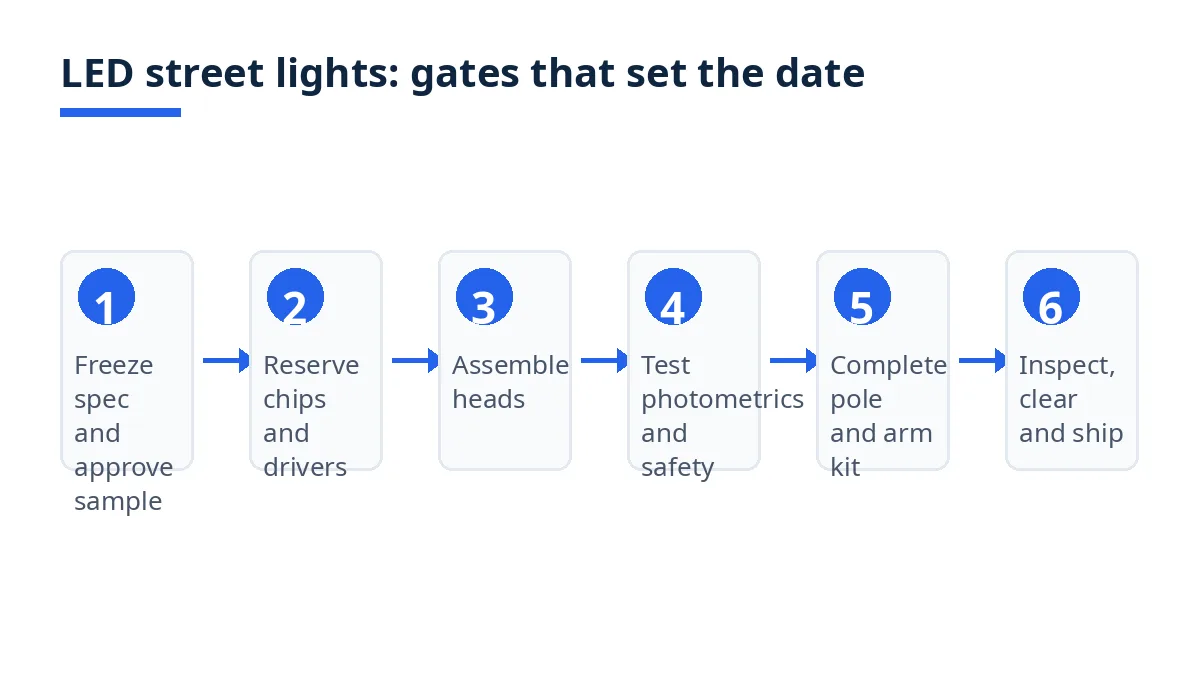
Freeze one specification for every unit. Write down wattage, CCT, optics, housing, mounting type, driver model, control option, and whether poles, arms, brackets, bolts, and spares are included. One specification per model; a second wattage or optics choice is a second line through testing and assembly.
Ask for the kit list, not only the head price. Get the arm or bracket, mounting bolts, driver, and pole (when included) listed line by line, with who supplies each part. A head-only quote and a complete-kit quote cannot be compared on lead time.
Approve a sample of the exact model. Test the sample at the wattage, CCT, and optics you will order, mounted as it will be installed. Record approval or corrections in writing, and name the report the sample represents.
Reserve chips and drivers for the full quantity. Ask for written confirmation that the chip and driver for your CCT and wattage are reserved for the whole order, including spares. A partial reservation is the most common reason a build starts and then stops.
Get the test schedule in writing. Ask when the LM-79 report and the safety file for the model will be ready, and whether they already exist for the exact model or must be produced for it. A testing guide for street light certification puts the laboratory cycle at 10 to 15 working days with prepared samples and documents.2
Match heads to kit parts before packing. Confirm that every head has its arm, bracket, bolts, and pole, and that spares and drivers are packed and labeled per carton. Long arms and poles change carton size and pallet count, so agree the packing plan before the build ends.
Book inspection before the sailing, not after it. Agree what will be checked per unit and per carton, and leave time to correct and recheck. A failed check found after the vessel cut-off moves the shipment, not just the inspection.
Confirm export clearance and the vessel cut-off together. Confirm the Bill of Export set, the sailing, and the cut-off date on one schedule, so a cleared shipment is not left waiting for the next vessel.
Costs, timelines and documents
What are the typical costs and timelines?
There are no typical costs or timelines a guide can state as fact, because each supplier prices your wattage, optics, housing, driver, kit parts, test scope, packing volume, and delivery term. Costs move with a small set of drivers: whether chips and drivers are stocked or ordered in, how many wattage and optics variants share one driver platform, whether poles and arms are included, how much test work the destination market requires, and how much volume the packed kit occupies. Ask for each driver as a separate line, not as one lump sum.
For timelines, read the gate table below, not a single week count. Gates overlap: chip and driver reservation can run beside sample approval, and packing planning beside assembly. The delivery date is set by the last gate to close, and a change to wattage, CCT, optics, or driver after sample approval reopens the gates it touches.
Gate | What must be true before it closes | Planning shape |
|---|---|---|
Specification freeze and sample approval | Wattage, CCT, optics, housing, arm, driver, and controls frozen; sample approved in writing | 1–3 weeks |
Chip and driver reservation | Chip and driver for the full quantity, including spares, reserved in writing | 2–6 weeks, overlapping the sample stage |
Head assembly | Housings, lenses, and drivers on one line for one model at a time | 2–4 weeks |
Photometric and safety testing | LM-79 report for the exact model; safety file for road and street lighting in hand | 1–3 weeks |
Pole and arm kit completion | Every head matched to its arm, bracket, bolts, and pole where included | 1–2 weeks |
Inspection and packing | Per-unit and per-carton checks done; spares packed and labeled | 1–2 weeks |
Export clearance and sailing | Bill of Export approved; vessel cut-off met | 1–2 weeks |
Which documents are needed?
For export clearance in Bangladesh, goods may not be loaded or stuffed in containers for export unless an export declaration, the Bill of Export or Shipping Bill, is submitted to Customs and approved.6 Documents enclosed with the Bill of Export include the export letter of credit, or where there is none, the export contract, purchase order, or export guarantee approved by the negotiating bank; the signed commercial invoice with a detailed description of goods; the packing list with quantity, weight, and packing information; the EXP form certified by an authorized dealer; the certificate of origin issued by the EPB or a Chamber of Commerce and Industry; the VAT registration certificate; and the taxpayer identification number.6
Your order set sits beside the export set: the frozen specification, itemized quotation, purchase order with the gate schedule, sample approval, LM-79 report, safety file, inspection record, and a packing list matching cartons to heads, arms, and spares. Keep one legal name for the supplier across the quotation, invoice, packing list, and Bill of Export, since the declaration names the exporter and the foreign buyer.6
One delivery term should govern every quotation. The Incoterms 2020 rules set out 11 rules with a clear allocation of cost, risk, and obligations.7 Compare lead times only on the same rule and named place, and note that the CIF rule is reserved for maritime trade while CIP carries the higher insurance cover.7
Bangladesh-specific rules and tips
Confirm the test file before you confirm the date. Ask whether the safety file or photometric report already exists for the exact model or must be produced for your order, and put the answer on the gate schedule. A file produced after assembly is a gate, not a formality.2
Treat the pole and arm as a separate supply line. Poles, arms, and brackets may be made, bought in, or supplied by the buyer, and each route has its own lead time and packing plan. State who supplies each kit part in the purchase order, check that mounting dimensions on the pole match the bracket on the head, and agree the packing plan for long arms and poles while assembly is still running.
Mistakes and red flags
What are the most common mistakes?
Approving the head and forgetting the kit. A signed sample for the head alone does not approve the arm, bracket, bolts, or pole. Approve the kit as it will be installed, or the last gate will be a mounting part, not a light.
Accepting a photometric claim without the report. Ask for the LM-79 report for the exact model, and check the wattage, CCT, and optics on it.1 A report for a different wattage or optics set does not cover your order, and a lifetime claim without LM-80 data behind it is not a test result.4
Changing CCT, optics, or driver after sample approval. Each change can reopen sample approval, chip reservation, and testing. If a change is unavoidable, get a revised gate schedule in writing first, and move your installation date to match.
Reading IP as IK, or IK as IP. An IP66 head is dust-tight and protected against powerful water jets, but that says nothing about impact resistance.3 A site needing both ratings needs both tested, not one assumed to cover the other.
Comparing lead times on different delivery terms. Dates quoted on different Incoterms rules carry different handover points and obligations.7 Compare only replies to the same specification, kit list, and rule and named place.
Booking the vessel before the test file closes. A sailing booked around an assumed test date becomes a missed sailing when the report slips. Book the vessel against the test schedule, with a buffer for one correction round.
Treating a profile as proof of capacity. A supplier profile is a starting point for inquiries, not proof that a supplier can build your wattage and optics combination or deliver the complete kit on your date.
Checklist
Before you confirm, every line should be answered in writing.
Specification frozen: wattage, CCT, optics, housing, mounting, driver, controls.
Kit list agreed: head, arm or bracket, bolts, driver, pole where included, spares.
Sample of the exact model approved in writing, with corrections closed.
Chip and driver reserved for the full quantity, including spares, in writing.
LM-79 report for the exact model in hand or dated on the gate schedule.1
Safety file for road and street lighting confirmed for the destination market.2
IP and IK ratings specified separately for the installation site.3
Inspection plan agreed per unit and per carton, before the sailing.
Packing plan agreed for heads, arms, poles, and spares.
Export set agreed: Bill of Export, invoice, packing list, EXP form, certificate of origin.6
Quotations compared on the same specification, kit list, and Incoterms rule.7
How Exportain helps
On Exportain, browse suppliers and post a request for quotation on the RFQ board with your specification summary, kit list, and delivery term, so suppliers quote against the same head, arm, and test requirements. Ask each reply for its dated gate schedule: sample approval, chip and driver reservation, test file dates, kit completion, inspection, and cut-off. Read the Incoterms guide before comparing quotations, and the LED street lights quality control checklist and HS code guide for LED street lights before confirming the specification.
FAQs
What should I know first about LED street lights?
Know the three files before the date: the frozen specification, the LM-79 report for the exact model,1 and the safety file for road and street lighting.2 Specify IP and IK ratings separately,3 and confirm whether poles, arms, and spares are inside the quote. Heading 9405 covers lamps and lighting fittings and their parts,5 but confirm the subheading with your forwarder.
What are the typical costs and timelines?
There are no typical figures a guide can state as fact. Costs move with chip and driver availability, wattage and optics variants, kit parts, test scope, packing volume, and the delivery term. Timelines move gate by gate: sample approval, chip and driver reservation, testing, kit completion, inspection, and export clearance. Get each gate dated in writing and compare quotations only on the same specification, kit list, and Incoterms rule.7
Which documents are needed?
The order set is the frozen specification, itemized quotation, purchase order with the gate schedule, sample approval, LM-79 report, safety file, inspection record, and matching packing list. The export set is the Bill of Export, commercial invoice, packing list, EXP form certified by an authorized dealer, certificate of origin, VAT registration certificate, and taxpayer identification number.6 Goods may not be loaded unless the Bill of Export is submitted and approved.6
What are the most common mistakes?
The most common mistakes are approving the head without the kit, accepting a photometric claim without the report for the exact model,1 changing CCT, optics, or driver after sample approval, reading IP as IK or IK as IP,3 comparing lead times on different delivery terms,7 booking the vessel before the test file closes, and reading a profile as proof of capacity.
Next steps on Exportain
Browse suppliers, then post your specification summary, kit list, and delivery term on the RFQ board so suppliers state their dated gates for the same order. Before you confirm, read how to import LED street lights from Bangladesh and the LED street lights quality control checklist.
Sources
- LM-79-19 report | Photometric & chromaticity parameters. ZGSM (accessed )
- LED Street Light CE Certification Guide | EU Market Entry Compliance & EN 60598 Standard. Guangdong Meide Certification & Testing Technology (accessed )
- What Is an IK Rating? Complete Guide to Impact Protection Standards. LightAdviser (accessed )
- What is the Difference Between LM-79, LM-80 and TM-21?. StandardPro (accessed )
- Classification Detail – HS Code 9405. United Nations Statistics Division (accessed )
- Customs Clearance Procedures for Export. Bangladesh Customs, National Board of Revenue (accessed )
- Incoterms® 2020. International Chamber of Commerce (ICC) (accessed )
- quality control
- buyer guide
- customs clearance
- importing from Bangladesh
- Bangladesh sourcing
- Electrical equipment
- Lead time
About the author
Sourcing from Bangladesh?
Post a request for quotation and suppliers on Exportain can send you their quotes directly.
Post an RFQ


