

LED Bulbs Lead Time From Bangladesh: Production and Shipping Timeline
LED bulbs lead time from Bangladesh: chip and driver sourcing, sampling, binning, lumen testing, inspection and transit for US, UK, EU and UAE buyers.
Short answer
LED bulbs lead time from Bangladesh is set by component sourcing, not by assembly alone. Chips and drivers, color-temperature binning, lumen and lifetime testing, cap variants and destination-market labeling each add a gate before packing, and fragile packing and export clearance add the last gates before transit.
On this page
Key takeaways
LED bulbs lead time is set by gates, not assembly alone: chip and driver supply, sample approval, color-temperature binning, lumen and lifetime evidence, cap and labeling checks, inspection, fragile packing and export clearance.
Fix the cap, wattage, color-temperature tolerance and destination-market labeling route before sampling, because a late change reopens tooling, artwork or test evidence.
Require the pre-production sample to use the exact production chip and driver models, and ask for lumen maintenance evidence rather than accepting a printed lifetime figure.
Compare supplier timelines only on the same specification and the same Incoterm, and replace every illustrative figure in this guide with the supplier's dated commitment.
An LED bulb order from Bangladesh does not move at one speed. The bulb looks simple, but its lead time is set by a chain of gates: chip and driver supply, sample approval, color-temperature binning, lumen and lifetime evidence, cap and labeling checks, inspection, fragile packing, export clearance and transit.
This guide gives a realistic timeline for LED bulb orders from Bangladesh for buyers in the USA, the UK, the EU and the UAE. It explains each stage, what to ask for in writing, which documents to prepare, and which mistakes most often add weeks. Figures labeled as illustrative are for planning only, not supplier promises.
What sets the LED bulbs lead time in Bangladesh
What should I know first about LED bulbs?
An LED bulb is a light source with a cap designed for installation in a luminaire, and the cap is part of its identity. In a United States tariff ruling, E26 and E27 screw-cap LED lamps were described as light-emitting diode lamps consisting of a heat sink containing the LEDs and other electrical and electronic components with a lens, each with a screw cap to be screwed onto a lighting fixture.1 The ruling classified those lamps under subheading 8539.52.0030 of the Harmonized Tariff Schedule of the United States.1 That detail matters for lead time because a change of cap, from E27 to B22 or from E26 to E27, is a change of part, tooling and carton marking, not a label change.
Safety scope is also fixed before production starts. IEC 62560:2011 specifies the safety and interchangeability requirements, together with test methods, for self-ballasted LED lamps for domestic and similar general lighting purposes, up to 60 W, more than 50 V up to 250 V, and caps according to its Table 1.2 Outside that wattage or voltage range, or with a cap outside the agreed table, the test route changes and the schedule should be re-planned rather than squeezed.
Three LED-specific facts shape the whole timeline. First, color is binned: bulbs from one run must match within an agreed color-temperature range, or a room lit with them will look uneven. Second, lifetime claims rest on test evidence, not on a printed number: ENERGY STAR guidance treats lumen maintenance test reports under IES LM-80 as the evidence base for qualification, and states that a product may not claim a longer rated lumen maintenance life than the IES TM-21 projection value.3 Third, destination labeling is a production input: in the EU, a light source placed on the market as an independent product in packaging is supplied with a label printed on the packaging, and the supplier enters product information into the public part of the product database.4 Artwork, label data and database entries must therefore be ready before packing.
See the HS code for LED bulbs guide for classification detail, and the LED bulbs quality control checklist for inspection points.
Why this matters for buyers and sellers
For the buyer, lead time decides launch dates, retail listings and cash flow. A bulb that arrives after a seasonal listing window is stock without a shelf, and a bulb with mixed color temperatures is a return problem. For the seller, lead time protects the production plan: chips and drivers are ordered against your specification, binning and testing consume line and laboratory time, and a late change to wattage, color temperature, cap or labeling restarts part of that chain.
Two controls keep the schedule honest. The first is a written inspection plan agreed before production. ISO 2859-1 defines a system of acceptance sampling plans for inspection by attributes, indexed by acceptance quality limit (AQL) for lot-by-lot inspection, and AQL is the maximum average percentage of defective items considered acceptable during random sampling.5 The second is one delivery term for every quotation: the Incoterms 2020 rules set out 11 rules with a clear allocation of cost, risk and obligations.6 Compare timelines only on the same term, because a supplier quoting EXW and a supplier quoting DDP are quoting different end points.
Step-by-step: how it works
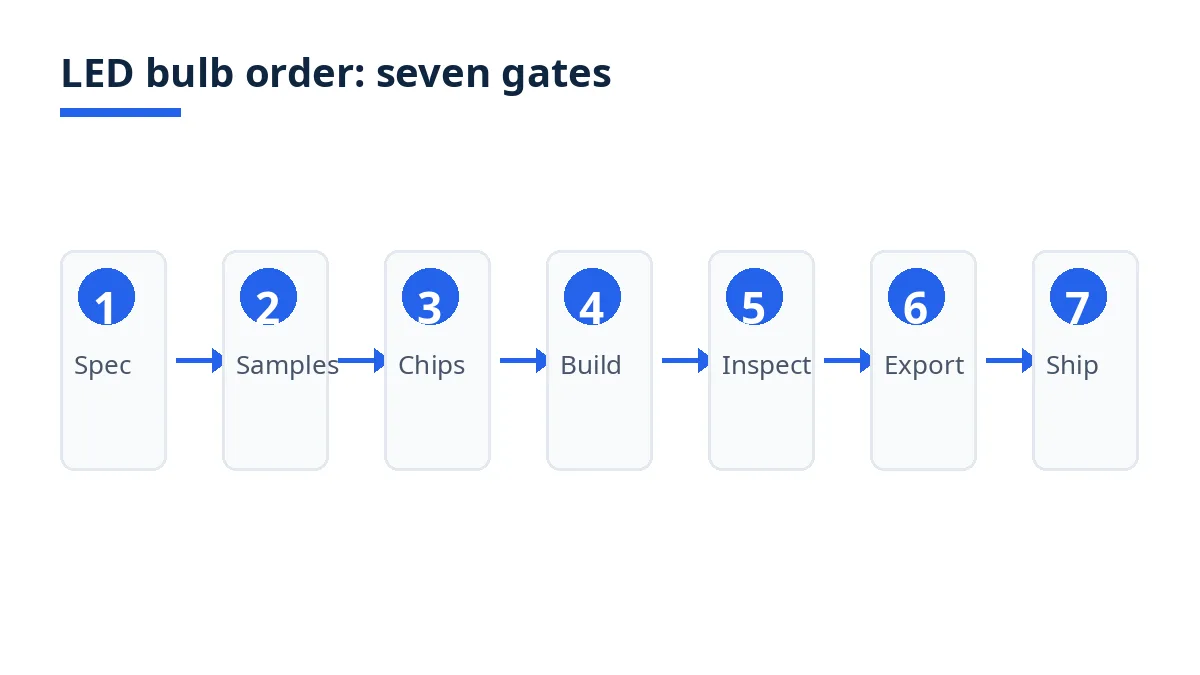
Confirm one written specification. State wattage, lumen output, color temperature and tolerance, color rendering index, cap type, dimming behavior, rated voltage range, carton quantity and destination markets. Name the safety and labeling route for each market before sampling.
Approve samples in stages. Order a proto sample, then a pre-production sample in the actual chip, driver, diffuser, cap and packaging. Measure lumen output and color temperature, check dimming and cap fit, and approve or list corrections in writing.
Lock chip and driver supply. Ask which chip and driver models are stocked, which are ordered in, and what each order quantity covers. A driver change after approval is a new sample, not a substitution.
Agree binning and test evidence. Record the color-temperature bin range, the lumen maintenance evidence required, and which test reports will accompany the shipment. ENERGY STAR guidance requires LM-80 test reports to show the subcomponent model or series tested and the month and year the report was first issued.3
Run production with in-line checks. Agree hold points for incoming chip and driver lots, first-piece approval, in-line lumen and color checks, and end-of-line function testing. Record failures by cause: chip, driver, assembly, cap or packaging.
Inspect, pack and clear export. Inspect against the agreed AQL plan,5 pack for fragility with cartonization agreed in advance, and prepare the export set. Goods may not be loaded unless an export declaration, the Bill of Export or Shipping Bill, is submitted to Customs and approved.7
Ship on the agreed term. Confirm the vessel or flight booking, the named place under the chosen Incoterm,6 and the document set the buyer needs for import clearance.
Costs, timelines and documents
What are the typical costs and timelines?
There is no single typical cost or timeline for LED bulbs from Bangladesh, because chip and driver choice, wattage, color-temperature range, cap variant, order quantity, labeling route and delivery term each move the figure. A supplier quoting without your cap, color-temperature tolerance and destination markets is quoting a different bulb.
Example figures: the table below shows how one order can be planned. It is illustrative only, and each line should be replaced by the supplier's dated commitment for your order.
Stage | Example duration | What gates it |
|---|---|---|
Specification and quotation | 1 week | Complete spec, cap and market list |
Proto and pre-production samples | 2 to 3 weeks | Chip and driver availability, correction rounds |
Chip and driver ordering | 2 to 4 weeks | Stock position, order quantity |
Bulk assembly | 2 to 3 weeks | Line capacity, binning yield |
Lumen, color and safety checks | 1 week | Test evidence, failed-lot rework |
Inspection and fragile packing | 1 week | AQL result, cartonization |
Export clearance and transit | 2 to 5 weeks | Booking, route and destination port |
For costs, ask for separate lines: chip and driver, housing and diffuser, cap, assembly, testing, packaging and cartons, inspection, inland transport, freight and insurance under the chosen term.6 A lump sum hides which gate is expensive.
Which documents are needed?
For export clearance in Bangladesh, goods may not be loaded unless an export declaration, the Bill of Export or Shipping Bill, is submitted to Customs and approved.7 Enclosed documents include the export contract or purchase order where there is no export letter of credit, the commercial invoice, the packing list, the EXP form certified by an authorized dealer, and a certificate of origin from the EPB or a Chamber of Commerce and Industry.7
For the bulb itself, keep a separate file: the agreed specification, sample approvals, chip and driver model records, color-temperature bin records, lumen maintenance evidence,3 safety test evidence under the applicable route,2 EU label and product-database records where the EU is a destination,4 and the inspection report against the agreed AQL plan.5 The buyer also needs the import set for the destination market, including tariff classification: the United States ruling above used subheading 8539.52.0030 for E26 and E27 screw-cap LED lamps.1
Bangladesh-specific rules and tips
Confirm the export set early, not at the port. The Bill of Export names the exporter and the foreign buyer,7 so the legal name on the trade license, quotation, proforma invoice and payment account should match. A mismatch found at clearance costs days.
Ask which components are imported for your order. Chips, drivers and some caps may be bought in for your specification, and an imported driver can set both the earliest production date and the minimum quantity. Agree the chip and driver models in writing before the bulk order, and record what happens if a model is replaced.
Treat EU labeling as a production step. Under Regulation (EU) 2019/2015, suppliers ensure that each light source placed on the market as an independent product in packaging is supplied with a label printed on the packaging, and that product information values are entered into the public part of the product database.4 The regulation defines a light source as an electrically operated product intended to emit light, and expressly excludes LED dies and LED chips from that definition.4 Send label artwork and database data with the pre-production sample.
Keep one specification across every paper. The cap, wattage, lumen output, color temperature and destination markets on the quotation, purchase order, sample approval, inspection report, invoice and packing list should be identical. A carton marked E27 for a shipment approved as B22 is a failed inspection, even if the bulbs work.
Mistakes and red flags
What are the most common mistakes?
Approving a sample without the production chip and driver. A sample built with a different driver or chip bin proves nothing about the bulk order. Require the pre-production sample to use the exact models and bin range agreed for bulk.
Leaving color-temperature tolerance unwritten. Without a bin range, mixed color is a matter of opinion. Write the nominal color temperature and the accepted tolerance, and check it on the pre-production sample and at inspection.
Accepting a lifetime number without evidence. A printed hour figure is a claim, not a test result. Ask for the lumen maintenance evidence behind it: ENERGY STAR guidance states that a longer rated lumen maintenance life than the TM-21 projection value may not be claimed.3
Changing the cap or labeling late. A cap change reopens tooling and carton marking, and an EU label change reopens artwork and database entry.4 Freeze cap, labeling and carton marking at pre-production approval.
Comparing timelines on different delivery terms. The Incoterms 2020 rules allocate cost, risk and obligations differently for each rule,6 so a shorter timeline on EXW and a longer timeline on DDP may describe the same factory schedule. Compare only replies to the same specification on the same term. See the Incoterms guide.
Packing bulbs like garments. Glass and diffuser parts break under carton pressure, and mixed cartons hide damage until the buyer opens them. Agree dividers, carton strength, carton quantity and palletisation before production, and inspect an opened carton.
Treating a profile or a badge as a production guarantee. A profile is a starting point for inquiries. It does not test whether a supplier can source your chip and driver, hold your color bin, or meet your labeling route, and sample approval and inspection stay with you.
Checklist
Before you confirm, every line should be answered in writing.
Specification frozen: wattage, lumen output, color temperature and tolerance, color rendering index, cap type, dimming, voltage range.
Destination markets named, with the safety and labeling route for each.
Chip and driver models recorded, with stock position and order quantity.
Color-temperature bin range agreed and checked on the pre-production sample.
Lumen maintenance evidence requested, with no claim beyond the TM-21 projection value.3
Safety route confirmed: IEC 62560 scope checked for wattage, voltage and cap.2
EU label artwork and product-database data sent with the pre-production sample, where the EU is a destination.4
Inspection level and AQL values in the purchase order.5
Fragile packing agreed: dividers, carton quantity, carton marking, palletisation.
Quotations compared on the same specification and Incoterm.6
Export set agreed: invoice, packing list, EXP form, certificate of origin, Bill of Export.7
Tariff classification checked for each destination, including subheading 8539.52.0030 for the United States where it applies.1
How Exportain helps
On Exportain, browse suppliers and post a request for quotation (RFQ) on the RFQ board with your bulb specification, cap type, color-temperature tolerance, destination markets and delivery term, so suppliers quote against the same specification. Ask each reply for its chip and driver models, sample schedule, binning range and test evidence. When you accept a quotation, confirm the sample, inspection and packing terms in writing before bulk production starts.
Read the LED bulbs MOQ guide before setting quantities: chip and driver order quantities can set the practical minimum.
FAQs
What should I know first about LED bulbs?
An LED bulb is defined in part by its cap, and the cap, wattage, voltage and safety route must be fixed before sampling. IEC 62560 covers self-ballasted LED lamps for domestic and similar general lighting purposes up to 60 W and more than 50 V up to 250 V, with caps according to its Table 1.2 In the United States, E26 and E27 screw-cap LED lamps were classified under subheading 8539.52.0030.1
What are the typical costs and timelines?
There are no typical figures a buyer can rely on, because chip and driver choice, wattage, color-temperature range, cap variant, quantity, labeling route and delivery term drive the price and the schedule.6 Use the example table in this guide for planning only, and replace every line with the supplier's dated commitment for your order.
Which documents are needed?
The order documents are the specification, itemized quotation, sample approvals and purchase order, with chip and driver models, bin range and inspection terms on both. The export set is the Bill of Export, commercial invoice, packing list, EXP form certified by an authorized dealer, and a certificate of origin issued by the EPB or a Chamber of Commerce and Industry.7
What are the most common mistakes?
The most common mistakes are approving a sample built with different chips or drivers, leaving color-temperature tolerance unwritten, accepting a lifetime figure without lumen maintenance evidence,3 changing the cap or labeling late, comparing timelines on different delivery terms,6 and packing fragile bulbs without agreed dividers and cartonization.
Next steps on Exportain
Browse suppliers, then post your bulb specification, cap type, color-temperature tolerance and delivery term on the RFQ board so suppliers state their sample schedule and test evidence. Before you confirm, read the Incoterms guide and the LED bulbs quality control checklist.
Sources
- Ruling N349718: Tariff classification of LED lamps (E26 and E27 screw cap). U.S. Customs and Border Protection (accessed )
- IEC 62560:2011 - Self-ballasted LED-lamps for general lighting services by voltage > 50 V - Safety specifications. International Electrotechnical Commission, (accessed )
- ENERGY STAR Program Guidance Regarding LED Package, LED Array and LED Module Lumen Maintenance Performance Data. U.S. Environmental Protection Agency, ENERGY STAR (accessed )
- Commission Delegated Regulation (EU) 2019/2015 with regard to energy labelling of light sources. European Union (accessed )
- ISO 2859-1:2026 - Sampling procedures for inspection by attributes — Part 1: Sampling schemes indexed by acceptance quality limit (AQL) for lot-by-lot inspection. International Organization for Standardization (accessed )
- Incoterms® 2020. International Chamber of Commerce (ICC) (accessed )
- Customs Clearance Procedures for Export. Bangladesh Customs, National Board of Revenue (accessed )
About the author
Sourcing from Bangladesh?
Post a request for quotation and suppliers on Exportain can send you their quotes directly.
Post an RFQ


