

Typical MOQ for LED Bulbs in Bangladesh (and How to Negotiate It Down)
No single LED bulb MOQ in Bangladesh: what sets the minimum per bulb line, from chip and driver lots to carton print runs, and how to negotiate a smaller order by changing the line structure.
Short answer
There is no single typical MOQ for LED bulbs in Bangladesh. Each supplier sets a minimum per line, defined by wattage, cap, color temperature, driver, housing, and packing, driven by chip and driver lots, assembly set-up, carton print runs, and test batches. Ask for the minimum per line in writing, then negotiate by cutting lines, sharing a driver platform, using stocked inputs, or paying set-up separately.
On this page
Key takeaways
There is no single typical MOQ for LED bulbs in Bangladesh, because each supplier sets a minimum per line, not per order.
A line is one combination of wattage, cap, color temperature, driver, housing, and packing, and changing any one item can create a new minimum.
Chip and driver lots, housing and cap set-up, color temperature runs, carton and label print runs, and test batches are the drivers that set the floor.
Ask for the MOQ per line, per color temperature, and per driver platform in writing, with set-up costs itemized apart from the unit price.
Negotiate the structure first: fewer lines, a shared driver platform, stocked inputs, a supplier carton for the first order, and set-up paid as a separate line.
Ask three suppliers for the LED bulb MOQ in Bangladesh and you will get three different answers, even when the bulbs look identical. There is no single typical MOQ, because each supplier sets a minimum for your exact line: one combination of wattage, cap, color temperature, driver type, housing, and packing. Changing any one item can create a new minimum.
The supplier is protecting fixed runs underneath the order: a chip and driver run, a housing and assembly run, a print run for the carton and label, and a test batch. Change the run that binds, and the floor falls.
What sets the LED bulb MOQ in Bangladesh
What should I know first about LED bulbs?
Define the line first: every minimum is stated per line, not per order. Two bulbs at the same wattage are different lines if cap, color temperature, or driver differ, so a total spread across many lines can clear a headline minimum while every line falls short.
Chip and driver runs. Light output depends on the LED chip and driver, and poor-quality chips and drivers are why cheap bulbs can be less efficient and less stable.1 A chip is bought in a production lot, and a driver is matched to a wattage and voltage range. An uncommon chip or special driver carries its own run, while a standard platform can sometimes be shared across lines.
Housing, cap, and assembly changeover. The housing, heat sink, diffuser, and cap must fit together, and the line must be set up for that combination. IEC 62560 covers self-ballasted LED lamps for general lighting, lamps with integrated means for stable operation, rated up to 60 W and above 50 V up to 250 V, with safety and interchangeability requirements.2 A cap or housing change is therefore not cosmetic: it changes interchangeability, testing, and set-up, and can move the minimum at the same wattage.
Color temperature runs. Bulbs sold as one product must look like one product on the shelf. Color temperature is specified per line, so a line split across two color temperatures is two lines for production. Ask for color temperature in kelvin on the quotation, and keep a sealed reference sample.
Carton, label, and packing runs. Printed cartons, blister packs, inner boxes, and labels each have their own print-run minimum, so a private-label order can meet the bulb minimum yet fall below the carton print run. Ask whether carton, label, and inner packing minimums sit inside the bulb MOQ or apart from it, per line.
Testing and burn-in batches. Sampling, burn-in, and final inspection are scheduled for a lot, and a very small lot still uses the same test set-up. Agree the sampling plan before production. ISO 2859-1 defines a system of acceptance sampling plans for inspection by attributes, indexed by acceptance quality limit (AQL) for lot-by-lot inspection, and AQL is the maximum average percentage of defective items considered acceptable during random sampling, which determines sample sizes and acceptance or rejection thresholds.3
In the Harmonized System, subheading 8539.52 covers light-emitting diode (LED) lamps, under heading 8539 for electric filament or discharge lamps and similar articles.4 See the HS code for LED bulbs guide before you confirm a line list, and the MOQ definition guide for the general meaning of a minimum order quantity.
Example figures: 5,000 bulbs split across five lines at 1,000 per line, each with a different color temperature and cap, can fail every line minimum, while the same 5,000 bulbs in two lines at 2,500 per line sharing one driver platform and carton can clear every run. The example shows structure only, not a typical MOQ, price, or lead time.
Why this matters for buyers and sellers
For the buyer, the MOQ decides how much cash sits in stock and whether a first order can test a line before a larger repeat. For the seller, the minimum protects runs that cannot be reused: chips, drivers, housings, and branded cartons for your line cannot be sold to another buyer.
Two controls keep the negotiation honest: a sampling plan agreed before production, following ISO 2859-1, so a smaller order is still checked against an agreed AQL,3 and one delivery term for every quotation, since the Incoterms 2020 rules allocate cost, risk, and obligations.5
Step-by-step: how it works
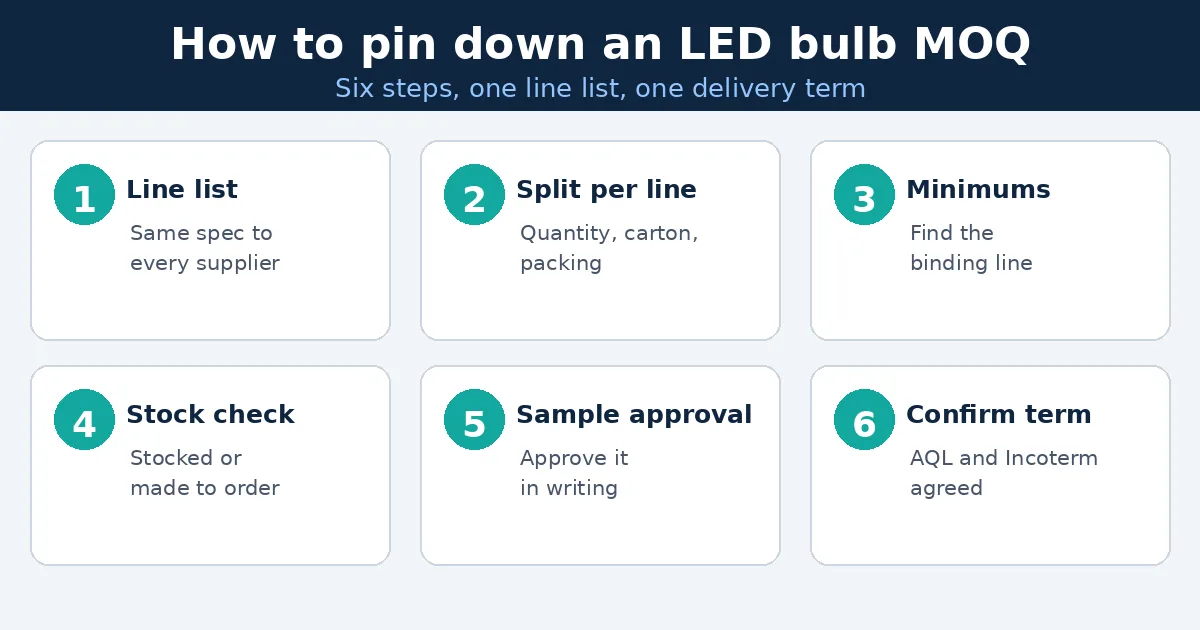
Write one line list for every candidate. State wattage, lumens, cap, color temperature, driver, housing, carton and label, packing, and quantity per line. Send the same list to every supplier.
State the split, not only the total. Give quantity, carton count, and packing per line. A total without a split cannot be answered with a usable MOQ.
Ask for the minimums line by line. Ask for the MOQ per line, per color temperature, per driver platform, and for any separate carton and label minimums, and which line binds.
Ask what is stocked and what is made to order. Record whether each chip, driver, housing, and carton is stocked or made for your line. Stocked inputs are where a lower minimum is most often possible.
Ask what is imported or assembled for your line. Some bulbs or components are imported, and others are imported in completely knocked-down (CKD) form and assembled in Bangladesh.1 An imported chip or driver can set both the minimum and the earliest production date, so ask which inputs are imported and which are assembled locally.
Approve samples in writing. Order a sample in your exact line specification, check output and color consistency, run the agreed burn-in, then approve or list corrections in writing.
Agree inspection and delivery term before you confirm. Write inspection level and AQL values into the purchase order, following ISO 2859-1,3 and state one Incoterm and named place for every quotation.5
How to negotiate or structure a smaller order
Negotiation works when you change the structure that creates the minimum, not when you ask for an exception. Get the result in writing.
Reduce the number of lines first. Lines multiply chip lots, driver runs, housing set-ups, and carton print runs. Cutting one color temperature or cap raises quantity per remaining line, usually the fastest way to clear a binding minimum.
Share one driver platform across wattages. Where the supplier offers it, two wattages on the same driver platform and housing can sometimes share a run. Ask whether the platform minimum can be met across both lines combined, in writing.
Use stocked chips, drivers, and cartons. A standard chip and driver in a standard carton removes part of the made-to-order run. Ask for the stock list before finalizing color temperatures and packing.
Accept the supplier carton for the first order. A plain bulk or supplier standard carton avoids a private-label print run. If your brand carton matters for retail, price it separately and use the supplier carton for the first order.
Pay set-up and tooling as a separate line. Where the floor comes from a housing tool, carton print plate, or label run, ask for those costs apart from the unit price. The run can then be shorter, and the same set-up serves the repeat. Record paid set-ups for the repeat enquiry.
Stage the order. If the supplier cannot move on the full line list, place a smaller first order in fewer lines, with a written repeat price and MOQ for the same specification. Do not remove sample approval, burn-in, or inspection.
Costs, timelines and documents
What are the typical costs and timelines?
There are no typical costs or timelines a guide can state as fact, for the same reason there is no typical MOQ. Each supplier prices your chip, driver, housing, carton and label runs, testing, packing, and delivery term.5 A stocked-driver line with a supplier carton prices differently from a special-driver line with a private-label carton, even at the same wattage.
Sampling depends on component availability and correction rounds; bulk production on chip and driver delivery, assembly set-up, testing, and carton printing. Ask for each phase dated separately. Where components are imported or assembled from CKD kits, ask for the component arrival date as its own line.1
Which documents are needed?
For export clearance in Bangladesh, goods may not be loaded unless an export declaration, the Bill of Export or Shipping Bill, is submitted to Customs and approved.6 Enclosed documents include the export contract or purchase order where there is no export letter of credit, the commercial invoice, the packing list, the EXP form certified by an authorized dealer, and a certificate of origin issued by the EPB or a Chamber of Commerce and Industry.6
For the order itself, the documents are the line list, itemized quotation with the MOQ per line, sample approval record, and purchase order carrying the split, inspection level and AQL values, and delivery term.3 5 Keep the per-line test record with the shipment file.
Bangladesh-specific rules and tips
Check standards claims by scope, not by logo. For products under mandatory certification, a BSTI CM licence indicates assessment against prescribed standards, and buyers are advised to check CM licence information rather than packaging claims.1 Named companies in Bangladesh sell LED bulbs and other lighting products that comply with BSTI standards.1 That does not mean every bulb carries the same cover. Ask which standard, model, and producing site the licence covers, in writing, for your exact line.
Keep luminaires and lamps apart. IEC 60598-1 covers luminaires, or lighting fixtures, while IEC 62560 covers self-ballasted LED lamps.2 7 A certificate for a luminaire does not prove a bulb line. Match the document to the product you are buying.
Ask what to confirm in writing about the producing site. This guide names no factory location, capacity, or export value for LED bulbs, because no opened source here verifies those points for your line. Instead, ask the supplier to confirm in writing the producing site, whether the line is manufactured or assembled from CKD components, which inputs are imported, and which test records apply to that site and model.1
Keep one legal name across every paper. The export declaration names the exporter and the foreign buyer,6 so the name on the trade licence, quotation, proforma invoice, and payment account should match.
Mistakes and red flags
What are the most common mistakes?
Asking for a total MOQ only. The binding minimum is usually per line, per color temperature, or per driver platform. An order can clear the total and still fall below one line minimum, which then carries a surcharge or removal.
Comparing MOQs on different lines or terms. A lower minimum on a stocked driver, supplier carton, or different term is a different offer. Compare only replies to the same line list on the same Incoterm.5
Accepting a verbal exception. Record any agreed lower minimum, shared platform, or waived set-up on the quotation and purchase order, with the split it applies to.
Paying set-up twice. Keep paid set-up lines from the first purchase order and attach them to the repeat enquiry, including any housing tool, carton plate, or label run already paid for.
Treating a profile or badge as proof of capability. A profile is a starting point. Exportain verification is a document and photo review, not a factory inspection, and no substitute for sample approval and inspection.8
Skipping burn-in or inspection to save time. Sampling under ISO 2859-1 checks a lot against an agreed AQL.3 A small order needs that control more, not less, because one faulty lot is a larger share of a small stock.
Checklist
Before you confirm, every item should be answered in writing.
Line list sent: wattage, lumens, cap, color temperature, driver, housing, carton, label, packing.
Split stated per line, with carton count and packing.
MOQ confirmed per line, per color temperature, per driver platform; binding line named.
Stocked or made-to-order status recorded per input.
Carton, label, and packing minimums confirmed apart from the bulb MOQ.
Imported or CKD inputs named, with a component ready date.1
Standard, model, and producing site confirmed for every standards claim.1 2
Set-up and tooling costs itemized apart from unit price; paid set-ups recorded.
Sample in exact line specification color-checked and approved in writing.
Inspection level and AQL in the purchase order.3
Quotations compared on the same line list and term.5
Export set agreed: invoice, packing list, EXP form, origin certificate, Bill of Export.6
How Exportain helps
On Exportain, browse suppliers and post a request for quotation (RFQ) on the RFQ board with your line list, split, and delivery term, so suppliers quote against the same specification. Ask each reply for per-line minimums, stocked or made-to-order inputs, and carton and label minimums. Read the verification page before treating a badge as evidence: verification is free, staff-reviewed, and a document and photo review, not a factory inspection.8 Membership plans never grant a badge.8 Sample approval, burn-in, and inspection stay with you.
See how supplier verification works on Exportain and the how to import LED bulbs from Bangladesh guide.
FAQs
What should I know first about LED bulbs?
There is no single MOQ to look up. The minimum is set per line by chip and driver lots, housing and cap set-up, color temperature runs, carton print runs, and test batches. Self-ballasted LED lamps up to 60 W and above 50 V up to 250 V fall under IEC 62560,2 and LED lamps sit under HS subheading 8539.52.4
What are the typical costs and timelines?
There are no typical figures a buyer can rely on: each supplier sets price, MOQ, and lead time for your line. Chip, driver, housing, carton and label runs, testing, and delivery term drive price,5 and component availability, assembly set-up, testing, and carton printing drive timeline. Ask for each phase dated separately.1
Which documents are needed?
The order documents are the line list, itemized quotation, sample approval record, and purchase order, with the MOQ per line, inspection level, and delivery term on both.3 5 The export set is the Bill of Export, commercial invoice, packing list, EXP form certified by an authorized dealer, and a certificate of origin issued by the EPB or a Chamber of Commerce and Industry.6
What are the most common mistakes?
The most common mistakes are asking only for a total MOQ, comparing minimums on different lines or terms,5 accepting a lower minimum verbally, paying set-up twice, and reading a badge as proof of capability. Verification is a document and photo review, not a factory inspection,8 and sampling under ISO 2859-1 checks the lot before it becomes stock.3
Next steps on Exportain
Browse suppliers, then post your line list, split, and delivery term on the RFQ board so suppliers state their MOQ per line. Before you confirm, read the LED bulbs quality control checklist and the MOQ definition guide.
Sources
- Uncertified LED bulbs grab half of Tk3,000cr market, squeezing compliant manufacturers. The Business Standard, (accessed )
- IEC 62560:2011 Self-ballasted LED-lamps for general lighting services by voltage > 50 V - Safety specifications. CSA Group (accessed )
- ISO 2859-1:2026 - Sampling procedures for inspection by attributes — Part 1: Sampling schemes indexed by acceptance quality limit (AQL) for lot-by-lot inspection. ISO (accessed )
- HS Code 853952 - Light-Emitting Diode LED Lamps. ABRAMS.wiki (accessed )
- Incoterms® 2020. International Chamber of Commerce (ICC) (accessed )
- Customs Clearance Procedures for Export. Bangladesh Customs, National Board of Revenue (accessed )
- BS EN IEC 60598-1:2024 Luminaires - General requirements and tests. British Standards Institution (accessed )
- Supplier verification: Earn trust badges buyers can see. Exportain (accessed )
About the author
Sourcing from Bangladesh?
Post a request for quotation and suppliers on Exportain can send you their quotes directly.
Post an RFQ


