

Typical MOQ for Leather Wallets in Bangladesh (and How to Negotiate It Down)
Leather wallet MOQs in Bangladesh are counted per layout, color and leather, not per order total. This guide works the split, the five wallet minimums and six negotiation levers, with every number labelled as an example figure.
Short answer
There is no single typical MOQ for leather wallets from Bangladesh. Each supplier counts the minimum per layout, per color, and per leather, through five minimums: the cutting die and stitching setup, the leather and color lot, the interior and edge finish, hardware and embossing, and packing. State the split line by line, find the binding minimum, and negotiate by changing the split, sharing lots, or paying setups separately.
On this page
Key takeaways
There is no single typical MOQ for leather wallets from Bangladesh, because each supplier counts the minimum per layout, per color, and per leather.
Five minimums bind a wallet order in order: the die and stitching setup, the leather and color lot, the interior and edge finish, hardware and embossing, and packing.
A passing order total can still fail a per-layout and per-color line, so test the split line by line on Example figures before discussing price.
Negotiate by changing the order: fewer layouts, fewer colors, shared leather and color lots, stocked inputs, setups paid separately, and phased orders.
An agreed minimum is tied to a layout, a lot, a price validity, and a production slot, and it stops applying when any of the four changes.
A wallet order fails at a small line. One layout in one color falls short while the order total looks large enough to pass. There is no single typical minimum order quantity (MOQ) for leather wallets from Bangladesh. Each supplier counts the minimum against a different split, and the split decides whether an order can be made.
This guide is for buyers ordering leather wallets from Bangladesh for resale in the USA, UK, EU, or UAE. Every number here is an example figure.
Why a wallet minimum is counted differently
A wallet is many small parts cut, skived, folded, stitched, and finished to tight measurements. A bifold, a trifold, and a card holder are not three sizes of one product. Each layout needs its own cutting dies, card-slot pattern, fold sequence, and stitching setup. Changing the layout restarts that work, even when the leather and color stay the same.
Yield also works at small scale. The exterior, card slots, lining, and coin-section parts are cut from one hide or skin, and the usable area, the marks on it, and the way panels nest decide how many wallets one cutting run produces. A mark that could sit harmlessly on a large panel can ruin a card slot. Ask how panels are graded and shade is judged. For the general meaning of MOQ, see the MOQ meaning guide.
The five wallet minimums, in the order they usually bind
Ask for each figure separately, in writing. The first minimum that fails decides the order.
1. The cutting die and the stitching line
Each layout needs cutting dies for the exterior, card slots, lining, and any coin or note section, plus a stitching setup for that fold sequence. A new layout means new dies and a new line setup. Ask which dies exist and what new dies cost, as a separate line. Fix the layout, slot count, fold, and measurements before you ask for a minimum: changing them after sampling restarts the die work and the sample.
2. The leather and color lot
Leather is bought and finished in lots, and a color made to order carries the lot minimum with it. A running leather in a standard color the workshop already holds may carry a lower minimum. A new leather, finish, or color starts a new lot. Ask whether the leather is stocked or finished to order, and whether one lot can serve more than one layout.
Tannery evidence rides with the leather lot, not with the workshop. The Leather Working Group (LWG) audit, first launched in 2005, assesses a tannery across 17 sections: 85 percent for Gold, 75 percent for Silver, 65 percent for Bronze, and 50 percent for Audited, with the medal set by the lowest-scoring section.1 Certification lasts 24 months for leather manufacturing facilities and does not rule out restricted substance failures in a final product.1 For Gold and Silver, chromium VI must be below 3 mg/kg, and any level above that results in automatic failure.1
3. The interior, lining and edge finish
The interior decides much of a wallet minimum, because card slots, lining, and edge work multiply the parts per wallet. Each slot adds a panel, a fold, and a stitch, and the lining color and edge finish each add a run. A wallet with six card slots and a coin section is a different run from a card holder with four slots, even in the same leather and color. Ask for the minimum per layout. Standardize the interior first: one lining color, edge finish, and thread color across layouts remove runs.
4. Hardware, embossing and labels
Hardware is small and easy to overlook, and it is often the lot that binds a small order. Snaps, zips, rivets, and key rings are bought in lots in one metal and finish, and a brass finish and a gunmetal finish are two lots. Embossing adds a plate or die per logo, per position, and per layout, and labels, hang tags, and cartons each add a print run. A standard running finish can remove a whole lot from the calculation. Ask what the embossing plate costs as a separate line that you pay once and reuse on a repeat order.
5. Packing, gift boxes and cartons
Packing is a minimum of its own, because a gift box, a sleeve, and a printed carton are each made in runs. A printed gift box, a sleeve, and a layout-named carton each carry a making minimum, and a box made for a bifold does not fit a trifold. Ask for the packing minimum per layout and per box type, apart from the wallet minimum, and ask whether a standard box or a plain box with a label can replace a printed box for the first order.
Work the split before you talk price
Work your own split line by line before you accept a quotation.
Example figures: a buyer plans 720 wallets in three layouts and four colors, at 60 per layout and color, against a minimum of 100 per layout and color. The 720 total clears a 500-piece total minimum, but all 12 lines fail by 40. The same 720 in two layouts and three colors, at 120 per line, clear the minimum on all six lines. Only the split changed.
Example figures: sharing one leather and color lot of 600 across three layouts totaling 720 clears the lot, but a card holder at 120 still fails a 300-piece per-layout minimum.
Split | Example figures | Against the stated minimum |
|---|---|---|
Total order | 720 wallets | Passes a 500-piece total minimum |
Per layout and color, 12 lines | 60 wallets per line | Fails a 100-piece line minimum |
Per layout and color, 6 lines | 120 wallets per line | Passes a 100-piece line minimum |
Shared lot | 720 wallets, one leather and color | Passes a 600-piece lot minimum |
Per layout, card holder | 120 wallets | Fails a 300-piece per-layout minimum |
Embossing plate lot | One plate per logo and layout | Binds each layout separately |
Negotiate in wallet order: six levers
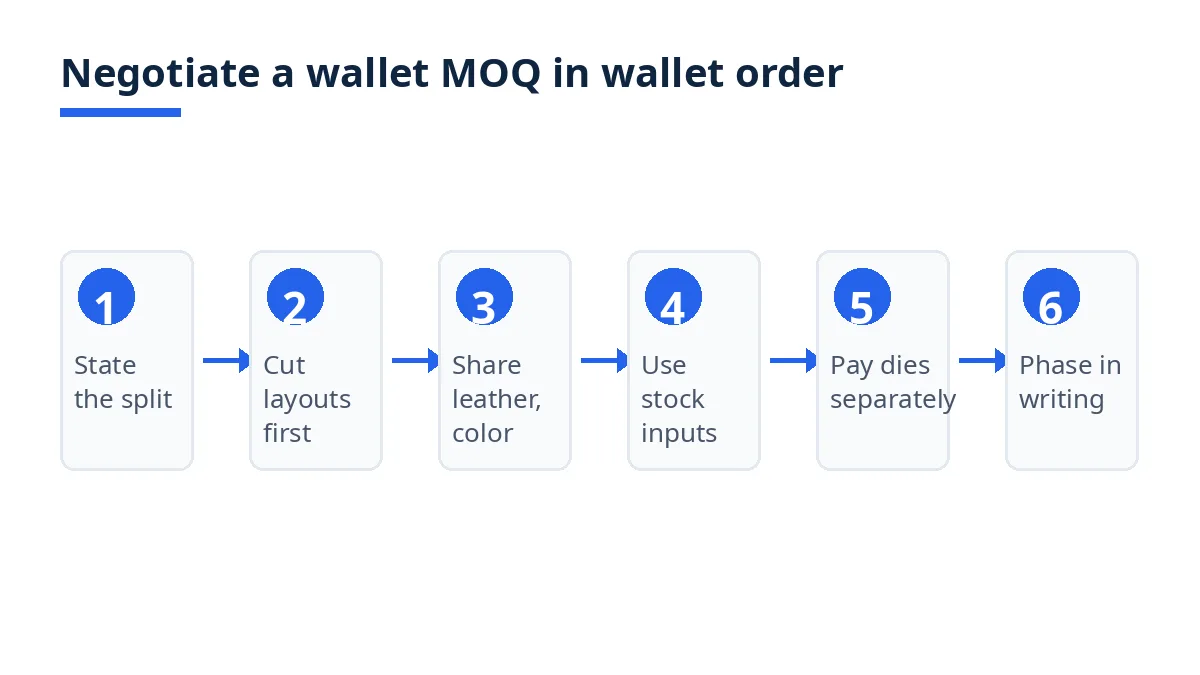
Raise the six levers in order, and record each agreed change on a new quotation version.
Cut layouts before you cut colors. Dropping a layout removes its dies, stitching setup, hardware lot, and packing run at once.
Cut colors second, per layout. Two colors at half quantity each are two lots that each fall short, not one lot that passes.
Share one leather and one color across layouts. Two layouts from the same lot in the same color can sometimes share the lots, if the supplier confirms it in writing.
Use stocked leather, running hardware, and a standard box. Stocked leather, running hardware, and a standard box remove the made-to-order lots.
Pay the dies, the plate, and the setup as separate lines. Ask for the setup apart from the unit price, so the run can be shorter and the die or plate can serve the repeat order.
Phase the order, with the repeat in writing. A smaller first order, with a written repeat price and MOQ for the same specification and lots, can succeed where a one-off small order fails.
Do not trade away the sample or inspection for a lower minimum. ISO 2859-1:2026 defines a system of acceptance sampling plans for inspection by attributes, indexed by the acceptance quality limit (AQL), and AQL is the maximum average percentage of defective items considered acceptable during random sampling.2 Name the AQL values, inspection level, and defect classes in the order terms, and keep one sealed counter-sample per layout. See the quality control checklist for leather wallets for wallet-level checks.
What a lower minimum costs
Once the binding minimum is named, the shortfall has a price. All figures here are Example figures.
Example figures: a buyer needs 360 wallets in one layout and color against a 500-piece line minimum. A surcharge of 5 units per piece on 360 pieces costs 1,800 units, with no extra stock. Ordering up to 500 pieces at 18 units for the 140 extra wallets costs 2,520 units and leaves 140 wallets in stock. Dropping the color removes its lot entirely.
Example figures: a supplier quotes an index price of 100 units per piece below 500 pieces and 92 units per piece from 500 pieces. An order of 360 pieces at 100 units costs 36,000 units, while 500 pieces at 92 units cost 46,000 units. Ordering up for the tier costs more in total here, even though the unit price falls. Confirm the tier basis and how long it holds.
When an agreed minimum stops applying
An agreed MOQ is tied to a layout, a lot, a price validity, and a production slot. It stops applying when any of the four changes: a leather lot sells out, a color lot is replaced, a hardware finish is discontinued, a die wears or is lost, or a price validity expires. Agree the validity in writing at the first order: how long the terms hold, whether the repeat uses the same lots and dies, and what happens if a lot changes.
Classification is separate from the MOQ, and it must be settled before pricing is fixed. Subheading 4202.31 covers cases and containers of a kind normally carried in the pocket or in the handbag, with an outer surface of leather or composition leather, while 4202.32 covers the same articles with an outer surface of plastics sheeting or textile materials.3 A leather-look wallet therefore takes a different line from a leather wallet.3 Treat every heading here as indicative until your broker confirms the full national code. See the HS code guide for leather wallets.
Mistakes and red flags
Agreeing a total without a split. The binding minimum is usually per layout, per color, or per leather. State the split first, or a passing total will hide a failing layout.
Negotiating the lowest MOQ and the lowest tier price together. The top-tier price assumes the top-tier quantity. A smaller order at that price asks the supplier to give up both.
Accepting a lower minimum verbally. A message agreeing to a smaller run has not changed the order until the quotation, the dies, and the sample change with it. Record every agreed minimum on a new quotation version, with the split it applies to.
Changing a layout or a color late. A late layout change restarts the dies and the stitching setup. A late color change restarts the color lot and the shade approval. Price any late change as a new lot and a new setup.
Treating a tannery certificate as a wallet certificate. An audit or test report for a tannery covers the tannery and the leather it names. It does not cover the workshop, and it does not replace testing your own wallets. LWG certification does not rule out restricted substance failures in a final product.1
Judging capacity from a listing alone. A listing and a badge do not test whether a supplier can cut and stitch your layouts. Confirm any association claim with the association: the Leathergoods and Footwear Manufacturers and Exporters Association of Bangladesh (LFMEAB) has rebranded as the Footwear Leathergoods and Accessories Exporters Association (FLAXA), unveiled at its 22nd annual general meeting on 5 March 2026.4
Checklist: agree the wallet minimum before you pay
Split per layout, color, and leather, with the quantity against each line.
Minimum per layout, color, and leather, with the binding minimum named.
Die and stitching setup per layout, with new dies priced separately.
Leather status per layout: stocked or finished to order, with running colors named.
Color lot figure apart from the leather lot figure, with shared lots in writing.
Interior, lining, and edge finish standardized or priced per layout.
Hardware, embossing plate, label, and carton minimums apart from the wallet minimum.
Setup, die, plate, and surcharge costs itemized, with plate ownership recorded.
Pre-production sample approved in writing, with a sealed counter-sample kept.
Inspection level and AQL values in the purchase order, with defect classes named.2
Price tier basis confirmed, with validity dates.
Repeat-order terms: same lots and dies, validity period, and lot-change terms.
Classification as indicative 4202.31, full national code to be confirmed by the broker.3
How Exportain helps
On Exportain, post a request for quotation (RFQ) on the RFQ board with your split, delivery term, and validity, so each supplier states its minimum against the same specification. Read each badge for what it records, using the supplier verification guide: verification is a document and photo review, not a factory inspection, and a badge is not a promise of capacity, quality, or delivery.
What should I know first about leather wallet MOQs?
Know the order as five minimums, not one number. The die and stitching setup, the leather and color lot, the interior and edge finish, the hardware and embossing lot, and the packing lot each set a minimum per layout, per color, or per leather, and the first one that fails decides the order. State the split first, ask for each minimum in writing, and test every line before you discuss price.
What are the typical costs and timelines for a small wallet order?
There are no typical costs or timelines a guide can state as fact, because each supplier prices your layout, leather, color, hardware, split, and delivery term. A smaller order usually costs more per piece, through a surcharge or a setup charged apart from the unit price, and timelines follow the leather lot, the hardware, the dies, and the sample approval in that order. Ask for a cost breakdown by line, a lead time by gate, and a validity date.
Which documents lock in an agreed wallet MOQ?
The order documents are the specification with the layout, slot count, leather, color, hardware, and packing, the accepted quotation version stating the minimum per layout, per color, and per leather with the setups itemized, and the purchase order carrying the same split, the inspection standard, and the validity dates. Classification under indicative subheading 4202.31 is confirmed by the broker before filing.3
What are the most common mistakes with leather wallet MOQs?
The most common mistakes are agreeing a total without a split, asking for the lowest minimum and the lowest tier price together, accepting a lower minimum verbally, changing a layout or color late, reading a tannery certificate as a wallet certificate, and paying a deposit before the split is written.
Next steps on Exportain
Browse suppliers, then read the leather wallet manufacturers guide before you send an enquiry. When the layouts, colors, and split are fixed, post a free RFQ on Exportain with the split per layout and color, and compare quotes on the same specification, delivery term, and packing.
Sources
- Certification - Leather Working Group. Leather Working Group (accessed )
- ISO 2859-1:2026 - Sampling procedures for inspection by attributes — Part 1: Sampling schemes indexed by acceptance quality limit (AQL) for lot-by-lot inspection. ISO (accessed )
- HS, 2017 - Code 4202 Classification Detail. United Nations Statistics Division (accessed )
- LFMEAB has rebranded as FLAXA. Footwear Leathergoods and Accessories Exporters Association (FLAXA) (accessed )
About the author
Sourcing from Bangladesh?
Post a request for quotation and suppliers on Exportain can send you their quotes directly.
Post an RFQ


