Leather Wallets Exporters in Bangladesh: Supplier Verification Checklist
A five-gate supplier verification checklist for leather wallet exporters in Bangladesh: wallet function, leather and tannery evidence, chemical tests, identity and terms, and classification, with a pass-or-hold scorecard for each supplier.
Short answer
Check a leather wallet exporter in Bangladesh through five gates before you order: the wallet must pass slot, fold, and closure tests on a sample built to your tech pack; leather and tannery evidence must name your leather; chemical reports must cover your market; identity, site, minimum, and payment terms must match in writing; and classification, labels, and inspection terms must be agreed before production. Hold the order while any gate is open.
On this page
Key takeaways
A badge records a document and photo review by Exportain staff, not a factory inspection or a guarantee; check the documents, sites, samples, and inspection terms yourself.
Work five gates in order: wallet function, leather and tannery evidence, chemical evidence for skin contact, identity and commercial terms, and classification and the shipment file.
Tannery and chemical evidence must name your leather, your tannery, and your product; evidence for a different leather, tannery, or product is background only.
Record a pass or hold for each gate, with the evidence held and the owner named, and order only when every gate is marked pass.
A leather wallet supplier is checked through the wallet first, and through the company file second. A supplier with sound documents can still ship a wallet whose card slots grip, whose fold springs open, or whose leather fails a chemical test for the market where it will be sold. A supplier with a sound sample can still be wrong when the tannery evidence names a different leather, the minimum is counted on a different basis, or the producing site is never named. This checklist runs five gates in the order a buyer should clear them. A gate that is not cleared holds the order, whatever the price.
Use it for a first order with a new exporter of leather wallets in Bangladesh, and run it again when the leather, tannery, site, layout, or destination market changes. Keep one file per supplier, with the same specification sent to every supplier you compare. A wallet is judged in a pocket and in a hand, not in a catalogue photograph.1
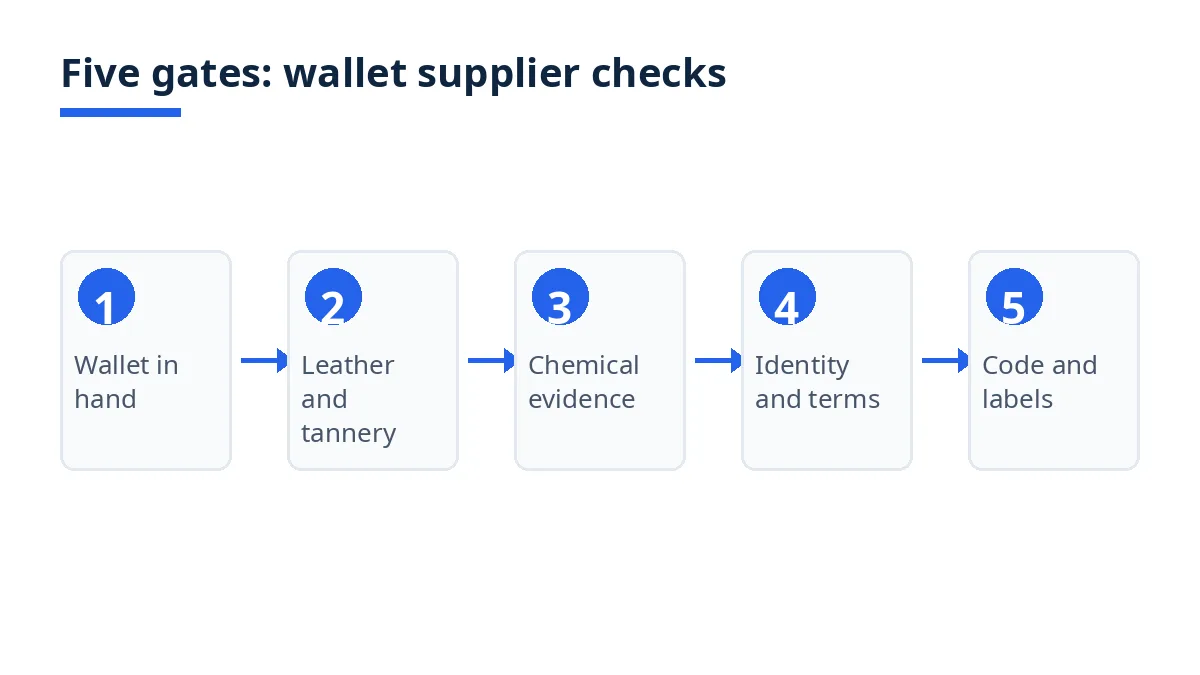
The diagram below shows the five gates, in order, from the wallet to the shipment file.
Gate 1: The wallet passes in the pocket
The first gate tests function, not paperwork. Ask for a sample built to your tech pack, in your layout, with your slot count and test contents. The quality control checklist for leather wallets works from the inside out, from layout and card fit through packing and sampling.2
Layout and fold. Check the bifold, trifold, or card-holder layout, slot number and position, note and coin sections, fold lines, and closed and open measurements against the tech pack. The wallet must fold on its intended lines, close flat, and stay closed without springing open.2
Card fit with your own test card. Test every slot with a card of the size you specify. It must enter without forcing, release without tearing the slot mouth, and stay in place when the wallet is tipped gently.2 As a reference only, the ISO/IEC 7810 ID-1 format specifies 85.60 by 53.98 millimetres, but your specification decides whether a slot passes.2
Note, coin, and closure function. Check that notes of the size you specify fit as designed, that the coin pocket opens wide enough to use and holds coins as designed, and that every snap, magnetic closure, zipper, and flap works through its full travel.2
Closed thickness and bulk. Measure closed thickness with the contents your specification names, and check fold and spine bulk from side to side. Record whether each measurement was taken empty or with contents, open or closed, and use the same condition for every wallet.
Hold the gate when a slot, fold, or closure fails, or when the sample uses a different layout. Ask for a corrected sample and re-test it with the same test card. Do not approve bulk production from a photograph.
Gate 2: The leather and tannery evidence names your wallet
The second gate ties the leather in the sample to a named tannery and a named test or audit record. Check leather identity per style, per color, and per tannery, because an order can change leather, color, or tannery between sample and bulk production. The manufacturers guide sets leather identity and panel consistency as its second check, and tannery evidence as its third.1
Leather stated per style, in full. For each style, record leather type and grain, thickness, color, and finish, and whether the leather is stocked or finished to order. A quotation that omits leather type, thickness, or finish cannot be compared with another, because a lower price in thinner leather is a different wallet.1 Check the surface for scars, holes, veins, loose grain, and cracking, judged by position and size, with extra attention to slot mouths and fold panels.2
Shade standard under a named light. Agree the color standard and the light under which shade is judged, and check shade between the exterior and card panels of the same wallet, between wallets in the lot, and between wallet and trim.1 Genuine leather comes from animal hides, so natural marks are inherent, and the task is grading rather than demanding a mark-free hide.2 Agree the grading rule for natural marks by position and size before cutting.
Tannery named for your leather. Record which tannery made the leather in your sample, for each style and color. The Leather Working Group (LWG) audit, first launched in 2005, assesses a tannery across 17 sections.1 Thresholds are 85 percent for Gold, 75 percent for Silver, 65 percent for Bronze, and 50 percent for Audited, the final medal is the lowest category achieved, and certification is valid for 24 months.1 Ask for the certificate and test report naming your leather, tannery, and method, and check holder, site, coverage, and expiry. Evidence naming a different tannery or leather is background only.
Stitching, edges, hardware, and lining. Check stitching lines and density on the short card-panel runs, stitching at folds, slot mouths, and pocket corners, and reinforcement where specified; check edge finish at narrow card-panel and fold edges; check that hardware is firmly attached, correctly placed, and free of burrs; and check lining fit inside slots, pockets, and the note compartment, with no twisting, bunching, or glue marks.2
Hold the gate when leather wording is incomplete, when shade has no named light, or when tannery evidence names another leather or has expired. Retest when leather, tannery, or color changes. LWG states that certification does not ensure there will be no restricted substance failures in a final product, classifies leather as chrome-free below 1,000 mg/kg of total chromium on a dry weight basis under BS EN 15987, and requires chromium VI below 3 mg/kg for Gold and Silver certification.1
Gate 3: Chemical evidence for skin contact
The third gate is laboratory evidence, and it cannot be cleared by looking at the wallet. A wallet is handled daily, so it sits squarely in the skin-contact group, and a chemical failure is found only by laboratory testing.1 Send your restricted substances list at the enquiry stage, before sampling, and require test reports naming your product, leather, and method for each limit your market applies.
Restricted substances list sent before sampling. Give the factory the list for each destination market at the enquiry stage, naming the styles, leathers, and colors it covers. A sample made without it may use a dye, finish, or treatment that the market does not accept.
Chromium VI report for your wallet. For the United Kingdom, under assimilated REACH rules, leather articles coming into contact with the skin must not be placed on the market where they contain chromium VI at or above 3 mg/kg of the total dry weight of the leather.1 Require a report naming your product and leather, stating method and result, below the limit your market applies.
Azo dye and dimethyl fumarate limits. Azo dyes that release listed aromatic amines above 30 mg/kg must not be used in articles in direct and prolonged skin contact, in a list naming purses and wallets, and leather products above 0.1 mg/kg dimethyl fumarate must not be placed on the market, on the same United Kingdom guidance.1 Ask for a report for each limit your market applies, naming product, leather, and method. A report for one limit does not cover another.
Colorfastness and abrasion by named method. Require each lab report to name the method and record the result against your specification, with no universal grade assumed.2 An inspection account lists ISO 17075 for colorfastness to rubbing among its lab tests.2 Agree which tests apply, on which panels, and what result passes, before bulk approval.
Hold the gate when no report exists for a limit your market applies, or when a report names a different product, leather, or color. Hold bulk approval until a report on your own wallet exists, and retest when leather, tannery, dye, or finish changes.
Gate 4: Identity, site, and commercial terms on one page
The fourth gate puts the company, the producing site, and the commercial terms on one page, so a mismatch is visible before money is committed. The manufacturers guide treats registration, association, and badge evidence as one check, with the legal name and address on the trade licence and Export Registration Certificate (ERC) matched against the quotation and invoice.1
Identity documents match the quotation. Check the legal name and address on the trade licence and ERC against the quotation and invoice, and resolve any difference in writing before discussing price.1 On Exportain, verification is a document review by Exportain staff, not a factory inspection and not a check against any government database, and a badge is not a guarantee of production capacity, product quality, or delivery.3 Exportain Verified records identity, phone, email, and business registration checks, Export Verified records an ERC check, Factory Verified records reviewed photos of the factory, and Trading Company Verified records reviewed photos of the trading company office or warehouse.3 A company without a badge shows nothing, which means a check has not been approved, not that the company failed one.3
Producing site and bought-in stages named. Record which site cuts, stitches, and finishes your wallet, which site tanned or supplied the leather, and which stages are bought in, such as hardware setting, lining, zips, or edge paint. For a trading company, record the producing factory for each style before any deposit, and name it in the order terms.
Association claim confirmed. If a supplier claims membership of the sector association, confirm it with the association and record the answer. The sector association is the Footwear Leathergoods and Accessories Exporters Association (FLAXA), formerly LFMEAB, which rebranded at its annual general meeting on 5 March 2026.1 Use membership as one identity check, not as evidence a factory can make your wallet, and confirm any certificate with the issuing body, checking holder, site, coverage, and expiry.
Minimum, capacity, and payment terms in writing. Ask each supplier to state its minimum order quantity (MOQ) against your specification, including the counting basis: per order, per style, per color, or per leather.1 Example figures: an MOQ of 1,000 pieces counted per color, across two styles in two colors each, means a smallest order of 4,000 pieces.1 Ask what is in production now, when your run would start, and where leather and hardware will come from, and agree payment terms, including any funds hold, in writing before paying. On Exportain, money for a goods order is held only when both parties agree to a funds hold.3 Confirm bank details through a second channel, and treat any late change as a reason to pause.
Hold the gate when names differ, when a site is unnamed, when an association claim is unconfirmed, when the counting basis is unstated, or when payment terms are open. Verification on Exportain is free and never purchased, and membership plans never grant a badge.3
Gate 5: Classification, labels, and the shipment file
The fifth gate is cleared before pricing is fixed, because classification decides which duty line customs applies, and a code copied from another product or country does not transfer. Classification follows the product type and the outer surface, not the marketing name.1 Treat every heading as indicative until your broker confirms the full national code.
Pocket-article test per style. Ask whether each style is of a kind normally carried in the pocket or in the handbag, and what material forms its visible outer surface. Subheading 4202.31 covers pocket articles with an outer surface of leather or composition leather, while 4202.32 covers the same articles with an outer surface of plastics sheeting or textile materials.1 The Harmonized System is a multipurpose international product nomenclature developed by the World Customs Organization (WCO), comprising more than 5,000 commodity groups, each identified by a six-digit code, and used by more than 200 countries and economies as a basis for their customs tariffs.4 A leather-look wallet takes a different line from a leather wallet, and a coin section does not create a second article.4
National code confirmed with the broker. Confirm the subheading and full national code with your broker, for each style, before you fix a price. In the United States schedule, the leather pocket-article line 4202.31 splits into a reptile leather line and an other line, and in the United Kingdom the tariff lists the line with hand-made and other commodities, so the hand-made question must be answered before the final digits are chosen.4 Confirm the duty rate and any preference position beside the confirmed code, for your exact product, origin, and entry date. No duty rate is stated here.
Labels approved word for word. Approve every label proof word for word, for each destination market, before the label run, checking content, spelling, and position, and check the finished label before bulk sewing. The quality control checklist lists main, care, and size labels where specified, and logo or branding with correct content, spelling, and position, among its checks.2 Agree fiber wording, care instructions, size, and origin marking in full. No label mandate for a single market is stated here.
Inspection terms agreed before production. Agree the inspection standard, sampling plan, defect classes and values, and the action on a failed lot, in the order terms, before production. The quality control checklist applies the agreed plan to the finished, packed lot, and gives, as a published standard-table example only, a lot of 51 to 90 wallets at General Inspection Level II giving code letter E and a sample size of 13, with acceptance and rejection numbers of 1 and 2 for major defects at AQL 2.5 and 1 and 2 for minor defects at AQL 4.0, as buyer-agreed values.2 Name the inspector and agree the report format: lot, sample size, defects with photographs, measurements, and packing. A supplier checking its own work is factory quality control, not an independent inspection. Confirm packing that keeps wallets flat so hardware does not press into the leather.2
Hold the gate when the code was copied from another country or product, when label proofs are unapproved, or when inspection terms were agreed after production. Exportain is a marketplace, not a party to your goods contract, and holds money only when both parties agree to a funds hold.1
What to do when a gate fails
A failed gate is a hold, not a negotiation point. Record the gate, the evidence missing, the owner, and the date the fix is due.
Gate | Hold signal | First action |
|---|---|---|
1. Wallet in the pocket | Slot, fold, or closure fails on the sample | Corrected sample to the tech pack, re-tested with the same test card |
2. Leather and tannery | Evidence names another leather or tannery, or has expired | Certificate and report naming your leather and tannery, holder and expiry checked |
3. Chemical evidence | No report for a limit your market applies | Report on your own wallet, naming product, leather, and method |
4. Identity and terms | Names differ, site unnamed, or counting basis unstated | Documents, site names, and counting basis in writing, bank details checked twice |
5. Classification and file | Code copied, labels unapproved, or inspection terms late | Broker-confirmed code, approved label proofs, and inspection terms in the order |
Scorecard: one page per supplier
No file download is offered with this article. Copy the scorecard below into your supplier file, and record a pass or hold for each gate. Order only when every gate is marked pass. No deposit is paid while a hold affecting the wallet, leather, chemical evidence, identity, site, or payment remains open.
Gate | Evidence to hold | Owner | Decision |
|---|---|---|---|
1. Wallet in the pocket | Sample record, test card result, measurements with stated condition | Buyer | Pass or hold |
2. Leather and tannery | Leather wording per style, shade standard, tannery certificate and report | Buyer | Pass or hold |
3. Chemical evidence | Restricted substances list, reports per limit, named methods and results | Buyer and lab | Pass or hold |
4. Identity and terms | Documents, site names, association answer, counting basis, payment terms | Buyer | Pass or hold |
5. Classification and file | Broker-confirmed code, label proofs, inspection plan and report format | Buyer and broker | Pass or hold |
How Exportain helps
Exportain connects buyers with Bangladeshi suppliers, and the catalogue filters help at the shortlist stage: search by keyword and category, filter by badge, sample availability, and OEM or ODM capability, and sort by MOQ or lead time.1 Read each badge for what it records, and remember that verification is free, membership never grants a badge, and a badge records a document and photo review, not a factory visit.1 Message suppliers through their profiles, send every supplier the same specification, and compare versioned quotations on the same fields.1 Exportain does not inspect goods, book freight, or clear customs, so keep your broker and inspection provider central. If you suspect fraud or misrepresentation, report it through the Trust Center, where reports go to the verification team and are handled by people, not automatically.3
When should this checklist be used?
Use it before a first order, when a supplier changes site, leather source, tannery, or range, and when the destination market changes. Repeat it at quotation, at sample approval, and before any deposit. A gate cleared for one style, leather, color, or site does not clear the same gate for another style, leather, color, or site.
Who should complete it?
The buyer owns the checklist, the gates, and the decision. The supplier supplies documents, names sites and tanneries, and produces the sample; a forwarder or broker can complete the classification and duty parts; an inspector or laboratory can complete the sample, inspection, and chemical parts. The final decision stays with the buyer.
What are the most common failures?
A sample approved from a photograph, tannery evidence for a different leather, a chemical report for a different product, an unnamed producing site, a minimum counted on an unstated basis, bank details changed late, and a code copied from another product or country. Each is fixed by closing the gap in writing, with named evidence, before the order proceeds.
Can a third party do it?
Yes. A third party can check documents, confirm association claims, inspect the sample and finished goods, arrange laboratory testing, and confirm classification and duty position with the broker. It needs the specification, quotations, documents, sample record, and written authority, and it must report lot, sample size, defects with photographs, measurements, and packing. The buyer remains responsible for the decision.
Next steps on Exportain
Start with the wallet in hand: write the layout, slot sizes, leather wording, and restricted substances list into one specification, then read the quality control checklist for leather wallets for the product checks inside Gate 1, and the leather wallets manufacturers guide for the eight criteria behind the gates. When the five gates are drafted, browse suppliers and post an RFQ on the RFQ board with your specification, counting basis, and delivery term, and compare replies gate by gate on the same terms.
Sources
- Top Leather Wallets Manufacturers in Bangladesh: How to Find and Verify Them. Exportain (accessed )
- Quality Control Checklist for Leather Wallets From Bangladesh. Exportain (accessed )
- Trust & Safety Center. Exportain (accessed )
- HS Code for Leather Wallets: Classification Guide for Importers. Exportain (accessed )
About the author
Sourcing from Bangladesh?
Post a request for quotation and suppliers on Exportain can send you their quotes directly.
Post an RFQ