

Leather Jackets MOQ in Bangladesh: The Production Split That Sets It
Jacket MOQs in Bangladesh are counted through five lots — leather, size curve, lining, hardware, and sample and tooling — not one order total. This guide works the split, the size curve, and six negotiation levers, with every number labelled as an example figure.
Short answer
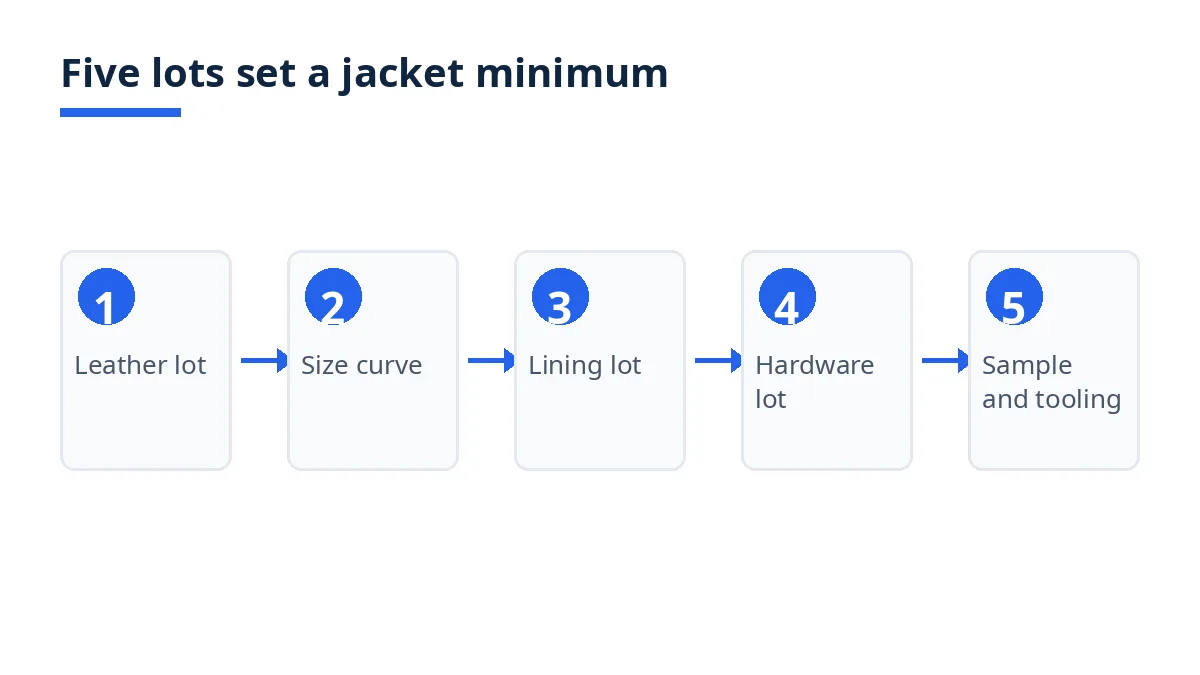
There is no single typical MOQ for leather jackets from Bangladesh. Each supplier counts the minimum through five lots: the leather lot, the size curve, the lining lot, the hardware lot, and the sample and tooling work. State the size curve first, find the binding lot, and negotiate by changing the split, standardizing the lining and hardware, or paying sample and tooling separately.
On this page
Key takeaways
There is no single typical MOQ for leather jackets from Bangladesh, because each supplier counts the minimum through five lots, not one order total.
The five lots are the leather lot, the size curve, the lining lot, the hardware lot, and the sample and tooling work, and the first lot that fails decides the order.
The size curve multiplies every jacket order: sizes times colors times styles, with each line needing to clear the line minimum on its own.
Negotiate in jacket order: consolidate the curve, standardize lining and hardware, share one leather lot, use stocked inputs, pay tooling separately, and phase the curve.
An agreed minimum is tied to a size curve, a leather lot, a lining and hardware lot, a tooling set, a price validity, and a production slot, and it stops applying when any of them changes.
A quotation says 500 jackets, and the number looks like an answer. It does not say whether the 500 is per style or per color, how many sizes it must cover, whether one leather lot serves every panel, or whether the zips and lining in the sample are the zips and lining in the bulk order. There is no single leather jackets MOQ Bangladesh figure that settles those questions for every supplier. Each supplier counts the minimum against its own production split: the leather lot, the size curve, the lining lot, the hardware lot, and the sample and tooling work before bulk production. This guide works that split in jacket order, with every number labelled as an example figure, for buyers ordering leather jackets from Bangladesh for resale in the USA, UK, EU, or UAE.
The jacket production split: five lots that each set a minimum
A leather jacket is a panel garment: front, back, sleeves, collar, and pockets cut as separate panels, stitched into a shaped shell, fitted with a full lining, and finished with a zip that must work while the jacket is worn. A minimum order quantity is the smallest quantity a supplier will accept on its normal terms, counted per order, per style, or per color as the supplier states, and a supplier can combine a quantity minimum with a minimum order value.1 For jackets, add the size curve and the separate lots for lining and hardware. See the MOQ meaning guide.1
Lot | What it counts | Ask for it as |
|---|---|---|
Leather lot | Leather type, grain, thickness, color, tannery | Minimum per leather, color, and tannery |
Size curve | Sizes, colors, and styles in the range | Minimum per size, color, and style |
Lining lot | Body lining, sleeve lining, interlining | Minimum per lining type and color |
Hardware lot | Zip, snaps, buttons, rivets, labels | Minimum per zip, finish, and label run |
Sample and tooling | Pattern, markers, plates, sealed sample | Sample and tooling cost as separate lines |
No one lot decides the order on its own. The binding minimum is the first lot that fails, and a total that clears the leather lot can still fail on the size curve or the hardware lot.
Start with the leather lot: panels, shade, and tannery evidence
A jacket uses far more leather surface than a belt or a wallet, and the panels must read as one jacket. Grain and shade must hold across the front panels, back panel, and both sleeves, and between jackets in the same color, under the agreed light.2 Ask how the supplier lays out panels from the hides and whether one lot serves every size or whether large sizes draw a second lot.
Genuine leather comes from animal hides, so natural marks such as scars, insect holes, blood veins, and growth wrinkles are inherent, and the inspection goal is grading by position and size rather than zero defects.2 Agree the grading rule before sampling, and state the leather type and grain in the tech pack: full-grain, top-grain, suede, and nubuck cut, stitch, and finish differently, and a quotation naming only "leather" has not fixed the lot.2
Tannery evidence rides with the leather lot, not with the jacket workshop. The Leather Working Group (LWG) audit, first launched in 2005, assesses a tannery across 17 sections, with thresholds of 85 percent for Gold, 75 percent for Silver, 65 percent for Bronze, and 50 percent for Audited, and the final medal is set by the lowest-scoring section.3 Certification is valid for 24 months for leather manufacturing facilities, and certification does not guarantee that there will be no restricted substance failures in a final product.3 It is not an assessment of legal compliance and grants no operating permit.3 Read any evidence for the leather, tannery, scope, and expiry it names, and confirm it with the issuing body: an audit covers the tannery and the leather it names, not the jacket workshop or the finished jacket.
Two chemical limits shape the leather conversation. Leather counts as chrome-free below 1,000 mg/kg of total chromium on a dry weight basis under BS EN 15987, and for Gold and Silver LWG certification, chromium VI must be below 3 mg/kg, with any level above that resulting in automatic failure.3 Under the REACH restriction in Annex XVII entry 47, leather articles coming into contact with the skin, and articles containing leather parts coming into contact with the skin, shall not be placed on the market in the EU where they contain chromium VI at or above 3 mg/kg of the total dry weight of the leather or leather part.4 Treat those as market and certification thresholds, not as a pass mark for your jacket: require lab reports naming your product, leather, and method for each limit your market applies, including ISO 17075 for colorfastness to rubbing where specified.2 Retest when the leather or tannery changes, and send your restricted substances list before sampling.
The size curve multiplies a jacket order
A jacket range is a ladder of sizes, and each rung needs its own pattern grading, panel cutting, lining cut, and size label. Cutting the ladder in half does not halve the work. It halves the quantity on each rung while keeping the pattern, cutting, and label work for the sizes that remain.
Example figures: a buyer plans two styles in three colors and four sizes, at 30 jackets per size, color, and style. The order totals 720 jackets and clears a 500-piece total minimum. Against a minimum of 50 jackets per size, color, and style, all 24 lines fail by 20. The same 720 jackets in one style and two colors across four sizes, at 90 jackets per line, clear the same minimum on all eight lines. Only the curve changed.
Three drivers set a minimum before negotiation starts: the material, the trims, and the variety.1 Custom leather brings the tannery minimum into the maker minimum, and every extra color, size, or style adds changeovers. Drop the thinnest-selling sizes first, and keep the core sizes that carry the range.
Lining, zips, and hardware carry their own lots
The body lining, the sleeve lining, and any interlining are cut, matched, and stitched as separate pieces. The lining must be securely attached, flat, with no pulling, bunching, or loose threads, and the sleeve lining must be free of twist, with no bunching at the elbow.2 A twisted sleeve lining is found by putting an arm through the jacket, not by laying the jacket flat. Ask for the lining minimum per lining type and color, apart from the leather minimum.
Hardware is bought in lots in one metal and one finish, and the front zip is the working part of the jacket. Hardware must operate smoothly, sit firmly attached, keep a consistent finish, and show no rust or scratches.2 The front zip must open and close fully several times with no catching or skipped teeth, the teeth must meet evenly, and the tape must lie flat with no wave or pull at the lapel curve.2 A zip that fits one jacket style does not automatically fit another, so a style change can restart the hardware lot even when the leather lot stays the same. Ask for the zip and hardware minimum per zip type and finish, apart from the shell minimum.2
Labels must carry the correct content, spelling, and position for each destination market.2 Packing for jackets is hanging packing: hanger, garment bag, tissue, polybag, and carton as specified, hanging and not folded, with no hardware pressing into the leather and no shoulder crease.2 Ask for the packing minimum per carton type and per size.
Samples and tooling: the minimum before the minimum
Before bulk production, the jacket must exist as a pattern, a graded size set, and a sealed sample that every later check is judged against. The approved sample, size run, and tech pack fix the leather, panel layout, collar, pockets, hardware, lining, stitching, labels, and size run.2 Send one version-numbered tech pack to every supplier, so both quotations price the same jacket, and keep the approved sample sealed.
A new pattern set, graded markers, a cutting die or template where one is used, and an embossing plate for a logo each carry a setup cost of their own. Ask what each costs as a separate line that you pay once and reuse on a repeat order, and who owns the pattern and plates. A pre-production sample in your leather, in the agreed colors, and in the full size run proves the panels, the lining, the zip run, and the shade before the bulk lots are cut. Do not approve bulk production from a photograph, which cannot show a zip catching, a sleeve pair out of step, or a lining that twists.
Work the split on paper: one jacket order, five counts
Work your own split line by line before you accept a quotation. The table below uses example figures only, for the same 720-jacket order, against a 50-piece line minimum, a 200-piece color lot, a 300-piece hardware finish lot, and a 600-piece leather lot.
Split | Example figures | Against the stated minimum |
|---|---|---|
Total order | 720 jackets | Passes a 500-piece total minimum |
Per size, color, and style, 24 lines | 30 jackets per line | Fails a 50-piece line minimum |
Per size, color, and style, 8 lines | 90 jackets per line | Passes a 50-piece line minimum |
Per color, 3 colors | 240 jackets per color | Passes a 200-piece color lot |
Per hardware finish, 2 finishes | 360 jackets per finish | Passes a 300-piece finish lot |
Per size, color, style, and finish, 48 lines | 15 jackets per line | Fails a 50-piece line minimum |
Shared leather lot | 720 jackets, one lot | Passes a 600-piece leather lot |
Sharing one leather lot clears the lot, but splitting the same order across two hardware finishes restarts the zip, snap, and label runs for the second finish. Counting per size, color, style, and finish together, the finest split, turns a passing order into 48 failing lines. The diagram below names the five lots in the order this guide works them.
Do not trade away inspection for a lower minimum. ISO 2859-1:2026 defines a system of acceptance sampling plans indexed by AQL, and AQL is the maximum average percentage of defective items considered acceptable during random sampling.5 Agree the standard, inspection level, and AQL values per defect class in writing before production.2 See the quality control checklist for leather jackets for the worn-jacket checks the sampling plan must cover.2
Negotiate in jacket order: six levers
Record each agreed change on a new quotation version. An MOQ can often be discussed, but a smaller order usually costs more per unit, and none of these options is guaranteed: each changes the supplier's costs, so raise them as questions and expect a trade-off.1
Consolidate the size curve before anything else. Dropping a size removes its pattern grading, panel cutting, lining cut, and size label at once.
Standardize the lining and hardware across the range. One lining color and one zip type and finish across all shell colors removes the lining and hardware lots and the finish-matching checks.
Share one leather, color, and thickness across styles. Two styles cut from the same lot can sometimes share the lot, if the supplier confirms it in writing.
Use stocked leather, a running zip, and a standard carton. Stocked inputs remove the made-to-order lots. Custom leather, a new zip finish, and a printed carton each add a lot back.
Pay the pattern, plates, and sample as separate lines. Ask for the pattern set, embossing plate, and pre-production sample apart from the unit price, with ownership recorded, so the setup can serve the repeat order.
Split the shipment and phase the curve, with the repeat in writing. A first shipment of core sizes and colors, with a written repeat price and MOQ for the extended sizes on the same lots, can succeed where a one-off small order covering every size fails.
What a lower minimum costs, and when it stops holding
All figures here are example figures. A supplier may state in a quotation that an order below the quoted quantity will carry an upcharge.1
Example figures: a buyer needs 960 jackets across 24 lines against a 50-piece line minimum, which sets the smallest order at 1,200 jackets. A surcharge of 6 units per jacket on 960 jackets costs 5,760 units, with no extra stock. Ordering up to 1,200 jackets at 18 units for the 240 extra jackets costs 4,320 units and leaves 240 jackets in stock. At an index price of 100 units below 1,200 jackets and 93 units from 1,200 jackets, 960 jackets cost 96,000 units and 1,200 cost 111,600 units. Compare the total at each tier, and check whether the extra stock is sellable.
An agreed MOQ is tied to a size curve, a leather lot, a lining and hardware lot, a tooling set, a price validity, and a production slot. It stops applying when any of them changes: a leather lot sells out, a color lot is replaced, a zip finish is discontinued, a plate wears, or a price validity expires. Agree the validity in writing at the first order. Classification under indicative subheading 4203.10, articles of apparel, is confirmed by the broker before pricing is fixed.6 The Harmonized System comprises more than 5,000 commodity groups, each identified by a six-digit code, and is used by more than 200 countries and economies as a basis for their customs tariffs.7 Only the first six digits are shared, so the full national code must be read in the destination tariff for the exact jacket: the European Union line is 4203 10 00, the United States schedule splits apparel nationally between reptile leather and other leather, and the United Kingdom code is 4203 10 00 00.8 A quilted lining changes nothing, while a furskin lining, or furskin outside beyond mere trimming, removes the garment from Chapter 42.8
Each quotation states unit price, MOQ, lead time, Incoterm, payment terms, and validity.1 The Incoterms 2020 rules allocate cost, risk, and obligations across 11 rules, and the CIF rule, reserved for maritime trade, carries Institute Cargo Clauses (C) as the default insurance level while the CIP rule requires the higher Institute Cargo Clauses (A) cover.9 State the Incoterm, destination, and packing in the same RFQ that states the split.
Jacket mistakes that cost a second run
Agreeing a total without a size curve. The binding minimum is usually per size, per color, per style, or per hardware finish, and a total that looks large enough can fail on every line.
Adding a size, a color, or a finish late. A late size change restarts grading and cutting; a late color change restarts the leather and lining lots; a late finish change restarts the hardware lot.
Treating a tannery certificate as a jacket certificate. An audit for a tannery covers the tannery and the leather it names, not the jacket workshop or the finished jacket, and LWG certification does not guarantee that there will be no restricted substance failures in a final product.3 Require lab reports naming your jacket, leather, and method.
Judging capacity from a listing or a badge. A listing and a badge do not test whether a supplier can cut panels to a size curve, hold shade across a jacket, and run a zip at every size. Verification on Exportain is a review of documents and photos by Exportain staff, not a factory visit, and a badge is not a guarantee of production capacity, product quality, or delivery.10 Read each badge for the check behind it, using the supplier verification guide.10
Copying a classification from another leather product. Jackets are apparel at 4203.10; belts sit at 4203.30 and gloves at 4203.21 or 4203.29, and sharing heading 4203 is not sharing a code.6 8 See the HS code guide for leather jackets and have the broker confirm the full national line.8
Agree these lines before you pay
Size curve per size, color, and style, with the quantity against each line and the minimum that applies to it.
Leather type, grain, thickness, color, and tannery per line, with stocked or finished-to-order status and lot identity in writing.
Lining type and color for body and sleeves, with the twist and attachment checks named against the approved sample.2
Zip type, length, tooth size, and finish, with snaps, buttons, rivets, and labels per style, and the hardware lot named.
Pattern, markers, and plates itemized as separate lines, with ownership recorded and the sealed sample kept.
Collar, lapel, pocket, and sleeve-pair checks against the approved sample, with the measurement method stated.2
Inspection standard, level, and AQL values in the purchase order, with defect classes named and the action on a failed lot stated.5
Price tier basis, Incoterm, and validity dates confirmed, with repeat-order terms, hanging packing specified, and classification as indicative 4203.10 to be confirmed by the broker.6
What should I know first about leather jacket MOQs?
Know the order as five lots, not one number. The leather lot, the size curve, the lining lot, the hardware lot, and the sample and tooling work each set a minimum per leather, size, color, style, or finish, and the first one that fails decides the order. State the size curve first, ask for each minimum in writing, and test every line before you discuss price.
What are the typical costs and timelines for a small jacket order?
There are no typical costs or timelines a guide can state as fact, because each supplier prices your size curve, leather, lining, hardware finish, split, and delivery term. A smaller order usually costs more per piece, through a surcharge or a setup charged apart from the unit price, and timelines follow the lots, the tooling, and the sample approval in that order. A smaller order can also carry an upcharge stated in the quotation for an order below the quoted quantity.1
Which documents lock in an agreed jacket MOQ?
The order documents are the version-numbered tech pack, the accepted quotation version stating the minimum per size, color, style, and finish with price tier and validity, and the purchase order carrying the same split, the inspection standard and AQL values, and the delivery term. Classification under indicative subheading 4203.10 is confirmed by the broker before filing.6 Keep the lab reports, tannery evidence, and sealed-sample record with the same file, so a later change triggers a fresh check.
What are the most common mistakes with leather jacket MOQs?
The most common mistakes are agreeing a total without a size curve, asking for the lowest minimum and the lowest tier price together, accepting a lower minimum verbally, adding a size, color, or finish late, reading a tannery certificate as a jacket certificate, judging capacity from a listing alone, approving bulk production from a photograph, and paying a deposit before the split, the curve, the lining, and the hardware are written.
Next steps on Exportain
Browse suppliers, then read the leather jackets manufacturers guide. When the size curve, colors, styles, leather, lining, and hardware finish are fixed, post a free RFQ on Exportain with the split per size, color, and style, and compare quotes on the same specification, delivery term, and hanging packing.
Sources
- MOQ Meaning (Minimum Order Quantity). Exportain (accessed )
- Quality Control Checklist for Leather Jackets. Exportain, (accessed )
- Certification - Leather Working Group. Leather Working Group (accessed )
- Commission Regulation (EU) No 301/2014 amending Annex XVII to Regulation (EC) No 1907/2006 (REACH) as regards chromium VI compounds. European Union, (accessed )
- ISO 2859-1:2026 - Sampling procedures for inspection by attributes — Part 1: Sampling schemes indexed by acceptance quality limit (AQL) for lot-by-lot inspection. ISO (accessed )
- Classification Detail: HS, 2017, Code 4203. United Nations Statistics Division (accessed )
- What is the Harmonized System (HS)?. World Customs Organization (accessed )
- HS Code for Leather Jackets: Classification Guide for Importers. Exportain, (accessed )
- Incoterms® 2020. International Chamber of Commerce (ICC) (accessed )
- How Supplier Verification Works on Exportain. Exportain, (accessed )
About the author
Sourcing from Bangladesh?
Post a request for quotation and suppliers on Exportain can send you their quotes directly.
Post an RFQ


