Leather Gloves Price in Bangladesh: FOB Cost Breakdown for Buyers
A leather glove FOB price is nine cost lines ending at loading on board, not one number. Read each line's scope, driver, and written confirmation before ranking any quotation.
Short answer
On FOB terms, a leather gloves price from Bangladesh adds nine cost lines that end when the gloves are on board at the named port: glove leather, cutting, stitching and making, lining, trims and labels, pair checks with lab evidence, packing, inland freight with port handling, and export clearance with loading. Ocean freight, cargo insurance, import duty, and destination charges sit outside FOB. Rank quotations line by line on one specification, one price basis, and one named port.
On this page
Key takeaways
FOB ends at loading on board at the named port. Freight, insurance, duty, and destination charges fall outside it.
Example figures: an unlined goatskin work glove at USD 6.00 per pair and a lined sheepskin dress glove at USD 11.40 per pair differ mostly in skin, lining, and making, not in port lines.
Compare quotations line by line on one specification, one price basis, and one named port; a single total hides which line differs.
FAS, FOB, CFR, and CIF are sea and inland waterway rules only. For air, road, rail, or terminal handover, use an any-mode rule such as FCA, CPT, or DPU.
An audit judges the tannery, never the glove lot. Require lot testing under named methods, apart from audit evidence.
When buyers search for leather gloves price bangladesh, the figure that comes back is usually a single total with a delivery term attached. This guide opens that figure up: nine cost lines from the skin to loading on board, what moves each line, and the confirmation that settles it.
The on-board point that fixes a glove quotation
FOB is short for Free On Board, an Incoterms 2020 rule from the International Chamber of Commerce (ICC). The rule puts delivery on the ship: the seller brings the gloves to the named shipment port, gets them on the vessel the buyer names, and finishes the export paperwork, and the buyer takes the risk from the moment the gloves are on board.1 The buyer also picks the carrier, pays the sea freight, and deals with import paperwork.1
Without a named port, the inland freight and loading charges cannot be tested, and quotations priced to different ports cannot be ranked. The buyer has to pass on the ship name and the exact loading spot in good time; if word arrives late, risk and extra costs can move to the buyer early, and a late ship can leave storage costs at the port with the buyer.1
For containerised gloves, the seller usually hands containers to a terminal instead of straight onto the ship, so the ICC Academy notes that FCA (Free Carrier) is the more appropriate rule.1 Keep FOB where the gloves genuinely go on board, and use FCA where handover happens at a terminal.
From skin to ship: nine lines inside one glove price
The table lists the nine lines in the order they arise. No line carries a market figure here; every number in the worked examples is labelled as example figures.
Line | What it covers | Confirm in writing |
|---|---|---|
1. Glove leather | Skin by animal, thickness, tannage, finish | Animal, thickness, finish |
2. Cutting | Pattern pieces, cutting average, size split | Pattern set, size split |
3. Stitching and making | Sewing, welts, turning, shaping | Features, finish steps |
4. Lining | Lining material and attachment | Lining type, attachment |
5. Trims and labels | Closure, labels, hangtags, barcodes | Trims, label wording |
6. Pair checks, lot testing | Pair inspection, lab tests for the lot | Sampling plan, test methods |
7. Packing | Flat packing, cartons, carton marks | Packing method, carton marks |
8. Inland freight and port handling | Factory to port, terminal handling | Port, route, handling |
9. Export clearance and loading | Export papers, loading on board | Papers, charges itemised |
Line 1: glove leather and skin
The skin sets the character of the glove before any work begins. Common glove leathers include hair sheepskin, deerskin, cowhide, goatskin, and pigskin, differing in cost, finish, colour fastness, abrasion resistance, and suppleness.2 Confirm the animal, thickness, tannage, and finish in writing; common thickness runs 0.7 to 1.0 mm.
Line 2: cutting
Cutting turns skins into glove pieces, and the pattern decides how much skin each pair consumes. A driver glove is traced as separate pieces: palm with index and pinky fingers, middle and ring fingers, a thumb piece, and the back fingers.3 More components need more leather per pair. Confirm the pattern set, component count, cutting average, and size split.
Line 3: stitching and making
Stitching joins the cut pieces, the lining goes in at this stage, and welts and protective thermoplastic rubber are fitted where specified.3 Confirm which features sit inside this line and whether any protective addition is priced here or as a separate extra.
Line 4: lining
The lining is fitted while the glove is sewn. Lining options include cashmere, wool, and silk, or no lining at all, and the lining must sit flat, be fixed at the fingertips and cuff, and stay put when worn.4 An unlined glove carries no lining cost, but the line should still appear at zero. Confirm the lining material and attachment points.
Line 5: trims and labels
Trims are small items with their own supply runs, and custom versions cost more than standard ones. Whatever closure is ordered, elastic, strap, or button, it must shut right up, stay shut when tugged lightly, and match on both gloves.4 Confirm every trim and the label wording and position.
Line 6: pair checks and lab evidence
Gloves are checked as pairs, and the checks must attach to the lot offered. Inspection covers pair matching, finger length, thumb position and angle, fourchette panels, stitching, lining attachment, closure function, and shade under one agreed light.4 Record the method and result for each lab test required, with the lot marking on the report. A tannery audit cannot stand in for that evidence: the Leather Working Group audit looks at how a tannery tracks, manages, and reports the impact of making leather.5
Line 7: packing
Pack pairs flat, fingers straight, with no folding, banding, or crushing: folds and tight bands leave lasting creases.4 Confirm the packing method, pairs per carton, carton marks, and whether inner packing is included.
Line 8: inland freight and port handling
Inland freight moves the packed gloves from the factory to the named port, and under FOB the seller carries this leg.1 Terminal handling sits on the boundary with the next line: confirm whether it sits inside line 8, inside line 9, or split between them.
Line 9: export clearance and loading
The last FOB lines are the export papers and the act of loading. Under FOB the seller must complete the export formalities,1 and in Bangladesh the export declaration, known as the Bill of Export or shipping bill, must be approved by Customs before goods are loaded or stuffed for export.6 The papers enclosed with it include the export letter of credit or contract, invoice, packing list, EXP form, certificate of origin, VAT certificate, and TIN.6 Confirm the papers and charges itemised, plus the storage terms for a delayed vessel.1
Two pairs, two ports: worked FOB figures
Example figures throughout this section. The two examples use different glove types, pair counts, destinations, and figures, so neither can be read as a market price. Both are priced FOB Chattogram.
Example A is an unlined goatskin work glove, 2,400 pairs, for a buyer in the United Kingdom.
FOB line, Example A | Per pair, USD |
|---|---|
1. Glove leather | 2.40 |
2. Cutting | 0.48 |
3. Stitching and making | 0.96 |
4. Lining (unlined) | 0.00 |
5. Trims and labels | 0.20 |
6. Pair checks, lot testing | 0.34 |
7. Packing | 0.28 |
8. Inland freight and port handling | 0.72 |
9. Export clearance and loading | 0.62 |
FOB total per pair | 6.00 |
Example figures: 2,400 × USD 6.00 = USD 14,400, or USD 72.00 per dozen.
Example B is a lined hair sheepskin dress glove, 1,800 pairs, for a buyer in the United States.
FOB line, Example B | Per pair, USD |
|---|---|
1. Glove leather | 4.60 |
2. Cutting | 0.72 |
3. Stitching and making | 1.35 |
4. Lining | 1.10 |
5. Trims and labels | 0.38 |
6. Pair checks, lot testing | 0.55 |
7. Packing | 0.42 |
8. Inland freight and port handling | 1.18 |
9. Export clearance and loading | 1.10 |
FOB total per pair | 11.40 |
Example figures: 1,800 × USD 11.40 = USD 20,520, or USD 136.80 per dozen. The gap sits mostly in the skin, lining, and making lines, not in the port lines.
Buyer-side line, outside FOB | Who prices it |
|---|---|
Ocean freight to the destination port | Buyer forwarder |
Cargo insurance for the voyage | Buyer insurer or broker |
Import duty and taxes at destination | Buyer broker, beside the confirmed code |
Destination port and onward transport charges | Buyer forwarder |
Heading 4203 covers gloves of leather or composition leather: 4203.21 is sports gloves, 4203.29 is the rest.7 Ask the broker to confirm the full national code.
Four sea rules, and the any-mode rules beside them
Four Incoterms 2020 rules belong to sea and inland waterway transport only: FAS, FOB, CFR, and CIF. FAS and FOB both require the seller to deliver at the designated port of shipment and to complete the export formalities.1 CFR and CIF sit in the same sea family: under both, the seller loads the goods on board at the port of shipment, while under CPT and CIP the seller hands the goods to the carrier at the designated place.8 FOB for air freight, road, or rail therefore names a rule that does not fit the transport.
CPT, CIP, DAP, DPU, and DDP work across modes: CPT is shown used for a road movement, with delivery when the seller hands the goods to the carrier,8 and all D terms may be used for any mode, including multimodal shipments.8 Under D terms the seller delivers at the named destination and bears the transport risk up to that point, while under C terms delivery and risk transfer happen at origin.8 Under DDP the seller carries out all customs formalities, including import, while under DAP and DPU the buyer handles import formalities.8 CIF and CIP are the two rules where the seller must arrange cargo insurance, with CIF reserved for maritime trade.8 A CIF quote and an FOB quote are never like for like.
Savar, effluent evidence, and what an audit does not prove
Bangladesh's export tanning is centred on the Savar Tannery Industrial Estate, the site that replaced Hazaribagh in Dhaka.9 The central effluent treatment plant (CETP) there treats 14,000 to 18,000 cubic metres a day, against about 45,000 cubic metres needed in the busy weeks after Eid-ul-Azha.9
The Leather Working Group audit is evidence about the tannery. It covers 17 sections, and the weakest section decides the final medal: a tannery rated Gold in sixteen sections and Bronze in one is Bronze overall.5 The medal cut-offs are 85 percent for Gold, 75 for Silver, 65 for Bronze, and 50 for Audited; a manufacturing certificate lasts 24 months, and how well the CETP performs can move the scores.5 Certification is no promise that a finished product passes restricted-substance testing, and traceability gets its own percentage score, apart from the medal.5 Read a certificate for the site, rating, and validity dates, then require testing of the glove lot itself, under named methods, apart from the audit. Exportain verification is narrower still: staff check papers and photos, without visiting the site, and no badge promises capacity, quality, or on-time delivery.10
Comparisons that mislead, and the check that replaces each
Ranking an FOB quote against a CIF or DDP quote. The CIF figure carries freight and insurance and the DDP figure carries freight and delivery to destination. Restate every quote to the same rule, port, and nine lines before ranking.
Using FOB for air freight or containerised cargo. FOB is a sea and inland waterway rule with delivery on board.1 For air, road, rail, or terminal handover, use an any-mode rule such as FCA, CPT, or DPU.8
Assuming insurance is included. Under FOB the seller has no duty to arrange cargo insurance for the buyer, since only CIF and CIP oblige the seller to arrange it.8 Confirm who insures the voyage before loading.
Assuming the wrong party clears customs. Under FOB the seller completes export formalities and the buyer handles import formalities.1
Mixing per-pair and per-dozen figures. A per-dozen quote of USD 72.00 and a per-pair quote of USD 6.00 are the same figure. Restate every figure to one basis.
Before you sign: the pre-order FOB checklist
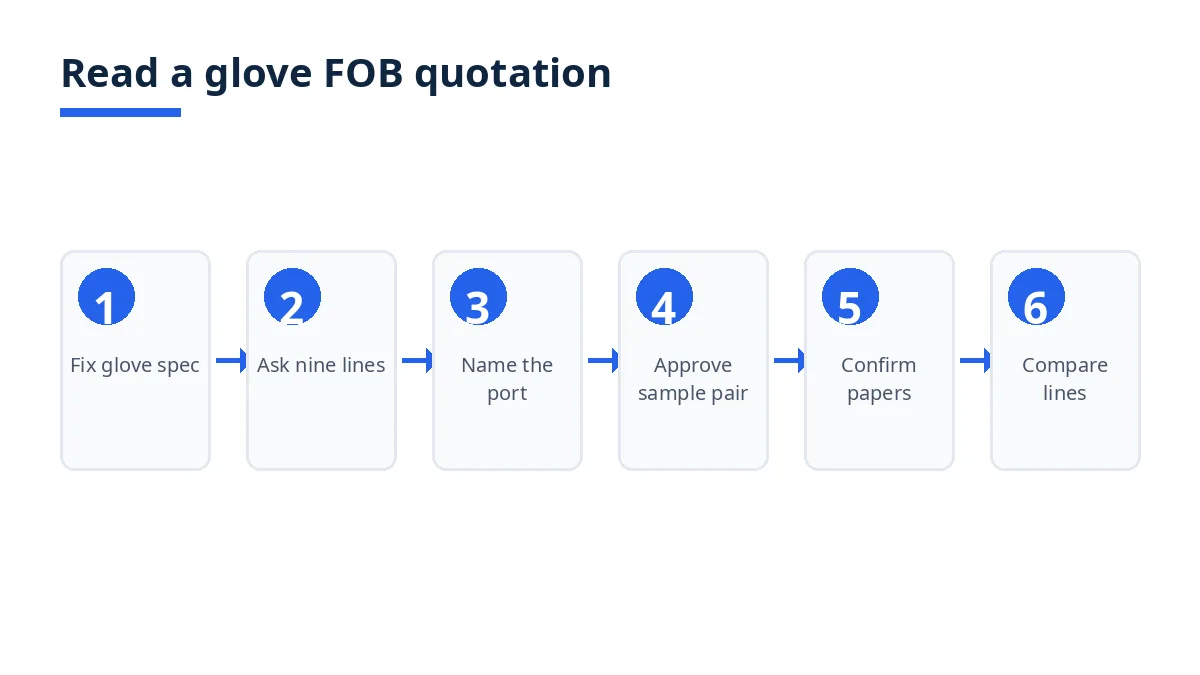
Glove specification in writing: animal, thickness, tannage, finish, lining, closure, and size split, with the kept sample pair named as the standard.
The nine FOB lines itemised, each with its figure, unit, and currency.
Port of shipment named, route stated, delivery rule confirmed, and terminal handling assigned to a line.
Lines excluded from FOB listed separately: ocean freight, cargo insurance, import duty and taxes, and destination charges.
Sample and pre-production approval recorded: the kept sample pair, the production sample gate, and bulk held to the approved pair.
Pair checks and lab evidence agreed: sampling plan, named test methods, lot marking, and the action on a failed lot.
Packing, carton count, and carton marks agreed.
Export papers agreed with the forwarder and broker: Bill of Export set, invoice, packing list, origin evidence, and confirmed classification code.6
Commercial terms in writing: validity date, lead time, shipment window, payment terms, minimum per combination, and the storage rule for a delayed vessel.1 11
What should I settle first about a leather glove price?
Settle the glove and the delivery point before the figure: the animal, thickness, tannage, finish, lining, closure, and size split, the named port of shipment, and the rule that matches the transport. Under FOB, nine lines run up to loading on board at that port, and nothing beyond it.1
What do FOB costs and timelines look like for leather gloves?
Inside FOB are the nine lines listed above. Outside it are ocean freight, cargo insurance, import duty and taxes, and destination charges. No standard timeline exists: agree lead time, shipment window, and validity as written quotation terms.11
Which documents travel with an FOB leather glove shipment?
Settle the list with the forwarder and broker before shipment: export declaration and enclosures, invoice, packing list, bill of lading, specification, classification code, and origin evidence.6 Export clearance stays with the seller under FOB; import clearance stays with the buyer.1
What mistakes most often distort a leather glove price comparison?
Ranking FOB against CIF or DDP totals, using FOB for air or containerised cargo, assuming insurance or clearance sits with the wrong party, mixing per-pair and per-dozen figures, and leaving the port unnamed. Each is fixed by the same discipline: one specification, one rule, one named port, one price basis, and nine lines compared separately.
Next steps on Exportain
Start with Bangladeshi suppliers: open each profile and read the badge meanings before shortlisting. Then read how supplier verification works and the MOQ guide. For line 6, use the gloves quality checklist and the gloves HS code guide before confirming the code with your broker.
Post a free RFQ on Exportain and get quotes from verified Bangladeshi suppliers → https://exportain.com/rfqs
Sources
- FOB & FAS Incoterms® 2020 explained: Key differences. ICC Academy (accessed )
- Glove Company Tips: What's the Best Glove Leather?. Olympia Gloves, (accessed )
- How Are Leather Gloves Made. Khas Industries, (accessed )
- Quality Control Checklist for Leather Gloves From Bangladesh. Exportain, (accessed )
- Certification - Leather Working Group. Leather Working Group (accessed )
- Customs Clearance Procedures for Export. Bangladesh Customs, National Board of Revenue (accessed )
- Classification Detail: HS, 2017, Code 4203. United Nations Statistics Division (accessed )
- Incoterms® 2020 C rules vs D rules: Risk transfer explained. ICC Academy (accessed )
- Govt to fix Savar CETP's deficiencies, back tanneries' own ETPs: Commerce minister. The Daily Star, (accessed )
- How Supplier Verification Works on Exportain. Exportain, (accessed )
- MOQ Meaning (Minimum Order Quantity). Exportain (accessed )
About the author
Sourcing from Bangladesh?
Post a request for quotation and suppliers on Exportain can send you their quotes directly.
Post an RFQ