Typical MOQ for Leather Gloves in Bangladesh (and How to Negotiate It Down)
A leather glove minimum is counted per combination, not per order total. Work the color, lining, size-curve and dye-lot splits, then negotiate with the levers that move each one.
Short answer
There is no single typical MOQ for leather gloves from Bangladesh. Each supplier counts the minimum per style, color, dye lot, size curve, lining, and palm specification, and the combination count sets the smallest order. State every split in the request, work the multiplication, and negotiate by changing a split, using stocked leather, or phasing the order.
On this page
Key takeaways
A glove minimum is counted per combination of style, color, dye lot, size curve, lining, and palm specification, not per order total.
The dye lot binds first: hands cut from different skins or dye lots will not match in shade, so state the lot and the agreed light.
Work the combination count before quoting: in the worked example, 2 colors and 2 linings at 240 pairs per combination mean 960 pairs.
Negotiate by changing a split, accepting stocked leather, simplifying trims, offering a surcharge, or phasing the order, always in writing.
A buyer asks for a small order of leather gloves and hears a minimum far larger than the order discussed. The gap is rarely a refusal. It is usually a counting difference: the buyer counted pairs in total, while the supplier counted pairs per color, per lining, per size curve, or per dye lot, and each count restarted the minimum.
This guide is for buyers sourcing leather gloves from Bangladesh for the USA, UK, EU, or UAE. No typical minimum, price, or lead time is stated as a fact. Every number illustrating a calculation is labeled "Example figures" and uses hand-checked arithmetic.
What a glove minimum is actually counted against
A minimum order quantity is the smallest quantity a supplier will accept for a product on its normal terms, counted per order, per style, or per color, and sometimes combined with a minimum order value.1 For leather gloves, read that definition as a question: counted per what? A supplier can apply more than one basis at once, so one figure can mean very different commitments depending on the unit attached to it.1
Counting basis | What restarts the count | Ask in writing |
|---|---|---|
Style | A new pattern, cut, or design feature | Minimum per style |
Color and dye lot | A new color, or a new dye batch | Minimum per color and per dye lot |
Size curve | A new size breakdown inside the total | Minimum per size range |
Lining | A new lining type or lining run | Minimum per lining |
Palm and reinforcement | A new palm material, welt, or feature | Minimum per palm specification |
Leather lot | A new skin, grade, finish, or tannage | Minimum per leather lot |
Quotations on Exportain state unit price, minimum, lead time, Incoterm, payment terms, and validity, so the counting basis should be visible in the same document as the price.1
The leather lot comes first: dye lot, skin, and shade
Gloves are cut from skins, and skins vary. Natural marks such as scars, insect holes, blood veins, and wrinkles are inherent to hides, so inspection grades by position and size rather than by rejecting every marked skin.2 The usable leather in a lot, not the number of skins bought, decides how many matching pairs the lot can yield.
A dye lot is one batch of leather dyed and finished together. Hides from two lots rarely match in shade. A shade split inside a pair usually means the hands were cut from different skins or dye lots.2 Color must be even within each pair, judged against a stable light source and a color datum.2
State the lot before discussing quantity: animal and skin, grade term, finish, tannage, color, and the shade standard with the agreed light named. Ask whether the quotation covers one dye lot or several, and whether a repeat order will draw on the same lot or a new one. Stock leather may carry a lower minimum than a color dyed to order. Ask which colors are stocked, and still ask for the lot lab report by named method.
How one style becomes several minimums
Keep each split separate in the request for quotation, so a concession on one split is not read as a concession on every split.
Color. A minimum counted per color multiplies across the range: each color must reach the minimum on its own. Fewer colors at the full minimum are often easier to agree than many colors below it.1 Combining colors helps only when they share one dye lot.
Palm, reinforcement, and components. A glove is made of components: for a driver glove, the index and pinky finger with the palm as one piece, the middle and ring finger, a separate thumb piece, and the four back fingers as one piece.3 More components require more leather per pair, so gloves with many components have a higher cutting average, the leather used per pair, and tend to cost more.3 Name the palm material, any reinforcement, and the closure, and ask for the minimum per palm specification.
Size curve. A glove size corresponds to the circumference of the palm in inches, measured around the widest part of the palm just below the knuckle, excluding the thumb, using the dominant hand.4 On one published chart, 6.5 to 7 inches takes size 7, 7.5 to 8 takes size 8, 8.5 to 9 takes size 9, and 9.5 to 10 takes size 10.4 Size charts are not universal, so the supplier's own chart, with its measurement points and tolerances, is the chart the order is graded against.
Lining. The lining types named for leather gloves are cashmere, wool, silk, or unlined, and the lining must lie flat, attach at fingertips and cuff, and not bunch or pull out when worn.2 A lining change restarts cutting and sewing, because the lining is added during sewing and must reach the fingertip and stay secured there.2 Ask whether each lining counts as a separate combination.
Work the multiplication before you quote
Work the count on paper before accepting a quotation. Example figures only: a supplier states a minimum of 240 pairs per color-and-lining combination, and the order has 2 colors and 2 linings.
Combination | Example figures | Smallest order |
|---|---|---|
1 color, 1 lining | 240 pairs | 240 pairs |
2 colors, 1 lining | 240 pairs per color | 480 pairs |
1 color, 2 linings | 240 pairs per lining | 480 pairs |
2 colors, 2 linings | 240 pairs per combination, 4 combinations | 960 pairs |
The size curve divides each 240-pair combination. Example figures: sizes 7, 8, 9, 10, and 11 at 30, 60, 60, 60, and 30 pairs total 240 pairs. Work in this order:
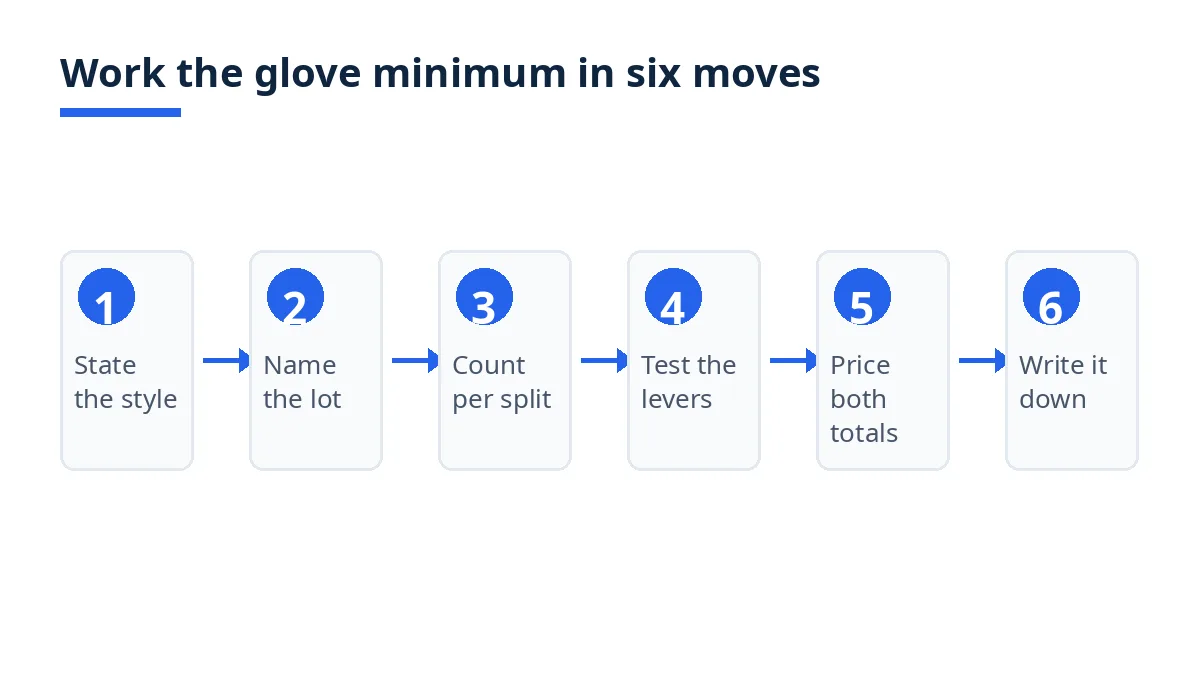
Cutting the range from 2 colors and 2 linings to 1 color and 1 lining takes the smallest order from 960 pairs to 240 pairs in this example, because the combinations fall from four to one. Adding a third color adds one full combination.
Six levers that move a glove minimum, and what each one trades away
An MOQ can often be discussed, but a smaller order usually costs more per unit, and none of the options below is guaranteed: raise them as questions and expect a trade-off.1 Record each agreed change on a new quotation version.
Combine colors on one dye lot. Ask whether two colors can share one dye lot and one shade agreement, or whether one color can serve the range.
Accept stocked leather and a running color. Ask whether the style can be made from leather the supplier or its tannery already carries, instead of a custom color or finish. Stock leather can remove a custom dye-lot minimum, as stock fabric can remove a custom fabric minimum.1 The lot must still be tested.
Simplify the lining and palm. Ask whether one lining, one palm specification, and standard closures can serve the order. Fewer combinations mean fewer changeovers.
Accept standard trims and packing. Custom labels, hang tags, printed polybags, and branded cartons each bring a minimum of their own, and a custom label made only in large runs can drive the minimum.1 Ask which trims drive the figure.
Offer a surcharge, or order up to the minimum, and compare both totals. Ask what a below-minimum surcharge would be, so the decision uses a concrete number.1 Example figures: a surcharge of 5 index units per pair on 200 pairs adds 1,000 index units and leaves no extra stock, while ordering up to a 240-pair minimum adds 40 pairs at 100 index units, or 4,000 index units, and leaves 40 pairs in stock. The trade-off is cash against stock.
Phase the order, with the repeat in writing. Ask whether a first shipment of core colors and sizes, with a written repeat price and minimum for the rest on the same lot, can succeed where a small order covering every combination fails. Share a realistic forecast, and do not promise volumes that cannot be placed.1
Do not trade away testing for a lower minimum. Require the lab report for the lot offered, naming the method, and agree the inspection plan in writing. No sampling or defect figure is stated here as a universal rule: the values are the ones written into the purchase order for that lot.
What a smaller minimum does to price, timing, and paperwork
Price tiers mean the unit price falls in steps as quantity rises, and small orders cost more per piece, because costs that do not shrink with quantity, such as leather, trims, line planning, quality checks, and export paperwork, are spread across fewer pairs.1 Asking for the lowest minimum and the lowest tier price together asks for two things that pull in opposite directions: the top-tier price assumes the top-tier quantity.1 Check both sides of every price break with example figures: 940 pairs at 100 index units cost 94,000 index units, while 960 pairs at 96 index units cost 92,160 index units, so ordering 20 more pairs costs less in total at the break. The agreed price is the one in the accepted quotation.1
Timing follows the lots, not the order total. Dye-lot scheduling, sample approval, lab turnaround, and inspection booking each take their own time, and a phased order adds a second production slot. No standard lead time is stated here: agree the time per stage in writing, tied to the lot it covers.
Reading the Bangladesh supply chain behind a glove quotation
The leather in a glove order usually starts at a tannery, and the glove maker cuts and sews what the tannery supplies. Ask for the tannery name and lot identity, separately from the glove maker's evidence.
Tannery evidence rides with the tannery, not with a single lot. The Leather Working Group audit, first launched in 2005, assesses a tannery's manufacturing operations across 17 sections, with thresholds of 85 percent for Gold, 75 percent for Silver, 65 percent for Bronze, and 50 percent for Audited, and the final medal is set by the lowest-scoring section.5 Certification is valid for 24 months for leather manufacturing facilities, and does not guarantee no restricted substance failures in a final product.5 For Gold and Silver, chromium VI must be below 3 mg/kg, and any level above that results in automatic failure.5 Ask for the audit evidence, then ask separately for the lot lab report by named method.
Most Bangladeshi tanneries sit at the Savar Tannery Industrial Estate, after the move from Hazaribagh. In May 2026 the commerce minister said the central effluent treatment plant at Savar could treat between 14,000 and 18,000 cubic meters of waste a day, against about 45,000 cubic meters needed in the peak period after Eid-ul-Azha.6 Ask how the tannery behind the glove leather treats its effluent, and what third-party evidence covers the lot offered.
The Leathergoods and Footwear Manufacturers and Exporters Association of Bangladesh is the trade body for manufacturers and exporters of leather products, footwear, synthetic, and allied factories in Bangladesh.7 A directory check proves membership only. Test capacity with a trial lot.
Signals that the minimum was never settled
A number with no unit. A minimum without per style, per color, per lining, or per lot tells the buyer nothing. Ask for the counting basis in writing.
A price agreed before the splits. A price agreed before the splits are fixed will move when they are fixed.
A sample pair from a different lot. Approve sealed sample pairs per combination, and record which lot each pair came from.
A shade agreement with no light named. Agree the light and the color datum, and sort into bands.2
A lining or palm change treated as a detail. Treat each as a new combination until the supplier confirms otherwise.
A badge read as a production check. Verification on Exportain is a review of documents and photos by Exportain staff, not a factory visit, and a badge is not a guarantee of production capacity, product quality, or delivery.8
Settle these lines in the quotation before you order
Style, pattern, and design features, with the glove job and any sporting or protective purpose stated.
Leather lot: animal and skin, grade term, finish, tannage, dye lot, shade standard, and agreed light.
Minimum per style, per color, per lining, per palm specification, and per lot, with the combination count worked.
Size curve per combination, with the supplier's size chart, measurement points, and tolerances attached.
Lining, palm, reinforcement, and closure per combination, with the sample pair sealed per combination.
Lab tests by named method for the lot offered, and the inspection plan with buyer-specified values, agreed in writing.
Price tier basis, surcharge or order-up comparison, payment terms, Incoterm, and validity dates.
Broker confirmation of classification per glove type, where needed.
What should I know first about leather gloves?
Know the order as a set of splits, not one number: per style, per color and dye lot, per size curve, per lining, and per palm specification. Gloves are judged as pairs, so finger length, thumb angle, lining attachment, and shade must match left and right together.2
What are the typical costs and timelines?
There are no typical costs or timelines a guide can state as fact: each supplier prices the skin, grade, finish, lining, palm work, size range, and delivery term for that order. A smaller order usually costs more per pair, and timelines follow the dye lots, sample approval, and lab reports.1 Compare quotations only on one identical specification.
Which documents are needed?
The order documents are the specification, the accepted quotation stating the minimum per split, and the purchase order carrying the same splits and validity dates. Keep the lot lab report and the sealed sample record with the shipment documents. Ask for the trade license and Export Registration Certificate yourself, and check that the name and address match the quotation and invoice.8
What are the most common mistakes?
The most common mistakes are agreeing a number with no counting unit, asking for the lowest minimum and the lowest tier price together, accepting a lower minimum verbally, adding a specification late, approving a sample from a different dye lot, judging shade under different lights, treating a tannery audit as a lot certificate, and paying before the splits are written.
Next steps on Exportain
Browse suppliers, then read the supplier verification guide and the MOQ guide. Check the leather gloves quality checklist and the HS code guide for leather gloves while writing the specification. When the splits are fixed, post a free RFQ on Exportain with the quantity per style, color, lining, and size, and the flexibility offered on each lever.
Sources
- MOQ Meaning (Minimum Order Quantity). Exportain (accessed )
- Quality Control Checklist for Leather Gloves From Bangladesh. Exportain, (accessed )
- How Are Leather Gloves Made. Khas Industries, (accessed )
- How to measure glove size. Ansell (accessed )
- Certification - Leather Working Group. Leather Working Group (accessed )
- Govt to fix Savar CETP's deficiencies, back tanneries' own ETPs: Commerce minister. The Daily Star, (accessed )
- President's Message - LFMEAB. Leathergoods and Footwear Manufacturers and Exporters Association of Bangladesh (LFMEAB) (accessed )
- How Supplier Verification Works on Exportain. Exportain, (accessed )
About the author
Sourcing from Bangladesh?
Post a request for quotation and suppliers on Exportain can send you their quotes directly.
Post an RFQ