

Leather Belts Exporters in Bangladesh: Supplier Verification Checklist
Three passes for checking a leather belt exporter in Bangladesh: what each Exportain badge records, how to test the belt in hand, and which terms to lock before payment.
Short answer
Check a leather belt exporter in Bangladesh in three passes before you pay: read each Exportain badge for the exact document and photo checks it records, match identity and export documents, name the site and tannery, test a sample built to your tech pack, and lock the minimum, inspection, payment and export papers in writing. Hold the order while any pass is open.
On this page
Key takeaways
A badge records a document and photo review by Exportain staff, not a factory inspection or a guarantee; check the documents, sites, samples and inspection terms yourself.
Work three passes in order: paper before contact, the belt in hand, and the order file before payment, and hold the order while any pass is open.
Tannery and laboratory evidence must name your leather, your tannery and your belt; evidence for a different leather, tannery or product is background only.
Record a pass or hold for each pass, with the evidence held and the owner named, and re-run the passes a change of leather, site, tannery or market touches.
Profiles of leather belt exporters in Bangladesh can look alike. Each one lists straps, buckles, colours and a minimum, and each one claims it can make your belt. The difference between a supplier you can order from and one you should hold sits in three kinds of evidence: what Exportain staff have already reviewed, what names your belt, your leather and your site, and what has been tested on a belt built to your specification.
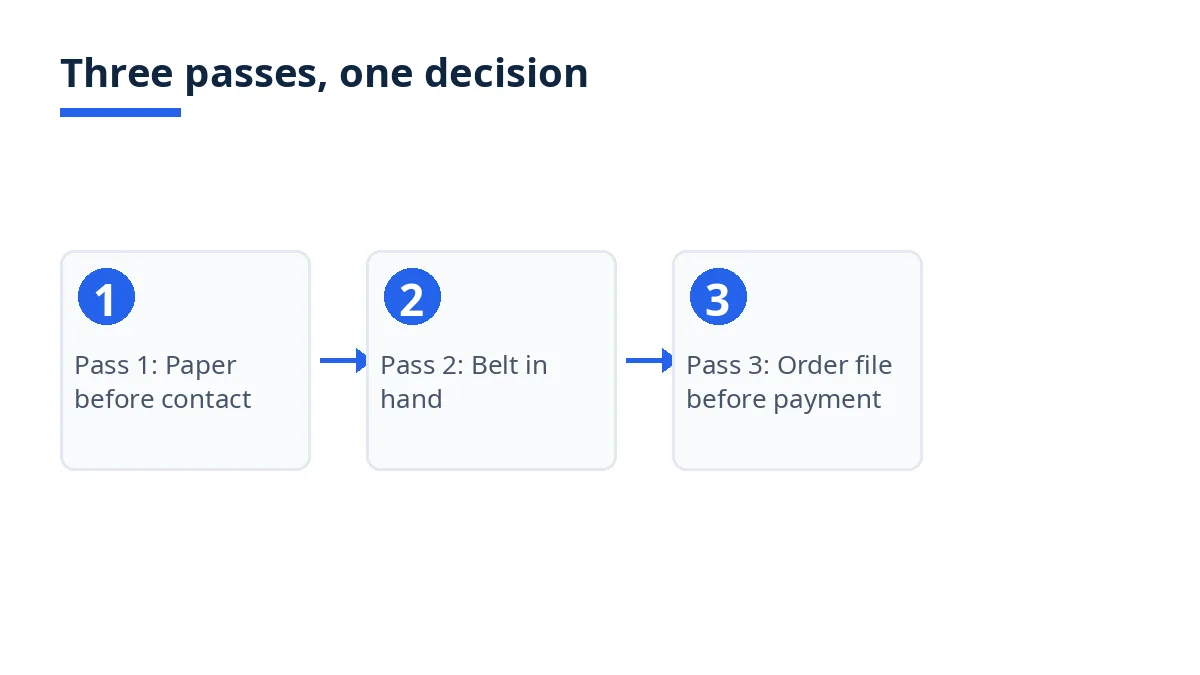
This checklist works in three passes. Pass 1 is paper, checked before samples. Pass 2 is the belt in hand. Pass 3 is the order file, settled before payment. An uncleared pass holds the order, whatever the price. Run all three for each supplier on the same specification, keeping one evidence file per supplier. It is written for buyers in the USA, the UK, the EU and the UAE placing a first order with a new exporter, and for buyers returning after a change of leather, tannery, site, buckle or market.
Why this checklist matters
A trust badge on Exportain records a document and photo review, not a factory inspection. Verification is a document review by Exportain staff, and it is not a check against any government database.1 A badge is not a guarantee of production capacity, product quality or delivery.1 Badges therefore shorten a shortlist. They do not replace the checks that protect a real order: asking for the documents yourself, approving a sample, inspecting before shipment, choosing payment terms that match the risk, and putting the terms in writing.2
That division is the logic here. Pass 1 reads each badge and document for exactly what it records. Pass 2 proves the belt. Pass 3 proves the terms. No pass substitutes for another: a sound file says nothing about hole spacing, and a sound sample says nothing about whether the site was named.
Before you start
Send every supplier the same specification: belt type, strap construction, leather type, grain, thickness, colour and finish, width, hole count and spacing, buckle and keeper, tip, edge finish, stitching, lining where fitted, size run, labels and packing.3 State how each belt is measured, laid flat, uncoiled and relaxed, buckle to tip and buckle to each hole, using the same condition for every belt.3 Add the shade standard and light, the defect classes, and the sampling plan, with values you specify rather than any figure assumed from a standard table.
Name one owner for the file, one decision rule, and one date for each pass. Each check is marked pass only when the named evidence is held in the file, and the order waits while any check is marked hold. A supplier that answers with a general assurance instead of the named evidence has not cleared the check. Ask again, in writing, with a date. If the evidence cannot be produced, hold the supplier and move to the next one on the shortlist.
The diagram below shows the three passes in order.
The full checklist, in pass order
Work the passes in order. Do not skip to samples because a profile looks strong, and do not agree payment terms because a sample looks good. Hold a pass when the stated evidence is missing, names something else, or has expired.
Pass 1: Paper before contact
Pass 1 is done from profiles, documents and the destination tariff. It answers one question: what has actually been reviewed, and does the company on paper match the company that will make the belt?
Read each badge for what it records. Read the badge sentence, not the badge colour. Exportain Verified records identity, phone, email and business registration checks; Export Verified records an Export Registration Certificate (ERC) check; Factory Verified records reviewed photos of the factory; Trading Company Verified records reviewed photos of the trading company office or warehouse; and Trusted Trader records completed orders on Exportain with no disputes.1 Record which badges are held and which are not. A missing badge is an unchecked check, not a failed one.
Read the profile trust and verification checklist, with dates. The profile lists each check as verified or not verified, and where it applies, shows the date a check was verified and the date it is valid until.2 Record those dates. The list also includes a payment account line: when verified, the supplier bank account was checked against its verified company name, with no bank details shown to buyers.2 Treat it as a name match only; confirm payment details through a second channel in Pass 3.
Match identity documents against the quotation. Ask for copies of the trade licence and the ERC, and check that the legal name and address match the quotation and the invoice.2 Where a TIN or incorporation document was provided, check it against the same name and address.1 Resolve any difference in writing before discussing price, even when explained as a group or trading name.
Name the producing site for each style. Record which site cuts, stitches and finishes your belt, which site tanned or supplied the leather, and which stages are bought in, such as buckle setting, lining, edge paint or packing. A company can sit in more than one route, from tannery-integrated strap making to trading consolidation, so judge each order by the route that controls it.3 For a trading company, record the producing factory for each style before any deposit and name it in the order terms: a badge records checks for the profile holder only.3 Hold the pass when a site is unnamed, or when one style site is assumed to cover another.
Check product certifications as documents, not as labels. A certification marked "Verified by Exportain" means Exportain staff reviewed the certificate the supplier uploaded for that product, and it appears only while approved and not past its expiry date.2 Anything the supplier simply typed in is marked as declared by the seller, and Exportain has not verified it.2 Record name, issuing body, number where given, scope and valid-until date, and confirm any certificate that matters with the issuing body.2 A certificate for a different product, site or scope is background only.
Settle the indicative classification before pricing is fixed. The United Nations Statistics Division lists subheading 420330 as belts and bandoliers, of leather or of composition leather, under heading 4203, articles of apparel and clothing accessories, of leather or of composition leather.4 Treat 4203.30 as indicative and confirm the subheading and full national code with your broker for the exact belt before you fix a price.5 Test the boundaries: a watch strap is excluded from heading 4203 and falls under heading 9113, belting leather for machinery sits in heading 4205, a textile or plastics strap is tested under the headings for its own material, and a loose buckle is classified on its own terms.5 In the United Kingdom tariff, 4203.30 splits into hand-made and other, so answer the hand-made question before choosing the final digits.5 No duty rate is stated here.
Pass 2: Belt in hand
Pass 2 is done with a sample built to your specification, in your leather, colour and buckle. It answers one question: does this belt work as worn, and does the evidence name this belt?
Approve a sample built to the tech pack. Ask for a sample in your layout, leather, colour, buckle finish and edge finish, with the hole count and spacing, tip shape, stitching and lining from the tech pack.3 The quality control checklist for leather belts works along the strap in the order a wearer notices each fault, starting with length, hole spacing and hole count, then buckle fit, keeper travel and tip shape.6 Test it as worn: fasten and release it, pass the tip through the keeper, and check it lies flat. Do not approve bulk production from a photograph, or accept a different leather, colour or buckle as proof for your belt.
Test the hole run, buckle, keeper and tip through their full travel. Check length buckle to tip and buckle to each hole, hole spacing, count, shape, alignment and edge distance, strap width and thickness, buckle frame and prong fit, buckle operation at the first, middle and last holes, attachment, keeper position, travel and fit, and tip shape when worn, all against the size chart and tech pack.6 Record each measurement with its condition stated. Hold the pass when a hole drifts, a prong will not seat, a keeper slides, or a tip curls or lifts.
Check leather, grain, shade and edges along the full strap. Check leather type and grain, grain and shade buckle end to tip and between belts under the agreed light, surface defects graded by position and size, stitching on both edges and at buckle end, keeper and tip, and edge finish along the full length, including cracks and peeling where flexing is greatest.6 Natural marks are inherent in genuine leather, so grade by position and size: a mark minor on a wide panel can cross a full strap width.6 Agree the grading rule before cutting, and hold the pass when shade has no named light.
Treat the buckle as its own evidence line. Check the buckle frame against the approved sample in shape, size and finish, the prong seating in every hole, the attachment bar, loop or rivets as specified, and the finish for rust, scratches and burrs.6 Record the buckle finish separately from the strap: a buckle finish carries a minimum of its own, and a change of finish can change the counting basis in Pass 3.3 A belt without a buckle does not leave 4203.30, and a fitted buckle does not by itself move the belt elsewhere, but that does not settle whether the buckle works.5 Hold the pass when the sample buckle differs from the specified buckle, even when the strap is sound.
Check tannery evidence against the leather in your sample. Record which tannery made the leather in your sample, for each style and colour. The Leather Working Group (LWG) audit, first launched in 2005, assesses how a tannery measures, controls and reports the impact of its operations across 17 sections, including water and energy, chemical and waste management and effluent treatment.7 Section ratings use thresholds of 85 percent for Gold, 75 percent for Silver, 65 percent for Bronze and 50 percent for Audited, and the final medal is the lowest category achieved.7 Certification is valid for 24 months for leather manufacturing facilities, commissioning manufacturers and subcontractors.7 Ask for the certificate and any test report naming your leather, tannery and method, and check holder, site, coverage and expiry; evidence naming a different tannery or leather is background only. LWG states that certification does not guarantee no restricted substance failures in a final product, that leather is chrome-free below 1,000 mg/kg of total chromium on a dry weight basis, and that chromium VI must be below 3 mg/kg for Gold and Silver.7 Confirm the certificate with the issuing body where it matters, and retest when leather, tannery, dye or finish changes.
Require laboratory reports that name your belt. Send your restricted substances list at the enquiry stage, before sampling, naming the styles, leathers and colours it covers. Require each report to name your product, leather and method, and record the result against the limit your market applies, with no universal grade or pass mark assumed. The belt checklist treats lab evidence the same way: the report names the method and records the result against the buyer specification, including colourfastness to rubbing under ISO 17075 where specified.6 A report for one limit, product, leather or colour does not clear this check for another.
Pass 3: Order file before payment
Pass 3 is done on paper again, with the sample approved. It answers one question: are the quantity, inspection, payment and export papers all agreed in writing, on the same terms, before money moves?
Get the minimum counting basis in writing. A minimum order quantity is the smallest quantity a supplier will accept for a product on its normal terms, counted per order, per style or product, or per colour, and sometimes combined with a minimum order value.8 On a belt order the basis can also run per size range or per buckle finish, so ask for it in writing, with the supplier own total for your exact mix, before you plan colours, sizes and finishes.8 There is no standard minimum for Bangladesh or for belts that can safely be assumed, so confirm the unit as carefully as the number.8 Ask which input drives the minimum: custom leather brings the mill minimum into the workshop minimum, labels and buckles each carry minimums of their own, and every extra colour or finish adds changeovers.3
Check capacity with dates attached. Ask what is in production now, when your run would start, what happens if leather or buckles arrive late, and when the pre-production sample will be ready.3 State in the order that bulk production starts only after written approval of a pre-production sample in your leather, colour and buckle.3 An answer without dates is not evidence. Hold the pass when the start date, sample date or input source is unstated, and re-check capacity when leather, tannery or site changes.
Agree inspection terms before production. Agree the inspection standard, sampling plan, defect classes and the values you specify, and the action on a failed lot, in the order terms, before production.6 Name the inspector and report format, covering lot, sample size, defects with photographs, measurements, packing, and hole and buckle function, and agree packing that keeps belts flat.6 A supplier checking its own work is factory quality control, not an independent inspection; an independent pre-shipment inspection checks finished goods against your order, with sampling basis and acceptance values agreed in writing.2 No sampling or defect figures are stated here as rules: the values are yours to specify.
Put payment terms in writing and confirm bank details twice. Agree the unit price, currency, Incoterm, payment schedule, inspection and shipment terms in writing before you pay, and confirm bank details through a second channel.2 On Exportain, money for a goods order is held only when both parties agree to a funds hold, and without a hold, payment is arranged between buyer and supplier on the terms stated in the proforma invoice.1 Treat any late change to bank details as a reason to pause, and pay no deposit while any Pass 1 or Pass 2 hold remains open. Suspected fraud, such as counterfeit certificates or a company claiming another company factory, goes to the verification team, where reports are handled by people, not automatically.1
Confirm the export document set the supplier must produce. Goods must not be loaded or stuffed for export unless a Bill of Export, also called a shipping bill, has been submitted to Customs and approved, stating the goods, value, exporter, foreign buyer and transport operator.9 Its enclosures for all export consignments are the export letter of credit or, where there is none, the export contract, purchase order or export guarantee approved by the negotiating bank; the signed commercial invoice; the packing list; the EXP form certified by an Authorized Dealer bank; the certificate of origin issued by the Export Promotion Bureau or a chamber of commerce and industry; the VAT registration certificate; and the Taxpayer Identification Number.9 Ask for copies of the invoice, packing list and certificate of origin before loading, and check the belt description matches the classification description: belt type, strap material, buckle fitted or not, and any attached holder.5 Fix any difference at the source document, and reissue every document that copied it.
Record the decision, pass by pass. Record a pass or hold per pass, with evidence, owner and date, and order only when every pass is pass. Note the re-run triggers: a new style, leather, colour, buckle finish, site, tannery or market reopens the passes it touches.
Red flags that stop the sequence
A red flag is not a point to negotiate. It stops the sequence until the named evidence is produced, or it ends the shortlisting of that supplier. Record the flag, the date and the supplier answer in the evidence file.
Red flag | What it means | First action |
|---|---|---|
Badge claimed beyond its sentence | A badge is described as a factory inspection, a guarantee or a certificate | Ask for the badge sentence in writing, and re-read the profile checklist |
Names differ across documents | Licence, ERC, quotation and invoice do not match | Hold the order and resolve the difference in writing |
Site or tannery unnamed | The producing site or tannery behind the sample is not named | Ask for the site and tannery per style, in the order terms |
Evidence names another belt | A certificate, report or sample covers a different leather, product or colour | Ask for evidence naming your belt, and retest on your own sample |
Minimum counted on an unstated basis | The quotation states a number without per order, per style, per colour or per finish | Ask for the counting basis and the supplier own total in writing |
Bank details changed late | Payment details change after terms were agreed | Pause, confirm through a second channel, and do not pay |
Inspection agreed after production | Sampling, defect values or the inspector were settled once goods were made | Agree the terms in writing before the next run, and inspect the finished lot to your values |
Summary table: one supplier, one page
There is no file to download with this article. Copy the table below into the supplier file, one row per pass, and add the contract number, specification version, owner and check date for each line. A pass is marked pass only when the evidence in the middle column is held.
Pass | Evidence to hold | Decision |
|---|---|---|
1. Paper before contact | Badge sentences, profile checklist with dates, matching identity documents, named site per style, certification scope and expiry, broker-confirmed indicative code | Pass or hold |
2. Belt in hand | Tech-pack sample record, hole and buckle function results, leather and shade record, buckle evidence, tannery certificate and report, lab reports naming your belt | Pass or hold |
3. Order file before payment | Counting basis and supplier total, dated capacity, inspection terms and report format, payment terms and bank check, export document copies | Pass or hold |
Compare the product checks in Pass 2 with the quality control checklist for leather belts, the classification boundaries in Pass 1 with the HS code guide for leather belts, and the minimum in Pass 3 with the MOQ guide. Read the badge sentences in full in how supplier verification works on Exportain before you shortlist.
When should this checklist be used?
Use it before a first order, when a supplier changes site, leather source, tannery or range, and when the market changes. Run Pass 1 at shortlisting, Pass 2 at sample approval, and Pass 3 before any deposit. A pass cleared for one style, leather, colour, finish or site does not clear it for another.
Who should complete it?
The buyer owns the checklist, the passes and the decision. The supplier supplies documents, names sites and tanneries, and produces the sample. A forwarder or broker can complete the classification and export document parts, and an inspector or laboratory can complete the sample, inspection and chemical parts. Each third party needs the specification, quotations, documents and written authority. Keep inspector and maker separate: a supplier checking its own work is factory quality control, not independent inspection.
What are the most common failures?
A badge read as a guarantee, documents that do not match the quotation, an unnamed site or tannery, a sample approved from a photograph, evidence for a different leather or product, a minimum on an unstated basis, bank details changed late, and a code copied from another product or country. Each is fixed in writing, with named evidence, before the order proceeds. The most common failure is treating one pass as proof for the others.
Can a third party do it?
Yes. A third party can check documents, confirm certification claims with the issuing body, inspect the sample and finished goods, arrange laboratory testing, and confirm classification and the export document set with the broker. It needs the specification, quotations, documents, sample record and written authority, and must report lot, sample size, defects with photographs, measurements, packing, and hole and buckle function. The buyer remains responsible for the decision.
Next steps on Exportain
Send one specification to every shortlisted supplier, so replies are judged on the same belt, leather, buckle and counting basis. Browse suppliers, open each profile trust and verification checklist, then post an RFQ with your specification, counting basis and delivery term, and compare replies pass by pass. Exportain is a B2B marketplace where buyers find Bangladeshi suppliers and post requests for quotation. It is not a party to the contract for the goods, and it does not inspect goods, book freight or clear customs.
Sources
- Trust & Safety Center. Exportain (accessed )
- How Supplier Verification Works on Exportain. Exportain, (accessed )
- Top Leather Belts Manufacturers in Bangladesh: How to Find and Verify Them. Exportain (accessed )
- Classification Detail: HS, 2017, Code 4203. United Nations Statistics Division (accessed )
- HS Code for Leather Belts: Classification Guide for Importers. Exportain, (accessed )
- Quality Control Checklist for Leather Belts. Exportain, (accessed )
- Certification - Leather Working Group. Leather Working Group (accessed )
- MOQ Meaning (Minimum Order Quantity). Exportain (accessed )
- Customs Clearance Procedures for Export. Bangladesh Customs, National Board of Revenue (accessed )
About the author
Sourcing from Bangladesh?
Post a request for quotation and suppliers on Exportain can send you their quotes directly.
Post an RFQ


