Typical MOQ for Knitted Underwear in Bangladesh (and How to Negotiate It Down)
No single knitted underwear MOQ in Bangladesh: what sets the minimum per style, colour and size ratio, how to ask, and how to negotiate or structure a smaller order.
Short answer
There is no single typical MOQ for knitted underwear from Bangladesh. Each factory sets its minimum per style, per colour and per size ratio for your specification, driven by fabric and dye lots, elastic and waistband runs, cutting efficiency and label and packing runs. Ask for the minimum per style and per colour in writing, then negotiate the split or the set-up costs.
On this page
Key takeaways
There is no single typical MOQ for knitted underwear from Bangladesh, because each factory sets its minimum per style, per colour and per size ratio for your specification.
Fabric and dye lots, elastic and waistband runs, cutting efficiency and label, tag and packing runs are the drivers that set the floor.
Ask for the MOQ per style and per colour in writing, with the size ratio stated and set-up costs itemized apart from the unit price.
Negotiate the structure first: fewer colours, stocked fabric and stock elastic, one fabric shared across two styles, and set-up paid as a separate line.
Exportain verification is a document and photo review, not a factory inspection, and a badge is not a guarantee.
Ask several factories for the knitted underwear MOQ in Bangladesh for the same cotton brief and you will get different answers. There is no single typical MOQ for knitted underwear from Bangladesh, because each factory sets its minimum for your specification, usually per style and per colour, and inside each colour by the size ratio you ask for.
The Bangladesh Knitwear Manufacturers and Exporters Association (BKMEA), established in 1996, is the apex trade body for the knitwear sector and represents approximately 2,540 member factories.1 Knitwear exports reached $5.963 billion in July to September 2026, up 6.88 percent year on year, within ready-made garment exports of $10.578 billion, according to data released by the Export Promotion Bureau (EPB).2 That scale produces no shared minimum.
What sets the knitted underwear MOQ in Bangladesh
What should I know first about knitted underwear?
The binding minimum is almost never the headline total. A quote carries separate minimums underneath it, and the one you miss decides whether the order can run.
Per style, per colour and per size ratio. A style change means a new pattern, new markers and a line set-up, and a colour change means a new dye lot and elastic set. Inside a colour, the size ratio decides how the pieces divide across sizes. Factories therefore state MOQs per style and per colour, for a stated size ratio. A large total can still fail if one colour is too small to dye or cut alone.
Fabric and dye lots. Underwear is usually cut from knitted single jersey, rib or interlock fabric, knitted and dyed in lots. A dyed-to-order colour carries the lot minimum with it. A stocked fabric in a standard colour may carry a lower minimum. State the composition, construction and weight, and whether each colour is stocked or dyed to order.
Cutting efficiency. Underwear pieces are small, so one marker holds many pieces across several sizes. How the pieces fit decides how much fabric each piece consumes, so a wide size range, an uneven ratio or many small colour runs waste more fabric per piece. Factories protect that waste in the minimum or in the unit price.
Elastic and waistband runs. Waistband elastic is bought or woven per style and per colour, and a jacquard waistband woven with your brand name is made in its own run for your order only. Leg elastic and binding follow the same pattern, and that work is fixed whether the run is short or long, so factories recover it through the minimum or a set-up charge. Ask whether elastic sits inside the garment MOQ.
Labels, tags, polybags and cartons. Woven labels, size and care labels, hang tags and printed cartons are ordered in their own print runs, each with its own minimum, and retail packing adds polybags or printed boxes per pack format. A private-label order can meet the garment minimum and still fall below the label run.
In the Harmonized System, heading 6107 covers underpants, briefs, nightshirts, pyjamas, bathrobes, dressing gowns and similar articles for men or boys, knitted or crocheted,3 and heading 6108 covers slips, petticoats, briefs, panties, nightdresses, pyjamas and similar articles for women or girls, knitted or crocheted.4 If you sell into the European Union, Regulation (EU) No 1007/2011 states that a textile product shall be labelled or marked with the name and percentage by weight of all constituent fibres in descending order.5 See the HS code for knitted underwear guide and the MOQ definition guide.
Driver | What sets the floor | State in your enquiry |
|---|---|---|
Style | Pattern, markers and line set-up | Style, with tech pack |
Colour | Dye lot per colour | Quantity per colour |
Size ratio | Pieces per size inside each colour | Ratio per colour |
Fabric | Knitting and dye lot | Composition, construction, weight |
Cutting | Marker efficiency across sizes | Size range and ratio |
Elastic | Waistband and leg elastic runs per style | Elastic type, width, branding |
Labels and packing | Separate print and pack runs | Label, tag, bag and carton spec |
Example figures: a buyer splits 1,200 pieces across four colours at 300 per colour, in a six-size ratio. The total clears the factory minimum while each colour sits below its per-colour dye minimum. The same 1,200 pieces in two colours at 600 per colour can clear both lines. The example shows structure only, not a typical MOQ, price or lead time.
Why this matters for buyers and sellers
For the buyer, the MOQ decides how much cash sits in stock and whether a first order can test a style and ratio before a larger repeat. For the seller, the minimum protects the run: fabric dyed for your colour, waistband elastic woven with your brand and labels printed with your name cannot be sold to another buyer, and a short run still uses the dye lot and line change, so cost per piece rises as quantity per colour falls.
Two controls keep the negotiation grounded. The first is an inspection plan agreed before production. ISO 2859-1 defines a system of acceptance sampling plans for inspection by attributes, indexed by acceptance quality limit (AQL) for lot-by-lot inspection.6 The second is one delivery term for every quotation: the Incoterms 2020 rules set out 11 rules with a clear allocation of cost, risk and obligations.7
Step-by-step: how it works
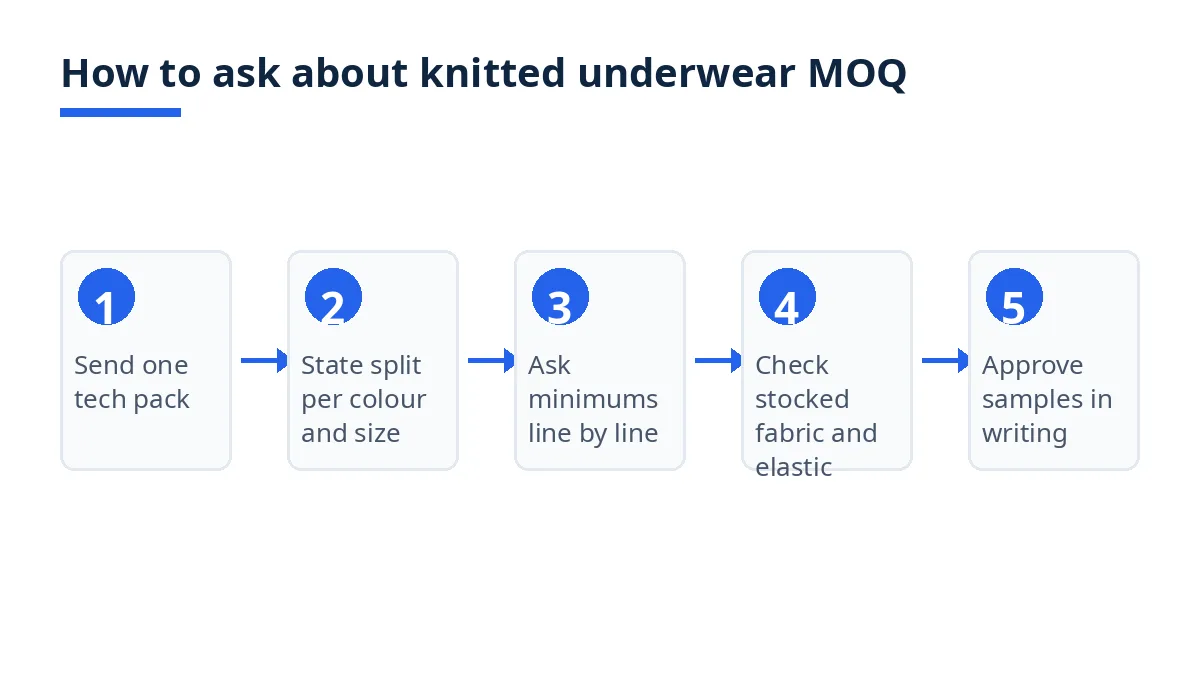
Send one tech pack to every candidate. State fabric composition, construction and weight, style (brief, boxer brief, trunk or panty), waistband type and width, leg finish, size chart, labels, and packing format.
State the split, not only the total. Give the quantity per style, per colour and per size, as one size ratio per colour. A total without a split cannot be answered with a usable MOQ.
Ask for the minimums line by line. Ask for the MOQ per style, per colour and dye lot, the ratio the quote assumes, and any separate elastic, label, tag, bag and carton minimums, and which line is binding.
Ask what is stocked. Record whether each fabric colour is stocked or dyed to order, and whether waistband elastic, leg elastic and labels are stock items. Stocked inputs are where a lower minimum is most often possible.
Approve samples in writing. Order a proto sample, then a pre-production sample in your actual fabric, colour, waistband and labels. Measure it, wash it, check elastic recovery, then approve or list corrections in writing.
Agree inspection and delivery term before you confirm. Write the inspection level and AQL values into the purchase order, following ISO 2859-1,6 and state one Incoterm and named place for every quotation. The Incoterms 2020 rules allocate cost, risk and obligations for each rule.7
See the knitted underwear quality control checklist for fit, elastic and stitching points.
How to negotiate or structure a smaller order
Negotiation works when you change the structure that creates the minimum, not when you ask for an exception. Get the result in writing.
Reduce the number of colours first. Colours multiply dye lots, elastic sets and cutting runs. Cutting one colour raises the quantity per remaining colour at the same total.
Share one fabric across two styles. A brief and a boxer brief cut from the same fabric and colour share one dye lot. Ask whether the fabric minimum can be met across both styles combined, in writing.
Use stocked fabric and stock elastic. A standard colour in a stocked jersey, with a plain stock waistband instead of a woven jacquard band, removes the dye lot and the branded elastic run. Ask for the stock list before you finalise colours.
Pay set-up as a separate line. Where the floor comes from jacquard waistband weaving, label runs or printed boxes, ask for those costs apart from the unit price. The run can then be shorter, and the same set-up serves the repeat order.
Simplify the waistband and label work. A printed or plain elastic, one label design across sizes apart from the size mark, and one pack format reduce set-up.
Stage the order. If the factory cannot move, place a smaller first order in fewer colours, with a written repeat price and MOQ for the same specification. Do not negotiate by removing sample approval or inspection.
Costs, timelines and documents
What are the typical costs and timelines?
There are no typical costs or timelines a guide can state as fact, for the same reason there is no typical MOQ. Each factory prices your fabric, construction, elastic, label and packing runs, finishing and the delivery term you choose.7
For timelines, sampling depends on fabric and elastic availability and correction rounds, and bulk production on dyeing, elastic delivery and line capacity. Ask for sampling, fabric ready, production and inspection dates as separate lines.
Which documents are needed?
For export clearance in Bangladesh, goods may not be loaded unless an export declaration, the Bill of Export or Shipping Bill, is submitted to Customs and approved.8 Enclosed documents include the export contract or purchase order where there is no export letter of credit, the commercial invoice, the packing list, the EXP form certified by an authorized dealer, and a certificate of origin issued by the EPB or a Chamber of Commerce and Industry.8
Bangladesh-specific rules and tips
Confirm association claims at the source. If a supplier claims BKMEA membership, confirm it with the association itself. BKMEA represents the knitwear sector and its member factories,1 so membership signals an active knitwear business, not the MOQ on offer or capacity for your order. BKMEA also states that it addresses environmental and labour standard issues in its member factories,1 and a factory carrying audit obligations schedules line time in planned blocks, one more reason a short run can be refused.
Keep one legal name across every paper. The export declaration names the exporter and the foreign buyer,8 so the name on the trade licence, quotation, proforma invoice and payment account should match.
Ask which inputs are imported for your order. Elastane yarn, branded waistband elastic and some trims may be bought in for your specification, and an imported input can set both the minimum and the earliest production date. Agree the size ratio per colour before production.
Mistakes and red flags
What are the most common mistakes?
Asking for a total MOQ only. The binding minimum is usually per colour, per style or per elastic run. An order can clear the total and still fall below the per-colour minimum for one colour, which then carries a surcharge.
Comparing MOQs on different specifications. A lower minimum on a lighter fabric, a plain elastic instead of a jacquard waistband, stock labels or a different term is a different offer. Compare only replies to the same tech pack on the same Incoterm.7
Accepting a verbal exception. Record any agreed lower minimum, shared dye lot or waived set-up on the quotation and purchase order, with the split and size ratio it applies to.
Paying set-up twice. Keep the paid set-up lines from the first purchase order and attach them to the repeat enquiry.
Treating a profile or a badge as verification. A profile is a starting point for enquiries. It does not test whether a factory can make your brief to your ratio, and a badge is not a guarantee.9
Skipping the inspection to save time. Sampling under ISO 2859-1 checks a lot against an agreed AQL,6 the last control before the goods become your stock.
Checklist
Before you confirm, every line should be answered in writing.
Tech pack sent: fabric, style, waistband, leg finish, labels, sizes, packing.
Split stated per style, colour and size, with one size ratio per colour.
MOQ confirmed per style and per colour; binding line named.
Fabric status per colour recorded: stocked or dyed to order.
Elastic, label, tag, bag and carton minimums confirmed apart from the garment MOQ.
Set-up costs itemized apart from the unit price; paid set-ups recorded.
Pre-production sample measured, washed and approved in writing.
Inspection level and AQL values in the purchase order.6
Quotations compared on the same specification and Incoterm.7
Export set agreed: invoice, packing list, EXP form, certificate of origin, Bill of Export.8
How Exportain helps
On Exportain, browse suppliers and post a request for quotation (RFQ) on the RFQ board with your tech pack summary, split per colour, size ratio and delivery term, so suppliers quote against the same specification. Ask each reply for its per-style and per-colour minimums. When you accept a quotation, Exportain creates one order and issues one proforma invoice from the accepted terms.9
Read the badges for what they record. Exportain Verified means Exportain has checked identity, phone, email and business registration, and Export Verified means it has checked the Export Registration Certificate (ERC).9 Factory Verified means it has reviewed photos of the manufacturer factory, while Trading Company Verified means it has reviewed photos of the trading company office or warehouse.9 Verification is a document review by staff, free, and never granted by membership plans.9 10 It is not a factory inspection,9 10 so sample approval and inspection stay with you. See how supplier verification works on Exportain.
FAQs
What should I know first about knitted underwear?
There is no single MOQ to look up. The minimum is set per style, per colour and per size ratio by fabric and dye lots, elastic runs, cutting efficiency and label and packing runs. Men's knitted underwear sits under HS heading 6107, which covers underpants, briefs and similar articles for men or boys, knitted or crocheted,3 and women's briefs and panties sit under HS heading 6108.4
What are the typical costs and timelines?
There are no typical figures a buyer can rely on, because each factory sets its price, MOQ and lead time for your specification. Fabric, construction, elastic, the split and the delivery term drive the price,7 and sampling, dyeing and line capacity drive the timeline.
Which documents are needed?
The order documents are the tech pack, itemized quotation and purchase order, with the MOQ per style and per colour and the size ratio on both. The export set is the Bill of Export, commercial invoice, packing list, EXP form certified by an authorized dealer, and a certificate of origin issued by the EPB or a Chamber of Commerce and Industry.8
What are the most common mistakes?
The most common mistakes are asking only for a total MOQ, comparing minimums on different specifications or terms,7 accepting a lower minimum verbally, and reading a badge as a guarantee.9
Next steps on Exportain
Browse suppliers, then post your tech pack summary, split per colour, size ratio and delivery term on the RFQ board so suppliers state their MOQ per style and per colour. Before you confirm, read how to import knitted underwear from Bangladesh.
Sources
- BKMEA at a Glance. BKMEA (accessed )
- Exports up over 6% to $13.1bn in Q1 of current fiscal. United News of Bangladesh (accessed )
- Classification Detail — HS Code 6107. United Nations Statistics Division (accessed )
- Classification Detail — HS Code 6108. United Nations Statistics Division (accessed )
- Regulation (EU) No 1007/2011 on textile fibre names and related labelling and marking of the fibre composition of textile products. European Union, (accessed )
- ISO 2859-1:2026 - Sampling procedures for inspection by attributes — Part 1: Sampling schemes indexed by acceptance quality limit (AQL) for lot-by-lot inspection. ISO (accessed )
- Incoterms® 2020. International Chamber of Commerce (ICC) (accessed )
- Customs Clearance Procedures for Export. Bangladesh Customs, National Board of Revenue (accessed )
- Trust & Safety Center. Exportain (accessed )
- Supplier verification: Earn trust badges buyers can see. Exportain (accessed )
About the author
Sourcing from Bangladesh?
Post a request for quotation and suppliers on Exportain can send you their quotes directly.
Post an RFQ