Typical MOQ for Kitchen Towels in Bangladesh (and How to Negotiate It Down)
No single kitchen-towel MOQ in Bangladesh: the minimum is set per towel type, colour and size by loom runs, dye lots and set-up. See how each type differs and how to negotiate or structure a smaller order.
Short answer
There is no single typical MOQ for kitchen towels from Bangladesh. Each factory sets its minimum per design, per colour and per size for your specification, driven by loom runs, dye lots, dobby and embroidery set-up, edging and label runs. Ask for the minimums line by line, then negotiate the structure: fewer colours, a shared dye lot across a set, stocked cloth, and set-up priced apart from the unit price.
On this page
Key takeaways
There is no single typical MOQ for kitchen towels from Bangladesh, because each factory sets its minimum per design, per colour and per size for your specification.
Loom runs, dye lots, dobby and embroidery set-up, edging and label runs are the fixed runs that set the floor, and the dye lot often binds before the weaving run.
Hotel towels on stocked white cloth carry the most flexible minimum, while a retail towel split across colours and sizes multiplies dye lots and set-ups at the same total.
Negotiate the structure, not the exception: fewer colours, one dye lot shared across the sizes in a set, stocked cloth, and set-up priced apart from the unit price.
A lower unit price on a larger lot is a cash decision, and Exportain verification is a document review, not a factory inspection, so sample approval and inspection stay with you.
Ask three factories for the kitchen towels MOQ in Bangladesh for the same towel and you will get three different answers. There is no single typical MOQ for kitchen towels from Bangladesh, because each factory sets its minimum for your specification, usually per design, per colour and per size rather than for the order as a whole.
In 2024-25, Bangladesh Bank recorded home textiles export receipts of USD 453.8 million and terry towel export receipts of USD 18.7 million, with terry towel receipts up 14.0 percent on the previous year.1 That scale produces no shared minimum: the floor for your towel comes from how it is woven, dyed, edged and packed, and from how you split it across colours and sizes.
What sets the kitchen-towel MOQ in Bangladesh
What should I know first about kitchen towels?
Start with the towel itself, because the type decides which minimum binds. A terry towel is woven with loops standing up from the ground cloth, giving absorbency and deciding how it is woven and sheared. A flat cotton tea towel has no pile: a plain woven cloth, often with a dobby border or simple hem. A waffle towel is woven in a raised square pattern, while a microfibre towel is made from fine split synthetic filaments that behave differently from cotton in washing and linting.
Four choices shape every quotation: GSM, the cloth weight in grams per square metre, stated with fibre content; size and single or set; edging, where a hem, dobby border or fringe each carry different set-up work; and surface behaviour, since a terry towel can shed lint in early washes.
The binding minimum is almost never the headline total. State the quantity per design, per colour and per size from the first enquiry, and ask which line binds.
MOQ by towel type
Each towel type carries a different floor. The table compares drivers, not figures: any number you are given applies to one specification at one factory.
Towel type | What sets its floor | How the minimum behaves |
|---|---|---|
Cotton terry towel | Terry loom run, loop yarn, dye lot, dobby border | Per colour |
Waffle towel | Waffle weave set-up, dye lot per colour | Per colour |
Microfibre towel | Filament supply, dye lot, edge sealing | Per colour |
Flat cotton tea towel | Plain weave, print or yarn-dye, hem work | Per design and colour |
Hotel and contract towel | Repeat white stock, standard sizes, plain edging | Often the most flexible; cloth and colour are stocked |
Retail multi-piece set | Several sizes in one colourway, set packing | The set can meet a dye lot no single size meets alone |
Hotel and retail orders differ through repetition. A white hotel towel in a standard size repeats a cloth the factory already runs, so its minimum can sit on stocked material. A retail towel in four colours, two sizes, with a dobby border and printed label multiplies dye lots and label runs at the same total. A refused small retail order is usually a refused split, not a refused total.
Why the minimum exists: looms, dye lots and set-up
A towel order passes through fixed runs, short or long. The loom is set for one cloth construction and width, and changing it means changing the set-up. Yarn or fabric is dyed in lots, and a dyed-to-order colour carries the lot minimum, while a stocked colour does not. A dobby border has its own set-up, an embroidered logo needs a digitised design per placement, and a printed tea towel needs print set-up per artwork colour.
Edging and packing add their own floors: hemming, fringing and edge sealing run per design, and labels, hang tags and cartons come in their own print runs. A private-label order can meet the towel minimum yet fall below the label run, so ask whether labels, tags and cartons sit inside the towel MOQ.
Classification does not set the minimum, but it fixes the specification you quote. Heading 6302 covers kitchen linen, with 6302.60 for cotton terry towelling, 6302.91 for other cotton kitchen linen, 6302.93 for man-made fibres and 6302.99 for other textile materials.2 If you sell into the European Union, Regulation (EU) No 1007/2011 harmonises textile fibre names and fibre-composition labelling.3 See the HS code for kitchen towels guide and the MOQ definition guide.
The MOQ vs unit-price tradeoff
The minimum and the unit price move against each other because fixed runs are spread over the pieces in the lot. Dye lots, loom set-up, dobby and embroidery set-up and label runs cost the same for a few hundred towels as for a few thousand, so the fixed cost per towel falls as the lot grows. A factory that agrees to a very short run usually charges more per towel.
Example figures: the table uses an index, not prices. The index is set at 100 for the smallest lot.
Lot size in the example | Fixed cost per towel (index) | What you give up or gain |
|---|---|---|
Smallest lot | 100 | Highest unit cost, least stock held |
Double the lot | 92 | Lower unit cost, twice the stock |
Four times the lot | 85 | Lowest unit cost, most cash in stock |
The example shows structure only, not a typical MOQ, price or lead time. The decision is a cash decision: a lower unit price that leaves two seasons of towels in a warehouse costs more than a higher unit price on a lot that sells through. Check how many weeks of sales the larger lot represents before you chase a lower price.
Step-by-step: how to ask for a kitchen-towel MOQ
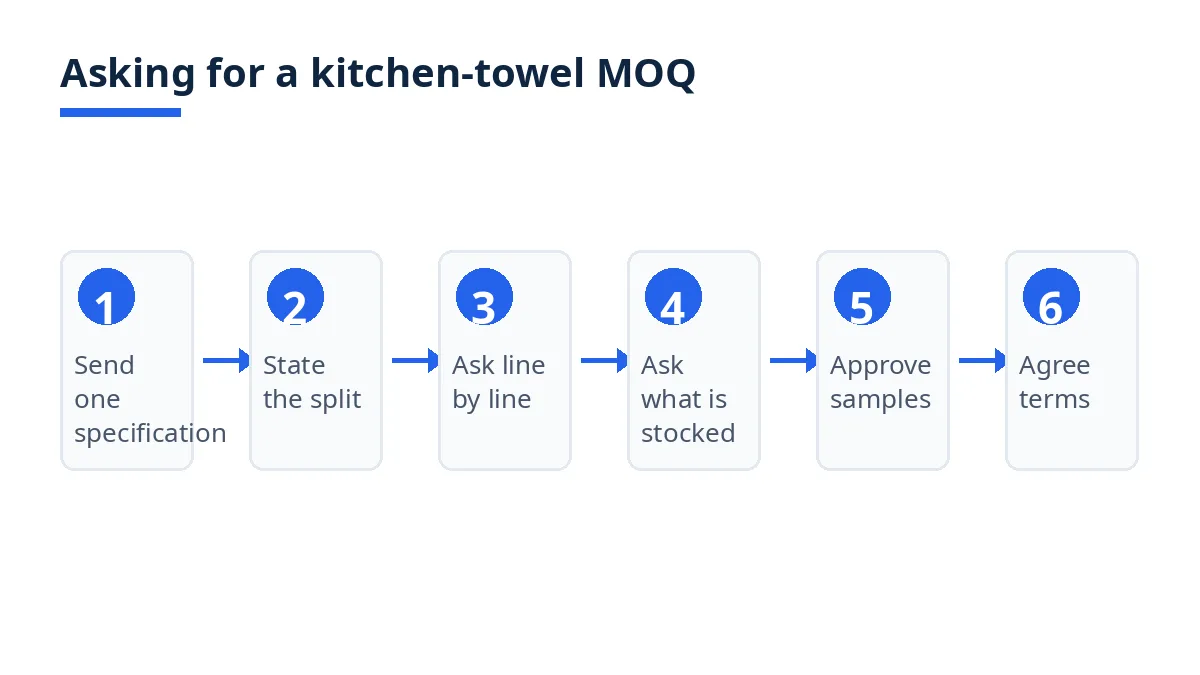
Send one specification to every candidate. State towel type, fibre, GSM, size, edging, dobby or print detail, embroidery placement, label and packing, and single or set.
State the split, not only the total: quantity per design, per colour and per size. A total without a split cannot be answered with a usable MOQ.
Ask for the minimums line by line. Ask for the MOQ per design, per colour and dye lot, per size, and any separate dobby, embroidery, label, tag and carton minimums, and which line binds for your split.
Ask what is stocked. Record whether each cloth and colour is stocked or dyed to order. Stocked inputs are where a lower minimum is most often possible.
Approve samples in writing. Order a proto sample, then a pre-production sample in your actual cloth, colour, edging and labels. Measure it, wash it, check linting and edging, then approve or list corrections in writing.
Agree inspection and delivery term before you confirm, in writing in the purchase order, and compare MOQs only on the same specification and term.
How to negotiate the MOQ down
Negotiation works when you change the structure that creates the minimum. Get the result in writing.
Reduce the number of colours first. Colours multiply dye lots, border sets and cutting runs. Cutting one colour raises the quantity per remaining colour at the same total, and that alone can clear a blocking dye lot.
Share one dye lot across the sizes in a set. A hand towel, a tea towel and a larger towel in the same cloth and colour can share one dye lot, where no single size would fill it alone. Ask whether the dye minimum can be met across the set combined.
Use stocked cloth and standard colours. A stocked white terry or a standard colour removes the dye lot and part of the set-up. Ask for the stock list before you finalise colours.
Share the dobby border and the embroidery across designs. One border design and one digitised logo, used across colours or sizes, spreads the same set-up over more pieces. Ask for set-up priced apart from the unit price, so the run can be shorter and the same set-up serves the repeat order.
Simplify the edging and label work. One edging style, one label size and fewer print colours reduce set-up. Record paid set-ups so the repeat order does not pay them twice.
Stage the order. If the factory cannot move, place a smaller first order in fewer colours, with a written repeat price and MOQ for the same specification.
Small-order workarounds when the factory will not move
When the minimum will not move, change the order instead of the factory. A stocked-colour order in the factory's standard cloth removes the blocking dye lot. A set order combining sizes in one colourway meets the dye lot by the set, even though each size alone falls short. Or accept the factory's standard border, hem and label spec for the first order, and introduce your own on the repeat.
Do not split one colour across two factories: each faces its own dye lot and set-up, and the lots may not match in shade. Ordering a larger lot only helps if the colour and size will still sell when the balance ships.
Costs, timelines and documents
What are the typical costs and timelines?
There are no typical costs or timelines a guide can state as fact. Each factory prices your cloth, GSM, edging, dobby or print work, embroidery, label and carton runs, finishing and packing, and the delivery term you choose. The Incoterms 2020 rules set out 11 rules with a clear allocation of cost, risk and obligations,4 so compare MOQs only on the same term. Ask for sampling, cloth ready, production and inspection dates as separate lines, not a single delivery week.
Which documents are needed?
For export clearance in Bangladesh, goods may not be loaded unless an export declaration, the Bill of Export or Shipping Bill, is submitted to Customs and approved.5 Enclosed documents include the export contract or purchase order where there is no export letter of credit, the commercial invoice, the packing list, the EXP form certified by an authorized dealer, and a certificate of origin issued by the EPB or a Chamber of Commerce and Industry.5 Your order documents are the specification, the itemized quotation and the purchase order.
Bangladesh-specific rules and tips
Confirm what a badge records before you rely on it. Exportain verification is a document review by staff, not a factory inspection.6 Exportain Verified covers identity, phone, email and business registration, Export Verified covers the Export Registration Certificate (ERC), and Factory Verified covers reviewed factory photos.6 A badge is not a guarantee of capacity, quality or delivery,6 and verification is free and never granted by membership plans.7
Keep one legal name across every paper: the export declaration names the exporter and the foreign buyer.5
Agree the inspection plan before production. ISO 2859-1 defines acceptance sampling plans for inspection by attributes, indexed by acceptance quality limit (AQL) for lot-by-lot inspection.8 AQL is the maximum average percentage of defective items considered acceptable during random sampling, and it determines sample sizes and acceptance or rejection thresholds.8
Mistakes and red flags
What are the most common mistakes?
Asking for a total MOQ only. The binding minimum is usually per colour or per size, and an order can clear the total yet fall below one colour's dye minimum, which then carries a surcharge or removal.
Comparing MOQs on different specifications. A lower minimum on a lighter cloth, a flat tea towel instead of terry, stock labels or a different term is a different offer. Compare only replies to the same specification on the same Incoterm.4
Accepting a verbal exception, and paying set-up twice. Record any agreed lower minimum or waived set-up on the quotation and purchase order, and attach paid set-up lines to the repeat enquiry.
Treating a profile or a badge as verification. A profile does not test whether a factory can weave your towel, and a badge is not a guarantee of capacity, quality or delivery.6
Skipping the sample check to save time. Sampling under ISO 2859-1 checks a lot against an agreed AQL,8 and a washed pre-production sample is the last control before the goods become your stock.
Checklist
Before you confirm, every line should be answered in writing.
Specification sent: towel type, fibre, GSM, size, edging, dobby or print, embroidery, labels, packing, single or set.
MOQ confirmed per design, per colour and per size; binding line named.
Cloth and colour status per item recorded: stocked or dyed to order.
Dobby, embroidery, label, tag and carton minimums confirmed apart from the towel MOQ.
Set-up costs itemized apart from the unit price; paid set-ups recorded.
Pre-production sample measured, washed, checked for linting and edging, and approved in writing.
Inspection level and AQL values in the purchase order.8
Export set agreed: invoice, packing list, EXP form, certificate of origin, Bill of Export.5
How Exportain helps
On Exportain, browse suppliers and post a request for quotation (RFQ) on the RFQ board with your towel specification, split per colour and size, and delivery term, so suppliers quote against the same specification. Ask each reply for its per-design, per-colour and per-size minimums and which line binds. On acceptance, Exportain creates one order and issues one proforma invoice from the accepted terms.6
Read the badges for what they record, as described above: verification is a document review by staff, free, and never granted by membership plans.7 It is not a factory inspection,6 7 so sample approval and inspection stay with you. See how supplier verification works on Exportain.
FAQs
What should I know first about kitchen towels?
Know the towel type first. Terry, waffle, microfibre and flat cotton tea towels are woven and finished differently, and the minimum is set per design, colour and size by loom runs, dye lots and set-up.
What are the typical costs and timelines?
There are no typical figures a buyer can rely on: each factory sets its price, MOQ and lead time for your specification. Cloth, GSM, edging, the split and the delivery term drive the price,4 and sampling, dyeing and line capacity drive the timeline.
Which documents are needed?
The order documents are the specification, itemized quotation and purchase order. The export set is the Bill of Export, commercial invoice, packing list, EXP form certified by an authorized dealer, and a certificate of origin issued by the EPB or a Chamber of Commerce and Industry.5
What are the most common mistakes?
Asking only for a total MOQ, comparing minimums on different specifications or terms,4 accepting a lower minimum verbally, paying set-up twice, and reading a badge as a guarantee.
Next steps on Exportain
Browse suppliers, then post your towel specification and split per colour and size on the RFQ board so suppliers state their MOQ per design, per colour and per size. Before you confirm, read how to import kitchen towels from Bangladesh.
Sources
- Annual Export Receipts of Goods and Services 2024-25. Bangladesh Bank (accessed )
- HS 2017 - Code 6302: Bed linen, table linen, toilet linen and kitchen linen. United Nations Statistics Division (accessed )
- Regulation (EU) No 1007/2011 on textile fibre names and related labelling and marking of the fibre composition of textile products. European Union, (accessed )
- Incoterms® 2020. International Chamber of Commerce (ICC) (accessed )
- Customs Clearance Procedures for Export. Bangladesh Customs, National Board of Revenue (accessed )
- Trust & Safety Center. Exportain (accessed )
- Supplier verification: Earn trust badges buyers can see. Exportain (accessed )
- ISO 2859-1:2026 - Sampling procedures for inspection by attributes — Part 1: Sampling schemes indexed by acceptance quality limit (AQL) for lot-by-lot inspection. ISO (accessed )
About the author
Sourcing from Bangladesh?
Post a request for quotation and suppliers on Exportain can send you their quotes directly.
Post an RFQ