Quality Control Checklist for Instant Noodles From Bangladesh
A numbered QC checklist for instant noodles from Bangladesh: noodle block moisture and oil quality, seasoning sachets, cooking test, destination labels, and packing, with fixes for common failures.
Short answer
Use this instant noodles quality control checklist to check the noodle block, seasoning and oil sachets, cooking texture and broth, oil quality and lab evidence, destination labels for the USA, UK, EU and UAE, and packs and cartons for instant noodles from Bangladesh before shipment. Agree style, tolerances, test methods and acceptance numbers in the purchase order.
On this page
Key takeaways
Judge instant noodles in the bowl: the cooking test for texture, clumping, and broth decides what a carton count cannot.
Check fried and non-fried blocks against different Codex moisture limits, and check acid value evidence for fried noodles only.
Open every sampled pack and count every sachet, because a missing or swapped seasoning or oil sachet fails the whole pack.
Check allergen lines per destination, because the USA nine-allergen list and the EU and UK 14-allergen emphasis rules differ.
If you buy instant noodles from Bangladesh, judge the shipment in the bowl, not only in the pack. A neat-looking block can still cook soft or clump, and a missing sachet or wrong allergen line shows only when the pack is opened. Use this checklist at final inspection, with the approved sample beside you, recording each point as pass, fail, or not applicable.
Instant noodles are prepared from wheat flour, rice flour, or other flours or starches as the main ingredient, characterised by pregelatinisation and dehydration either by frying or by other methods, and presented as fried or non-fried noodles.1 That split matters: fried and non-fried blocks have different moisture limits, and oil quality is a fried-noodle question first.
Why this checklist matters
An instant noodle pack is a small system. The block, seasoning powder, oil or sauce sachet, and dried garnish must all arrive intact, in the right count, and in the right condition. One weak part changes the eating result, and transit adds a second test: blocks are fragile, sachets can burst under carton pressure, and heat can push frying oil toward rancidity.
Before you start
Do not begin until the references are complete: an approved sample for each flavour and pack size, the purchase order and pack specification, the label artwork for each destination, and the agreed lab reports. Confirm whether the order is fried or non-fried, because that decides the moisture limit. Under the Codex standard, the maximum moisture content for the noodle block, excluding seasonings, is 10% for fried noodles and 14% for non-fried noodles.1
Agree the sampling plan before inspection. ISO 2859-1 specifies an acceptance sampling system for inspection by attributes, indexed in terms of the acceptance quality limit (AQL), for lot-by-lot inspection.2 Agree the defect classes, the acceptance numbers, and the test methods in the purchase order, and draw the sample at random across flavours, pack sizes, and cartons. Never accept a sample the factory selects. See the AQL acceptance quality limit explainer.
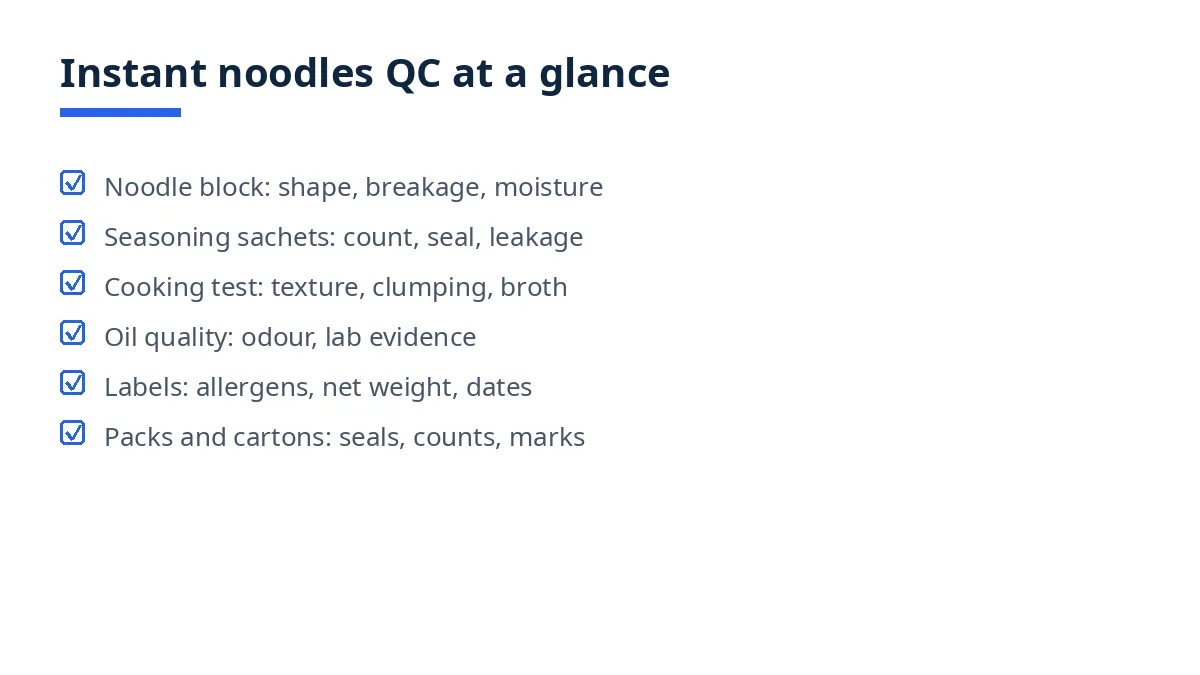
The full checklist (numbered, printable)
Noodle block: shape, breakage, and moisture
Check each sampled block against the approved sample for shape, thickness, and colour, and for a dry surface with no damp patches, mould, or off odour.
Check for broken blocks, crushed corners, and loose fragments, and compare breakage with the defect class agreed in the purchase order.
Check that no foreign matter is present in the block or the pack. The Codex standard requires the product to be free from foreign matter, with acceptable appearance, texture, aroma, taste, and colour.1
Review moisture evidence for the noodle block, excluding seasonings, against the Codex limits: 10% maximum for fried noodles and 14% for non-fried noodles.1 Confirm the report names the style, flavour, and lot.
Check block weight against the pack declaration. Example figures: if the pack states a noodle block of 80 g, record the actual weights found, not pass marks alone, and flag packs outside the agreed tolerance.
Check that blocks are not stuck together, warped, or unevenly dried, and that cup blocks seat correctly without forcing.
Seasoning, oil, and garnish sachets
Open sampled packs completely and count every sachet against the specification: seasoning powder, oil or sauce, and dried garnish where specified. A missing sachet fails the whole pack.
Check each sachet seal for full closure, with no leaking powder, oil staining, or burst corners, and no sachets stuck to the block.
Check sachet weights against the specification, and check that seasoning powder is dry and free-flowing, with no lumps, dampness, or off odour.
Check dried garnish, where included, for colour, dryness, and freedom from foreign matter, and for a match with the flavour named on the pack.
Check that no sachet is swapped between flavours: open at least one pack per flavour and confirm the sachet contents match the outer flavour name.
Cooking test: the decisive check
Cook sampled packs exactly as the label directs, and record the water quantity and time used.
Check cooked texture against the approved sample: firm and separate, not mushy, pasty, or still hard in the centre.
Check for clumping, breakage during cooking, and strands that stick together after draining or standing.
Check broth colour, clarity, aroma, and taste against the approved sample, and check that seasoning dissolves fully.
Check cooked yield and appearance after the label standing time, because noodles can turn soft if left standing.
Repeat the cooking test for each flavour, and for cup and pack formats separately.
Oil quality and lab evidence
For fried noodles, check the block and any oil sachet for rancid, stale, or burnt odour, and for oil staining outside the sachet.
Review acid value evidence for fried noodles. The Codex maximum is 2 mg KOH/g oil, for fried noodles only.1 Confirm the report names the oil, lot, and test method.
Review any further lab evidence agreed in the purchase order, and confirm each report matches the flavour, date, and lot.
Check that no lab report is reused across flavours or lots: a report for one flavour or an earlier lot does not clear this shipment.
Labels by destination: USA, UK, EU, and UAE
Check product name, flavour name, net quantity, and pack count against the purchase order, and check that the outer flavour matches the sachets inside.
Check the ingredient list against the approved artwork, including every sachet ingredient, and check that cooking directions match the cooking test used here.
For the USA, check allergen declaration against the nine major food allergens: milk, eggs, fish, Crustacean shellfish, tree nuts, peanuts, wheat, soybeans, and sesame, added as the ninth effective 1 January 2023.3 Declare the allergen source name in parentheses after the ingredient or in a Contains statement.3
For the EU and the UK, check allergen emphasis in the ingredient list. Regulation (EU) No 1169/2011 requires mandatory particulars to include the food name, ingredient list, Annex II allergens, net quantity, date marking, storage conditions, operator details, and a nutrition declaration.4 The Annex II allergen name must be emphasised so it stands out, for example by font, style, or background colour.4 The 14 allergens include cereals containing gluten, crustaceans, eggs, fish, lupin, milk, molluscs, mustard, nuts, peanuts, sesame seeds, soya, and sulphur dioxide and sulphites.5
Check the nutrition declaration, date marking, and lot code on each destination version, and check that no artwork is used for the wrong market.
For the UAE, ask your UAE importer to confirm the Arabic wording, date format, and importer details before printing, and check the printed result against that confirmation.
Check that no flavour, ingredient, or nutrition claim appears without the evidence agreed in the purchase order.
Packs, cartons, and shipment
Check inner pack seals for full closure, with no gaps or air leakage, and check cup lids for full sealing and a clean peel.
Check outer packs and cartons for crushing, water damage, and pressure marks, and check that overfilling does not crush blocks or burst sachets.
Check carton counts, flavour mix, and pack size mix against the packing list, and check that barcodes scan and match.
Check carton markings, including lot code, production date, and destination, and confirm they match the packs inside.
Check that the shipment is stored and loaded dry, away from heat and strong odours, and that damaged cartons are segregated and re-inspected separately.
Common failures and how to fix them
A broken block usually traces to handling or carton pressure: re-check carton filling and stacking, and re-inspect the affected cartons as a group. A soft cooking result points first to the block or the directions: cook a fresh sample exactly as the label directs and compare it with the approved sample.
Rancid odour in a fried noodle points to oil quality or storage: stop and check the lab evidence for that lot, not an earlier lot. A leaking oil sachet usually traces to seal settings or carton pressure: re-seal a test run and check the seal under pressure first. A missing or swapped sachet is a packing-line fault: recount a full sample from that run and re-inspect it separately. A wrong allergen line is a label fault: stop printing, correct the artwork for that destination, and re-check every version.
Above the agreed acceptance level, the options are re-inspection after sorting or rework, documented partial acceptance, or rejection.
Downloadable template / summary table
Copy the checklist into your inspection sheet, add the flavour list, style, tolerances, and acceptance numbers, and record a result per pack.
Section | Checks | Evidence |
|---|---|---|
Noodle block | Shape, breakage, moisture, weight | Sample, lab reports |
Sachets | Count, seals, weights, flavour match | Opened packs |
Cooking test | Texture, clumping, broth, standing | Cooked samples |
Oil and lab | Odour, acid value, lot reports | Reports per lot |
Labels | Allergens, nutrition, dates, claims | Destination artwork |
Packs and cartons | Seals, counts, marks, storage | Packing list |
How Exportain helps
Exportain is a B2B marketplace connecting buyers with Bangladeshi suppliers of processed food, so the style, flavour list, label versions, and lab evidence can be agreed at the enquiry stage. Use inspection services when you plan the check, and read the pre-shipment inspection guide first. Supplier profiles show which document and photo checks have been recorded, not factory inspections. Exportain is not a party to the goods contract and does not inspect goods.
FAQs
When should this checklist be used?
Use it at final inspection, when goods are finished, sealed, and largely packed. For first orders and new flavours, also use it during production, while drying, sealing, and printing can still be corrected.
Who should complete it?
The buyer, a local agent, or an independent inspector can complete it, using the approved sample, the specification, the destination artwork, and a random sample.
What are the most common failures?
Broken blocks, leaking oil sachets, missing or swapped sachets, soft or clumped cooking results, rancid odour in fried noodles, and wrong allergen lines are the failures this checklist is built to catch.
Can a third party do it?
Yes, if you share the approved sample, the style and flavour list, the tolerances, the acceptance numbers, and the destination artwork first, and the cooking test follows the label directions.
Next steps on Exportain
Before production starts, agree the style, flavour list, tolerances, test methods, and destination artwork, then read the AQL acceptance quality limit explainer and the pre-shipment inspection guide, and plan the check with inspection services.
Sources
- Codex Standard for Instant Noodles (CODEX STAN 249-2006). FAO/WHO Codex Alimentarius Commission (accessed )
- SIST ISO 2859-1:2003 - Sampling procedures for inspection by attributes, Part 1: Sampling schemes indexed by acceptance quality limit (AQL). International Organization for Standardization, (accessed )
- Food Allergies: What You Need to Know. U.S. Food and Drug Administration (accessed )
- Regulation (EU) No 1169/2011 on the provision of food information to consumers. European Union (accessed )
- Food Labelling. Allergy UK (accessed )
- pre-shipment inspection
- quality control
- aql inspection
- Processed food
- Packaging Bangladesh
- Instant noodles
About the author
Sourcing from Bangladesh?
Post a request for quotation and suppliers on Exportain can send you their quotes directly.
Post an RFQ