

Industrial Lighting Lead Time From Bangladesh: Production and Shipping Timeline
Industrial lighting lead time from Bangladesh runs on seven stages, not one delivery week: sampling, driver and housing sourcing, fabrication, photometric testing, inspection, export clearance and transit. This guide gives planning ranges, documents and checks for each stage.
Short answer
An industrial lighting order from Bangladesh usually runs from sample approval to delivered goods in a span measured in weeks, not days. The chain has seven stages: enquiry and sample approval, driver and housing sourcing, housing fabrication, assembly with photometric testing, inspection and packing, export clearance, and transit. Driver lead time and destination testing usually set the pace. Ask every supplier for dated stage milestones, not a single delivery week, and hold the shipment plan to those dates.
On this page
Key takeaways
Industrial lighting lead time runs on seven stages, and the driver and housing stages usually set the pace, not final assembly.
Judge a fitting on the LM-79 report for the finished luminaire, with an IES file that matches it, never on chip lumens alone.
Ask for dated milestones for sampling, driver ready, housing ready, production, inspection, load and sailing, not a single delivery week.
Compare quotations only on the same specification and the same Incoterm, and confirm the export set before the sailing.
Exportain verification is a document and photo review, not a factory inspection, and a badge is not a guarantee of delivery.
An industrial lighting order from Bangladesh is a project order, not a shelf order. High-bay fittings, floodlights, warehouse battens and area lights are built to a specification: wattage, lumen target, beam pattern, housing size, driver type and ingress protection rating. The factory orders drivers and housings for your order, builds the fitting, tests its light output and then packs a heavy, bulky consignment for sea freight. Each stage can move the delivery date, and the stage that moves it is rarely the one a buyer watches.
The timeline below follows seven stages, from enquiry to delivery in the USA, the UK, the EU or the UAE. The ranges are planning ranges to confirm with each supplier in writing, not promises and not a typical figure for the whole market. A repeat order with stocked drivers moves faster than a first order with new tooling or new reports. Ask for dated milestones for each stage, and judge a supplier on whether those dates hold.
Why this matters for buyers and sellers
For the buyer, the lead time decides the project plan: a warehouse opening or factory fit-out has a fixed install date, and lighting ordered late holds up the whole site. For the seller, the lead time protects the build, since drivers bought for your wattage and dimming protocol, housings cast for your fitting and optics matched to your beam pattern cannot be sold to another buyer if you cancel.
What should I know first about industrial lighting?
Industrial lighting differs from household lighting in ways that shape the timeline. The fitting runs for long hours at high output, so heat management and driver selection matter more than looks. It must survive its site, so dust, moisture, vibration and wash-downs set the ingress protection rating. The buyer needs proof of light performance, not a data sheet claim. And the fitting is heavy and bulky, so packing and freight take more planning than a carton of bulbs.
Proof of performance starts with the whole luminaire, not the chip inside it. LM-79 is a test method created by the Illuminating Engineering Society for a complete LED luminaire, and it reports lumen output, efficacy in lumens per watt, correlated color temperature, color rendering index and light distribution for the finished fitting.1 The test is run by an accredited third-party lab, and its data feeds design software through a digital IES file.1 If the IES file does not match the tested luminaire, the lighting layout built from it cannot be trusted.1
Safety testing runs beside photometric testing. IEC 60598 sets general requirements for luminaires, covering classification by degree of protection against dust, solid objects and moisture, marking, mechanical construction and electrical construction, and it covers electrical, thermal and mechanical safety aspects.2 Indoor fittings are commonly designed to IP20, which resists 12 mm solid objects and not water, while outdoor fittings are commonly designed to IP44, which resists 1 mm solid objects and splashing water from all directions.2
Step-by-step: how it works
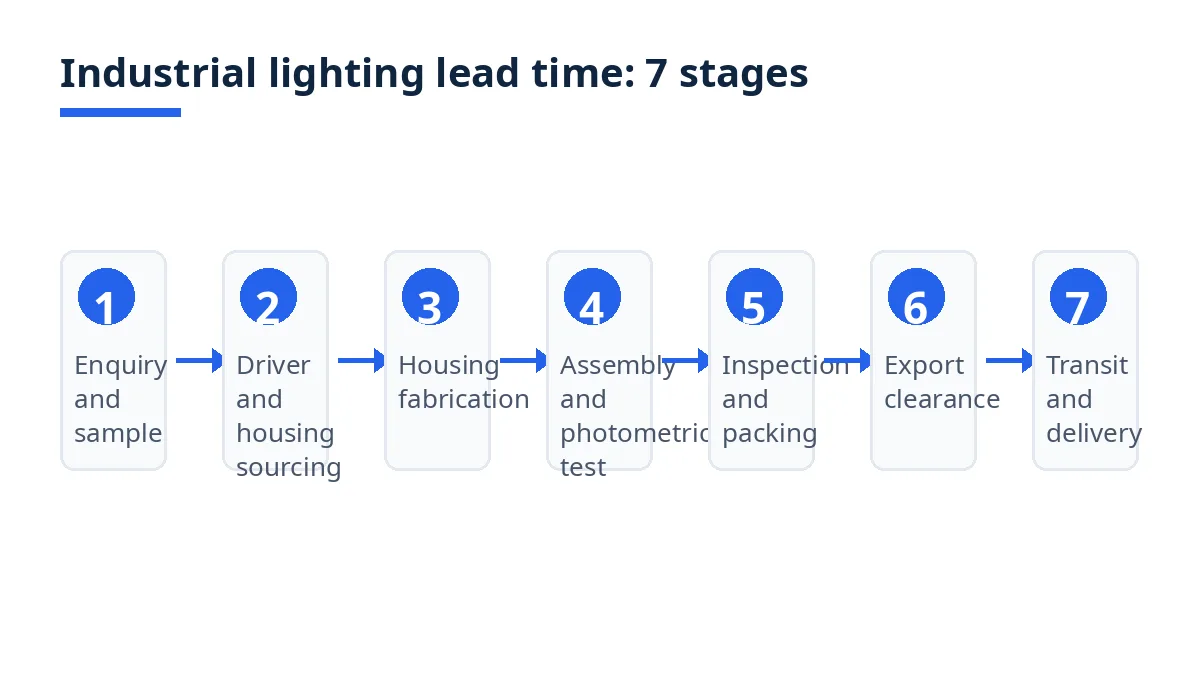
Enquiry and sample approval. Send one specification to every candidate: fitting type, wattage, lumen target, color temperature, color rendering index, beam angle, driver type and dimming protocol, housing material and finish, IP rating, mounting type, packing and destination. Order a sample in the actual housing and driver, test it, and approve it or list corrections in writing.
Driver and housing sourcing. The supplier orders LED modules, drivers and housing inputs for your order. Drivers are the usual bottleneck: a branded driver in a set wattage and dimming protocol may be stocked locally or imported, and an imported driver sets the earliest production date. Confirm driver brand, model and stock status in writing before you confirm the order.
Housing fabrication. Housings for high-bay and floodlight fittings are commonly die-cast aluminum, then machined, finished and coated. A new housing size or finish needs tooling time and a first-article check, while a repeat housing in a stocked finish moves faster.
Assembly and photometric testing. Modules, drivers, optics and housings come together on the line, and finished fittings go through function tests. Sample or first production units go for photometric testing, which reports the finished fitting's lumen output, efficacy, color temperature, color rendering index and distribution.1
Inspection and packing. Agree the inspection plan before production starts. ISO 2859-1 defines a system of acceptance sampling plans for inspection by attributes, indexed by acceptance quality limit (AQL) for lot-by-lot inspection.3 AQL is the maximum average percentage of defective items considered acceptable during random sampling, and it sets sample sizes and acceptance or rejection thresholds.3
Export clearance. The supplier or its C and F agent files the export declaration and the supporting set, and the goods load only after approval. Goods shall not be loaded or shipped for export unless an export declaration, known as the Bill of Export or Shipping Bill, is submitted to Customs and approved.4
Transit and delivery. Sea freight from Chattogram to the UAE, the UK, the EU or the USA runs through transshipment ports, so the sailing schedule and the transshipment connection set the arrival date more than the distance does.
Stage | Planning range to confirm | What moves it most |
|---|---|---|
Enquiry and sample approval | 1–3 weeks | Sample rounds and specification changes |
Driver and housing sourcing | 2–6 weeks | Imported drivers and new housing tooling |
Housing fabrication | 2–4 weeks | Finish, tooling and first-article checks |
Assembly and photometric testing | 1–3 weeks | Retests and optics or driver changes |
Inspection and packing | 1–2 weeks | Inspection findings and packing corrections |
Export clearance | About 1 week | Document errors and physical checks |
Sea transit | UAE 2–4 weeks, UK and EU 4–6 weeks, USA 5–7 weeks | Sailings and transshipment connections |
The ranges above overlap: sourcing often runs beside sample approval, and packing runs beside inspection. The supplier's dated stage plan, not this table, governs your order.
Costs, timelines and documents
What are the typical costs and timelines?
There is no typical unit price for industrial lighting that a guide can state as fact, because the price follows your specification. LED modules, driver brand and protocol, housing material and finish, optics, testing and destination reports, packing and freight each move the price, and the delivery term moves it again. The Incoterms 2020 rules set out 11 rules with a clear allocation of cost, risk and obligations.5 Compare quotations only on the same rule and named place: a lower price on EXW and a higher price on CIF are different offers. Read the Incoterms guide for shipments from Bangladesh before you compare terms.
For timelines, the two dates that matter are the sample approval date and the ship date. Ask for sampling, driver ready, housing ready, production, inspection and load dates as separate lines, not a single delivery week.
Which documents are needed?
The export set for a Bangladesh shipment is fixed by Customs. The documents enclosed with the Bill of Export for customs clearance include the export letter of credit or, where there is none, the export contract or purchase order approved by the negotiating bank, the commercial invoice, the packing list, the EXP form certified by an authorized dealer, and the certificate of origin issued by the EPB or a Chamber of Commerce and Industry.4 VAT registration and taxpayer identification number documents are also enclosed.4 Keep one legal name across the trade licence, quotation, proforma invoice and payment account, because the export declaration names the exporter and the foreign buyer.4
The buyer documents sit beside the export set: the specification sheet, the sample approval record, the LM-79 report and matching IES file for the exact model,1 the IEC 60598 test evidence for the fitting's safety and ingress protection class,2 the inspection report with its AQL plan,3 and the packing list with carton marks. Classification belongs in the file early: heading 9405 covers lamps and lighting fittings including searchlights and spotlights and parts thereof, and subheading 9405.40 covers other electric lamps and lighting fittings, with parts under 9405.99.6 Confirm the full code for your fitting and destination with your broker before production.
Bangladesh-specific rules and tips
Confirm destination requirements before production, not at packing. The test report your market needs should be ordered with the first production units. A photometric report or a safety test added after the goods are packed means opening cartons, retesting and repacking, and the sailing waits.
Treat the driver as the critical path. Ask which drivers are stocked, which are imported and what the import time is. A driver change after sample approval is a new sample in practice: output, dimming behavior and heat all change with it. Freeze the driver brand and model at sample approval, and record any change as a written variation with a new date.
Plan packing for weight and handling. High-bay and floodlight fittings are heavy for their carton size, and a pallet stacked for a light product will fail under them. Ask for carton weight, pallet pattern and stacking limits before production, and check the first pallet against the packing list.
Hold a buffer at both ends of the sea leg. Keep one buffer week before the planned sailing for document or inspection corrections, and one buffer week after the planned arrival for port handling and inland delivery.
Mistakes and red flags
What are the most common mistakes?
Accepting chip lumens instead of luminaire lumens. A chip data sheet states what the LED package emits before optics, housing and driver losses. LM-79 measures the finished luminaire, reporting its lumen output, efficacy, color temperature, color rendering index and distribution.1 Judge the fitting on the luminaire report, never on the chip sheet.
Approving a sample without its IES file. A sample that looks bright on a bench can still fail a lighting layout. The IES file from the tested luminaire is what design software uses, and a file that does not match the report makes the layout unreliable.1 Approve the sample and the file together.
Comparing quotations on different delivery terms. The Incoterms 2020 rules allocate cost, risk and obligations differently under each rule,5 so a price comparison across terms compares different scopes. Restate every quotation onto one term and named place before you rank it.
Treating one delivery week as a plan. A single week hides which stage slips. Dated stage milestones show the slip early, while there is still time to change a driver or move a sailing. No milestone plan means no early warning.
Reading a badge as a promise of delivery. Exportain verification is a document review by staff, not a factory inspection, and a badge is not a guarantee of production capacity, product quality or delivery.7 Verification is free and never granted by membership plans.7 Sample approval and inspection stay with you.
Skipping inspection to save a week. Sampling under ISO 2859-1 checks a lot against an agreed AQL,3 and it is the last control before heavy fittings become your stock. A skipped inspection saves days at origin and risks months of claims at destination.
Checklist
Before you confirm, every line should be answered in writing.
Specification frozen: fitting type, wattage, lumen target, color temperature, color rendering index, beam angle, driver, IP rating, mounting, packing.
Sample approved in the actual housing and driver, with the matching IES file and LM-79 report for the exact model.1
Driver brand, model and stock status confirmed; imported driver time written into the plan.
Housing tooling confirmed: existing tool or new tool, finish and first-article check date.
Inspection level and AQL values in the purchase order.3
Packing agreed: carton weight, pallet pattern, stacking limits, carton marks matching the packing list.
Export set agreed: invoice, packing list, EXP form, certificate of origin, Bill of Export.4
Quotations compared on the same specification and Incoterm.5
Dated milestones for sampling, driver ready, housing ready, production, inspection, load and sailing.
How Exportain helps
On Exportain, browse suppliers and post a request for quotation (RFQ) on the RFQ board with your specification, lumen target, driver and IP requirements and dated milestones, so suppliers quote against the same plan. Ask each reply for its driver stock status, housing tooling position and stage dates. When you accept a quotation, Exportain creates one order and issues one proforma invoice from the accepted terms.7
Read the badges for what they record. Exportain Verified means Exportain has checked identity, phone, email and business registration, and Export Verified means it has checked the Export Registration Certificate (ERC).7 Factory Verified means it has reviewed photos of the manufacturer factory, while Trading Company Verified means it has reviewed photos of the trading company office or warehouse.7 Verification is a document and photo review, not a factory inspection.8 See the industrial lighting MOQ guide.
FAQs
What should I know first about industrial lighting?
Industrial lighting is specified by performance: wattage, lumen target, beam pattern, driver type, housing build and ingress protection rating. The proof that matters is the LM-79 report for the finished luminaire, which reports lumen output, efficacy, color temperature, color rendering index and distribution,1 with an IES file that matches it.
What are the typical costs and timelines?
There are no typical figures a buyer can rely on, because each supplier prices and schedules your specification. Driver availability, housing tooling, testing and destination reports, packing and the delivery term drive the price, and the Incoterms 2020 rules allocate cost, risk and obligations under the term you choose.5 Plan on roughly 8–14 weeks from confirmed order to shipped goods for a standard repeat high-bay order, and confirm dated stage milestones in writing.
Which documents are needed?
The order documents are the specification sheet, itemized quotation and purchase order, with driver, housing, test and milestone terms on both. The export set is the Bill of Export, commercial invoice, packing list, EXP form certified by an authorized dealer, and certificate of origin issued by the EPB or a Chamber of Commerce and Industry.4 Keep the LM-79 report and matching IES file,1 the IEC 60598 test evidence2 and the AQL inspection report3 in the same file.
What are the most common mistakes?
The most common mistakes are judging a fitting on chip lumens instead of the luminaire report,1 approving a sample without its IES file, comparing prices on different delivery terms,5 accepting a single delivery week instead of dated milestones, and reading a badge as a promise of delivery. A badge is not a guarantee of production capacity, product quality or delivery.7
Next steps on Exportain
Browse suppliers, then post your specification, lumen target and dated milestones on the RFQ board so suppliers state their driver position and stage dates. Before you confirm, read how to import industrial lighting from Bangladesh and the industrial lighting quality control checklist.
Sources
- Why You Should Always Request an LM-79 Report with Your Lighting Design. Midstream Lighting (accessed )
- IEC 60598 General Requirements and Testing. LISUN Group (accessed )
- ISO 2859-1:2026 - Sampling procedures for inspection by attributes — Part 1: Sampling schemes indexed by acceptance quality limit (AQL) for lot-by-lot inspection. ISO (accessed )
- Customs Clearance Procedures for Export. Bangladesh Customs, National Board of Revenue (accessed )
- Incoterms® 2020. International Chamber of Commerce (ICC) (accessed )
- HS Nomenclature 2012 - Chapter 94: Lamps and lighting fittings. World Customs Organization (accessed )
- Trust & Safety Center. Exportain (accessed )
- Supplier verification: Earn trust badges buyers can see. Exportain (accessed )
About the author
Sourcing from Bangladesh?
Post a request for quotation and suppliers on Exportain can send you their quotes directly.
Post an RFQ


