

Typical MOQ for Industrial Lighting in Bangladesh (and How to Negotiate It Down)
No single industrial lighting MOQ in Bangladesh: what sets the minimum per model and variant, how to ask line by line, and how to negotiate it down without cutting sample approval or inspection.
Short answer
There is no single typical MOQ for industrial lighting from Bangladesh. Each supplier sets its minimum per model and per variant, driven by driver lots, optic batches, housing finish runs and packing units. Define the model fully, split the quantity per variant, ask for the minimums line by line, then negotiate the structure: fewer variants, shared drivers, stocked inputs, set-up paid separately, and repeat terms in writing.
On this page
Key takeaways
There is no single typical MOQ for industrial lighting from Bangladesh, because each supplier sets its minimum per model and per variant for your specification.
Driver lots, optic batches, housing finish runs and packing units are the drivers that set the floor, and the binding line is usually per variant, not per order.
Ask for the MOQ line by line, with the quantity split per variant and set-up costs itemized apart from the unit price.
Negotiate the structure first: fewer variants, shared drivers, stocked inputs, set-up paid separately, spares bundled into the first order, and repeat terms in writing.
Never trade sample approval or inspection for a lower minimum, and never treat a supplier profile as proof of capacity for your model and variant.
Ask three suppliers for the industrial lighting MOQ in Bangladesh for the same high bay and you can receive three different answers. There is no single typical MOQ, because each supplier sets its minimum per model and per variant for your specification, not for the order as a whole. A high bay in one wattage, optic and driver setting is a different production run from the same housing with a different driver, color temperature or protection rating, so the minimum follows the variant, not the catalogue page.
An LED luminaire is a complete integrated unit, with the light source, control driver, heat sink, housing and optics in a single module.1 That integration is why a small specification change can create a new minimum: the driver program, optic, housing finish or control option changes what must be set up, ordered or packed for that variant. Before you compare two MOQ replies, check that both describe the same model, variant and delivery term.
The scale of the model also matters. In the United States Department of Energy federal purchasing table, an industrial high bay starts at 10,000 lumens with efficacy of at least 175 lumens per watt, while a low bay sits from 5,000 to under 10,000 lumens at at least 143 lumens per watt.2 Those two models are built for different mounting heights and different work, so their runs, packing units and minimums are set separately.
Why this matters for buyers and sellers
For the buyer, the MOQ decides how much cash sits in stock, how many spare drivers and lenses must be held, and whether a first order can test one model before a larger repeat. A first order too small for the binding variant line can carry a surcharge, lose a variant, or be refused, while an order padded to clear one minimum can leave slow-moving variants on the shelf.
For the seller, the minimum protects the run. A housing finish run, a driver order, a lens batch and a printed carton run each carry fixed set-up or batch costs whether the run is short or long. A short run spreads those costs over fewer fittings, so the unit price rises as the quantity per variant falls.
Two anchors keep the negotiation grounded in the product rather than the headline total. The first is the finished-fitting datasheet. The principal international performance standard for LED luminaires for general lighting is IEC 62722-2-1, with a testing method that records luminous flux every 1,000 hours over a minimum test time of 6,000 hours.1 Ask for rated input power, luminous flux, efficacy, color temperature, color rendering index, rated life with its lumen maintenance factor, and rated ambient temperature for performance, for each model, not for the range as a whole. The second anchor is the protection rating. Under IEC 60529, the first digit of the IP rating indicates protection against solids and the second indicates protection against liquids.3 A 5 in the first position means dust protection and a 6 means completely protected against dust.3 A variant with a different IP rating can carry its own housing, gasket and test batch, and its own minimum.
Step-by-step: how it works
Work through the MOQ in this order, and get each answer in writing.
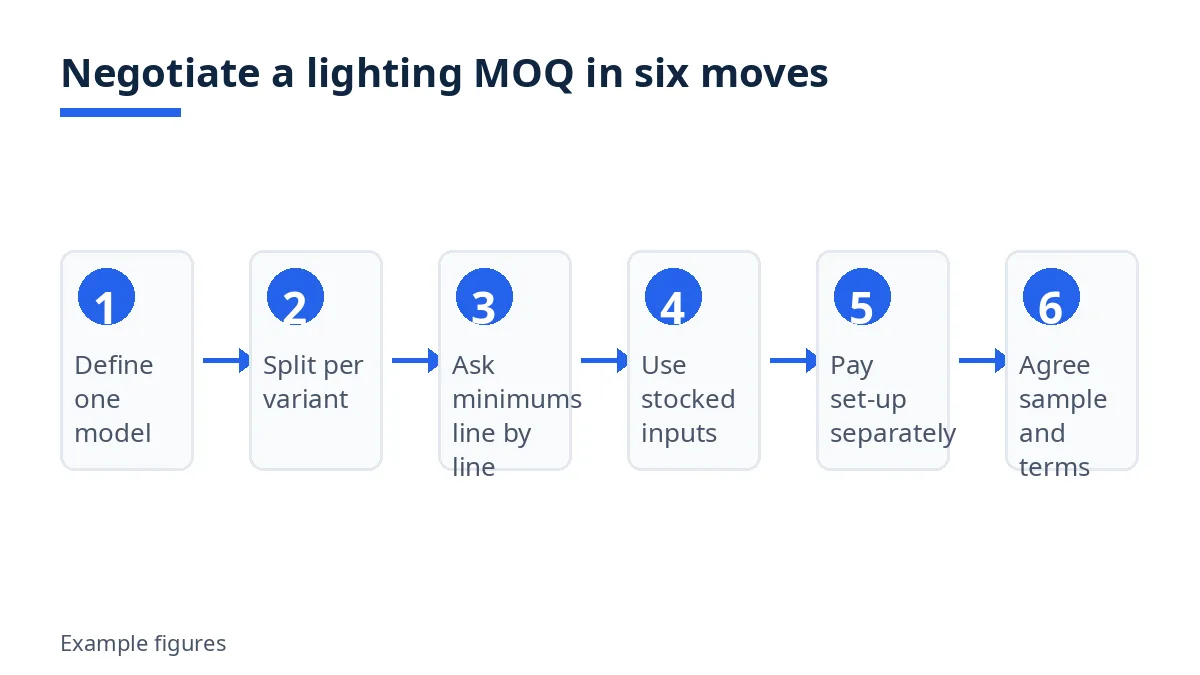
Define one model in writing. State wattage, luminous flux, efficacy, color temperature, color rendering index, optic and beam, driver type, dimming or sensor option, IP rating, mounting kit, housing color and finish, and packing unit. A model defined only as a high bay cannot be quoted with a usable MOQ.
Split the quantity per model and per variant. Give the quantity for each wattage, color temperature, driver, optic, IP rating and control option separately. A total without a split cannot be answered, because the binding minimum is almost always per variant.
Ask for the minimums line by line. Ask for the MOQ for the finished fitting, and separately for the driver lot, optic batch, housing finish run, printed carton run, and spares. Ask which line is binding for your split, and whether the minimum counts units, cartons, or both.
Ask what is stocked and what is built to order. Record whether each driver, optic, housing finish and control option is stocked or ordered for your specification. Stocked inputs are where a lower minimum is most often possible.
Read the table below as structure, not as market facts. It uses labeled example figures only. Your supplier's bands will differ, and no band here is a typical MOQ, price or lead time.
Model type | What usually sets its minimum | Example figures: illustrative MOQ band only |
|---|---|---|
High bay | Driver lot, optic batch, housing run, carton unit | Example figures: 50 to 100 units per variant |
Low bay | Driver lot, optic batch, carton unit | Example figures: 50 to 100 units per variant |
Linear fitting | Length variant, driver lot, control option | Example figures: 100 to 200 units per variant |
Floodlight | Housing protection batch, optic and mounting variant | Example figures: 50 to 100 units per variant |
Negotiate the structure, not the exception. The levers that move a MOQ are changes to what must be set up or ordered, and each one should be recorded in writing.
Cut the variant count first. Variants multiply driver lots, optic batches and packing runs. Cutting one color temperature or control option raises the quantity per remaining variant at the same total.
Share one driver across models. Where two models can use the same driver and control setting, ask whether the driver minimum can be met across both models combined, in writing.
Use stocked drivers and optics. A standard driver and optic remove a batch order from the calculation. Ask for the stock list before you finalize variants.
Pay set-up as a separate line. Where the floor comes from a housing finish run, a printed carton run or a control program, ask for those costs apart from the unit price. The run can then be shorter, and the same set-up serves the repeat order.
Bundle spares into the first order. Spare drivers and lenses matched to the installed model ride on the same driver and optic batches as the fittings. Example figures: a buyer adds 10 spare drivers to a 200-unit high bay order, so the spares use the same driver lot rather than opening a second small lot later. The example shows batch logic only, not a typical spares ratio.
Phase the order with repeat terms. If the supplier cannot move on the first order, place a smaller first order in fewer variants, with a written repeat price and MOQ for the same specification.
Agree sample, inspection and delivery term before you confirm. Order a sample in your actual model, variant and packing, then approve or list corrections in writing. Agree the inspection plan before production: ISO 2859-1 defines acceptance sampling plans for inspection by attributes, indexed by acceptance quality limit (AQL) for lot-by-lot inspection.4 State one delivery term and named place for every quotation: the Incoterms 2020 rules set out 11 rules with a clear allocation of cost, risk and obligations.5 Compare MOQs only on the same term.
Costs, timelines and documents
Costs. There are no typical costs a guide can state as fact, for the same reason there is no typical MOQ. Each supplier prices your model, wattage, driver, optic, control option, mounting kit, spares and packing, plus the delivery term you choose.5 The costs that move most with a small order are the fixed ones: housing finish runs, driver lots, optic batches, control programming and printed cartons. Ask for those costs itemized apart from the unit price.
Timelines. There are no typical lead times a guide can state as fact. Sampling depends on whether the model and its driver are stocked or built to order, production on component availability, and inspection on the agreed sampling plan.4 Ask for sampling, production, inspection and shipment dates as separate lines.
Documents. For the order itself, keep the specification sheet, the variant split, the line-by-line MOQ reply, sample approval in writing, the spares list, and the purchase order carrying the MOQ per variant, set-up lines, inspection plan and delivery term. For export clearance in Bangladesh, goods may not be loaded unless an export declaration, the Bill of Export or Shipping Bill, is submitted to Customs and approved.6 Enclosed documents include the export contract or purchase order where there is no export letter of credit, the commercial invoice, the packing list, the EXP form certified by an authorized dealer, and a certificate of origin issued by the EPB or a Chamber of Commerce and Industry.6
Bangladesh-specific rules and tips
Confirm datasheet fields per model, not per catalogue. A supplier may carry a wide lighting catalogue, but the IEC 62722-2-1 fields are stated per model.1 Ask for them per model and per variant, and treat a catalogue page without them as an inquiry still open.
Set the protection rating from the installation, not the headline. The two digits of an IP rating describe separate properties,3 and dust protection and complete protection against dust are different ratings.3 State the rating each variant needs, for the housing and driver compartment separately where they differ, before you ask for the MOQ. Changing the rating after agreement can reopen the housing batch and move the minimum.
Ask which inputs are ordered in for your specification. Drivers, optics and control modules may be bought in for your variant, and an ordered-in driver can set both the minimum and the earliest production date. Ask whether each driver and optic is stocked and what lot it is ordered in. If the driver is ordered in, the driver lot, not the fitting count, may be the binding line.
Do not trade inspection for a lower minimum. Sampling under ISO 2859-1 checks a lot against an agreed AQL,4 and it is the last control before the fittings become your stock. A supplier that offers a lower MOQ in exchange for skipping sample approval or inspection is offering a different deal, and the risk sits with the buyer once the goods ship.
Mistakes and red flags
Asking for a total MOQ only. The binding minimum is usually per model or per variant. An order can clear the total and still fall below the per-variant minimum for one driver or color temperature, which then carries a surcharge or a removal.
Comparing MOQs on different specifications. A lower minimum on a stocked driver, a standard optic, a different IP rating or a different delivery term is a different offer. Compare only replies to the same specification sheet on the same Incoterm and named place.5
Accepting a verbal exception. Record any agreed lower minimum, shared driver lot, waived set-up or phased repeat term on the quotation and purchase order, with the variant split it applies to.
Paying set-up twice. Keep the paid set-up lines from the first purchase order and attach them to the repeat inquiry, so the repeat MOQ reflects set-ups already paid for.
Treating a profile as proof of capacity. A supplier profile is a starting point for inquiries, not a substitute for a datasheet, a sample and a line-by-line MOQ reply. Read the supplier verification guide to see what a profile check covers.
Letting spares drift to a second order. A driver or lens ordered later, on its own, can fall below its own lot minimum or carry its own set-up. Price the spares pack with the first order, per model and variant.
Checklist
Every line should be answered in writing before you confirm.
Specification sheet sent: model, wattage, lumens, efficacy, color temperature, color rendering, optic, driver, control option, IP rating, mounting kit, housing finish, packing.
Quantity split stated per model and per variant.
MOQ confirmed per model and per variant; binding line named.
Driver, optic, housing finish and control status recorded per variant.
Set-up costs itemized apart from the unit price; paid set-ups recorded.
Sample approved in writing in the actual model and variant.
Inspection plan agreed, with sampling standard and AQL values in the purchase order.4
One delivery term and named place stated.5
Spares pack priced with the first order.
Repeat price, repeat MOQ and model-change notice agreed.
How Exportain helps
Browse industrial lighting suppliers, shortlist suppliers matching your model type, then send the same specification sheet and variant split to each one so the MOQ replies are comparable. Read the supplier verification guide before you treat any profile claim as evidence, and use the MOQ guide when you frame the questions. When the specification is ready, post a free RFQ on Exportain with the model, the variant split and the delivery term. Keep every reply and approval in the same thread.
FAQs
What should I know first about industrial lighting MOQ?
There is no single typical MOQ: the minimum is set per model and per variant. Define the model fully, split the quantity per variant, and ask for the minimums line by line, including the driver lot, optic batch, housing finish run and carton run, before you compare replies.
What are the typical costs and timelines?
There are no typical costs or timelines a guide can state as fact. Each supplier prices your model, driver, optic, control option, spares and packing, plus the delivery term you choose.5 Ask for set-up costs apart from the unit price, and for sampling, production, inspection and shipment dates as separate lines.
Which documents are needed?
For the order, keep the specification sheet, the variant split, the line-by-line MOQ reply, sample approval, the spares list, and the purchase order carrying the MOQ per variant, set-up lines, inspection plan and delivery term. For export clearance, the Bill of Export or Shipping Bill must be submitted to Customs and approved before loading,6 with the export contract or purchase order where there is no letter of credit, commercial invoice, packing list, EXP form certified by an authorized dealer, and certificate of origin issued by the EPB or a Chamber of Commerce and Industry.6
What are the most common mistakes?
The most common mistakes are asking for a total MOQ only, comparing MOQs on different specifications or delivery terms, accepting a verbal exception, paying set-up twice, treating a profile as proof of capacity, and leaving spares to a second order. Each is avoided by the same discipline: one specification sheet, a variant split, and every term in writing.
Next steps on Exportain
Browse industrial lighting suppliers and shortlist suppliers for your model type.
Post a free RFQ on Exportain with your model, variant split and delivery term.
Read the MOQ guide before you send the line-by-line MOQ questions.
Sources
- Module 173: Assuring the performance of LED luminaires. CIBSE Journal (accessed )
- Purchasing Energy-Efficient Commercial and Industrial LED Luminaires. U.S. Department of Energy (accessed )
- Watertightness and IP rating. Petzl (accessed )
- ISO 2859-1:2026 - Sampling procedures for inspection by attributes — Part 1: Sampling schemes indexed by acceptance quality limit (AQL) for lot-by-lot inspection. ISO (accessed )
- Incoterms® 2020. International Chamber of Commerce (ICC) (accessed )
- Customs Clearance Procedures for Export. Bangladesh Customs, National Board of Revenue (accessed )
About the author
Sourcing from Bangladesh?
Post a request for quotation and suppliers on Exportain can send you their quotes directly.
Post an RFQ


