

USA Buyers: How to Import Workwear and Uniforms From Bangladesh
USA buyers importing workwear and uniforms from Bangladesh: classify each garment under its US tariff code, file the ISF before loading, meet OSHA, ANSI hi-vis and FTC label rules, and build landed cost from confirmed duty plus MPF and HMF.
Short answer
United States buyers importing workwear and uniforms from Bangladesh should specify each garment separately, classify it under its full ten-digit United States tariff code, and confirm duty, labeling, and any hi-vis or protective standard before sampling. Appoint a customs broker and confirm the bond early, file the Importer Security Filing at least 24 hours before ocean loading, and build the landed cost from the confirmed duty, Merchandise Processing Fee, and Harbor Maintenance Fee before committing to a selling price.
On this page
Key takeaways
United States entry is decided garment by garment: woven trousers start from headings 6203 and 6204, shirts from 6205, and coveralls from 6211, so confirm the full ten-digit code and the current rate with a customs broker before pricing.
In the schedule opened for this guide, general rates include 16.6% on men's cotton trousers (6203.42.45), 10.3% on cotton bib overalls, 27.9% on men's synthetic trousers (6203.43.13), 19.7% on men's cotton shirts (6205.20.20), and 8.1% on men's cotton coveralls (6211.32.90), plus MPF and HMF where applicable.
The Importer Security Filing for ocean cargo must generally be submitted no later than 24 hours before the cargo is laden aboard the vessel at the foreign port, and an inaccurate, incomplete, or untimely filing can result in liquidated damages of $5,000 per violation.
The employer's OSHA hazard assessment drives the protective specification, ANSI/ISEA 107-2020 sets the hi-vis type and class, and United States labels must carry fiber content, country of origin, manufacturer identity, and care instructions.
There is no single typical MOQ, price, or transit time for workwear and uniforms from Bangladesh, so confirm each one in writing for your exact garment set, fabric, route, and shipment date, and treat the $30.77 landed-cost total in this guide as example figures only.
If you buy workwear and uniforms in the United States and source them from Bangladesh, the order does not end when the factory ships. You become the importer of record, and the United States entry is where the order is tested: the tariff line for each garment, the security filing that must reach Customs before loading, the bond, and the fees beside duty. Get those steps right and the landed cost is predictable; miss one and a container can sit at a United States port while storage charges accumulate.
This guide is written only for United States buyers. It follows woven workwear and uniforms made in Bangladesh for a United States workforce, cleared through United States Customs and Border Protection (CBP) at a United States port. It does not cover other destinations. Workwear here means jacket and trouser sets, bib and brace overalls, coveralls, work shirts, and uniform sets with a company logo. Duty, labeling, and any protective claim are decided garment by garment, not programme by programme.
Why source workwear and uniforms from Bangladesh
Bangladesh has a deep woven-garment base, and workwear sits inside it: cutting heavier twill, canvas, and ripstop fabrics, setting patch and tool pockets, and bartacking stress points. A factory set up for that work differs from a fashion-trouser or knitwear factory.
Plan in United States terms from the start, because the entry rules change the specification itself: a hi-vis garment needs a class and type decision before sampling, a protective garment needs its standard named before production, and label wording must be agreed before bulk label sewing begins.
Find and verify suppliers
Where should you start the search?
Start with the garment set, not with factory names. Write down every garment first: fabric composition and weight, weave, color, size range, pockets, reinforcement, closures, logo method, labeling, and packing. Then add the United States decisions: protective claims, hi-vis class and type, and expected tariff headings. Only then shortlist factories whose current range already includes woven workwear in comparable fabrics. Send every candidate the identical specification and ask for the same reply format: fabric assumed, price inclusions, validity, and minimum per garment and per color. Browse suppliers on Exportain and how to buy to compare profiles on the same terms.
How do you verify a supplier before you pay?
Check company documents first: trade licence, export registration, and association membership where applicable, so that name, address, and bank account name agree across every document. Then check capability: monthly workwear capacity, fabric source and weight, whether bartacking and embroidery are done in-house, and which recent workwear styles the factory can show. Ask to see a sewn coverall or jacket-and-trouser set from current production. Keep payments to the company account named in the documents, never to a personal account, and verify any change of bank details separately. On Exportain, trust badges record which document and photo checks have been reviewed; a badge is not a factory inspection or a guarantee. For a first order, add a video or in-person factory check and a small trial quantity.
MOQ, pricing and samples
What is the typical MOQ for workwear and uniforms from Bangladesh?
There is no single typical minimum order quantity for workwear and uniforms from Bangladesh. The minimum is set per garment and usually per color, because fabric is bought and dyed in batches and a sewing line is set up per garment. Ask each supplier how its minimum splits by garment, color, and size ratio, and at what quantity the unit price steps down.
How is the price built, and how should you compare quotes?
Fabric is usually the largest cost element in a woven work garment, followed by sewing, trims, logo work, testing, packing, and the factory margin. The sewing share rises with reinforcement: every extra pocket, knee panel, and bartacked stress point is its own operation group. Two quotes for the same drawing can differ because one assumes a heavier fabric, fewer pockets, or a different logo method. Ask what each price is based on, in writing, so a lower quote is judged as a different specification rather than accepted as a saving. Compare quotes on the same basis and convert every offer to an estimated landed cost before deciding.
Which samples do you need, and how do you approve them?
Work in stages. A development sample shows whether the factory can construct each garment and set pockets and reinforcement evenly. A pre-production sample, made in the actual production fabric, color, trims, and wash finish, is the set you approve for bulk. Fit and shrinkage cannot be approved from a sample in substitute fabric, and a hi-vis garment cannot be approved for class from a sample whose reflective tape differs from production tape. Test measurements, shrinkage, and seam strength, check hi-vis labels, approve in writing, and keep one sealed counter-sample of each garment.
Quality control and certifications needed
Which quality checks are specific to workwear and uniforms?
Against the approved sample and chart, check fabric weight and composition, measurements within your agreed tolerances, and consistency across the size set. Then check construction garment by garment: pocket position, bartack placement, knee-pad pocket alignment, reinforcement stitching, closure attachment, logo placement, and shade consistency. Agree the inspection method and defect limits before production: an inline check during sewing, and a final random inspection on packed goods. For a United States programme, add the label check and the protective-claim check.
Ordinary uniforms, protective clothing, and hi-vis: which rules apply?
Keep three categories apart. An ordinary uniform bought for identity, durability, and fit, with no protective claim, is ordinary workwear. A garment designed to protect against a workplace risk is protective clothing, and the buyer's own workplace duties attach to it. A hi-vis garment is a specific kind of protective garment whose visibility performance is classified.
The Occupational Safety and Health Administration's general personal protective equipment rule requires the employer to assess the workplace to determine whether hazards are present that necessitate protective equipment, and to select equipment that protects against the hazards identified, communicate the selection, and select equipment that properly fits each affected employee.1 OSHA has interpreted the same rule to require employers to provide and pay for required protective equipment, with narrow exceptions for personal items usable off the job. That duty sits with the United States employer.
For hi-vis garments, ANSI/ISEA 107-2020 classifies high-visibility safety apparel into three performance classes based on minimum background material and retroreflective area, and assigns a type by work environment: Type O for off-road work, Type R for roadway work, and Type P for public safety work.2 Class 1 is for off-road use with low-speed traffic under 25 mph, Class 2 is the minimum for workers on or near public roadways with traffic up to 50 mph, and Class 3 is specified for high-speed traffic over 50 mph, poor visibility, or complex backgrounds.2 For federal-aid highway workers, the Manual on Uniform Traffic Control Devices requires Class 2 or Class 3.2 A warehouse yard vest for a site separated from public traffic may therefore be Type O Class 1, while a vest for a crew beside a public roadway should be Type R Class 2 or Class 3. For protective claims, name the applicable standard and require the matching test report for the exact fabric.
Which label rules apply to every garment in the set?
Textile products imported into the United States must be marked with the country of origin before entry, and the marking must be permanent and legible for the ultimate purchaser.3 For apparel covered by the Textile, Wool and Fur Acts, labels must also include a complete breakdown of fiber content, the country of origin or manufacture, and the identity of the manufacturer, together with detailed care instructions, and the label must be attached permanently.3 The importer may use a Registered Identification Number in place of its name on the label.3 Agree the wording at sampling stage.
Incoterms, shipping and transit time
Which delivery term should a first United States order use?
The Incoterms 2020 rules are eleven standardized rules published by the International Chamber of Commerce, and each term answers who arranges and pays for each leg of transport, where risk transfers, and who handles clearance on each side.4 They say nothing about the price of the goods, payment terms, or when legal ownership transfers; those belong in the sales contract.4 The buyer pays import duties under every term except DDP, where the seller is responsible.4 For a first order shipped in containers, weigh FCA at the named terminal against FOB at the Bangladeshi port. Under FOB, the seller delivers the goods on board the vessel. Under FCA, delivery happens when the goods are handed to your carrier, which matches how containerized cargo moves, and FCA is the technically correct term for containerized freight.4 Write the term, the named place, and the edition into the purchase order, for example FCA Chattogram container terminal, Incoterms 2020, and confirm who contracts ocean freight and cargo insurance.4
How long does shipping take, and what is the United States filing clock?
There is no single typical transit time for workwear and uniforms from Bangladesh. Sea freight is the standard route for bulk orders and takes weeks rather than days, varying by port, routing, transshipment, and season. Plan from your forwarder's current sailing schedule for your United States port, and add clearance and inland delivery. The United States filing clock is separate from transit time. For cargo arriving by ocean vessel, the Importer Security Filing, known as 10+2, requires the importer or its authorized agent to submit ten importer data elements, plus two carrier data elements, to CBP: seller, buyer, importer of record number, consignee numbers, manufacturer or supplier, ship-to party, country of origin, the Harmonized Tariff Schedule number, container stuffing location, and consolidator.5 For most shipments, the information must be submitted no later than 24 hours before the cargo is laden aboard the vessel at the foreign port, while the container stuffing location and consolidator must be submitted as early as possible and no later than 24 hours before arrival at a United States port.5 An inaccurate, incomplete, or untimely filing can result in liquidated damages of $5,000 per violation.5 Build the ISF data request into the purchase order, so the supplier confirms the factory name and address, the stuffing location, and the consolidator at booking.
Import duty, taxes and documents
How are workwear and uniforms classified for United States duty?
Duty follows the classification of each garment in the United States tariff, not the supplier's product name, and each garment in a set is classified on its own. Chapter 62 covers apparel and clothing accessories, not knitted or crocheted.6 A knitted polo uniform therefore sits outside Chapter 62, while the woven jacket, trouser, and coverall in the same kit sit inside it, and garments which cannot be identified as either men's or women's garments are classified in the headings covering women's or girls' garments.6 Woven workwear starts from heading 6203 for men's styles and 6204 for women's styles, with cotton men's styles from 6203.42 and synthetic styles from 6203.43, shirts from heading 6205, and coveralls from heading 6211, including 6211.32 for men's cotton styles.6 Confirm the full ten-digit code for each garment with your broker before you price or ship.
What import duty applies in the United States?
Your rate depends on each garment's full code, the origin, and any additional measure in force on the entry date, so there is no single rate for a whole uniform set. The schedule opened for this guide is the Harmonized Tariff Schedule of the United States, Revision 11 (2023), Chapter 62, and the general rates below are the Column 1 general rates in that revision. Confirm the current rate for your entry date with your broker; additional Chapter 99 measures, if any, sit on top of the general rate. In that revision, the general rate for the other line under men's cotton trousers, 6203.42.45, is 16.6 percent, and for cotton bib and brace overalls, 6203.42.05 and 6203.42.25, it is 10.3 percent.6 The other line for men's synthetic trousers, 6203.43.13, is 27.9 percent, while synthetic bib and brace overalls on their other line, 6203.43.05, sit at 14.9 percent.6 Men's cotton shirts on the other line, 6205.20.20, carry 19.7 percent, and men's cotton coveralls on the other line, 6211.32.90, carry 8.1 percent.6 Bangladesh has no United States free trade agreement changing those general rates.
What taxes and fees sit beside duty on a United States entry?
United States customs value is the transaction value, the price actually paid or payable, excluding international transportation, insurance, and related services incident to the international shipment.7 Unlike many destinations that charge duty on a cost, insurance, and freight value, the United States excludes separately identified international freight and insurance from the dutiable value, so your commercial invoice should break out freight rather than rolling it into a single delivered price.7 Tooling, artwork, or components you supplied free of charge, and royalties paid as a condition of sale, also belong in customs value.7 Two user fees sit beside duty on most formal entries: the Merchandise Processing Fee at 0.3464 percent ad valorem, and the Harbor Maintenance Fee at 0.125 percent of cargo value on commercial vessel cargo.8 For fiscal year 2027, effective 1 October 2026, the Merchandise Processing Fee minimum and maximum per formal entry are $34.58 and $670.86, with the 0.3464 percent rate unchanged.7 The United States has no import value-added tax.
Which documents do you need for United States clearance?
The standard import set is the commercial invoice, packing list, bill of lading, and the entry documentation your broker files through the Automated Commercial Environment, together with a customs bond. The ISF Importer must possess a qualifying bond, or the authorized agent's bond may be used.5 Ask your broker whether a single-entry or continuous bond suits your programme volume. The invoice should name each garment plainly, and quantities, weights, and carton counts must agree across every document.
Landed cost example
A landed cost is the full cost of one uniform set, cleared. Every number below is an example figure only, not a quote.
Example figures: 1,800 two-piece woven cotton workwear sets, FCA Chattogram, sea freight to the Port of New York and New Jersey, duty at an example rate only, with Merchandise Processing Fee and Harbor Maintenance Fee calculated on the example entry value and allocated per set.
Cost element | Example figures (per set) | How to obtain your figure |
|---|---|---|
Product price, FCA | $22.50 | Pro forma invoice |
International freight | $2.40 | Forwarder quote per set |
Insurance | $0.22 | Forwarder quote |
Duty at the example rate of 16.6 percent on the $22.50 customs value | $3.74 | Broker calculation |
Merchandise Processing Fee at 0.3464 percent, allocated per set | $0.08 | Entry summary per set |
Harbor Maintenance Fee at 0.125 percent, allocated per set | $0.03 | Entry summary per set |
Port, clearance, and broker fees | $0.85 | Broker invoices per set |
Local delivery to warehouse | $0.95 | Carrier quote per set |
Total landed cost | $30.77 | Sum of all lines above |
No United States import value-added tax is included. Work the calculation twice: at quote stage and again after shipment with the actual invoices. See landed cost for imports from Bangladesh for the full method; only the method transfers, not the figures.
Step-by-step import checklist
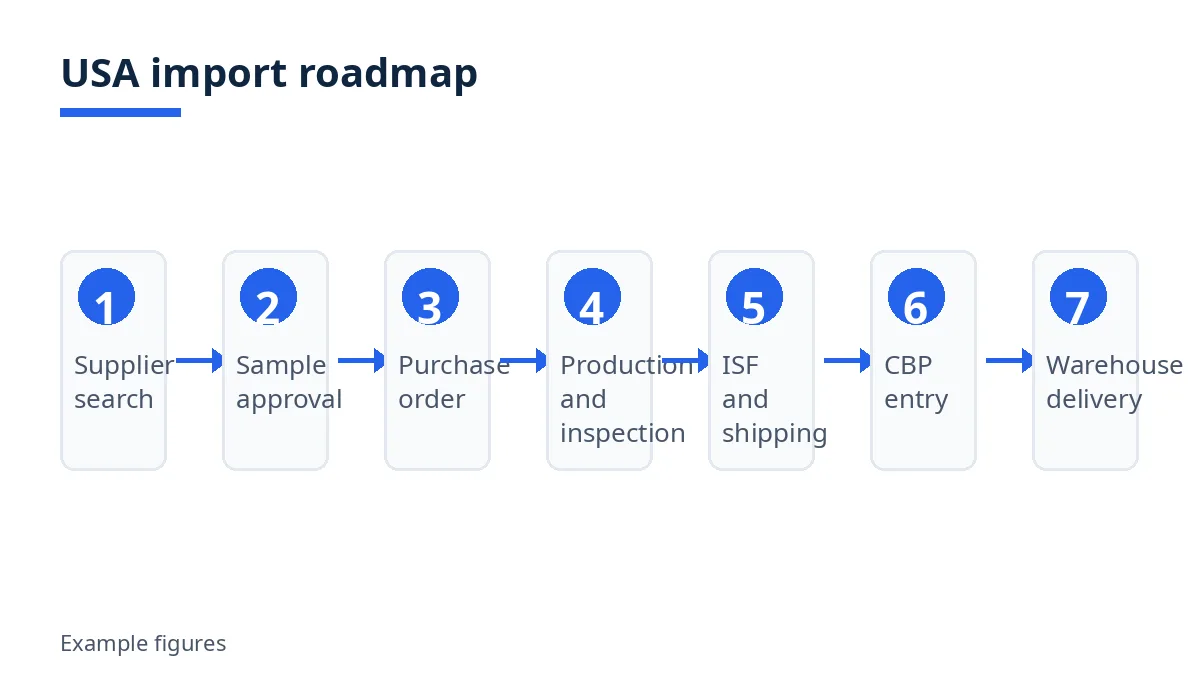
Write the specification garment by garment, including protective claims and hi-vis class and type.
Run the hazard assessment for each job, and record which garments carry a protective claim.
Classify every garment from 6203, 6204, 6205, and 6211, then confirm each full code and duty with your broker.
Shortlist woven workwear factories and request comparable quotes on the identical specification and delivery term.
Verify the chosen supplier: company documents, workwear capacity, fabric source, and a factory check.
Order samples in stages, test fit and shrinkage, check hi-vis labels, then approve a pre-production sample in production fabric.
Confirm the order in writing: purchase order, pro forma invoice, delivery and payment terms, inspection plan, labeling, packing, ISF duties, and shipment date.
Appoint your broker and confirm the bond before production ends, so ISF data is ready before loading at Chattogram.
Inspect during production and again on packed goods, checking labels and protective-claim reports.
Ship, file the ISF on time, clear customs with the confirmed code for each garment, and reconcile the actual landed cost.
How Exportain helps
Browse suppliers for Bangladeshi woven garment exporters and compare their ranges against your garment set, then use how to buy to work through the buying steps. Post your specification and target quantity as an RFQ and compare replies on the same terms before you choose a factory for sampling. Exportain is a B2B marketplace where buyers post RFQs, receive quotations, and message suppliers; it does not inspect goods, book freight, or file customs entries.
FAQs
What is the typical MOQ for workwear and uniforms from Bangladesh?
There is no single typical minimum. It is set per garment and usually per color, because fabric is bought and dyed in batches and a sewing line is set up per garment.
How long does shipping take?
Production time and transit time are separate, and neither has a single typical figure. Sea transit from Bangladesh to a United States port takes weeks rather than days. Separately, the Importer Security Filing for ocean cargo must generally be submitted no later than 24 hours before the cargo is laden aboard the vessel at the foreign port.5 The ISF clock runs from loading, not from arrival.
What import duty applies?
Duty follows the confirmed classification of each garment, the origin, and any additional measure in force on the entry date. In the schedule opened for this guide, general rates include 16.6 percent on men's cotton trousers, 6203.42.45, 10.3 percent on cotton bib and brace overalls, 27.9 percent on men's synthetic trousers, 6203.43.13, 19.7 percent on men's cotton shirts, 6205.20.20, and 8.1 percent on men's cotton coveralls, 6211.32.90.6 Confirm the current rate beside each garment's full code before you price, and add the Merchandise Processing Fee at 0.3464 percent and, for vessel cargo, the Harbor Maintenance Fee at 0.125 percent.8
How do I verify a supplier?
Check company documents first, so that name, address, and bank account agree across the trade licence, export registration, and invoices. Then check capability: workwear capacity, fabric source, and reinforcement arrangements. Keep payments to the company account named in the documents, approve a pre-production sample before bulk production, and appoint your broker and confirm the bond before loading.
Next steps on Exportain
Read how to import from Bangladesh for the full ordering process, then check landed cost for imports from Bangladesh for the costing method. When your garment set is written down, browse suppliers and compare quotes on the same terms.
Sources
- Employer Obligation to Pay for Personal Protective Equipment (standard interpretation, 29 CFR 1910.132). Occupational Safety and Health Administration (accessed )
- Class 1 vs 2 vs 3 Safety Vests: ANSI/ISEA 107-2020 and MUTCD. PK Safety (accessed )
- What Labeling Requirements Are There for Textiles?. Flexport (accessed )
- Incoterms 2020 Guide for Importers. Importivity (accessed )
- U.S. Importer Security Filing (ISF): Requirements, Deadlines, and Penalties. GHY International (accessed )
- Harmonized Tariff Schedule of the United States, Chapter 62: Articles of apparel and clothing accessories, not knitted or crocheted (Revision 11, 2023). United States International Trade Commission (accessed )
- US Import Costs: Duty, MPF, HMF and Customs Value. Qubeq (accessed )
- User Fee Table. U.S. Customs and Border Protection (accessed )
About the author
Sourcing from Bangladesh?
Post a request for quotation and suppliers on Exportain can send you their quotes directly.
Post an RFQ


