UAE Workwear Imports From Bangladesh: Duties, VAT and Suppliers
UAE workwear imports from Bangladesh: mainland and free zone entry, 5% duty and 5% VAT mechanics, HS classification, supplier checks and a worked landed cost for Jebel Ali and Khalifa Port buyers.
Short answer
To import workwear and uniforms from Bangladesh to the UAE, first settle whether you will import to the mainland or a free zone, then classify each garment, confirm the 5% duty and 5% VAT treatment with your broker, and verify the supplier before sampling. Agree the size curve, fabric, trims and conformity position in writing, ship to Jebel Ali or Khalifa Port, and reconcile the actual landed cost after clearance.
On this page
Key takeaways
UAE tariffs range from 0 to 5 per cent, with the Dubai tariff at 5 per cent of CIF value: confirm the duty line for each garment in the GCC tariff before pricing.
UAE VAT applies at 5 per cent, with mandatory registration above AED 375,000 and voluntary registration above AED 187,500; import VAT is charged on the CIF value plus duty.
Mainland or free zone entry decides the importer of record and the tax timing: goods in a free zone stay duty-suspended until they enter the mainland, and a free zone company cannot sell directly to the mainland public.
Woven workwear sits in chapter 62, in headings 6203, 6204, 6211 and 6210 by garment type and fibre, and the UAE declaration uses a 12-digit GCC code.
There is no single typical MOQ, price or transit time for workwear: confirm each one per style, colour and size curve, and approve a pre-production sample in production fabric and trims.
Importing workwear and uniforms from Bangladesh to the United Arab Emirates (UAE) is a different entry problem from importing the same garments to Europe or North America. The duty rate is low, but the entry route changes the tax timing, the importer of record, and the documents your broker files. Settle the mainland or free zone question first, classify each garment, and confirm duty and VAT in writing before bulk production.
The UAE Government portal puts government tariffs in the country at 0 to 5 per cent and gives the Dubai customs tariff as 5 per cent of the cost, insurance and freight (CIF) value, except for alcohol and cigarettes.1 VAT in the UAE applies at a standard rate of 5 per cent.2 Apply them to the right value, on the right entry route, for each garment type.
Why source workwear and uniforms from Bangladesh
Start from the end user, not from a catalogue. A UAE workwear order can cover site and logistics crews, hospitality staff, facilities teams, healthcare support staff, and drivers, and each group needs a different garment with its own specification. A coverall for outdoor site work, a tunic and trousers set for hospitality, and a high-visibility vest for road or yard work are not interchangeable items.
Write the specification garment by garment: fabric type and weight, construction, colour and trim, size range, and wash and wear performance. Fabric choice drives most of the rest. A cotton-rich fabric, a polyester-cotton blend, and a coated or treated fabric behave differently after repeated laundering, and they sit on different tariff lines. Do not quote vaguely on fabric: two suppliers quoting different fabrics are quoting different products.
Give Gulf-market sizing a separate pass before you send the request for quotation (RFQ). Ask the end customer for the size breakdown by headcount, including womens cuts where the workforce includes women, and short, regular and long lengths where the role needs them. If reflective tape or a high-visibility colour is required on site, get the placement and tape width from the customer in writing. Name the wash route: an industrially laundered uniform needs different seam, trim and colourfastness performance.
Shortlist factories whose current range already includes woven workwear, not fashion apparel only. The operations differ: heavier fabrics, reinforced seams and stress points, consistent sizing across a large size curve, and trims and reflective tape applied in the same position on every garment. Ask what workwear styles the factory currently makes, in which fabrics, and at what monthly volume, against your own size curve.
Find and verify suppliers
Send one identical specification document to every candidate. List each garment separately, with fabric, construction, trims, sizes, quantities by size, labelling and packing, and ask every supplier to reply in the same format: fabric assumed, price inclusions, validity, minimum per style and per colour, and production time. Compare replies only on an identical specification: a lower price on a lighter fabric is a different garment, not a saving. Browse suppliers on Exportain, and read how to buy for how RFQs work.
Decide the entry route before production, because it changes who the importer of record is and when duty and VAT fall due. Goods entering a UAE free zone are treated as outside the domestic customs territory, and no duty or VAT is charged while they stay in the zone or are re-exported.3 The moment the same goods leave the free zone and enter the mainland, they become liable for duty and VAT.3 A free zone company cannot sell directly to the mainland public: it must use a locally licensed distributor, a logistics partner, or a mainland branch.3
That choice also decides your registration work. Once a trade licence is active, the company must register with Dubai Customs and receive a unique importer code, also called a customs client number, before it can file import declarations.3 Importers must register with the relevant emirate customs department to obtain a customs code before filing declarations, and the code is emirate-specific.4 Confirm both registrations if you clear in more than one emirate.
Verification has three layers. First, company documents: trade licence, export registration and association membership, checked so name, address and bank account agree. Second, capability: capacity, fabric source, sewing for heavier fabrics, trim work, logo route, and recent workwear styles. Judge a finished garment from current production on seam finish, tape position, size consistency and shade matching. The third layer is payment discipline. Keep payments to the company account named in the documents, never to a personal account, and verify any change of bank details separately, through a channel you already trust. On Exportain, a document and photo review badge is not a factory inspection or a guarantee, and Exportain is not a party to the goods contract.
MOQ, pricing and samples
There is no single typical minimum order quantity (MOQ) for workwear and uniforms from Bangladesh. The minimum is set per style and usually per colour, because fabric is woven or dyed in batches, a cutting plan is set up per size range, and trims and reflective tape are bought for the order. A plain trouser and a coverall with reflective tape, pockets and logo work will not carry the same minimum. Ask how the minimum splits by style, colour, size curve and trim. Agree in writing whether the minimum applies to the order total, to each style, or to each colour, and what happens to sizes that fall below it.
Fabric is usually the largest cost element in workwear, followed by cutting and sewing, trims and reflective tape, embroidery or printing, testing, packing and the factory margin. Heavier fabrics cost more and use more freight volume, and detail adds operations: pockets, reinforcement, reflective tape, bar tacks and logo work. Compare quotes on the same garment, fabric, trims, size curve, packing and delivery term. Ask each supplier to state what is excluded, for example logo embroidery, reflective tape, testing, or special packing by wearer group.
Work in stages on samples. A development sample shows whether the factory can construct the garment, apply trims and tape in the right position, and hold the size curve. A size-set sample, covering the smallest, middle and largest sizes, shows whether the grading holds across the curve. A pre-production sample, made in the actual production fabric, colour, trims and logo work, is the sample you approve for bulk. Do not approve shade, tape position or logo placement from a sample in substitute fabric. Test samples as wearers will use them: measure every size, check tape position on every size, wash by the named route, and check colour, shrinkage and tape adhesion. Approve in writing and keep one sealed counter-sample of each style and colour.
Quality control and certifications needed
Against the approved sample and size chart, check fabric composition, finished weight, and measurements for every size. Then check construction garment by garment: seam type and stitch density at stress points, pocket and flap attachment, zip, button and fastener function, hem finish, and trim and reflective-tape position and adhesion. Check the set as a set: jacket and trousers must match in shade, and every size in one colour must come from the same shade batch.
Agree the inspection method and defect limits before production. ISO 2859-1:2026 defines a system of acceptance sampling plans for inspection by attributes, and its summary states that AQL stands for acceptance quality limit, the maximum average percentage of defective items considered acceptable during random sampling, used to determine sample sizes and acceptance and rejection thresholds.5 Inspect in stages: an inline check during sewing, and a final random inspection on packed goods.
No single certificate covers every workwear order, and ordinary uniform clothing and protective equipment must not be treated as the same case. Regulated products imported and sold in the UAE must conform to mandatory quality and safety standards, and the trader, importer or manufacturer must hold a valid certificate of conformity for each product.6 Regulated products must hold either an Emirates Conformity Assessment Scheme (ECAS) or Emirates Quality Mark (EQM) certificate to be sold in the UAE, and ECAS certificates are valid for one year, subject to annual renewal.6 The regulated scope list behind that scheme includes personal protective equipment (PPE) and textiles.6 If your garment is protective equipment, treat conformity as a gating item: confirm the regulated category, standard and certificate holder before production. For ordinary uniforms, still confirm the position in writing, because a customer may impose its own requirement. Name any such requirement in the specification and check the matching certificate's scope, product, issuing body and date.
Labels need the same early attention. Conformity documentation in the UAE scheme includes labels and, where required, user information in Arabic and English.6 Agree label wording, fibre composition, size marking and care instructions at sampling stage, and check the finished label before bulk sewing.
Incoterms, shipping and transit time
The Incoterms 2020 rules set out, for each rule, where delivery takes place, and risk passes from seller to buyer at the same point and time as delivery.7 Under FOB, CFR and CIF the seller must place the goods on board the vessel.7 On customs, in all rules but EXW the seller must carry out export formalities, and in all rules but DDP the buyer must carry out import formalities.7 The four sea rules, FAS, FOB, CFR and CIF, are only intended for port-to-port bulk or break-bulk shipments and are not suitable for container shipments, because a container is handed to the carrier before it is on board.7
For a first order shipped in containers, weigh FOB at the Bangladeshi port against FCA at the named terminal. Under FOB the factory delivers on board; under FCA delivery happens when goods are handed to the carrier, which matches containerised cargo. DDP looks simple because the seller handles import formalities, but in the UAE the importer needs a trade licence and a customs code, so confirm with your broker who can actually act as importer of record before you agree DDP.
For Dubai and the northern emirates use Jebel Ali; for Abu Dhabi use Khalifa Port. The Jebel Ali rail terminal now links the port to the national rail network, and through that network Jebel Ali has direct rail connectivity with industrial zones including Khalifa Port, Dubai Industrial City, Khorfakkan Port, Port of Fujairah and inland facilities such as Al Ghail Dry Port.8 Confirm the port of discharge against the final delivery point, not just the customer's head office. Confirm cartons per garment, carton dimensions and weight in the specification.
There is no single typical transit time for workwear from Bangladesh to the UAE. Sea freight is the standard route for bulk orders and it takes weeks rather than days, varying by port, routing, transshipment and season. Plan from your forwarder's current sailing schedule, and add clearance and delivery time at the UAE end.
Import duty, taxes and documents
Duty follows the classification of each garment in the destination tariff, not the supplier's product name. For woven garments, chapter 62 covers articles of apparel and clothing accessories, not knitted or crocheted.9 Heading 6203 covers mens or boys suits, ensembles, jackets, blazers, trousers, bib and brace overalls, breeches and shorts, and heading 6204 covers the equivalent womens or girls garments.9 Other garments fall in heading 6211, with separate lines by sex and fibre, and coated, impregnated or laminated garments sit in heading 6210.9 A woven cotton trouser, a woven synthetic jacket and a coated coverall in one order can therefore sit on three different lines. Confirm the full code for each garment before you price or ship, and classify knitted garments separately. The UAE uses a full GCC code for declaration: the international six-digit code plus further GCC and national digits, giving a 12-digit code.4 The duty rate attaches to the tariff code, not to the commercial description.4
There is no single rate for a whole workwear order. The UAE Government portal states that government tariffs range from 0 to 5 per cent, and gives the Dubai customs tariff as 5 per cent of the CIF value, except for alcohol and cigarettes.1 The standard duty rate is 5 per cent applied to the CIF value of most non-GCC goods, at the first UAE port of entry.4 Confirm the line for each garment before you commit to a selling price. Goods that stay in a free zone, or are re-exported, do not trigger mainland duty at entry.3
VAT in the UAE was introduced on 1 January 2018 at a standard rate of 5 per cent.2 A business must register for VAT if its taxable supplies and imports exceed AED 375,000, and it may register voluntarily where the total value of its taxable supplies and imports, or taxable expenses, exceeds AED 187,500.10 The Federal Tax Authority applies the same test: the previous 12 months, or the expectation of exceeding the threshold in the next 30 days.10 If your workwear imports alone will cross AED 375,000 in a year, registration is a pre-shipment task. Import VAT is calculated at 5 per cent on the sum of the CIF customs value, any applicable customs duty, and excise tax where relevant.4 VAT is therefore charged on the duty-paid value, not on the FOB price. If the importer is VAT-registered, VAT is due under the reverse charge mechanism, in which the importer accounts for the tax directly and may claim input tax credit.11 If the importer is not registered, VAT is paid on goods imported from outside the GCC, typically before the goods are released.11
The standard import set is the commercial invoice, packing list, bill of lading or air waybill, certificate of origin, and delivery order.3 Many of these documents also need attestation: in most cases commercial invoices and certificates of origin must be legalised by the UAE Embassy in the country of export and stamped by the relevant authorities, and failing to present properly attested documents can lead to delays, fines, or rejection at port.3 Confirm the attestation requirement with your broker before the goods leave Bangladesh. Name each garment plainly on the invoice, for example woven cotton work trousers with reflective tape, with composition, sizes, quantities, prices and delivery term. Keep different garment types on separate lines, and keep quantities, weights and carton counts in agreement across every document.
Landed cost example
A landed cost is the full cost of one uniform set, ready for delivery. Every number below is an example figure only, not a quote.
Example figures: 2,000 uniform sets, FCA Chattogram, sea freight to Jebel Ali, mainland entry, duty at the standard rate described above.
Cost element | Example figures (per set, AED) | How to obtain your figure |
|---|---|---|
Product price, FCA | 85.00 | Pro forma invoice |
International freight and insurance to Jebel Ali | 12.00 | Forwarder quote per set |
CIF value | 97.00 | Price plus freight and insurance |
Duty at 5 per cent of CIF value | 4.85 | Broker calculation |
VAT at 5 per cent of CIF value plus duty | 5.09 | Broker calculation |
Port, clearance and broker fees | 6.00 | Broker invoices per set |
Local delivery to warehouse | 4.00 | Local carrier quote per set |
Total landed cost | 116.94 | Sum of all lines above |
VAT note: the VAT line is shown as a cash cost at the border. A VAT-registered importer accounts for import VAT under reverse charge and may claim input tax credit; a non-registered importer pays VAT before release.11 Work the calculation twice: at quote stage and again after shipment with the actual invoices. See landed cost for imports from Bangladesh and the HS code guide for workwear and uniforms.
Step-by-step import checklist
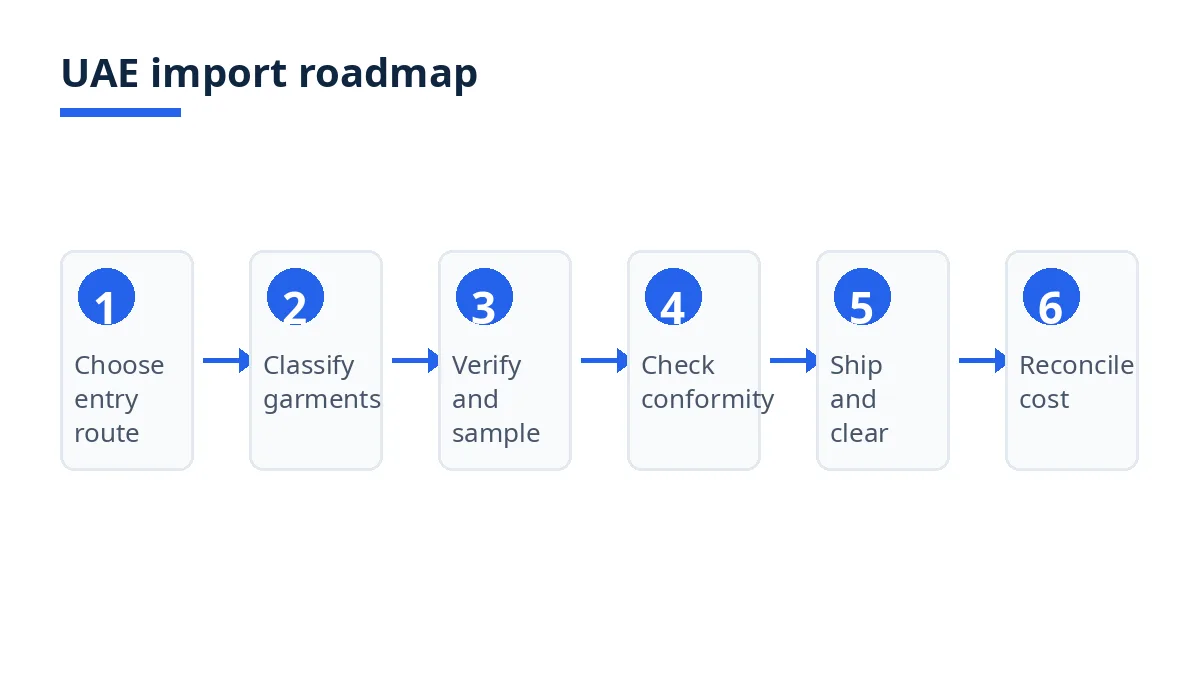
Decide the entry route: mainland import, free zone holding, or free zone plus mainland distribution.
Confirm your trade licence covers the activity, and register for the importer code for each emirate you will clear in.
Write the specification garment by garment, including fabric, trims, size curve, logo work, wash route, labelling and packing.
Classify every garment from chapter 62 for woven garments, and confirm the full GCC code with your broker.
Shortlist workwear suppliers and request comparable quotes on the identical specification.
Verify the chosen supplier: documents, capacity, fabric source, trim and logo route, and a current-production garment.
Order samples in stages, including a size-set sample and a pre-production sample, and approve in writing.
Confirm conformity in writing: regulated category, standard, and certificate holder.
Confirm the order in writing: purchase order, pro forma invoice, delivery and payment terms, inspection plan, labelling, packing and shipment date.
Ship to the agreed port, clear customs with the confirmed code for each garment, account for duty and VAT, and reconcile the actual landed cost.
FAQs
What is the typical MOQ for workwear and uniforms from Bangladesh?
There is no single typical minimum. It is set per style and usually per colour, because fabric, cutting plans and trims are bought per order. Ask how the minimum splits by style, colour and size curve, and agree it in writing before sampling.
How long does shipping take?
Production time and transit time are separate. Sea transit from Bangladesh to the UAE takes weeks rather than days and varies by port, routing, transshipment and season. Confirm the sailing schedule and the broker's clearance slot before you promise a delivery date.
What import duty applies?
Duty follows the confirmed classification of each garment and the entry route. The UAE Government portal puts government tariffs at 0 to 5 per cent and gives the Dubai tariff as 5 per cent of the CIF value, except for alcohol and cigarettes.1 Woven garments sit in chapter 62, with heading 6203 for mens or boys garments, heading 6204 for womens or girls garments, and heading 6211 for other garments.9 Confirm the full GCC code for each garment with your broker. Goods that stay in a free zone do not trigger mainland duty at entry.3
How do I verify a supplier?
Check company documents first, so name, address and bank account agree across documents. Then check capability: capacity, fabric source, trim work, logo route, and recent workwear production. Keep payments to the company account named in the documents, and approve a pre-production sample of each style in production fabric and trims before bulk production. On Exportain, a document and photo review badge is not a factory inspection or a guarantee.
Next steps on Exportain
Read how to import from Bangladesh, work through the landed cost guide with your broker's figures, then browse suppliers and compare quotes before sampling.
Sources
- Customs duty and tariff. UAE Government (accessed )
- Value Added Tax (VAT). UAE Ministry of Finance (accessed )
- How to Import Products into the UAE as a Free Zone Company. DUQE Free Zone (accessed )
- UAE Customs Duty on Imports: Requirements and Calculation Guide. GlobalTradePlaza (accessed )
- ISO 2859-1:2026 - Sampling procedures for inspection by attributes — Part 1: Sampling schemes indexed by acceptance quality limit (AQL) for lot-by-lot inspection. International Organization for Standardization (accessed )
- Navigating UAE Product Conformity: Understanding ECAS and EQM Certification. SGS, (accessed )
- Insider thoughts: Bob Ronai on Incoterms 2020 Rules; What are they about?. International Chamber of Commerce (accessed )
- DP World Launches Operations at Jebel Ali Rail Terminal. Transport and Logistics Middle East, (accessed )
- Chapter 62: Articles of apparel and clothing accessories, not knitted or crocheted. Statistics Canada (accessed )
- Registration For VAT. Federal Tax Authority (accessed )
- Will VAT be paid on imports?. Zoho (accessed )
About the author
Sourcing from Bangladesh?
Post a request for quotation and suppliers on Exportain can send you their quotes directly.
Post an RFQ