Solar Panels From Bangladesh to Saudi Arabia: A Buyer's Import Checklist
Solar panels from Bangladesh to Saudi Arabia: the SABER and SASO checks, 5% duty, 15% VAT, Jeddah and Dammam ports, and a worked landed-cost example.
Short answer
A Saudi buyer importing solar panels from Bangladesh must first clear the SASO conformity gate: a SABER product certificate for the exact model, based on IECEE evidence, and a SABER shipment certificate for each consignment. Modules enter under HS 8541.43 at 5 percent duty under the GCC tariff, plus 15 percent VAT on the duty-inclusive value. Containers land at Jeddah for the west or Dammam for Riyadh and the east.
On this page
Key takeaways
SASO conformity comes first: a SABER product certificate for the model and a shipment certificate for each consignment.
Solar modules enter under HS 8541.43 at 5 percent duty under the GCC tariff.
VAT is 15 percent on the customs value plus duty, paid at customs before release.
Jeddah serves the west; Dammam serves Riyadh and the Eastern Province.
Check the IEC 61215 test report names the exact model on the invoice.
Saudi Arabia plans to draw half its electricity from renewable sources by 2030, with 58.7 gigawatts of that capacity from solar.1 For a buyer sourcing those modules from Bangladesh, the order is decided before the price is agreed: Saudi conformity rules decide whether the shipment clears customs. This checklist works through the Saudi gate in order — the SABER and SASO requirements, the duty and VAT, the port choice, the documents, and the supplier checks — so the container that leaves Chattogram is the one that arrives in Riyadh, Jeddah or Dammam without a hold.
Why is Saudi Arabia buying solar panels at this scale?
Under Vision 2030, Saudi Arabia aims to source at least 50 percent of its power from renewable energy by 2030 and to expand renewable capacity to 130 gigawatts, of which 58.7 gigawatts is expected to come from solar and 40 gigawatts from wind.1 The Sakaka and Sudair solar projects, with a combined capacity of 1.5 gigawatts, commenced operations in June 2021.1
What is the SABER and SASO gate, and why does it come first?
The Saudi Standards, Metrology and Quality Organization (SASO) applies its technical regulation for small solar PV systems compulsorily to solar panels, inverters, combiner boxes and other solar products.2 The regulation sets safety requirements, including fire control and electrical safety, and specifies conformity assessment procedures for these products.2 Suppliers and manufacturers must obtain a national certificate of conformity (IECEE) before the products are traded, and register the products on SABER, SASO's electronic platform.2 Explanatory labels are also required, showing product details, usage instructions and warnings.2
Two different SABER certificates are involved. The product certificate covers the model: a SASO-accepted conformity assessment body reviews the technical file and test reports and issues it. The shipment certificate covers one consignment: since 1 October 2025 every customs declaration needs one, even for products without a technical regulation, and it is requested in SABER with the invoice data, quantities and country of shipment before the goods ship.3 It is valid for 90 days and costs SAR 350 plus VAT.3
The regulation also prohibits the manufacture, import, display or even advertising of products that do not conform. A product is judged non-conforming if the conformity labels or the Saudi Quality Mark are missing or wrongly fixed, if the certificate or supplier's declaration is missing or wrongly issued, or if the technical documentation, explanatory label or usage instructions are unavailable or incomplete.2 Get the product certificate sorted before the order is signed and the shipment certificate issued before the container sails.
Which HS code, duty and VAT apply to solar modules?
Solar modules enter Saudi Arabia under HS code 8541.43. Saudi Arabia applies the GCC Common External Tariff of 5 percent on solar modules, cells and inverters, and VAT of 15 percent on top.4 The VAT base is the customs value plus excise tax, customs duty and other charges, excluding VAT, and the VAT is paid with the duty on the customs declaration before the goods are released.3 A VAT-registered company normally deducts the import VAT on its return, but its tax number must appear on the declaration.3
Two details deserve attention before the order is priced. First, the customs value starts from the transaction value — the price actually paid or payable to the factory — so the invoice, the payment and the declaration must match.3 The riyal has been pegged at 3.75 per US dollar since 1986, which makes the conversion simple.3 Second, Saudi Arabia uses a 12-digit national tariff code, and the code decides both the rate and which certificates apply, so check the current rate for the exact code in the ZATCA tariff before ordering.3
Which Saudi port should the container use?
Saudi Arabia has ports on two coasts, and the right one depends on where the modules are going. Jeddah Islamic Port, on the Red Sea, handles approximately 65 percent of Saudi Arabia's sea imports and serves as the primary gateway for the western half of the country, including Makkah and Madinah.5 King Abdulaziz Port in Dammam, on the Arabian Gulf, handled approximately 3.2 million TEU in 2024, up 43 percent year on year; it is the gateway to Riyadh, connected to the capital by road and rail, and to the Eastern Province.5
Cargo for Riyadh or the Eastern Province should land at Dammam; cargo for Jeddah, Makkah or Madinah at Jeddah Islamic Port. Ask the forwarder about Red Sea routing on your sailing: Jeddah's container volumes fell 33.4 percent in 2024 as shipping lines rerouted around the Cape of Good Hope.5 The freight quotation should name the port pair, the Incoterm and the free time at the destination port.
What documents does the shipment need?
Each document below proves the goods are what the declaration says, or that the model is allowed into the Kingdom. Prepare them before the container sails.
Document | Who provides it | What it proves |
|---|---|---|
Commercial invoice | Supplier | Price, model, quantity and currency |
Packing list | Supplier | Contents of each pallet and carton |
Bill of lading | Carrier | Goods loaded on the named vessel |
Certificate of origin | Supplier | The modules were made in Bangladesh |
SABER product certificate of conformity | Conformity assessment body | The model meets the SASO technical regulation |
SABER shipment certificate | Importer, via SABER | This consignment may be declared to customs |
IECEE test reports and national certificate | Supplier and test laboratory | The model passed the required tests |
Arabic labels and usage instructions | Supplier | Product details and warnings in Arabic |
Customs declaration in FASAH | Broker | Duty and VAT declared and paid before release |
Only a licensed importer can bring goods into the Kingdom; for a company that means a commercial registration, whose number also identifies the importer for VAT.3 Before the first shipment the importer registers on FASAH, the national trade platform, and can authorise a licensed customs broker there.3 The customs declaration is filed in FASAH at least 48 hours before arrival, and product information must be in Arabic.3
In what order should the checks happen?
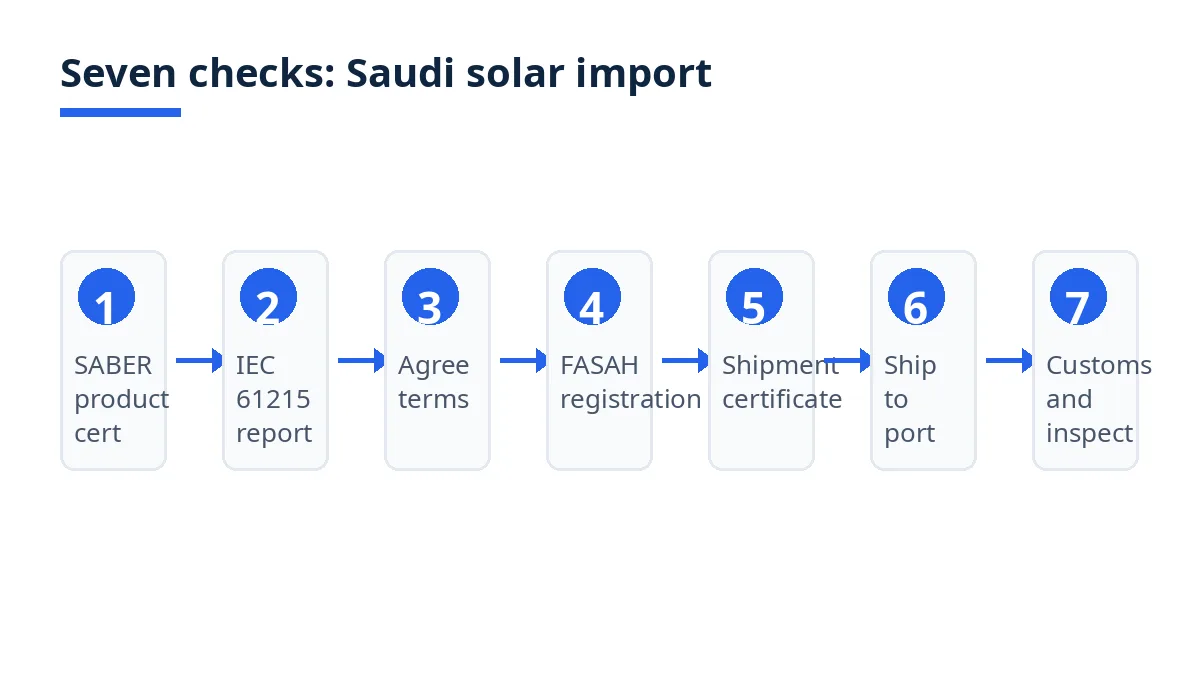
Confirm the conformity route. Establish whether the exact model needs a SABER product certificate under the small solar PV systems regulation, and which body will issue it.
Check the test evidence. Ask for the IEC 61215 test report for the precise model quoted, and confirm it covers that model rather than a sibling from the same factory.4
Agree the commercial terms. Put the price, the Incoterm, the payment method and the warranty into the contract, and name the port pair and the delivery point.
Register and authorise. The Saudi importer registers on FASAH and authorises the customs broker for the chosen port.
Issue the shipment certificate. Request the SABER shipment certificate in SABER with the invoice data before the container sails.
Ship and track. The container leaves Chattogram; confirm the arrival date with the broker so the declaration is filed in time.
Clear customs and inspect. The broker files the declaration, duty and VAT are paid, and the modules are inspected before the container is released.
What should you check on the supplier before you order?
Bangladesh's solar assembly base keeps growing, and the supplier check should weigh Saudi experience ahead of the price sheet. A factory that has already shipped to Saudi Arabia or another Gulf market has handled the SABER documents and the Arabic labelling, and it can name the broker it used.
Ask for the IEC 61215 test reports for the exact model, the factory's export history under HS 8541.43, and the certificate of origin in the form Saudi Arabia requires. Ask for the warranty in writing — product and performance warranties separately — and who honours them in Saudi Arabia. Ask for two reference shipments that can be checked, and for the serial numbers on the packing list.
What does a shipment cost landed in Saudi Arabia?
Example figures. One 40-foot container of modules worth $16,000, on the Chattogram to Dammam lane. Every figure is illustrative — get the live numbers from your supplier and broker before you commit.
Cost line | Amount |
|---|---|
Modules, FOB Chattogram | $16,000 |
Sea freight to Dammam | $1,800 |
Cargo insurance | $200 |
CIF value at Dammam | $18,000 |
Duty at 5% of the CIF value | $900 |
VAT at 15% of $18,900 | $2,835 |
SABER shipment certificate (SAR 350, about $93) | $93 |
Indicative landed cost in Dammam | $21,828 |
Duty is 5 percent of the CIF value of $18,000, which is $900. VAT is 15 percent of the duty-inclusive base of $18,900, which is $2,835 — not 15 percent of the factory price, which would be $2,400. The SABER shipment certificate adds SAR 350, about $93 at the pegged rate of 3.75 riyals per dollar.3 A VAT-registered importer deducts the $2,835 of import VAT on its return, so its cash cost is lower than the table shows; an unregistered buyer bears the full amount.3
What goes wrong most often?
The first error is ordering before the product certificate exists. The certificate takes a conformity assessment body's review of the technical file, and a deposit paid before that review starts is a deposit on a shipment that cannot legally enter the Kingdom.
The second error is accepting a test report for the wrong model. Factories quote a family of modules and send the report for the one that passed, which may be a sibling with a different cell count or frame. The report must name the exact model on the invoice, or the certificate will not match the goods at the border.
The third error is budgeting VAT on the factory price. VAT is charged on the customs value plus duty and other charges, so on the example above it is $2,835 rather than $2,400 — a $435 gap straight out of the margin.3
The fourth error is landing at the wrong port. A container for Riyadh that arrives at Jeddah faces a long inland leg, and a container for the western region that arrives at Dammam faces the same problem in reverse. Match the port to the final destination before the freight is booked.
The fifth error is accepting the modules without inspecting them. Damage is visible on the pallet: cracked frames, crushed corners, damp marks. Photograph it on the spot and tell the insurer the same day.
Next steps on Exportain
For the Gulf comparison, read our guide to importing solar panels to the UAE, where the same 5 percent tariff meets a different conformity system and 5 percent VAT. For the general process, see how to import solar panels from Bangladesh, the solar panels quality control checklist and the HS code guide for solar panels. To start an order, browse Bangladeshi suppliers or raise an RFQ — name the module model, the SABER certificate status and the destination port — and how to buy covers what happens after the quotation.
Sources
- Saudi Arabia's Vision 2030's Renewable Energy Project Initiatives. Climate Scorecard, (accessed )
- SASO Announces Implementation of the Requirements of the Technical Regulation for Small Solar PV Systems. Saudi Standards, Metrology and Quality Organization (accessed )
- How to import equipment from China to Saudi Arabia: taxes, SABER certificates and documents. Bridgetop, (accessed )
- Solar Import Duty Rates 2026: by Country Global Guide. SurgePV, (accessed )
- Top Ports in Saudi Arabia - Ranking. ShipHub (accessed )
About the author
Sourcing from Bangladesh?
Post a request for quotation and suppliers on Exportain can send you their quotes directly.
Post an RFQ