Spain Socks Imports From Bangladesh: Barcelona Entry and IVA
How to import socks from Bangladesh to Spain: Barcelona entry, EORI and IVA, HS 6115 duty, Spanish fiber labels, MOQ and samples, and an example landed cost per pair.
Short answer
To import socks from Bangladesh to Spain, fix each style by pair: fiber mix, gauge, cuff, heel and toe, and size curve. Classify each style in heading 6115, confirm the EBA preference and origin proof, and settle the Barcelona or Valencia entry, EORI number and IVA route before ordering. Approve a pre-production sample, agree the inspection plan, and build the landed cost per pair before bulk production.
On this page
Key takeaways
Socks are classified in heading 6115 by fiber: 6115.94 wool, 6115.95 cotton, 6115.96 synthetic fibers and 6115.99 other materials, with pairs as the supplementary unit; the third-country duty shown on the lines opened is 12 percent.
Bangladesh goods meeting the origin rules can enter duty-free under Everything But Arms, subject to the proof of origin agreed at order stage; confirm the current TARIC line and rate with your broker on the entry date.
Spanish fiber labels must state every fiber by name and percentage in descending order, in Spanish, and the importer carries the duty for the label where the manufacturer is not established in the Union.
Spain applies IVA at the standard rate of 21 percent on the customs value plus duty and costs to destination; the Canary Islands apply IGIC at 7 percent instead, so settle the island route separately.
A Spanish sock order is decided at the border before it is decided at the factory. Settle the entry port, importer of record, EORI number and IVA route first, and quotes can then be compared on equal terms.
Bangladesh enters the European Union under the Everything But Arms arrangement, which grants duty-free, quota-free access for all exports except arms and ammunition, with 19 billion euro in exports benefiting from the preferences in 2024 amid a 96 percent utilization rate.1 Textiles account for almost 94 percent of total EU imports from Bangladesh in 2025.1 The preference is a claim made at entry: it stands or falls on the origin proof and the classification.
For most buyers in Spain the natural entry point is Barcelona: in the first half of 2025 the Port of Barcelona reported full export and import containers totaling 721,461 TEU, up 10 percent on the first half of 2024.2 A single import tariff is due at the place of entry where the import declaration is made.3 Choose Barcelona or Valencia on the warehouse, the sailings available, and your broker's advice, before you ask for prices.
Why source socks from Bangladesh
A sock is sold and worn as a pair, and a pair that does not match in shade, size, cuff tension or pattern position is defective even when each sock looks acceptable alone. Judge a supplier on pair matching and cuff recovery across a size curve. Ask which constructions are running now, in which fiber mixes and gauges, and what the factory can show from a recent run in your gauge and yarn.
Each style is a separate decision, because the fiber mix decides the tariff line and the label wording. Shortlist factories whose current production already includes your constructions, and plan backward from the shelf date.
Find and verify suppliers
Write the pair specification first
A usable sock specification is written in pairs. For each style, fix the length, fiber mix by percentage, yarn and gauge, cuff height and rib, heel and toe construction, leg and foot lengths by size, size curve in pairs per color, color count, packing unit, and Spanish label wording. The mix decides the classification split inside heading 6115: 6115.94 for wool or fine animal hair, 6115.95 for cotton, 6115.96 for synthetic fibers and 6115.99 for other textile materials, with pairs as the supplementary unit.4 State the pricing unit, pairs or dozens, and require every quote to use it.
Send every candidate the identical specification and ask for the same reply format: fiber mix, yarn, gauge, sizes, price inclusions, validity, and the minimum split by style, color and size run. Browse suppliers on Exportain, and ask each candidate to confirm the Spanish label wording and the packing count per carton in pairs.
How do you check a supplier before you pay?
Check three layers. First, company documents: trade license, export registration and association membership where applicable, so that name, address and bank account name agree across every document. Second, capability: monthly capacity in pairs, constructions and fiber mixes in current production, gauge range, dyeing route, and boarding and pairing method. Ask to see a finished pair from current production in your gauge.
Third, payment discipline: keep payments to the company account named in the documents, never to a personal account, and check any change of bank details through a separate channel. For a first order, ask for a video walkthrough of the knitting, boarding and packing areas, including the pairing table. A profile badge is a review of documents and photos, not a factory inspection or a guarantee, and Exportain is not a party to the goods contract.
MOQ, pricing and samples
What is the typical MOQ for socks from Bangladesh?
There is no single typical minimum order quantity for socks from Bangladesh. The minimum is set per style and usually per color and size run, because yarn is dyed in batches, machines are set per gauge and construction, and a size curve is knitted as a set. A plain cotton ankle sock in three colors and a cushioned sport sock with grip and six colors will not carry the same minimum. Ask for the minimum split by style, color and size curve, in writing.
Fix the size curve at the specification stage, and check packed quantities against it at inspection.
How is the price built, and how should you compare quotes?
Yarn is usually the main cost element in a sock, followed by knitting, dyeing, boarding, pairing, labeling and packing, testing, and the factory margin. The fiber mix moves the price first. Construction moves it next: leg length, cuff depth, reinforcement, cushioning and grip each add yarn and time.
Compare quotes only on the identical specification and delivery term, and ask what is excluded, for example testing, special packing, header cards or barcodes. A quote that assumes a different yarn, a shorter leg or a simpler cuff prices a different sock.
Which samples do you need, and how do you approve them?
Work in stages. A development sample shows whether the factory can knit the construction, form the cuff evenly, close the heel and toe cleanly and pair the socks to the size chart. A pre-production sample, in the actual production yarn, color, gauge and finish, is the sample you approve for bulk.
Test the samples as your customers will use them: wear a pair, wash it following the care wording you will print, measure the leg and foot lengths after washing, stretch the cuff and check recovery, and check that both socks match across the size curve. Check the Spanish label on the sample pair before bulk printing. Approve in writing, name the approved sample in the purchase order, and keep one sealed counter-sample of each style.
Quality control and certifications needed
Which quality checks are specific to socks?
Against the approved sample and size chart, check the fiber composition and yarn, the cuff height and rib, the heel and toe closing, and the leg and foot lengths by size. Then check the pair: both socks must match in shade, size, cuff tension and pattern position. Check the finishing: boarding shape, loose threads, holes and dropped stitches.
Agree the inspection method and defect limits before production, and write them into the purchase order. ISO 2859-1:2026 defines a system of acceptance sampling plans for inspection by attributes, indexed by acceptance quality limit (AQL): AQL is the maximum average percentage of defective items considered acceptable during random sampling, used to determine sample sizes and acceptance and rejection thresholds.5 Set those numbers for your own order, style by style; no single AQL figure is a universal rule for socks. Inspect in stages: inline during knitting and boarding, and a final check on packed goods. See the socks quality control checklist and the HS code guide for socks.
Which label rules apply in Spain?
A textile product shall be labeled or marked with the name and percentage by weight of all constituent fibers in descending order.6 Agree the wording at sampling stage and check that the percentages match the production yarn. Where a fiber accounts for up to 5 percent, or fibers together account for up to 15 percent, the regulation allows the term other fibers with the total percentage.6
If the manufacturer is not established in the Union, the importer shall ensure the supply of the label and the accuracy of the information in it.6 The labeling shall be provided in the official language or languages of the Member State where the products are made available to the consumer.6 For goods sold in Spain that means Spanish wording, agreed before bulk label printing begins. The regulation also allows a manufacturing tolerance of 3 percent between the stated fiber composition and the percentages obtained from analysis.6
Which certifications do you actually need?
No single certificate covers every sock order. What you need follows your market and your customer: a retailer may name a specific test or scheme in its supplier manual, and baby socks will usually face stricter harmful-substance checks than a standard adult crew sock. Name any requirement in the specification and check the matching report's scope, product, issuing body and date.
OEKO-TEX STANDARD 100 is the voluntary scheme buyers most often name for this purpose: a label for textiles tested for harmful substances, with stricter requirements the more intensive the skin contact.7 Ask which product class the certificate covers, and check the certificate number in the scheme's label check.
Spain adds one forward-looking obligation to track. In 2025 the Spanish government published a draft Royal Decree on textile and footwear waste, which would establish an extended producer responsibility framework once adopted; its status is proposal, not yet in force.8 Under the draft, a company that first places products on the Spanish market would be considered a producer, with registration, reporting and financing duties.8 Ask your adviser to confirm the current Spanish position before you place goods on the Spanish market.
Incoterms, shipping and transit time
Which delivery term should a first order use?
For containerized sock shipments, weigh FCA against FOB and choose on the delivery point, not on habit. Under FCA, the seller delivers and transfers the risks to the buyer at the agreed location, once the goods are delivered to the carrier, and FCA is suitable for any mode of transport, including multimodal shipments.9 Under FOB, the seller delivers and transfers the risk once the goods are loaded onto the vessel at the named port of shipment, and FOB is to be used only for maritime or inland waterway transport.9
For socks shipped in containers from Chattogram, FCA at the named terminal or at the seller's premises usually matches how the cargo actually moves. State the named place in full in the contract, for example FCA Chattogram container terminal.
How long does shipping take?
There is no single typical transit time for socks from Bangladesh to Spain. Sea freight is the standard route for bulk orders and it takes weeks rather than days, varying by port, routing, transshipment and season. Plan from your forwarder's current sailing schedule, and keep production time separate.
An entry summary declaration must be presented before the arrival of the goods at the first point of entry into the EU.3 Give your forwarder and broker the invoice, packing list and origin documents early enough for that declaration. If the goods are cleared in Barcelona but are intended for use in another EU country, they can be placed under a VAT suspensive arrangement, and VAT will be charged in the country of destination.10 Decide that route with your VAT adviser before clearance.
Import duty, taxes and documents
How are socks classified for duty?
Duty follows each style's classification, not the supplier's product name. Heading 6115 covers pantyhose, tights, stockings, socks and other hosiery, including graduated compression hosiery and footwear without applied soles, knitted or crocheted.4 Everyday socks sit in the Other group, split by fiber: 6115.94 for wool or fine animal hair, 6115.95 for cotton, 6115.96 for synthetic fibers and 6115.99 for other textile materials.4 Graduated compression hosiery sits separately in 6115.10.4 Confirm the full national code for each style before you price or ship.
What import duty applies?
Your rate depends on the style's line, the origin, and any preference in force on the entry date. On the tariff lines opened for this guide, the third-country duty shown is 12 percent on the main sock lines in 6115.94, 6115.95, 6115.96 and 6115.99, and 8 percent on graduated compression hosiery of synthetic fibers in 6115.1010, with 12 percent on the other graduated compression line.4 Treat those figures as indicative for your entry date, and confirm the current line and rate in TARIC with your broker before you commit to a selling price.
Under Everything But Arms, Bangladesh goods that meet the origin rules and carry the required proof of origin can enter duty-free.1 The supplier often needs to provide proof of origin, which may be a certificate of origin or a declaration of origin issued by an authorized or registered exporter.3 Agree at order stage what origin document the supplier will supply, and who checks it before shipment.
Which documents do you need for clearance?
The standard import set is the commercial invoice, packing list, bill of lading, and proof of origin where a preference is claimed, with an entry summary declaration presented before arrival at the first point of entry into the EU.3 The invoice should name each style plainly, for example cotton crew sock, 80 percent cotton, 17 percent polyamide, 3 percent elastane, with sizes, quantities in pairs, unit prices and the delivery term, on its own line. Keep quantities, weights and carton counts in agreement across every document.
An EORI number is mandatory for the clearance of all types of customs operations in the EU, and a person can be assigned only one valid EORI number.11 The number consists of a country code followed by an identifier of up to 15 alphanumeric characters, so a Spanish-issued number starts with ES.11 In Spain, operators who meet the requirements for automatic registration are registered ex officio, while operators whose tax identification number begins with N, M, X or Y must request assignment through the AEAT electronic office.12 Apply well before the first shipment.3
What Spanish IVA applies at import?
Import VAT is levied on the importing of goods and is usually charged when customs clearance procedures take place.10 The taxable amount is the value for customs purposes plus customs duties and any other taxes due by reason of importation, plus supplementary costs up to the place of destination.10 In Spain the standard VAT rate is 21 percent, and socks take the standard rate: build the landed cost with IVA at 21 percent, and keep IVA separate from the duty line.13 VAT-registered firms can reclaim the import VAT as input tax.3 The IVA must be available on the clearance date.
Two Spanish particulars need a note in the file. First, the Canary Islands are excluded from the application of VAT, and apply IGIC instead, with a standard rate of 7 percent.10 13 Settle the IGIC route separately for any goods destined there. Second, there is no domestic VAT registration threshold in Spain: businesses must register as soon as they carry out taxable activities, with non-EU businesses required to appoint a fiscal representative.13 Settle those questions with your adviser at the same time as the EORI application.
Landed cost example
A landed cost is the full cost of one pair, ready to sell. Every number below is an example figure only, not a quote. Example figures: 9,600 pairs of cotton-blend crew socks, FCA Chattogram, sea freight to Barcelona, duty at 0 percent under Everything But Arms with valid origin proof, with the 12 percent fallback shown.1 4
Cost element | Example figure per pair | How to obtain your figure |
|---|---|---|
Product price, FCA | 0.47 EUR | Pro forma invoice |
Freight, Chattogram to Barcelona | 0.08 EUR | Forwarder quote / pairs |
Insurance | 0.01 EUR | Policy / quote |
Customs value | 0.56 EUR | FCA price + freight + insurance |
Duty at 0 percent, preference | 0.00 EUR | Broker / origin proof |
Duty at 12 percent, fallback | 0.07 EUR | 12% of customs value, TARIC |
Port, clearance, broker fees | 0.05 EUR | Broker invoices / pairs |
Delivery, Barcelona to Zaragoza warehouse | 0.03 EUR | Carrier quote / pairs |
Total, preference applied | 0.64 EUR | Sum at 0 percent duty |
Total, fallback duty | 0.71 EUR | Sum at 12 percent duty |
Import IVA at 21 percent is not included in either total. On the preference case it is calculated on 0.64 EUR per pair, giving example IVA of about 0.13 EUR per pair, recoverable as input tax for a VAT-registered importer.10 13 Work the calculation twice: at quote stage and again after shipment. See the landed cost for imports from Bangladesh for the full method.
Step-by-step import checklist
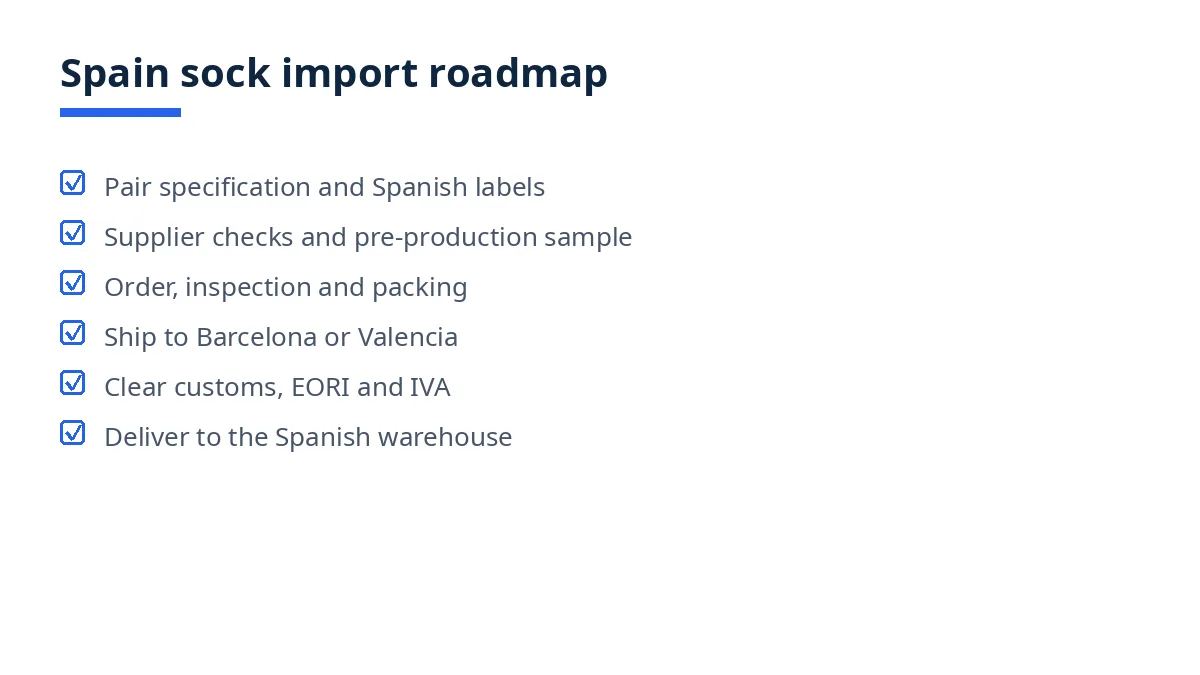
Decide the Spanish entry route first: Barcelona or Valencia, importer of record, EORI number and IVA route.
Write the specification pair by pair: style, fiber mix, gauge, sizes, colors, packing, and Spanish label wording.
Classify every style from heading 6115 and confirm each code and rate with your broker, including the origin proof needed.
Shortlist suppliers in your constructions and fiber mixes; request quotes on the identical specification and delivery term.
Check the supplier: documents, capacity, dyeing and boarding route, and a video or in-person check of the pairing table.
Approve a pre-production sample of each style in production yarn, tested for shade, size, wash, cuff recovery and pair matching.
Confirm the order in writing: purchase order, payment terms, inspection plan, labeling, packing, shipment date and origin document.
Inspect, ship, clear customs with the confirmed code and origin proof, pay the IVA, and reconcile the landed cost.
How Exportain helps
Browse suppliers for Bangladeshi sock and knitwear exporters and compare their current ranges against your style list. Then describe your specification and target quantity in an RFQ and compare replies on the same terms before you choose a factory for sampling. Read how to buy on Exportain for the buying steps. Exportain does not inspect goods, book freight or clear customs, and the contract for the goods is between you and the supplier.
FAQs
What is the typical MOQ for socks from Bangladesh?
There is no single typical minimum. It is set per style and usually per color and size run. Ask for the minimum split by style, color and size curve, in writing, before you fix the curve in the purchase order.
How long does shipping take?
Production and transit are separate, and neither has a single typical figure. Sea transit from Chattogram to Barcelona or Valencia takes weeks rather than days. Confirm the sailing schedule with your forwarder, and keep the entry summary declaration and origin documents ready before the vessel arrives.
What import duty applies?
Duty follows the confirmed classification, origin and preference on the entry date. Everyday socks sit in heading 6115: 6115.94, 6115.95, 6115.96 and 6115.99 by fiber.4 The third-country duty shown on the lines opened is 12 percent, and Bangladesh goods meeting the origin rules can enter duty-free under Everything But Arms.1 4 Confirm the current line and rate in TARIC with your broker.
How do I verify a supplier?
Check company documents so name, address and bank account agree, then check capability: capacity in pairs, constructions, fiber mixes, dyeing and boarding route, and a finished pair from current production. Keep payments to the company account named in the documents, and approve a pre-production sample before bulk production.
Next steps on Exportain
Read how to import from Bangladesh, then post an RFQ on Exportain with your pair specification, size curve and Spanish label wording, and compare replies on the same delivery term before you order samples.
Sources
- EU trade relations with Bangladesh. European Commission, (accessed )
- Strong increase in external trade at the Port of Barcelona, showing double-digit growth. DredgeWire, (accessed )
- Guide to import goods. European Commission, Access2Markets (accessed )
- HS heading 6115: hosiery, knitted or crocheted. GOV.UK (accessed )
- ISO 2859-1:2026 - Sampling procedures for inspection by attributes — Part 1: Sampling schemes indexed by acceptance quality limit (AQL) for lot-by-lot inspection. International Organization for Standardization (accessed )
- Regulation (EU) No 1007/2011 on textile fibre names and related labelling and marking of the fibre composition of textile products. European Union, (accessed )
- OEKO-TEX Standard 100. OEKO-TEX (accessed )
- Overview of All Textile Extended Producer Responsibility (EPR) Laws. Carbonfact, (accessed )
- FCA & FOB Incoterms 2020 explained: Key differences. ICC Academy (accessed )
- Value added tax. European Commission (accessed )
- Economic Operators Registration and Identification number (EORI). European Commission, Taxation and Customs Union (accessed )
- Registration and identification of economic operators (EORI) or association EORI-NIF. Agencia Tributaria (accessed )
- VAT in Spain: Rates, Registration and Compliance Guide. Taxually, (accessed )
About the author
Sourcing from Bangladesh?
Post a request for quotation and suppliers on Exportain can send you their quotes directly.
Post an RFQ