

Netherlands Socks Imports: Rotterdam, EBA Duty and VAT
Import socks from Bangladesh to Netherlands: Rotterdam entry, EBA duty position, Dutch VAT, EU fibre labels, MOQ and samples, shipping, and an example landed cost per pair.
Short answer
To import socks from Bangladesh to the Netherlands, classify each style in heading 6115 by fibre, confirm the Everything But Arms duty position and origin proof with your broker, and settle Dutch VAT registration and an EORI number before the goods sail. Approve a pre-production sample in production yarn, agree the AQL inspection plan, ship to Rotterdam under a named Incoterm, and build the landed cost per pair before bulk production.
On this page
Key takeaways
Everyday socks sit in heading 6115.94 to 6115.99 by fibre: wool or fine animal hair, cotton, synthetic fibres, and other textile materials. Graduated compression hosiery sits separately in 6115.10.
On the lines opened for this guide, the third-country duty shown is 12 percent. The Everything But Arms preferential duty is 0 percent only when the origin rules are met and proof of origin is in order, subject to confirmation in TARIC.
Dutch import VAT is charged at the 21 percent standard rate. With an Article 23 permit, the VAT is declared on the VAT return instead of being paid at the border; a foreign entrepreneur needs a tax representative to apply.
There is no single typical MOQ, price or transit time for socks. Confirm each one in writing for your exact style, fibre mix, colour count, size curve, packing, route and sailing date.
A sock order is bought, classified, inspected and sold in pairs. Two socks that do not match in shade, size or cuff tension are not one pair, and a buyer who specifies, checks and prices pairs will avoid most disputes that follow a shipment.
This guide is for a Netherlands-based buyer landing goods at Rotterdam and selling in the Netherlands or onward into the European Union. It covers the pair specification, supplier checks, samples and quality control, the Rotterdam entry, duty and Dutch import VAT, and an example landed cost per pair. Bangladesh benefits under the European Union Everything But Arms arrangement, which grants duty-free, quota-free access for all exports except arms and ammunition, subject to origin rules and proof of origin.1 That preference is conditional, not automatic.
Rotterdam handled 10.7 million TEU of containers in the first nine months of 2025, up 3.0 percent on the same period a year earlier, with throughput on Asia-Europe services up 8.8 percent.2 The constraint is usually earlier: a specification that leaves the toe, heel, cuff or size curve open to interpretation, and a file that cannot prove origin or fibre composition when asked.
Start with the pair: what a Netherlands sock order is
Write the order as a list of pairs. Each style needs its own line: length, fibre mix by percentage, gauge, size range with the size curve, colour range, cuff type and depth, heel and toe construction, and packing in pairs per polybag, inner carton and export carton. A style sold as a three-pair pack is a different order from the same sock sold singly, because shade matching across the pack, the header card and the barcode all become part of the specification.
Fibre mix drives classification inside heading 6115, label wording, dye method, shrinkage and price. Name the percentages you want quoted, and require the same percentages in the sample report, production order and packing list. Agree the size curve in pairs per colour, and how a short size is handled. State the fold, pairing method, polybag print, header card and carton markings in the purchase order, with a photo of a packed carton required before shipment. A carton stating style, colour, size range and pair count can be checked without opening it.
Why source socks from Bangladesh
Bangladesh has a knitwear sector organised around its own trade body. The Bangladesh Knitwear Manufacturers and Exporters Association describes itself as an apex trade body representing the knitwear sector of Bangladesh, established in 1996, and states that it represents approximately 2,540 knitwear member factories.3 A supplier that already makes socks will already hold the circular knitting machines, toe-closing setup and pairing line the order needs. A general knitwear factory may have none of that setup, so shortlist by current sock production first: styles in production this month, in your length and fibre mix, at gauges close to yours.
The European Commission states that Bangladesh is the largest beneficiary under Everything But Arms, with 19 billion euro of exports benefiting from the preferences in 2024 at a 96 percent utilisation rate, and that textiles account for almost 94 percent of EU imports from Bangladesh.1 Those figures describe the trade as a whole, not socks alone. Set the first order as a controlled test of one supplier, one fibre mix and a narrow size and colour range, judged on the delivered pairs.
Find and verify suppliers
Write the specification before you contact any supplier. A one-page style sheet per style, with a sketch or photo reference, fibre percentages, size curve, colour references, cuff and heel details, packing and the delivery term, turns replies into comparable quotes. Without it, each supplier quotes a different sock and the cheapest quote is usually the thinnest specification.
Start among makers whose current range already includes socks in your length and fibre mix. Ask whether knitting is in-house, where dyeing and finishing are done, and whether toe closing and pairing are done on site or subcontracted. Browse suppliers on Exportain and compare the ranges shown against your style pages. Ask each shortlisted supplier for the same evidence pack: registration and sock export history, current sock styles, machines and gauges, the dyeing and finishing route, and recent sock shipments described by style and quantity.
Verify in layers and keep a written record: documents checked, a video walkthrough of the knitting floor, toe-closing stations and pairing line with machines running, and a sample in production yarn. Drop a supplier that quotes without fibre percentages, size curve or packing detail, will not name the dyeing route, or offers to copy a branded sock. Read how to import from Bangladesh for the wider import sequence, and agree the delivery term, payment terms, inspection plan, defect limits, delivery window and remedy for a failed lot in the same document as the specification.
MOQ, pricing and samples
There is no single typical minimum order quantity, price or sample lead time for socks from Bangladesh. Confirm each one in writing for your exact style, fibre mix, colour count, size curve and packing. The minimum is usually set by the dye lot and machine setup: a small order needing a fresh dye lot per colour carries the dye cost across few pairs. Three levers move the minimum most: fewer colours, a narrower size range, and a repeat of a yarn and gauge the mill already runs. Compare a larger run and a smaller run on the landed cost per pair, not on the headline minimum.
Price drivers are fibre and yarn, colour count and dye method, pattern complexity, packing, and the delivery term. Elastane content, reinforced heel and toe, a patterned cuff and anti-slip grips each add cost and machine time, and printed packing costs more than a plain bag on every pair. Compare quotes only on the identical specification, delivery term, packing and inspection plan.
Samples come in stages. A proto sample proves the mill understood the style. A pre-production sample, in production yarn and the full size range, approves bulk production: approve it in writing and keep it sealed as the reference. A shipment sample from packed cartons proves the bulk run matched it. Do not approve bulk production from a photo or a substitute yarn. Agree sample costs, pairs per size and a dated timetable before samples are made.
Quality control and certifications needed
Quality control for socks is pair control. State the sampling method, defect classes and accept and reject numbers before production, and use the same plan inline and at final inspection on packed cartons. ISO 2859-1 defines the acceptance sampling system indexed by acceptance quality limit, AQL, for lot-by-lot inspection by attributes.4 Set your own limits in writing, and check that any AQL table you borrow fits a pair product: a defect affecting one sock still fails the pair.
Check pair matching by shade and size, heel and toe position, toe closure strength, cuff depth and elastic recovery, leg length, and colour consistency across sizes and dye lots. Wash the pre-production sample to the printed care instructions and measure shrinkage, cuff recovery and colour change.
Fibre labelling is a legal requirement in the EU. Under Regulation (EU) No 1007/2011, a multi-fibre product must be labelled with the name and percentage by weight of all constituent fibres in descending order, with limited derogations for small shares designated as other fibres.5 For socks, the Regulation excludes additional elastic yarns in the cuff and the stiffening and reinforcement yarns of the toe and heel from the fibre composition determination.5 That exclusion is narrow. Give the mill the exact label wording and require a label proof before bulk production. See the HS code guide for socks for the classification side.
OEKO-TEX STANDARD 100 is a label for textiles tested for harmful substances, with stricter requirements where skin contact is more intensive.6 Ask which product class the certificate covers, check the certificate number and validity, and require it to cover the finished sock, not only the yarn. Other claims, such as organic or recycled content, each need their own proof. Agree care, size, origin and barcode labelling before production, and use the socks quality control checklist as a starting list, with the pair checks, wash test and label proof added.
Incoterms, shipping and transit time
Choose the delivery term for containerised socks. Under Incoterms 2020, FOB means the seller delivers and transfers risk once the goods are loaded on board the vessel at the named port of shipment, and FOB is to be used only for maritime or inland waterway transport.7 FCA suits container and multimodal shipments, because the seller delivers to the carrier at an agreed place, which may be the seller's premises or a terminal.7 For a container moving from a factory to Chattogram port and by sea to Rotterdam, FCA at a named place often fits better than FOB, because the container is handed over before it reaches the vessel. State the term, named place and Incoterms version in the contract.
CIF and DDP shift more work to the seller. Under CIF the seller contracts main carriage and insurance to the destination port, while the buyer still handles clearance and duty. Under DDP the seller handles clearance and duty as well, leaving the buyer dependent on the seller's Dutch customs and VAT setup. Compare terms on total landed cost and control of each step, not on the headline freight figure.
Do not budget on a single transit time: sailing, routing, transhipment and season all move the date. Ask your forwarder for the schedule, routing and transit time for your sailing date, and build the timetable backwards from the on-sale date, with a buffer at the Rotterdam end. The import declaration is made where the goods are declared: a single import tariff is due at the place of entry, and the product can then circulate in the EU without further customs formalities.8 Agree who files the declaration and who holds the EORI number used. The carrier must present an Entry Summary Declaration before arrival at the first EU point of entry.8 Keep invoice, packing list, transport document and origin proof ready before shipment, and check that pairs invoiced, pairs packed and the transport document agree.
Import duty, taxes and documents
Duty follows classification, not the supplier's product name. Heading 6115 covers pantyhose, tights, stockings, socks and other hosiery, including graduated compression hosiery and footwear without applied soles, knitted or crocheted.9 Graduated compression hosiery sits in 6115.10, other pantyhose and tights in 6115.21 to 6115.29, other women's hosiery in 6115.30, and the other group splits by fibre: 6115.94 wool or fine animal hair, 6115.95 cotton, 6115.96 synthetic fibres, 6115.99 other textile materials.9 Everyday socks sit in 6115.94 to 6115.99, and the supplementary unit on the lines opened for this guide is the number of pairs. Confirm the full code per style with your broker, and treat every code here as indicative for your entry date.
On the lines opened for this guide, the third-country duty shown is 12 percent, for example on the cotton line 6115.95 and the synthetic-fibre lines in 6115.96.9 That is the rate without a preference. The Everything But Arms preferential duty is 0 percent when the origin rules are met and proof of origin is in order, subject to confirmation in TARIC on the entry date.1 Do not price on 0 percent until your broker confirms the TARIC line, origin rule and proof. Proof may be a certificate of origin or a declaration of origin issued by the authorised exporter or the registered exporter in the REX system, with authorisation or registration numbers stated.8
Settle the Dutch file before shipment. Business.gov.nl states that anyone importing or exporting goods and dealing with Dutch Customs must have an EORI number, applied for free of charge, and must always apply if someone else files declarations on their behalf.10 The EORI number is valid throughout the EU, and registration can take some time, so apply well ahead.8
The standard Dutch VAT rate is 21 percent, with a reduced rate of 9 percent and a zero rate for certain goods and services.11 Budget import VAT on socks at 21 percent and have your adviser confirm the rate. VAT on import is calculated on the value of the goods plus import duty and any excise duties.8 Without deferment, that VAT is paid at the border and reclaimed later through the return. Under Article 23, the Belastingdienst states that you are not required to pay VAT on import immediately, and it can be paid when you file your VAT return, provided you hold an Article 23 permit.12 A foreign entrepreneur cannot apply directly, but can engage a tax representative, who can apply, declare the VAT on the return and deduct it as input tax on the same return.12 The permit moves VAT into the return; it does not remove duty or VAT.
Prepare before shipment: customs declaration, Entry Summary Declaration, commercial invoice, packing list in pairs, transport document, proof of origin, and certificates relied on.8 The invoice, packing list and transport document must agree on style, pairs, fibre composition and value, and the declaration may be lodged by the importer or an appointed customs representative.8
Landed cost example
Every figure here is an example figure only, not a quote, and duty assumes the Everything But Arms preference at 0 percent with valid origin proof. If the preference does not apply, rebuild with the 12 percent rate, confirmed in TARIC.9 Import VAT is shown separately because, with an Article 23 permit, it is declared on the VAT return rather than paid at the border.12 VAT is calculated in US dollars for arithmetic only; the actual assessment is in euro.
Cost item | Example figure | Basis |
|---|---|---|
Quantity | 20,000 pairs | One style, one fibre mix |
FOB price, example | 9,000.00 dollars | 0.45 dollars per pair, example figure |
International freight, example | 1,800.00 dollars | Chattogram to Rotterdam, example figure |
Insurance, example | 90.00 dollars | Example figure |
Customs value, example | 10,890.00 dollars | FOB plus freight plus insurance, example figure |
Import duty at 0 percent, example | 0.00 dollars | Everything But Arms preference, subject to broker confirmation |
Customs clearance and port handling, example | 350.00 dollars | Example figure |
Inland delivery Rotterdam to warehouse, example | 400.00 dollars | Example figure |
Total landed cost excluding import VAT, example | 11,640.00 dollars | Sum of the example figures above |
Landed cost per pair excluding import VAT, example | 0.58 dollars | Total divided by 20,000 pairs |
Import VAT at 21 percent, example | 2,286.90 dollars | 21 percent of the example customs value, shown separately |
If the preference does not apply, duty at 12 percent is 1,306.80 dollars, the example total rises to 12,946.80 dollars, and the cost per pair rises to 0.65 dollars. Import VAT would then be calculated on the customs value plus duty.8 Work the calculation twice, at quote stage and after shipment. See the landed cost method for imports from Bangladesh for the full method.
Step-by-step import checklist
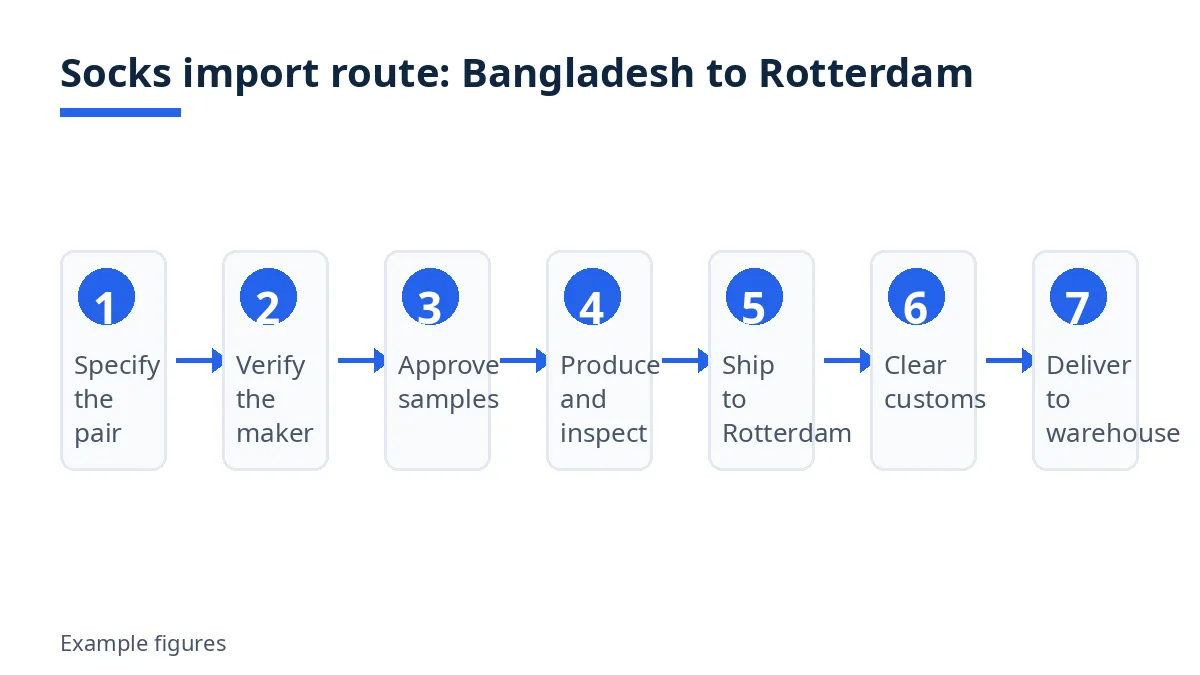
Write the pair specification: style, length, fibre percentages, size curve, colour range, cuff and heel details, and packing.
Shortlist sock makers in your length and fibre mix, request the evidence pack, and compare quotes on the identical specification and delivery term.
Verify in layers: documents, a video walkthrough, and a sample in production yarn.
Agree commercial terms in writing: delivery term and named place, payment terms, inspection plan, defect limits, delivery window and remedy for a failed lot.
Approve the pre-production sample in writing and keep the sealed sample with its approved label as the reference.
Confirm classification, duty and origin with your broker: full code, TARIC line, Everything But Arms position and REX proof.
Settle the Dutch file before shipment: EORI number, Dutch VAT registration or representative, and the Article 23 position, with the broker instructed in writing.
Produce, inspect inline and on packed cartons against the AQL plan and approved sample, including a wash test.
Ship to Rotterdam, confirm the Entry Summary Declaration, and check that invoice, packing list, transport document and origin proof agree.
Clear customs at Rotterdam, check delivered pairs against the packing list and approved sample, and record the actual landed cost per pair.
How Exportain helps
Exportain lists Bangladeshi suppliers, including knitwear makers, where a buyer can compare ranges against a style specification before contacting anyone. Shortlist makers whose current sock range matches your length and fibre mix, send the same specification to each, and compare replies on identical terms. Read how to buy on Exportain, then post the specification as a request for quotation and compare quotes, samples and inspection plans side by side. Exportain does not replace the broker, forwarder or inspection plan: confirm classification, duty, origin and VAT with advisers, and approve the pre-production sample before bulk production.
FAQs
What is the typical MOQ for socks from Bangladesh?
There is no single typical MOQ. The minimum is set by the dye lot, machine setup and colour and size range. Ask each maker for the minimum on your exact specification, in pairs per colour and size, and compare it with the per-pair price. If it is too high, reduce colours, narrow the size range, or repeat a yarn and gauge the mill already runs, and re-quote.
How long does shipping take?
Shipping time has no figure for all sock shipments from Bangladesh to the Netherlands. Ask your forwarder for the schedule, routing and transit time for your sailing date, and build the timetable backwards from the on-sale date, with a buffer at the Rotterdam end.
What import duty applies?
Duty depends on classification in heading 6115 and on whether the Everything But Arms preference applies. On the lines opened for this guide, the third-country duty shown is 12 percent, for example on the cotton line 6115.95 and the synthetic-fibre lines in 6115.96.9 The preferential duty is 0 percent when the origin rules are met and proof of origin is in order, subject to confirmation in TARIC on the entry date.1 Confirm the full code, TARIC line and origin proof with your broker before you price.
How do I verify a supplier?
Verify in layers and keep a written record: the evidence pack, a video walkthrough of the knitting floor, toe-closing stations and pairing line, and a sample in production yarn. Check certificate numbers for any claim made, such as an OEKO-TEX certificate covering the finished sock.6 Agree the inspection plan in the purchase order, inspect inline and on packed cartons, and judge the supplier on delivered pairs against the sealed approved sample.
Next steps on Exportain
Read how to buy on Exportain, then browse suppliers and compare current sock ranges against your style pages. When the specification is ready, post an RFQ with the pair specification, size curve, packing and delivery term, and compare quotes on the same terms before choosing a supplier for sampling.
Sources
- EU trade relations with Bangladesh. European Commission, (accessed )
- Throughput at the port of Rotterdam falls slightly in the first nine months of 2025. Port of Rotterdam, (accessed )
- BKMEA at a Glance. BKMEA (accessed )
- SIST ISO 2859-1:2003 - Sampling procedures for inspection by attributes, Part 1: Sampling schemes indexed by acceptance quality limit (AQL). International Organization for Standardization, (accessed )
- Regulation (EU) No 1007/2011 on textile fibre names and related labelling and marking of the fibre composition of textile products. European Union, (accessed )
- OEKO-TEX Standard 100. OEKO-TEX (accessed )
- FCA & FOB Incoterms 2020 explained: Key differences. ICC Academy (accessed )
- Guide to import goods. European Commission, Access2Markets (accessed )
- Pantyhose, tights, stockings, socks and other hosiery, including graduated compression hosiery and footwear without applied soles, knitted or crocheted - UK Integrated Online Tariff. UK Government (accessed )
- EORI number for all customs operations. Business.gov.nl (accessed )
- Dutch VAT rates and VAT compliance. Avalara (accessed )
- Reverse-charge mechanism on import: Article 23. Belastingdienst (accessed )
About the author
Sourcing from Bangladesh?
Post a request for quotation and suppliers on Exportain can send you their quotes directly.
Post an RFQ


