

Australia Socks Imports From Bangladesh: Sydney Entry, Duty and GST
How to import socks from Bangladesh to Australia: Sydney entry, HS 6115 duty and the LDC preference, 10% GST, Australian care and origin labels, MOQ, samples and a per-pair landed cost example.
Short answer
To import socks from Bangladesh to Australia, specify each style in pairs, classify it in heading 6115, and confirm the least developed country preference and origin proof with your broker before ordering. Settle the Sydney or Melbourne entry, the FCA or FOB term, Australian care and trade-description labels, and the landed cost per pair, then approve a pre-production sample before bulk production.
On this page
Key takeaways
Socks are classified in heading 6115 and counted in pairs: 6115.10 for graduated compression hosiery, and 6115.94 wool, 6115.95 cotton, 6115.96 synthetic fibers and 6115.99 other materials for other socks; mark every heading indicative until verified.
The general rates on the schedule lines opened are 5 percent on 6115.10.10, 6115.95.10 and 6115.96.10 and Free on 6115.94.10 and 6115.99.10; the LDC rate is Free unless otherwise indicated, but only where the origin rules are met.
GST is 10 percent of the value of the taxable importation: customs value plus any duty plus international transport and insurance to the place of consignment in Australia.
Australian labels need two layers: care instructions in English or the five care symbols or both, and a trade description in English naming the country of manufacture and giving a true description of the goods.
An Australian sock order is settled at the border before it is settled at the factory. The questions that change the price are Australian ones: which tariff line in heading 6115 the sock sits on, whether the origin file supports the least developed country preference, and how much Goods and Services Tax (GST) falls due on the value of the taxable importation. A buyer who answers those questions first can compare factory quotes on equal terms.
This guide is for Australian buyers of retail, private label, wholesale, workwear, sport and baby socks who clear goods at Sydney or Melbourne. It works in pairs throughout, because socks are classified, checked, packed and sold as pairs.
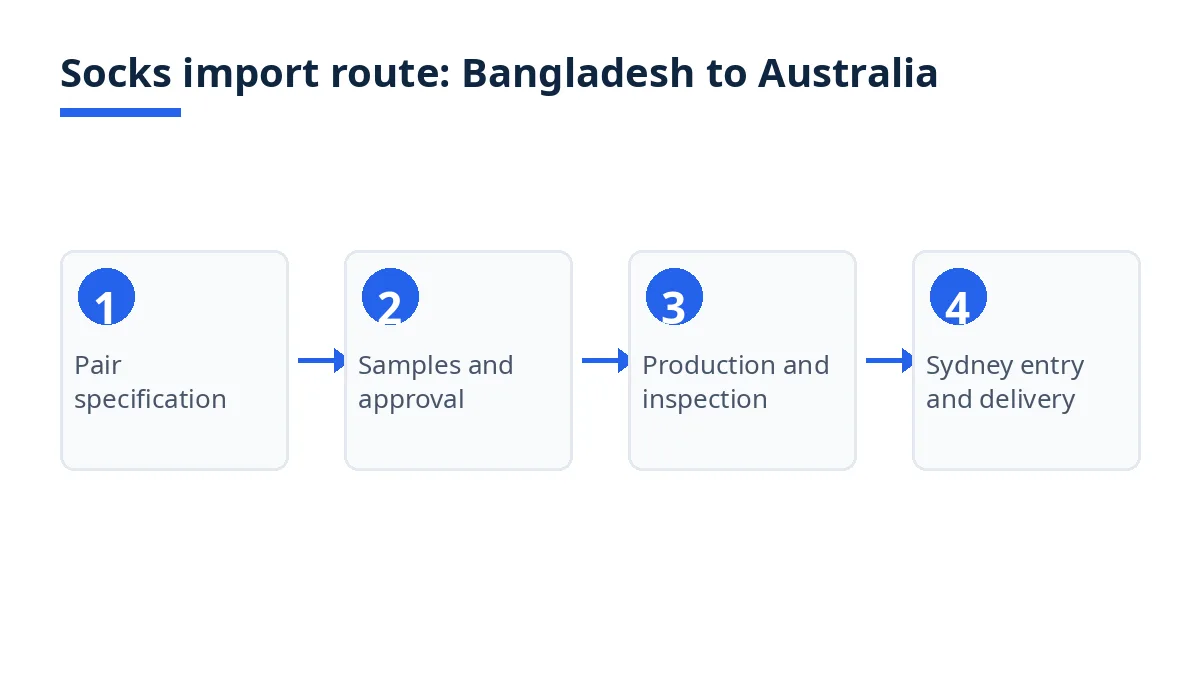
Sydney first: why the Australian entry decides the sock order
Settle the entry port first: Sydney or Melbourne, chosen from your warehouse and broker. Ask for the current sailing schedule for Chattogram to your chosen port, the container cut-off, and the delivery time to your warehouse.
You must complete an Import Declaration when imported goods in a consignment have a combined value of over AUD 1,000 and are being cleared into home consumption, and you must pay all applicable duties, taxes and charges before the goods can be released.1 The declaration is a statement by the importer or their agent, a licensed customs broker, about the goods, the importer, how the goods are transported, and the tariff classification and customs value.1 It may be submitted in the Integrated Cargo System (ICS) or lodged as a completed, signed document at an Australian Border Force (ABF) counter.1
From 1 July 2026, the biosecurity cost recovery charge for goods arriving by air and sea is AUD 48.00 and AUD 71.00 respectively, and it applies only to imported goods with a customs value over AUD 1,000, collected by the ABF through the ICS on behalf of the Department of Agriculture, Fisheries and Forestry (DAFF).2 That charge is separate from duty and GST.
Find and verify suppliers without a ranked list
Start with a pair specification that a factory can price without guessing, and send the identical specification to every candidate. For each style, fix the length, the fiber mix by percentage, the yarn and gauge, the cuff height and rib, the heel and toe construction, the leg and foot lengths by size, the size curve in pairs per color, the color count, the packing unit, and the label wording. State the pricing unit, pairs or dozens, and require every quote to use it.
Shortlist factories whose current production already includes your constructions. Judge a supplier on sock operations: hosiery knitting, toe closing, boarding, and pairing that keeps two socks together to the carton. Browse suppliers on Exportain and read the how to import from Bangladesh guide, then compare your approach with the HS code for socks guide.
Verification has three layers: company documents, capability, and payment discipline. Check trade licence, export registration and association membership so that name, address and bank account name agree across every document. Check monthly sock capacity by construction, whether knitting, toe closing and boarding are in-house, and the yarn source and gauge range. Keep payments to the company account named in the documents, never to a personal account. Read the how supplier verification works on Exportain guide. On Exportain, supplier profiles carry document and photo review badges, which are a review of documents and photos, not a factory inspection or a guarantee, and Exportain is not a party to the goods contract.
Ask every candidate the same origin questions at the same time as the price questions, because the Australian preference depends on the origin file, not on a promise made after shipment. Ask where the yarn was made, where knitting, toe closing, boarding and packing took place, and what factory cost records the supplier can support.
MOQ, pricing and samples: price the pair, not the carton
There is no single typical minimum order quantity (MOQ) for socks from Bangladesh. The minimum is set per style and usually per color, because yarn is dyed in batches and a knitting setup is made per style and gauge. Ask each supplier how its minimum splits by style, color, size range and packing unit, and whether a smaller first order is possible at a higher unit price with a stated surcharge.
Price is built from yarn, knitting, toe closing, boarding, dyeing, finishing, testing, packing and the factory margin, and yarn is usually the largest element. Detail adds operations: cushioned soles, arch support, grip dots, compression zones, jacquard patterns and embroidered logos each cost more to knit and to check. Two quotes can differ because one assumes a lighter yarn, a shorter cuff, less cushioning or simpler packing. Ask what each price is based on, in writing, so a lower quote is judged as a different specification rather than accepted as a saving.
Compare quotes on the same basis: same pair composition, sizes, fiber mix, gauge, cuff, heel and toe, delivery term and packing. Require the quote to state the delivery term, currency, validity period, payment terms, production lead time after sample approval, and carton details: pairs per polybag, polybags per inner carton, inner cartons per export carton, and carton dimensions and weight.
A development sample shows whether the factory can knit the construction, close the toe cleanly, form the heel, hold the cuff and pair the socks to your size chart. A pre-production sample, made in the actual production yarn, color, gauge and finish, is the sample you approve for bulk. Approve in writing and keep one sealed counter-sample of each style.
Quality control, care labels and trade descriptions for Australia
Against the approved sample and size chart, check fiber composition and finished weight, length and cuff height within your agreed tolerances, and consistency across the size curve. Then check construction pair by pair: toe closure and seam comfort, heel shape and position, cuff rib and recovery after stretching, and pattern position and matching across the pair.
ISO 2859-1:2026 covers sampling schemes indexed by acceptance quality limit (AQL) for lot-by-lot inspection, and its summary states that AQL stands for acceptance quality limit, the maximum average percentage of defective items considered acceptable during random sampling, used to determine sample sizes and acceptance and rejection thresholds.3 Inspect in stages: an inline check during knitting, toe closing and boarding, and a final random inspection on packed goods, using the socks quality control checklist.
The first layer is care labeling. The mandatory standard for care labeling for clothing and textiles applies to clothing, household textiles, apparel, furnishings and piece goods and yarns made from textiles, among other goods, and the standard allows care instructions written in English or the use of five internationally recognised care symbols, or both.4 Suppliers must meet the requirements in the mandatory standard, but they may provide extra information such as care instructions in other languages.4
The second layer is the trade description. The Commerce (Trade Descriptions) Regulation 2016 covers textile products and articles of apparel in its table of goods whose import without a trade description is generally prohibited, and it defines textile products as woven, knitted or felted materials manufactured from fiber, or tops, yarns, threads or lace.5 A person must not import goods covered by that table unless a trade description is applied to the goods in accordance with the Regulation.5 The trade description must include, in prominent and legible characters, the name of the country in which the goods were made or produced, and a true description of the goods, also in prominent and legible characters, and it must be in the English language.5
Certification is a buyer choice, not a single Australian requirement for socks. OEKO-TEX STANDARD 100 is a label for textiles tested for harmful substances, every item bearing the label is certified as having passed safety tests for harmful substances, and the laboratory tests are based on intended use, with stricter requirements the more intensive the skin contact.6 Product Class 1 covers products for babies and children up to 3 years and has the strictest requirements, and Product Class 2 covers products with direct skin contact.6 Name any such requirement in the specification, ask for the matching certificate, and check its scope, product class, issuing body and dates.
Incoterms, shipping and the Sydney-Melbourne choice
FCA is the appropriate rule when goods are transported in containers or pallets and multiple modes of transportation are used, while FOB is the appropriate rule when goods are transported in bulk between ports using maritime or inland waterway transportation.7 Under FCA, the seller delivers the goods at their premises or another named place, with export clearance completed, and transfers risks and costs to the buyer at that moment.7 Under FOB, the seller delivers the goods by loading them onto the vessel at the agreed port of shipment, with export clearance completed, and transfers risks and costs to the buyer at that point.7
Risk passes from seller to buyer at the same point and time as delivery, in only two rules, CIP and CIF, is there an obligation on the seller to provide insurance, and in the C rules and D rules the seller must contract for freight to the destination, while only in the E and F rules does the buyer arrange freight.8 In all rules but EXW the seller must carry out export formalities, and in all rules but DDP the buyer must carry out import formalities.8 The four sea rules, FAS, FOB, CFR and CIF, are only intended for port-to-port bulk or break-bulk shipments and are not suitable for container shipments in their current form.8 Name the rule, the named place and the Incoterms 2020 version in the purchase order, and agree who insures the sea leg.
Sea freight is the standard route for bulk orders and it takes weeks rather than days, varying by port, routing, transshipment and season. Plan from your forwarder's current sailing schedule, add clearance and delivery, and keep a buffer between vessel arrival and any retail launch date.
Import duty, GST and documents: the LDC preference is conditional
Heading 6115 covers panty hose, tights, stockings, socks and other hosiery, including graduated compression hosiery and footwear without applied soles, knitted or crocheted.9 The split inside heading 6115 is by construction and fiber: graduated compression hosiery in 6115.10, other panty hose and tights in 6115.21 to 6115.29, other women's hosiery in 6115.30, and other hosiery by fiber in 6115.94 for wool or fine animal hair, 6115.95 for cotton, 6115.96 for synthetic fibers and 6115.99 for other textile materials.9 The statistical unit for the sock lines is pairs, shown as Pr in the schedule.9 Classify each style separately and mark every heading indicative, subject to verification on the official tariff for your entry date.
The general rates shown on the schedule lines opened for this guide are 5 percent on the sock lines 6115.10.10, 6115.95.10 and 6115.96.10, and Free on 6115.94.10 for wool or fine animal hair socks and 6115.99.10 for socks of other textile materials.9 The schedule footnote states that, unless otherwise indicated, the NZ, PG, FI, DC, LDC and SG rates are Free.9 Confirm the current line and rate with your broker on the entry date, and treat every rate in this guide as indicative, subject to verification.
The Australian System of Tariff Preferences (ASTP) includes duty-free and quota-free access for least developed countries (LDCs), and on 1 July 2003 Australia granted duty-free entry to goods originating in LDCs, conditional on the goods meeting more stringent rules of origin than those devised for earlier developing country preference.10 While the rules allow materials from all developing countries, Forum Island countries and Australia to count as local content, the level of materials from all non-LDC sources that can count as local content is limited to 25 percent of the total factory cost of the goods.10 For partly manufactured goods claimed as the manufacture of a least developed country, the ABF guide states the minimum allowable factory cost percentage as 50 percent, and the second criterion is that the last process of manufacture occurred in the preference country.10 Do not claim the preference on shipment from Bangladesh alone. Agree the origin proof at order stage and have your broker confirm the LDC listing, the origin position and the declaration codes for your entry date.
GST is separate from duty and it applies even where duty is Free. GST is payable on most goods imported into Australia, whether or not the importer is registered for GST, and a GST-registered business that imports goods as part of its activities may be able to claim a GST credit for GST paid.11 The GST payable is 10 percent of the value of the taxable importation: the customs value, any customs duty payable, the amount paid or payable to transport the goods to their place of consignment in Australia, the insurance cost for that transport, and any wine tax payable.11 GST is generally payable before the goods are released, unless the importer is registered under the deferred GST scheme, subject to eligibility criteria.11 Keep the import declaration and the official receipt, because a GST credit must not be claimed without documentation showing the goods were imported and GST was paid or deferred.
The standard import set is the commercial invoice, packing list, bill of lading or air waybill, and proof of origin where a preference is claimed.
Landed cost example
Every number in this section is an example figure only, not a quote. Example figures: 12,000 pairs of cotton crew socks, FCA Chattogram, sea freight to Sydney, general duty at the schedule rate shown above, and the LDC preference case beside it for comparison.
Cost element | Example figures, general 5% duty (per pair) | Example figures, LDC preference met (per pair) | How to obtain your figure |
|---|---|---|---|
Product price, FCA (customs value basis) | A$1.20 | A$1.20 | Confirmed pro forma invoice |
International freight | A$0.28 | A$0.28 | Forwarder quote divided by pairs shipped |
Insurance | A$0.02 | A$0.02 | Policy or forwarder quote |
Duty | A$0.06 | A$0.00 | Broker calculation from confirmed codes and rates |
Biosecurity charge, sea (example spread) | A$0.01 | A$0.01 | Current DAFF charge divided by pairs |
Broker, port and local delivery | A$0.18 | A$0.18 | Broker and carrier quotes divided by pairs |
Total landed cost, excluding GST | A$1.75 | A$1.69 | Sum of all lines above |
GST, shown separately | A$0.16 | A$0.15 | 10% of customs value plus duty plus freight and insurance |
See the landed cost for imports from Bangladesh guide for the full method, and confirm the current import processing charge and biosecurity charge with your broker, because charges change and the example spread above is not a charge quote.
Step-by-step import checklist: socks from Bangladesh to Australia
Write the pair specification style by style: length, fiber mix, yarn and gauge, cuff, heel and toe, size curve in pairs per color, packing unit, and Australian label wording.
Classify every style from heading 6115, confirm each full code and rate with your broker, and mark every heading indicative until verified.
Choose the entry port from your warehouse and broker, Sydney or Melbourne, and ask your forwarder for the current sailing schedule and cut-off.
Shortlist factories whose current production already includes your constructions, and request comparable quotes on the identical specification, pricing unit and delivery term.
Verify the chosen supplier: company documents, sock capacity, yarn source and gauge range, dyeing route, a finished pair from current production, and the origin records needed for any preference claim.
Order samples in stages, test the pair, wash it following your care label, then approve a pre-production sample of each style in production yarn and color.
Confirm the order in writing: purchase order, pro forma invoice, delivery term with named place, payment terms, inspection plan with AQL and defect limits, labeling, packing, carton plan and shipment date.
Inspect during production and again on packed goods against the approved samples, checking pair matching, toe closure, heel position and shade consistency.
Ship, clear customs with the confirmed code for each style, the origin file for any preference claim, and the import declaration for a consignment over AUD 1,000, and reconcile the actual landed cost per pair.
How Exportain helps
Post a free RFQ on Exportain and state the fiber mix, gauge, size curve, delivery term and label wording in the request, so the quotes you receive can be compared pair by pair. Exportain is a B2B marketplace where buyers post RFQs, receive quotations and message suppliers. It does not inspect goods, book freight or clear customs.
What is the typical MOQ for socks from Bangladesh?
There is no single typical MOQ for socks from Bangladesh. The minimum is set per style and usually per color, because yarn is dyed in batches and a knitting setup is made per style and gauge. Ask each supplier how its minimum splits by style, color, size range and packing unit.
How long does shipping take from Bangladesh to Australia?
There is no single typical transit time. Sea freight is the standard route for bulk orders and it takes weeks rather than days, varying by port, routing, transshipment and season. Plan from your forwarder's current sailing schedule for Chattogram to Sydney or Melbourne, add clearance and delivery, and keep production time separate from transit time.
What import duty applies to socks entering Australia?
Duty follows the confirmed classification of each style in heading 6115, the origin, and any preference in force on the entry date, so there is no single rate for a whole sock order. The general rates on the schedule lines opened for this guide are 5 percent on 6115.10.10, 6115.95.10 and 6115.96.10, and Free on 6115.94.10 and 6115.99.10.9 The schedule footnote states that, unless otherwise indicated, LDC rates are Free, but the LDC preference is conditional on meeting the origin rules, so confirm the current line, rate and origin position with your broker on the entry date.9 10
How do I verify a socks supplier?
Check company documents first, so that name, address and bank account agree across the trade licence, export registration and invoices. Then check capability: sock capacity, knitting, toe closing and boarding, yarn source and gauge range, dyeing route, and a finished pair from current production. Ask the origin questions at the same time, keep payments to the company account named in the documents, and approve a pre-production sample of each style before bulk production.
Next steps on Exportain
Read the how to import from Bangladesh guide for the full process, then use the landed cost for imports from Bangladesh guide to work your own per-pair calculation. When your pair specification is ready, post a free RFQ on Exportain and compare quotes on the same terms. Read the how to buy guide for the buyer journey.
Sources
- Import declarations. Australian Border Force (accessed )
- ACN No. 2026/23: Increase to Biosecurity Cost Recovery Charge. Australian Border Force, (accessed )
- ISO 2859-1:2026 - Sampling procedures for inspection by attributes — Part 1: Sampling schemes indexed by acceptance quality limit (AQL) for lot-by-lot inspection. ISO (accessed )
- Care labelling for clothing and textiles mandatory standard. Australian Competition and Consumer Commission (accessed )
- Commerce (Trade Descriptions) Regulation 2016. Federal Register of Legislation (accessed )
- OEKO-TEX Standard 100. OEKO-TEX (accessed )
- FCA & FOB Incoterms 2020 explained: Key differences. ICC Academy (accessed )
- Insider thoughts: Bob Ronai on Incoterms 2020 Rules; What are they about?. International Chamber of Commerce (accessed )
- Chapter 61 - Articles of apparel and clothing accessories, knitted or crocheted. Australian Border Force (accessed )
- Preferential Rules of Origin. Australian Border Force (accessed )
- GST and imported goods. Australian Taxation Office (accessed )
About the author
Sourcing from Bangladesh?
Post a request for quotation and suppliers on Exportain can send you their quotes directly.
Post an RFQ


