Power Transformers From Bangladesh to Saudi Arabia: A Buyer's Import Checklist
A Saudi buyer's gate-first guide to importing power transformers from Bangladesh: SABER conformity, IEC 60076 and IECEE CB evidence, a 60 Hz specification, GCC duty and 15% VAT, Fatoora e-invoicing, clearance at Jeddah or Dammam, and a worked 1,250 kVA landed cost in riyals.
Short answer
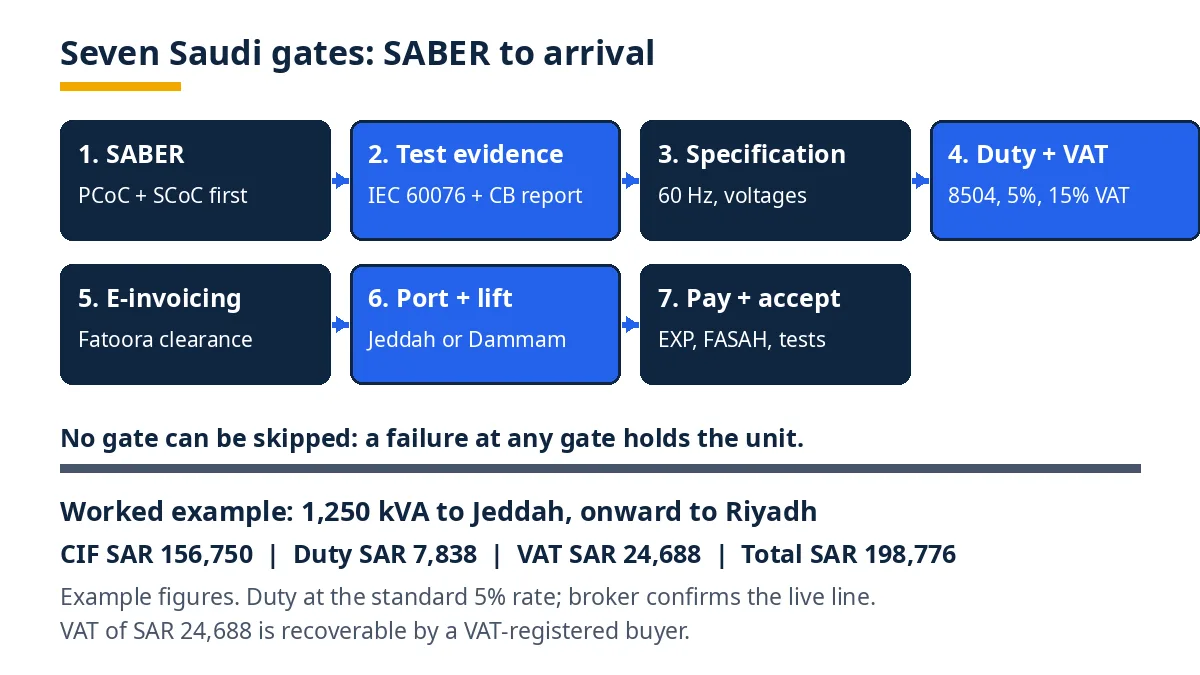
To import a power transformer from Bangladesh to Saudi Arabia, clear seven gates in order: SABER conformity (a Product Certificate per model and a Shipment Certificate per consignment), IEC 60076 test evidence with an IECEE CB report, a 60 Hz specification, classification under heading 8504 with the broker-confirmed 12-digit line, ZATCA e-invoicing, clearance through FASAH at Jeddah Islamic Port or King Abdulaziz Port, and arrival testing. Duty follows the GCC common tariff and VAT is 15%.
On this page
Key takeaways
SABER decides clearance: the Product Certificate covers the model for one year and a Shipment Certificate is needed for every consignment before the goods reach the port.
Write 60 Hz into the specification: Saudi Arabia runs at 60 Hz, so a unit built for another system needs the frequency and voltages checked line by line.
Duty follows the GCC common tariff at 5% of CIF on most goods, VAT is 15% on the customs value plus duty, and the broker must confirm the live 12-digit line for each rating.
File the FASAH declaration at least 48 hours before arrival, with the Shipment Certificate already in SABER, and book the heavy lift before the vessel sails.
A Saudi order for a power transformer from Bangladesh passes through seven gates, and any one of them can hold the unit: SABER decides whether it clears customs, the test evidence whether the buyer can accept it, the specification whether it runs on the Saudi system, the classification what duty and VAT apply, the invoice whether the buyer's tax records stand, the port whether the heavy lift works, and the arrival check whether the unit is energised. This guide works through the gates in that order, so a failure is found before money moves.1
Gate 1: Clear SABER before you order
SABER is the online conformity platform of SASO, the Saudi Standards, Metrology and Quality Organization, and it is the first gate because Saudi customs checks conformity electronically before release. A product covered by a SASO technical regulation needs a Product Certificate of Conformity (PCoC), issued through SABER by a SASO-approved body. The PCoC covers the model and is usually valid for one year, and every consignment needs its own Shipment Certificate of Conformity (SCoC), valid for 90 days.1
The Saudi importer holds the SABER account and applies; the Bangladeshi factory cannot register in SABER on its own. Since 1 January 2025 the SCoC must be issued before the goods reach the port, so a post-arrival application is invalid, and the SCoC draws on a valid PCoC, so a lapsed PCoC blocks every shipment. Start the PCoC while the specification is still being written.1
For certain electrical products SASO also requires a SASO IECEE Recognition Certificate, issued by a Saudi National Certification Body from an IECEE CB certificate and test reports. Ask your adviser whether the transformer falls under a SASO technical regulation, needs that IECEE step, or is non-regulated, with a self-declaration in SABER instead of a PCoC.1
Gate 2: Prove the build with IEC 60076 tests and a CB report
IEC 60076-1 divides transformer tests into three groups. Routine tests run on every unit before dispatch: dielectric tests, insulation resistance, winding resistance, no-load loss and current, voltage ratio with phase displacement, and short-circuit impedance with load loss. Type tests, including temperature rise and lightning impulse, run on one unit of a design; special tests such as partial discharge run by agreement.2 Require the routine report for each serial number, with the measured figures set against the guaranteed figures: total losses within plus 10%, voltage ratio within plus or minus 0.5%, and short-circuit impedance within plus or minus 7.5% where the impedance is 10% or more.2
The CB report is the second half of the evidence. The IECEE CB Scheme is an international system for the mutual recognition of test reports and certificates for electrical equipment, based on IEC standards, and Saudi Arabia is among the more than 50 participating countries. A National Certification Body issues the CB Test Certificate on the basis of the CB Test Report, and the two are used together when applying for recognition elsewhere. The certificate's model description must match the unit you are buying: a certificate for one model does not cover a different rating.3 See the power transformer quality checklist for the full check sequence at the factory.
Gate 3: Write the specification for a 60 Hz system
Saudi Arabia runs at 60 Hz. The standard supply is 230 V single-phase and 400 V three-phase, and older districts in Riyadh and Jeddah still carry legacy 127 V wiring, so confirm the voltage at the site rather than assuming the national standard applies there.4 Put the frequency on the first line of the specification, next to the kVA rating and the voltage pair: a unit ordered without a frequency is a guess, found only when it is connected.
Write one line per rating: kVA rating, primary and secondary voltages, frequency, vector group, short-circuit impedance with tolerance, tap range and changer, cooling method, guaranteed losses, insulation levels, fittings and packing. Name the standard edition and the type and special tests the contract requires. Give every candidate the identical specification and ask for replies in the same format: a lower price built on higher losses or a shorter test list is a different transformer, not a saving.
Gate 4: Classify the unit, then work the duty and VAT
The duty on each rating comes from its classification, not from the supplier's product name. Power transformers sit under heading 8504. The liquid dielectric lines are 8504.21 for units not over 650 kVA, 8504.22 for units over 650 kVA to 10,000 kVA, and 8504.23 for units over 10,000 kVA; the remaining transformer lines are 8504.31 to 8504.34.5 Since 1 January 2025 the GCC states, including Saudi Arabia, have used a 12-digit tariff based on HS 2022, so ask the broker to confirm the full national code for each rating.6 The HS code guide sets out the heading structure.
Saudi Arabia applies the Gulf Cooperation Council common external tariff, described by the United States International Trade Administration as at least 5% on most goods imported from outside the GCC, charged ad valorem on the CIF value. Ask the broker to confirm the live 12-digit line rate in writing before you price the order, with Bangladesh named as the origin, and work the example below at the standard 5% rate only until that confirmation arrives.6 VAT is 15% of the customs value plus duty, any excise tax and other charges, paid with the duty on the customs declaration before release.6 The rate has been 15% since 1 July 2020. Registration is mandatory once taxable supplies pass SAR 375,000 over 12 months, voluntary from SAR 187,500.7
Gate 5: Put the Saudi buyer's invoice through Fatoora
ZATCA's e-invoicing runs in two phases. Phase 1 required an electronic invoice with the right fields. Phase 2, the Integration Phase, has run since 1 January 2023 in waves, and it requires the invoicing system to connect to ZATCA's Fatoora platform. Standard tax invoices to businesses must be cleared by ZATCA before the buyer receives them, while simplified invoices to consumers must be reported within 24 hours. Each invoice is produced as UBL 2.1 XML, carries a UUID and a hash chained to the previous invoice, is signed with the system's cryptographic stamp, and carries a QR code. Wave 25 covers taxpayers whose VAT-taxable revenue exceeded SAR 187,500 in 2022 to 2025, and those businesses must be integrated with Fatoora by 1 February 2027.8
The Bangladeshi exporter does not file in Fatoora; the Saudi buyer does. Your part is the commercial invoice the buyer's system clears against: buyer and seller details, origin, the HS code per line, quantities, unit prices, total value and currency, matching the customs declaration exactly.
Gate 6: Pick the port and book the heavy lift
Choose the entry port by where the unit goes next. Jeddah Islamic Port is the Kingdom's largest port and handles 65% of Saudi Arabia's imports by sea, moving over 6.2 million TEU in 2024. King Abdulaziz Port in Dammam moved around 2.98 million TEU in 2024, and it is the main entry point for goods bound for Riyadh and the Eastern Province.9 Jeddah suits a western site; Dammam suits Riyadh and the Eastern Province, with the rail link onward to Riyadh. Name the port in the order, not just the city.
Height, weight and exposed bushings rule out a standard box, so a transformer usually travels as break-bulk or on a flat rack. Ask the forwarder which sailings can lift the packed unit and whether the inland haul has matching lifting gear, and settle it before the vessel sails: a unit that cannot be lifted waits at the port while storage charges run.
Gate 7: Pay, ship and accept the unit
Check the maker in this order: the test bay first, then the papers, then the bank details. The test bay shows whether the factory can run the routine tests your specification names and whether its instruments are calibrated. The papers show whether the name, address and bank account agree across the trade licence, the export registration and the invoices. Pay only the company account named in those documents, and verify any change of bank details separately.
In Bangladesh the exporter declares the shipment on the EXP form, filed in the Online Export Monitoring System (OEMS) ahead of customs formalities; the Bill of Export follows from customs. Within 14 days of shipment the exporter hands the authorised dealer bank the signed EXP form plus the certified Bill of Export and the shipping documents, and the full proceeds must normally be repatriated within four months.10 The Saudi importer files the FASAH declaration at least 48 hours before arrival, and the shipment certificate must already exist in SABER, since the two systems are integrated.6
When the unit lands, count units against the packing list and match each rating plate to the approved design before you sign, recording damage on the delivery note at once. Compare measured losses with the guaranteed figures and the tolerances from Gate 2, and do not energise the unit until the owner has accepted the evidence.
Worked example: landed cost for one 1,250 kVA unit
Example figures. One 1,250 kVA liquid dielectric transformer, FOB Chattogram, shipped to Jeddah Islamic Port and delivered onward to a Riyadh site. The unit takes subheading 8504.22, above 650 kVA up to 10,000 kVA.5 Duty is worked at the standard 5% rate; get the broker's written confirmation of the live 12-digit line rate first.6
Cost line | Example figures (SAR) |
|---|---|
Product cost, FOB Chattogram | 142,500 |
Ocean freight and insurance to Jeddah | 14,250 |
CIF value | 156,750 |
Customs duty at 5% of CIF | 7,838 |
VAT at 15% on CIF plus duty | 24,688 |
Customs broker fee | 1,500 |
Jeddah port and terminal charges | 2,200 |
Inland delivery to Riyadh site | 2,800 |
Arrival inspection and testing | 3,000 |
Total cash outlay | 198,776 |
Check it: 5% of the 156,750 CIF value is 7,837.50, shown as 7,838; 15% of 164,588 is 24,688.20, shown as 24,688; the lines sum to 198,776. A VAT-registered buyer recovers the 24,688 as input tax, so the net cost is 174,088.
Mistakes that hold a Saudi shipment at the port
Ordering before the Product Certificate exists is the first mistake: a model not registered in SABER cannot get a Shipment Certificate, and without it the goods cannot clear. Applying for the Shipment Certificate after the goods arrive is the second: since 1 January 2025 a post-arrival application is invalid.1 The rest follow the same pattern: a missing frequency, an unconfirmed duty line, a late FASAH declaration, or a CB certificate for a different model.3 6
FAQs
Is there a typical MOQ for power transformers from Bangladesh?
No single figure covers every order. Ask for the minimum per rating, in writing.
How long does shipping take?
Build time and sea time are separate, and neither has a single typical figure. A sailing takes weeks, and the time varies by port, routing and season.
What import duty applies?
The duty on your unit comes from its classification, its origin and the entry date. Power transformers sit in heading 8504.5 The GCC common tariff is at least 5% on most goods from outside the GCC, so confirm the live 12-digit line rate with your broker.6 VAT of 15% applies on the customs value plus duty.7
How do I verify a supplier?
Check the test bay first, then the papers, then the bank details. Ask for recent routine test reports on ratings close to yours, and approve one fully tested first unit of each rating. See how to buy for the steps that follow an order.
Next steps on Exportain
Start with the specification in Gate 3 and the SABER question in Gate 1, then look for Bangladeshi suppliers whose ranges cover your ratings and raise an RFQ giving the rating-plate fields, the IEC 60076 test scope and the Jeddah or Dammam entry. The how-to-import guide covers the full process, and the general power transformer import guide treats the same product with no destination.
Sources
- SABER Certificate for Saudi Arabia: PCoC and SCoC. TripleDocs (accessed )
- Testing of Power Transformer – Types & Significance. Electrical Mirror, (accessed )
- CB Certificate | CZ | TÜV Rheinland. TÜV Rheinland (accessed )
- Saudi Arabia Voltage Standards: 230V/60Hz Grid Theory and Appliance Sizing. ElectricalFlux, (accessed )
- HS, 2017 - Code 8504. United Nations Statistics Division (accessed )
- How to Export to Saudi Arabia in 2026: 5% Duty, 15% VAT, SABER and FASAH. TripleDocs (accessed )
- ZATCA VAT Registration in Saudi Arabia: Steps and Threshold. Tasis Partners (accessed )
- ZATCA Phase 2 requirements explained (UUID, CSID, QR). Prestige-SA (accessed )
- Saudi Arabia Port List: Jeddah Islamic, Dammam, Yanbu, King Abdullah. Tradlinx (accessed )
- Export Law Bangladesh 2026: Critical Rules for Exporters. TRW (accessed )
About the author
Sourcing from Bangladesh?
Post a request for quotation and suppliers on Exportain can send you their quotes directly.
Post an RFQ