

Polo Shirts From Bangladesh to Australia: Step-by-Step Guide
Australia polo import guide: Melbourne routing, DFQF duty at 6105.10 and 6106.10, N10 entry, GST on the taxable importation, care labeling, and an AUD landed-cost example for 4,800 shirts.
Short answer
To import polo shirts from Bangladesh to Australia, specify pique fabric, collar, placket and cuffs in full, verify supplier documents and polo production, and approve a pre-production sample with Australian care-label artwork. Classify men's styles under 6105.10 and women's under 6106.10, confirm the LDC duty-free claim and origin evidence with your broker, confirm the GST base, choose FOB or CIF to Melbourne, and build landed cost before bulk production.
On this page
Key takeaways
Polo shirts from Bangladesh enter Australia duty-free and quota-free as Least Developed Country goods under DFAT's statement, but the broker must confirm the preference claim, origin evidence, and current treatment for the exact styles on the entry date.
Knitted polo shirts split by wearer and fiber: 6105 for men's or boys' shirts and 6106 for women's or girls' blouses, shirts and shirt-blouses, with .10 for cotton, .20 for man-made fibers, and .90 for other textile materials; a woven polo belongs in Chapter 62.
A commercial order over AUD 1,000 is cleared with an N10 Import Declaration, GST is 10 percent of the value of the taxable importation, and all declaration documents must be kept for five years.
All clothing and most textile items sold in Australia must carry care instructions, and a Made in claim generally requires the last substantial step in making the product to have happened in that country.
Example figures only: 4,800 shirts FOB Chattogram to Melbourne land at AUD 7.01 per shirt excluding GST and AUD 7.68 including conditional GST of AUD 3,211.00, excluding the broker-confirmed import processing charge.
Start with the Australian entry and work backward. For a polo order from Bangladesh, four points decide whether a shipment clears cleanly in Melbourne, and all four are settled before loading: the exact specification, the classification on the entry, the origin evidence behind a duty preference claim, and the labeling artwork on every shirt. This guide follows the Chattogram to Melbourne route. Figures here are either statements from opened Australian sources or labeled example figures to replace with your own broker and forwarder quotes.
Why source polo shirts from Bangladesh
Bangladesh offers a deep knitwear base, and polo shirts sit squarely inside it. Knitted and crocheted apparel is the largest export category on the Bangladesh to Australia lane, so pique knitting, dyeing, collar making, button supply, and export packing are work Bangladeshi suppliers handle every week.1 A supplier that already runs polo styles can show production samples and discuss collar and placket construction.
Depth is no shortcut around specification. A polo fails in wear on details never written down: a collar that loses shape after washing, a placket that gaps, buttons that loosen, or a collar shade that does not match the body. Write down collar construction, placket length and button count, cuff finish, stitch expectations, and wash and colorfastness checks, then ask each supplier to quote against that same document.
Australia is favorable in one specific, conditional sense. As a Least Developed Country, products from Bangladesh enter Australia duty-free and quota-free, and the Department of Foreign Affairs and Trade states this treatment will continue when Bangladesh graduates from Least Developed Country status.2 The preference still depends on classification, origin rules, and evidence, and your broker must confirm the claim for your exact styles on the entry date.
Find and verify suppliers
Shortlist three to five suppliers before negotiating price. That number is manageable, and it still gives a real comparison on specification, quantity terms, sample discipline, and delivery. Include one supplier you could use if your first choice failed during production.
Start from the supplier record, not a product photograph. Ask for legal company name and registered address, and check that the same legal name appears on quotation, proforma invoice, bank account, and shipping documents. Request the trade licence, Taxpayer Identification Number and VAT registration where applicable, Export Registration Certificate issued through the Office of the Chief Controller of Imports and Exports, and chamber or trade association membership documents where relevant.3 A supplier that ships regularly should have these papers ready.
Then test production fit. Ask whether the supplier makes the polo itself or sources it from another factory, which polo styles it has run recently, what size and color ranges it covers, and whether it can show a production sample in your fabric. For larger orders, consider a factory visit, an independent audit, and reference orders or buyers the supplier is willing to name.
MOQ, pricing and samples
There is no single typical minimum order quantity for polo shirts from Bangladesh that you can safely copy into a plan. The minimum is set by the supplier, and it can apply per order, per style, per color, or per size. A minimum of 500 shirts per color is a different commitment from 500 shirts across five colors, and a per-size minimum can turn a small trial into a large order once the full size curve is added. Ask for the minimum stated in all four forms, then test your actual breakdown against it.
Compare quotations line by line on the same basis. Each quotation should state unit price, currency, Incoterm with named place, what the price covers and excludes, quantity breakdown, lead time from a named event, payment terms, sample terms, and validity date. Buttons, labels, hang tags, inner packing, and export cartons are most often left out of a low headline price, so ask each supplier to list them explicitly.
Samples are part of the contract, not a courtesy. The development sample confirms the supplier understood your specification, and you should expect corrections and often a second round. The pre-production sample must use actual materials, trims, labels, and packaging intended for bulk production, and bulk production should not start before you approve it in writing. Keep one sealed or signed piece yourself, with a matching piece at the factory. Agree sample terms in writing first: sample cost, courier cost, timing, rounds included, and whether charges are credited against the bulk order.
Quality control and certifications needed
Quality control for polos starts with the specification sheet and ends with an inspection that uses it. Check collar shape and symmetry after washing, placket straightness and button alignment, button security, cuff rib recovery, seam strength, and color consistency between collar, placket, cuffs, and body in the same dye lot. Check measurements against your size chart on a stated sample of shirts, and record every measurement so a later dispute is about numbers, not impressions.
Decide the inspection stage before production starts. A during-production check catches a collar or dye problem while it can still be corrected. A pre-shipment inspection, run against the approved pre-production sample, is the last point at which a failed lot can be held, reworked, or rejected without paying freight on shirts you cannot sell. Agree in writing who inspects, which sampling method applies, what counts as critical, major, and minor defects, and what happens to a failed lot.
On certifications, name what your customers actually require and put it in the specification. If a retail customer requires a particular test report, fiber composition test, colorfastness result, or factory social compliance document, state the exact document, testing method, and issuing party. Keep every test report and certificate with the shipment file.
Incoterms, shipping and transit time
Choose the Incoterm with its named place, and write both into quotation and contract. Under FOB Chattogram, the seller delivers goods on board at Chattogram, and you arrange and pay main freight and insurance from there. Under CIF Melbourne, the seller contracts and pays for carriage and at least minimum insurance to Melbourne, while import clearance, duty, and taxes remain yours. Under DAP Melbourne, the seller carries goods to the named place in Melbourne, and you still handle import clearance. Under EXW, you collect goods and handle export clearance and every leg after it. Convert every quotation to the same landed basis before comparing suppliers, using the method in the landed cost section.4
Plan the sea route around transshipment. Most shipments between Bangladesh and Australia move through hubs such as Singapore, Colombo, Port Klang, or Tanjung Pelepas before continuing to Australia, adding time and a transshipment charge.1 The Port of Chattogram is Bangladesh's largest and busiest seaport, while the Port of Melbourne is Australia's largest container port and the most common destination for garment shipments from South Asia.1 That pairing is the route used below.
Transit times here are dated guide estimates from the opened shipping guide, not a carrier promise. Your forwarder must replace them with a dated sailing for your week. Sea freight from Bangladesh to Australia is planned at roughly 25 to 45 days for a full container load, with the fastest services reaching Sydney or Melbourne in around 25 days, while less than container load usually runs longer, often 35 to 55 days once consolidation and deconsolidation are added.1 Air freight typically takes 3 to 10 days door to door.1 Air suits samples and urgent replenishment. It rarely suits a bulk polo order, where the freight premium per shirt would erase the margin the sea route protects. Book against your retail calendar, adding production, inspection, transit, clearance, and inland delivery, plus a buffer week.
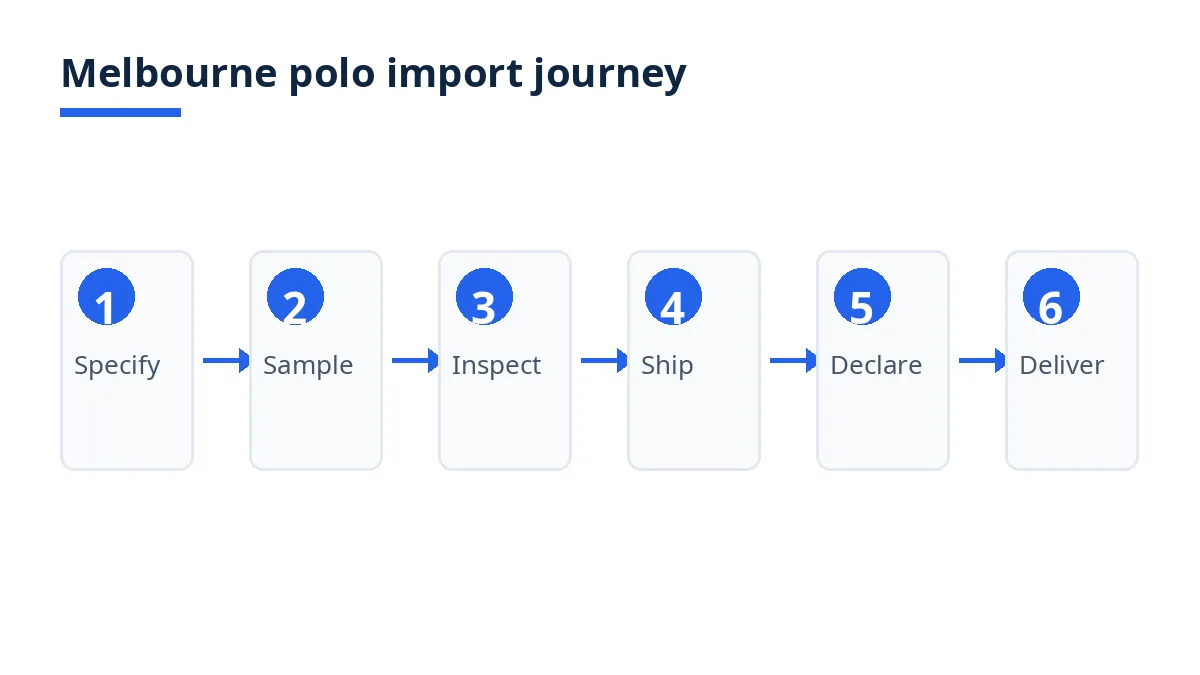
The diagram below traces the Melbourne journey in six stages.
Import duty, taxes and documents
Start with classification, because duty, preference claim, and entry all follow the code on the declaration. Heading 6105 covers men's or boys' shirts, knitted or crocheted, and heading 6106 covers women's or girls' blouses, shirts and shirt-blouses, knitted or crocheted, with the six-digit subheading set by fiber: .10 for cotton, .20 for man-made fibers, and .90 for other textile materials under both headings.5 A collar and partial opening at the neckline make a polo a shirt under 6105 or 6106, not a T-shirt under 6109, and a woven polo-style shirt belongs in Chapter 62, not Chapter 61.5 Give your broker the garment description in words, construction, fiber percentages by weight, collar and placket, sleeves, hem finish, and pockets, and confirm the full Australian national code before goods leave Bangladesh, because only the first six digits are harmonized worldwide.
On duty, the preference is conditional and evidence-based. The Australian Border Force guide confirms Australia granted duty-free entry to goods originating in Least Developed Countries on 1 July 2003, that entry is conditional on more stringent origin rules, and that non-LDC materials counting as local content are limited to 25 percent of total factory cost.6 The guide also sets a last process of manufacture test, which your broker must apply to your polo production. Ask the supplier early for origin information, including where fabric, trims, and making steps sit, and keep that evidence with the shipment file.
On the Australian entry, a commercial order over AUD 1,000 is cleared with an Import Declaration, known as N10. The Border Force states you must complete an Import Declaration when goods have a combined value over AUD 1,000 and are cleared into home consumption, and you must pay all applicable duties, taxes, and charges before goods can be released.7 The declaration is a statement by the importer, or a licensed customs broker acting for the importer, covering goods, importer details, transport, and classification and customs value.7 The Border Force encourages first-time or infrequent importers to use a licensed customs broker.7 After you or your broker makes an Import Declaration, you must keep all relevant documents for five years.7
Assemble the broker set before the vessel sails: commercial invoice, packing list, bill of lading or air waybill, origin evidence, and any permits that apply. If the entry is referred to the Department of Agriculture, Fisheries and Forestry, Border Force material states more information is required, including a reason for referral and a quarantine inspection location, so ask your broker before shipment whether any referral could apply to your cartons or packaging.7 Never let the vessel sail with a packing list that disagrees with the invoice on quantity, description, or value.
On tax, keep duty and GST separate. The Australian Taxation Office states GST on a taxable importation is 10 percent of the value of the taxable importation, being customs value plus any duty payable, transport to the place of consignment in Australia, insurance for that transport, and any wine tax payable.8 The example below uses that base as a conditional example only, and your broker must confirm it. If you are registered for GST and import for a creditable purpose, you may be able to claim a GST credit, subject to holding required documentation.8 No import processing charge amount is stated here, because the opened Border Force page confirms the charge applies over AUD 1,000 without stating the amount, so ask your broker to state it.7
On labeling, handle two points separately. All clothing and most textile items sold in Australia must carry a label detailing care instructions, covering prohibited treatments and warnings, washing, drying, ironing, and dry cleaning instructions.9 Approve care label artwork on the pre-production sample. On origin wording, a Made in claim generally means the last substantial step in making the product happened in that country, and that step must have made a significant change so the final product is fundamentally different in identity, nature, or essential character from its imported ingredients or components.10 Australian Consumer Law does not require non-food products to carry country of origin labeling, but other laws may apply, so ask your broker and retail customers to confirm what fiber content and origin statements your shirts must carry before production.10
Landed cost example (table)
Every figure below is an example figure for one Melbourne order, not a quote, tariff, or market price. Replace each line with your own quotation, forwarder quote, and broker advice. The order is 4,800 men's knitted cotton polo shirts, FOB Chattogram, shipped to Melbourne, with duty at AUD 0.00 only on a proved Least Developed Country preference claim confirmed by the broker. The import processing charge is excluded because its amount must be stated by the broker, and the GST line is conditional.
Line | Example figure (AUD) | Note |
|---|---|---|
Product cost: 4,800 shirts at AUD 6.20 FOB Chattogram | 29,760.00 | Example figure, FOB basis |
Ocean freight, Chattogram to Melbourne | 2,140.00 | Example figure |
Cargo insurance | 210.00 | Example figure |
Subtotal before duty | 32,110.00 | Sum of the three lines above |
Import duty | 0.00 | Conditional only, on a proved LDC claim |
Customs broker fee | 385.00 | Example figure |
Destination port and terminal charges, Melbourne | 410.00 | Example figure |
Inland delivery to a Melbourne warehouse | 295.00 | Example figure |
Pre-shipment inspection | 340.00 | Example figure |
Bank and currency costs | 120.00 | Example figure |
Total excluding GST and the import processing charge | 33,660.00 | Sum of all lines except conditional GST |
Landed cost per shirt excluding GST | 7.01 | 33,660.00 divided by 4,800 shirts |
Conditional GST at 10 percent of AUD 32,110.00 | 3,211.00 | Conditional example only, broker to confirm base |
Total including conditional GST, excluding the import processing charge | 36,871.00 | 33,660.00 plus 3,211.00 |
Landed cost per shirt including conditional GST | 7.68 | 36,871.00 divided by 4,800 shirts |
At AUD 6.20 FOB, the shirt already costs AUD 7.01 before GST once freight, insurance, broker, port, inland, inspection, and bank lines are added, more than 13 percent above FOB price before any tax. A smaller order carries the same fixed lines across fewer shirts and lands higher per shirt. Rebuild landed cost for every order size, route, and entry.4
Step-by-step import checklist
Work through this checklist in order, starting with Australian entry requirements.
Confirm the Australian entry first: classification, preference claim and origin evidence, labeling artwork, and the broker who will lodge the N10 entry.
Write the full polo specification: fabric and fiber percentages, pique and collar construction, placket length and button count, cuff finish, size chart, color standards, packing, and labeling.
Shortlist three to five suppliers, request the business documents listed above, and record the same information for every candidate.
Send every shortlisted supplier the same request for quotation, with the same specification, quantity breakdown, Incoterm with named place, and delivery definition.
Compare quotations line by line, convert each to an estimated landed cost, and confirm duty line and GST base with your broker before you choose.
Agree sample terms in writing, approve the development sample, then approve the pre-production sample in production fabric with production labels and packing.
Put the purchase order in writing: specification, quantity breakdown, price with Incoterm and named place, payment terms, inspection terms, defect definitions, and delivery date definition.
Book freight and inspection together, so inspection date, sailing date, and document handover sit in one plan with a buffer week for a missed connection.
Run during-production and pre-shipment inspection against the approved sample, and hold any failed lot for rework or re-inspection under written terms.
Check invoice, packing list, and bill of lading against each other and against the entry before the vessel sails, and send the full set to your broker early.
Lodge the N10 entry through your broker, pay duties, taxes, and charges that apply, and confirm the import processing charge for the shipment.
On arrival in Melbourne, clear goods, check cartons against the packing list, record damage or shortage in writing, and reconcile actual landed cost against the pre-production example.
How Exportain helps
Exportain gives a buyer a single place to run the comparison this guide describes, without turning the platform into a substitute for your own checks. You can search supplier profiles by product and category, compare quotations against the same brief, and keep specification, sample approvals, and order terms in one thread both sides can see.
Use the platform for steps where a shared record helps most: posting one brief to several suppliers, comparing replies on the same Incoterm and quantity breakdown, and tracking sample approvals in writing. Keep independent judgment in your own hands: supplier document checks, classification and origin confirmation with your broker, inspection decisions, and final landed cost calculation. A marketplace record supports those decisions. It does not replace them.
FAQs
What is the typical MOQ for polo shirts from Bangladesh?
There is no single typical minimum for every polo supplier, style, and order. The minimum is set by the supplier and can apply per order, per style, per color, or per size, so ask for it stated in all four forms and test your actual breakdown against it. Confirm it in writing before you accept a price.
How long does shipping take?
As dated guide estimates, sea freight from Bangladesh to Australia is planned at roughly 25 to 45 days for a full container load and often 35 to 55 days for less than container load, with most cargo moving through a transshipment hub.1 Air freight typically takes 3 to 10 days door to door.1 Replace both ranges with a dated sailing from your forwarder, and add clearance and inland delivery time after arrival in Melbourne.
What import duty applies?
Duty depends on classification, origin, and entry date, so no single rate can be copied into a plan. Products from Bangladesh enter Australia duty-free and quota-free as Least Developed Country goods under the Department of Foreign Affairs and Trade statement, and the Border Force guide confirms duty-free entry since 1 July 2003, subject to more stringent origin rules and a 25 percent cap on non-LDC materials counting as local content.2 6 Your broker must confirm the preference claim and current treatment for your exact styles on the entry date, and what rate would apply if the claim failed.
How do I verify a supplier?
Request the legal company name and registered address, trade licence, Taxpayer Identification Number and VAT registration where applicable, Export Registration Certificate, and chamber or trade association membership documents where relevant, and check that the same legal name appears on every document and quotation.3 Then test production fit with a production sample, reference orders or buyers the supplier is willing to name, and, for larger orders, a factory visit or independent audit.
Next steps on Exportain
Read the how to import from Bangladesh guide for the full import process around this polo order, then work through the landed cost for imports from Bangladesh guide to rebuild the example table with your own quotes. When your specification is ready, review the how to buy steps so quotation, sampling, and payment stages are clear before you approach suppliers.
Sources
- Shipping from Bangladesh to Australia. ShipHub (accessed )
- Bangladesh country brief. DFAT (accessed )
- How to Import from Bangladesh. Exportain (accessed )
- Landed Cost for Imports from Bangladesh. Exportain (accessed )
- HS Code for Polo Shirts: Classification. Exportain (accessed )
- Preferential Rules of Origin. Australian Border Force (accessed )
- Import declarations. Australian Border Force (accessed )
- GST and imported goods. Australian Taxation Office (accessed )
- Clothing and textiles. NSW Government (accessed )
- Country of origin claims. ACCC (accessed )
About the author
Sourcing from Bangladesh?
Post a request for quotation and suppliers on Exportain can send you their quotes directly.
Post an RFQ


