Spain Live Crabs From Bangladesh: Supplier Ledger and Landed Cost
Import live crabs from Bangladesh to Spain on a supplier ledger: one row per lot, the Spanish entry file and listings checked first, and a landed-cost build priced line by line, with duty and IVA broker-confirmed.
Short answer
To import live crabs from Bangladesh to Spain, open the Spanish Border Control Post file first, check the Annex IX country listing and the TRACES-NT establishment listing, settle the wild-caught or farmed proof lot by lot through CATCH or a farm-lot record, hold the health certificate copy before packing, obtain carrier acceptance in writing, and price duty and IVA only on broker-confirmed lines, with the landed cost divided by surviving weight.

On this page
Key takeaways
Open the Spanish entry file first: the designated Border Control Post, the confirmed CHED form, the notification deadline, and the file language, all in writing before booking.
The (1) marker beside Bangladesh in Annex IX to Regulation (EU) 2021/405 signals permission across the fishery-products range in the consolidated text opened, but the broker must re-check the current list for the entry date.
Wild-caught lots need a validated catch certificate filed through CATCH since 10 January 2026; farmed lots need farm-lot traceability instead, settled lot by lot.
No duty rate, VAT rate, transit time, MOQ, or price is stated as fact: the broker confirms the tariff and IVA lines, and every commercial figure is an example figure.
Price on surviving weight: the example build is EUR 18.10 per kilogram shipped before duty and IVA, or EUR 19.05 per surviving kilogram at an assumed 5 percent loss.
This guide explains how to import live crabs from Bangladesh to Spain on a supplier ledger, with a landed-cost build priced line by line. The file decides whether the crabs enter Spain; the ledger decides whether the price means anything on arrival. Work the ledger first: one row per lot, carrying the establishment, lot identity, catch or farm proof, certificate, packing and carrier acceptance, and count rule. No duty rate, transit time, temperature, minimum, or price is stated as fact: none was confirmed for this line and entry date. Every figure below is an example figure unless broker-confirmed.
The ledger comes first: one row per lot, nothing on trust
A lot is one consignment: one species and scientific name, one production method, one establishment, one certificate, and one packing and routing plan. Any change to those facts gains a new row. Mixed wild-caught and farmed lots are two lots with two proofs.
Each row holds the same fields: establishment name and approval number in listed form, species and scientific name, production method, health certificate model and copy, catch certificate or farm-lot record, packing and carrier acceptance, delivery term and named place, price basis and counting rule, and broker-confirmed duty and tax lines. Ask for answers in writing, file them against the row, and compare suppliers only on complete rows. Date each check, because listings, models, and tariff lines change.
Open the Spanish entry file before the supplier search
Settle the Spanish entry point before any supplier is shortlisted. A consignment that fails a border check can be refused, destroyed, given special treatment, or re-dispatched.1 At a designated Border Control Post, physical, identity, and documentary examinations run in turn, and admission covers only animal-origin goods from countries authorized to export to the European Union.1 The same official control rules apply at every post under Regulation (EU) 2017/625, but designation is post-specific.1 Ask the Spanish Border Control Post in writing whether it is designated for the category the Spanish authorities apply to this consignment, which entry document it expects, by when it expects notification, and in which language it requires the file.
Ask the Spanish post to confirm in writing which Common Health Entry Document (CHED) form governs live crabs for human consumption. The forms divide by consignment class: CHED-A covers animals, while the product form, CHED-P, covers products within point (b) of Article 47(1) of Regulation (EU) 2017/625.2 The crabs are fishery products meant for eating, so the product form is the working assumption, but the post's written confirmation settles it, given how close live crabs run to the live-animal line. The CHED carries English alongside a destination-country language, and the operator completes the consignment details.2 Confirm the deadline in writing, and work backwards from it and the agreed flight.
At the post, documentary checks verify the official certificates and other documentation, identity checks verify that the nature and labeling of the goods, including seals and means of transport, correspond to the documents, and physical checks involve direct examination, including sampling and laboratory testing if needed.1 Do not pay a deposit that assumes the border file will pass.
Read the listing lines: country, establishment, and the date checked
Two listings decide admissibility. Have the broker re-check Annex IX as it stands on the entry date; the consolidated text is not the current list. In the consolidated text of Commission Implementing Regulation (EU) 2021/405 opened for this guide, dated 15 December 2022, Bangladesh appears in Annex IX as "BD Bangladesh (1)".3 The (1) marker signals a broad permission: it takes in crustaceans, alongside finfish and products made from finfish.3 If the current listing does not cover the exact product, the order stops, whatever the price.
Have the broker run the TRACES-NT establishment check before shortlisting, and record the date.4 The published lists rest on proposals from approved, listed non-EU countries, kept by the Commission, with details in TRACES, the platform DG SANTE manages, and accuracy resting with the non-EU country competent authority.4 A plant may be proposed only after that authority has checked it against the Annex III hygiene rules for exported food of animal origin.4 Fishery products sit in Section VIII of that categorization.4 Ask each supplier for the establishment name and approval number in the exact listed form in TRACES-NT, and insist that the invoice, packing list, certificate, and CHED notification all carry that identical name and number.
Settle the lot identity: wild-caught proof or farm-lot proof
A consignment with a missing, mismatched, or unvalidated catch file gets turned away, so settle the production method lot by lot before shipping. Fishery products enter only with a catch certificate endorsed by the catching vessel's flag State, confirming the catches followed the laws and conservation measures in force.5 That endorsement comes from a public authority of the flag State, and the certificate carries the information set out in the Annex II specimen.5 File the endorsed certificate no later than three working days ahead of estimated arrival, unless an adapted deadline governs the air route; confirm which applies, since the period may shift with product type, distance, or transport means.5 Vessel, species, description, and weight must line up on the certificate and on the invoice, packing list, and air waybill alike.5
CATCH comes first for the wild-caught file. Since 10 January 2026, that European Union IT system for the catch certification scheme, part of TRACES NT, has carried the wild-caught paperwork.6 That date marks the changeover: CATCH use is compulsory for European Union importers from then, and the paper-based process it replaced no longer runs the file.6 7 Its compulsory scope reaches fish and fishery products under Chapter 3, and under headings 1604 and 1605, where IUU controls apply.6 CATCH covers wild-caught produce only; exempt aquaculture and freshwater produce is unchanged.6 A farmed lot takes the other fork: farm-lot traceability naming farm or holding unit, lot, and chain from harvest or holding to packing, in writing.
Verification costs time. Authorities may examine the products, verify declaration data and document authenticity, and examine accounts and records; release is suspended while verification runs, with storage costs on the operator.5 The ledger must show how much of each certificate has already been used.6 Agree in the sale contract who bears storage and waiting loss if verification is opened.
Hold the health certificate copy before packing
Consignments need official certificates from the exporting country's competent authority, confirming the goods meet European Union import conditions.1 No health certificate model is named: no model source for the exact species and presentation was opened. Ask the certifying authority and broker to name the current model in writing for the exact species, presentation, and establishment, and confirm wording, stamp and signature requirements, and weight basis before packing. Require a copy for broker checking before packing, and check establishment number, lot identity, species, quantity, and weight on the invoice, on the packing list, and on the air waybill.
If the copy cannot be confirmed before packing, hold the shipment. The document set must agree as one pack on species, establishment, lot, and weight. Require the supplier to list in writing, for this exact line, every export document it will produce; the research found no Bangladesh export-requirements page covering a live-crab line.
Why a ledger order suits Bangladesh supply, and where it breaks
Bangladesh is listed for all fishery products in the Annex IX text opened for this guide, subject to the broker re-check for the entry date.3 That listing, with a listed establishment and a proved lot, is what makes a Spain live-crab order workable. It does not make every supplier workable: consolidated supply makes lot identity harder to prove, so each lot is proved on its own row.
The ledger order breaks when a listing lapses, answers change between quotation and order, or a trial lot fails. A buyer needing one uniform grade, a fixed calendar, or a promised live-arrival figure should not place a bulk order on this guide.
Test suppliers on the ledger, not on a price list
Send every shortlisted supplier the identical specification and reply format. The specification names species and scientific name, production method, sex and size grade, live condition standard, packing format, delivery term with its named place, document set, and counting rule. The reply format asks for the same facts in the same order, plus minimum and unit, price split and basis, validity, and trial record.
Run the checks in order; pay nothing until each is closed. First, the paperwork: name, address, and bank account must match across the trade license, the export registration, and the invoices, and the account paid must be the company's own named account. Then file and capability: capacity, TRACES-NT listing, certificate position, catch or farm-lot file, with a trial shipment run under the same paperwork as a full order. Exportain badges are document and photo checks only, not factory inspections; Exportain takes no part in the goods contract and inspects no cargo, books no freight, and clears no customs. Use the guide to importing from Bangladesh and suppliers against the ledger specification.
Agree the minimum, the price basis, and the sample lot in writing
Unlike-for-unlike quotations mislead: a lot, a shipment, a packing unit. This guide gives no typical minimum and no typical price; no source consulted put a market-wide figure on either. Every minimum and price stays supplier-specific: agree each one in writing for the named species and grade, the size band, and the live condition. Before comparing, convert each minimum to kilograms of live weight as shipped and pin down whether it binds one lot, one shipment, or one packing unit.
Set the price on surviving weight, and put the counting rule in the sale contract before the order is placed. The rule names the counting point, who counts, when the count happens, what evidence it needs, and how the invoice adjusts for dead animals. Samples mean a trial shipment on the intended route, through the intended Spanish post, using the intended packing and count method. Check the live crabs MOQ guide before negotiating, and use the live crabs quality control checklist lot by lot.
Check quality at packing, at handover, and at the count
Fix the counting point first, then the evidence. Before the order, settle how liveness is judged at packing, handover, and arrival; who performs the dead-on-arrival tally; what proof it needs, photographs first, then a signed count sheet; how soon the supplier must hear; and what remedy follows.
Packing must survive border examination and still protect the animals.1 Agree packing in writing: restraint, separation, damp packing or water, air space or ventilation, marking, labeling, and care instructions on the outside of each container. No temperature, oxygen, water, or packed-time figure is stated here.
Agree the Spanish sales label before the cartons are printed. This guide states no Spanish labeling list: no Spanish or European Union labeling source for the exact product was opened in its research. Ask the broker and label adviser in writing to confirm the Spanish commercial designation and scientific name, production method wording, catch or farming area fact, allergen presentation, and label language, and approve the Spanish artwork. Ask the broker whether any wildlife-permit control applies to the named species, and record the answer; no wildlife status is claimed for any crab species here.
Fly only after the carrier accepts the consignment in writing
Carrier acceptance is a gate before departure, separate from booking. No carrier, container, or routing fact is stated: no carrier or live-cargo source was opened in its research. Obtain carrier acceptance in writing for the exact species, container, routing, and document set before packing starts. Work the airport timetable backwards from the arrival window, with a contingency for delay. A physical check extends the clock, so staff the handover team for the check. Agree the air-leg documents with the carrier and forwarder as the carrier directs.
State the delivery term, then settle mortality and refusal separately
Put the delivery term, complete with rule, named place, and version, in every document, with forwarder and broker confirmation. This guide states no rule-by-rule summary of delivery terms, because no delivery-terms source was opened in its research. In writing, assign the flight booking, the CHED notification and customs entry, duty, tax, and fees, border-check attendance, and any examination hold or waiting loss.
The sale contract must separately state when the risk in dead and weak animals moves, who carries the loss from packing to the counting point, how insurance answers mortality, delay, and border refusal, and what proof the count needs. Confirm the policy matches the count method and counting point with the insurer.
Price duty and IVA only on broker-confirmed lines
This guide states no customs duty rate and no tax rate. The research behind it consulted no European Union tariff schedule for the exact live-crab line, and no Spanish tax source for the exact product. The broker must confirm in writing the full tariff line for the entry date, covering the exact presentation and species, the duty rate on that line, whether any tariff preference applies and what proof of origin it requires, and the date each figure applies. Never lift a rate off another line, heading, country, or supplier quotation and apply it to the Spain price. See the HS code guide for live crabs; price only on the broker-confirmed line. Ask the broker and tax adviser in writing to confirm the Spanish IVA rate, base, payment route, and recovery position for the entry date. If any line cannot be confirmed before packing, hold the shipment.
Build the landed cost line by line, then divide by survivors
Example figures only. Treat the table as arithmetic practice, not a quotation: no number in it is a market price, a usual minimum, or a duty or tax rate. Duty and IVA stay broker-confirmed lines: the research consulted no tariff schedule or Spanish tax source for the exact line. The 5 percent loss is a stated assumption for the division, not a survival rate to expect.
Cost line | EUR per kg shipped | Basis |
|---|---|---|
Product price | 10.50 | Example figures |
Air freight and insurance to Spain | 5.80 | Example figures |
Subtotal before duty and IVA | 16.30 | 10.50 + 5.80 |
Spanish border, broker, examination, and handling charges | 1.10 | Example figures |
Onward delivery to the buyer in Spain | 0.70 | Example figures |
Total before duty and IVA, per kg shipped | 18.10 | 16.30 + 1.10 + 0.70 |
Customs duty | Broker-confirmed | Full tariff line for the entry date |
IVA | Broker and tax adviser confirmed | Rate, base, and recovery position confirmed in writing |
Total before duty and IVA, per surviving kg at 5% assumed loss | 19.05 | 18.10 / 0.95 |
The arithmetic is 10.50 plus 5.80 is 16.30; plus 1.10 and 0.70 is 18.10; dividing by 0.95 gives 19.05 per surviving kilogram before duty and IVA. When the broker confirms duty and IVA per kilogram shipped, add them to 18.10 before dividing. The landed cost guide is background only; broker confirmation still governs this line.
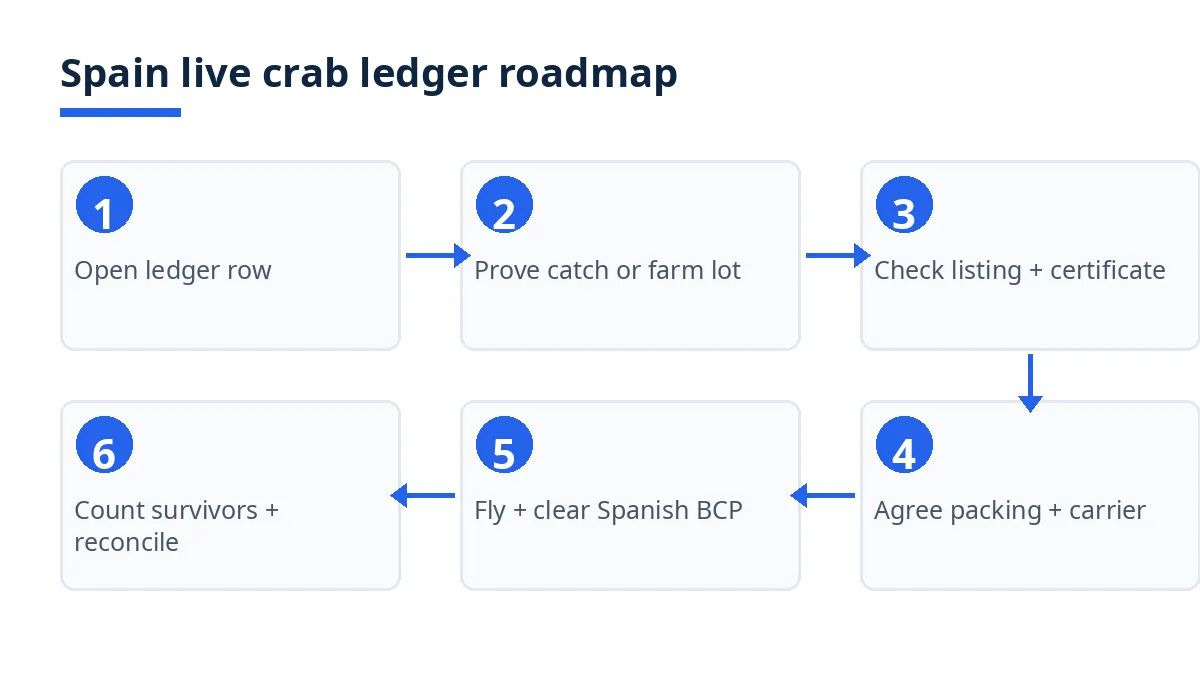
Work the ledger in order: the Spain import run
Open the Spanish entry file: designated post, CHED form, deadline, and file language, all in writing.
Record the country and establishment listings with their check dates, and have the broker re-check both for the entry date.
Settle lot identity lot by lot: wild-caught with a catch certificate through CATCH, or farmed with a farm-lot record; never one file for a mixed lot.
Obtain the health certificate copy on the current model named by the certifying authority and the broker, and have the broker check it before packing.
Agree the Spanish label facts and approve the artwork, matching the certificate and catch or farm-lot file.
Send one specification to every supplier, run the sequenced checks in order, and put a trial shipment through the full file, tallied on the agreed rule.
Agree the minimum, price split, price basis, and counting rule in the sale contract, on surviving weight.
Confirm the tariff line, duty, preference proof, and IVA treatment in writing, and build the landed cost on those lines.
Agree packing, handling figures, container, and routing with the carrier, and obtain carrier acceptance in writing before packing.
File the catch certificate and CHED notification inside their deadlines, and complete the carrier's air documents.
Present the consignment at the designated post, complete the three checks, and hold the CHED decision for customs.
Tally live, weak, and dead crabs at the point the contract names, and rework the landed cost on actual figures.
What is the typical MOQ for live crabs from Bangladesh?
Rank quotations only once denominators match. No typical minimum is given: no source consulted put a market-wide figure on one. The minimum stays supplier-specific, settled in writing lot by lot and converted to kilograms of live weight as shipped, the price basis, before any comparison.
How long does shipping take?
This guide gives no door-to-door duration. The research behind it turned up no published duration for the Bangladesh-to-Spain live-crab run. Agree routing and timetables with the carrier and Spanish post in writing before packing. Two clocks still bind the shipment: the catch certificate, due a full three working days ahead of estimated arrival unless an adapted deadline applies, and the CHED pre-notification deadline confirmed with the Spanish post.5
What import duty applies?
Leave the duty figure to the broker, who confirms it on the exact tariff line for the entry date. Any preference claim, its origin rule, and the proof of origin it needs all come from that same confirmation. The research consulted no tariff schedule for the exact live-crab line, so this guide asserts no rate, no preference, and no exemption for any consignment. IVA sits apart from duty: the broker and tax adviser confirm, in writing, its rate, its base, and its recovery position.
How do I verify a supplier?
Work from the ledger, not a catalog. Put counting rule, packing and carrier acceptance plan, health certificate model and copy, catch certificate or farm-lot record path, establishment name and approval number in listed form, production method lot by lot, and species and scientific name in one written request. Look the establishment up on the TRACES-NT list and note the lookup date.4 Run a trial shipment through the intended Spanish post on the full file before a bulk order.
Next steps on Exportain
Work the costing through the landed cost guide on broker-confirmed duty and IVA lines, settle classification with the HS code guide for live crabs, and read the guide to importing from Bangladesh for background. Once the Spanish entry file, listing checks, and specification are ready for testing, post a free RFQ describing the species, lot identity, establishment check, and counting rule, and compare replies against the same written basis. For the buying journey, see how to buy.
Sources
- Import controls of food and feed Q&As. European Commission (accessed )
- Commission Implementing Regulation (EU) 2019/1715. legislation.gov.uk (accessed )
- Commission Implementing Regulation (EU) 2021/405 — list of third countries authorised for fishery products. European Union (accessed )
- Non-EU countries authorised establishments. European Commission (accessed )
- Council Regulation (EC) No 1005/2008, Chapter III: Catch certification scheme for importation and exportation of fishery products. legislation.gov.uk, (accessed )
- CATCH - NEW EU SYSTEM. Sea-Fisheries Protection Authority (accessed )
- New digital certification system to tackle illegal fishing. European Commission, (accessed )
About the author
Sourcing from Bangladesh?
Post a request for quotation and suppliers on Exportain can send you their quotes directly.
Post an RFQ