Typical MOQ for Live Crabs in Bangladesh (and How to Negotiate It Down)
No single live-crab MOQ in Bangladesh: how grade, size, sex mix, tank batches and flight pallets build the minimum, and how buyers can negotiate a smaller, shippable order.
Short answer
There is no single typical MOQ for live crabs from Bangladesh. Each supplier sets its minimum per grade, per size band and per sex, driven by the holding-tank batch, the carton and flight-pallet quantity, the inspection batch and the live-arrival buffer. Ask for the minimum per grade in writing, then shrink the order by cutting grades, accepting the supplier carton and flight day, and agreeing a priced trial.

On this page
Key takeaways
There is no single typical MOQ for live crabs from Bangladesh, because each supplier sets its minimum per grade, per size band and per sex.
Five drivers build the minimum: grade, size and sex mix, holding-tank batch, flight-pallet quantity, live-arrival buffer and the inspection batch.
Cut grades before you cut weight: one size band and one sex, in the supplier carton on the supplier flight day, is the fastest route to a shippable minimum.
Agree the live-arrival buffer with a counting method, claim time limit and remedy in writing before shipment.
Exportain badges are document and photo reviews, not factory inspections, and Exportain is not a party to the contract for goods.
A live-crab minimum order quantity (MOQ) is not a single number on a price list. It is the smallest shipment a supplier can put together without breaking the way live crabs are graded, held, packed and flown. Ask only "what is your MOQ" and you get a figure that hides the mix, the batch and the flight behind it. Ask how the figure is built, and you can usually move it.
This guide is for buyers importing live crabs from Bangladesh who want a workable first order. It explains the five quantity drivers, the levers that move a live-crab MOQ, and the checks to run before you pay. All prices and quantities in the worked examples are illustrative, labelled "Example figures," because every supplier sets its own floor.
How a live-crab MOQ is built
A live-crab MOQ is the result of five quantity drivers stacking together. Change one driver and the total moves, which is why two suppliers can quote very different minimums for the same order.
The first driver is grade, size and sex mix. Live crabs are sold by size band and, in many trades, by sex. Each grade is a separate sort, and each sort needs enough animals to fill its own packing run. Three size bands and both sexes means six sorts, each with its own floor.
The second driver is the holding-tank batch. Live crabs are held in tanks before packing so weak or dead animals can be removed and the survivors graded. A supplier cannot economically run a tank, grade the catch and pack a shipment for a handful of animals. Orders below the tank batch are priced as a full batch.
The third driver is the flight-pallet quantity. Live crabs travel by air, and airfreight is sold by carton and pallet positions. A shipment filling a whole pallet position costs less per kilogram than one leaving half a position empty, so suppliers set minimums on whole cartons and pallet positions. A supplier may therefore accept a smaller weight in its own carton on its own flight day, and refuse the same weight packed your way.
The fourth driver is the live-arrival buffer. Some animals do not survive the journey, so buyers and suppliers agree in advance how many extra animals are packed against transit loss and who bears the cost if arrivals fall short. Agree the percentage, counting method and remedy in writing before shipment.
The fifth driver is the inspection and certification batch. Export paperwork, sample checks and health certification are handled per consignment, and their cost and time do not shrink with a small order. The Department of Fisheries runs fish inspection and quality control testing before export, covering antibiotics, dyes, bacteria and plate counts, according to its Dhaka laboratory head quoted in the Financial Express.1
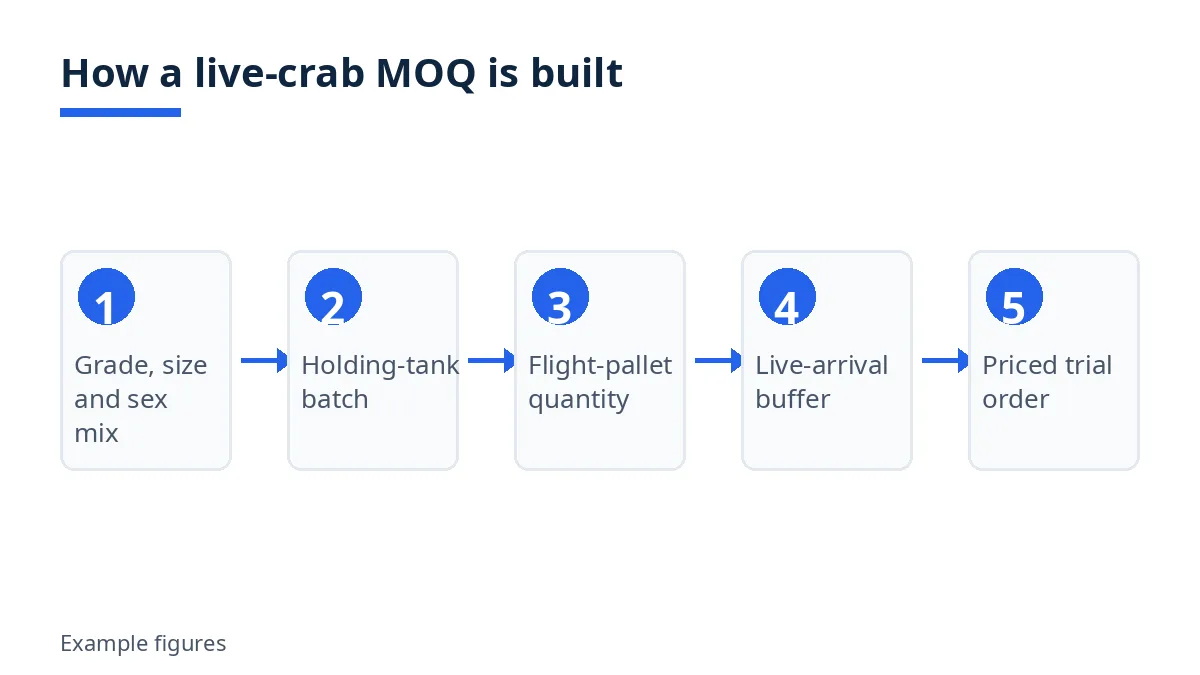
How the five drivers combine, with illustrative figures:
Driver | What it sets | Example figures |
|---|---|---|
Grade, size and sex mix | Number of sorts | One size band, males only: 1 sort |
Holding-tank batch | Smallest packing run | 400 kg per batch |
Flight-pallet quantity | Cartons and pallet positions | 10 cartons at 40 kg: 400 kg |
Live-arrival buffer | Extra animals against transit loss | 5 percent: 20 kg on 400 kg |
Inspection batch | Paperwork per consignment | One certificate set per shipment |
In this example, the buyer who orders one size band of males only, accepts the supplier carton and flight day, and agrees a 5 percent buffer reaches a 420 kg order. The buyer who orders three size bands and both sexes in a custom carton needs six sorts, each with its own floor, pushing the workable minimum far higher. That difference is the whole negotiation.
Why this matters for buyers and sellers
For buyers, the MOQ decides whether a trial order is possible at all. A small shipment that ignores tank batches and pallet positions arrives expensive per kilogram and teaches nothing about the supplier at scale. Understanding the drivers lets you shrink the order in ways that keep it shippable.
For sellers, the MOQ protects the economics of a live product. Holding, grading, packing and certifying live animals takes labour and time that does not fall with a smaller order, and a shipment that misses its flight because one grade was short wastes the whole batch. Once a buyer understands that, the conversation moves from haggling over a number to redesigning the order so both sides can say yes. Airfreight, carton and certification costs spread across shipment weight, so a load below a full pallet position costs more per kilogram, and two quotes cannot be compared without comparing the grade mix, carton size and buffer behind each.
Step-by-step: how it works
Work through these steps in order, getting each answer in writing before you move on.
Define the product precisely. State the species or trade name, size band in grams or carapace width, sex mix, hard-shell or soft-shell, and the condition you will accept at arrival. A vague specification produces a vague MOQ.
Ask for the MOQ per grade, not per order. Request the minimum per size band and per sex, the tank batch size, carton weight and pallet position it fills. That information lets you redesign the order.
Confirm the holding and packing location. Ask where the crabs are held and packed, and which airport and flight day the shipment uses. A packing point far from the departure airport means a longer road leg for live animals.
Agree the live-arrival terms. Set the buffer percentage, how live arrivals are counted and photographed at destination, the claim time limit, and whether the remedy is a credit, a replacement or a price adjustment. Put the counting method in the order, not in a chat message.
Confirm the documents for your destination. Certification, inspection and import rules differ by market, and some destinations add their own protocol. For China, live crab consignments have required clinical compliance certification by the state veterinary office under a protocol communicated by Chinese customs authorities.2 Check your own destination before you agree a quantity.
Run a priced trial order. Agree a trial quantity, price and flight day in a written order, and insist the trial follows the grading, packing and certification steps of a full order.
Review the trial against the agreed measures. Count live arrivals, check the grade mix, compare carton weights, and record what differed. Use that record to set the repeat-order quantity.
Costs, timelines and documents
Live-crab costs break into five parts: crab price by grade, holding and packing labour, cartons and packaging, airfreight and fuel charges, and certification and documentation fees. The crab price moves with grade and size, so a quote without a grade breakdown cannot be compared with another quote. Ask for each part as a separate line, and ask which lines change with quantity. Timelines are set by the slowest step, usually certification and flight availability rather than packing, so confirm the sample, certificate, packing, flight and arrival sequence in writing.
A live-crab shipment normally needs a commercial invoice, a packing list, a certificate of origin, a health certificate, an air waybill and a shipper certification for live animals. IATA requires a shipper certification for each shipment, completed in English and signed in duplicate, and live animals travel on their own air waybill with a 24-hour emergency contact in the handling information.3 For the European Union, live crustaceans for human consumption use the FISH-CRUST-HC model health certificate, and the master carton label must state container count, species per container, animal numbers and intended use.4 Stocking densities for live aquatic animals moved by air must take account of space and oxygenation capacity on the ground and during the flight.5 Use the correct classification on every document: live, fresh or chilled crabs fall under HS subheading 0306.33.6 Confirm the full national code for your destination.
Check each document against the order before packing day: invoice and packing list for grade, size, sex mix, carton count and weight; health certificate for destination model and species; origin certificate; air waybill for handling information and emergency contact; shipper certification signed in duplicate, in English.
Bangladesh customs export clearance procedures are published by Bangladesh Customs, and your forwarder should confirm the current steps for a live-animal consignment.7 Under Incoterms 2020, the point at which cost and risk pass depends on the term you choose, so agree the term before you agree the quantity.8
Bangladesh-specific rules and tips
Start with classification and certification, not with price. Confirm HS 0306.33 on the invoice and packing list, confirm which health certificate your destination requires, and confirm that the supplier can obtain it for your consignment. A supplier who cannot name the certificate model for your market is not ready for your order.
Ask how sampling works for your shipment. Traders have described a sequence in which a Department of Fisheries inspector examines and codes a sample before approvals and certificates follow, and have reported difficulty obtaining sample slots at times.9 Treat this as a scheduling risk: agree the sample date early. The Department of Fisheries e-certification system covers licences, health certificates, additional certificates required by the importing country, sample collection, inspection, test reports and certificate issuance, and connects directly to customs.10 Ask whether your consignment will move through that system and what reference you will receive.
Confirm the supplier export status for your destination market, not in general. Some destinations register specific enterprises or apply a specific protocol, as China has done for live crabs and eels.2 A supplier approved for one destination is not automatically approved for yours. Keep the grade mix narrow on a first order: one size band and one sex, in the supplier standard carton on the supplier flight day.
Mistakes and red flags
The most common mistake is ordering a small total weight split across many grades. Six sorts at a small weight each is six small orders, not one small order, and the supplier will either refuse it or price each sort at its own floor. Cut grades before you cut weight. Another mistake is agreeing a live-arrival percentage without a counting method: "live on arrival" means nothing unless you agree who counts, when, with what photographs, and within what time limit. A third mistake is comparing quotes that hide different carton sizes, flight days or buffers: two quotes at the same price per kilogram are not the same deal if one fills a pallet position and the other leaves half a position empty, or if one includes a 5 percent buffer and the other includes none.
Watch for red flags in the same places. A supplier who cannot state a per-grade minimum, a tank batch size or a carton weight is guessing, not quoting. A supplier who promises any quantity on any day without mentioning flight availability or certification timing has not checked either. A supplier who will not put the grade mix, buffer and counting method in writing is asking you to carry the risk of every ambiguity. A price far below other quotes for the same grade usually means a different grade or a missing buffer.
Checklist
Checklist before you confirm a live-crab order:
Specification written: species or trade name, size band, sex mix, shell condition, arrival condition.
MOQ confirmed per grade, per sex and per carton, with tank batch size stated.
Carton weight, carton count and pallet position confirmed, with flight day named.
Live-arrival buffer, counting method, claim time limit and remedy agreed in writing.
Health certificate model for your destination confirmed, with issuing route and timeline.
HS 0306.33 and full destination code confirmed on invoice and packing list.
Incoterms 2020 term agreed, with cost and risk point understood by both sides.
Trial order priced and packed as a full order, with review measures agreed in advance.
Supplier documents and photos reviewed on Exportain, with badge meaning understood.
Payment, funds-hold and claim terms agreed before packing day, not after arrival.
How Exportain helps
Exportain connects buyers with Bangladeshi suppliers and lets buyers post requests for quotation, compare quotations and message suppliers.11 Use it to shortlist suppliers, then test each one against the checklist, not the headline MOQ.
Supplier badges on Exportain are reviews of documents and photos, not factory inspections, certifications or guarantees, and Exportain is not a party to the contract for goods.11 Read the seller verification page before you treat a badge as assurance about holding tanks, grading or live-arrival performance.12 The checks in this guide — per-grade minimums, tank batches, carton positions, certificate models and arrival counting — are yours to run.
For grading and arrival checks, see the live crabs quality control checklist and importing live crabs from Bangladesh.
FAQs
What should I know first about live crabs?
Know that live crabs are a graded, held and flown product, not a bagged commodity. The grade, size and sex mix, the holding-tank batch, the carton and pallet position and the live-arrival buffer set the minimum order together, so a workable order starts from those five drivers. Live, fresh or chilled crabs fall under HS 0306.33.6
What are the typical costs and timelines?
There is no typical cost across grades and destinations, because the crab price moves with grade and size and airfreight moves with carton and pallet positions. Costs break into crab price by grade, holding and packing, cartons, airfreight and certification; ask for each part as a separate line. Timelines are set by the slowest step, usually certification and flight availability, so confirm the sample, certificate, packing and flight sequence in writing.
Which documents are needed?
A live-crab shipment normally needs a commercial invoice, a packing list, a certificate of origin, a health certificate, an air waybill and a shipper certification for live animals.3 The health certificate model depends on the destination: the European Union uses the FISH-CRUST-HC model for live crustaceans for human consumption, with master carton labelling that states container count, species, animal numbers and intended use.4 Confirm the model for your destination before you agree a quantity, and confirm the full national code beyond HS 0306.33.6
What are the most common mistakes?
The most common mistakes are splitting a small order across many grades, agreeing a live-arrival term without a counting method, and comparing quotes that hide different carton sizes, buffers or flight days. Cut grades before you cut weight, agree the buffer percentage with a counting method and claim limit, and compare quotes line by line.
Next steps on Exportain
Browse suppliers for live-crab exporters, compare their grade and carton terms against the checklist, and post a request for quotation through RFQs stating your size band, sex mix, carton acceptance and live-arrival counting method. Read the seller verification page first so you know what a badge does and does not cover.
Sources
- MoFL wants chemical tests for imported fish. The Financial Express (accessed )
- Compliance certificate for exporting crab, eel mandatory under Chinese protocol. The Financial Express (accessed )
- Questions and Answers for Shipping Live Animals by Air. International Air Transport Association (accessed )
- Aquatic animal export: certification requirements for the European Union. Canadian Food Inspection Agency (accessed )
- Control of risks associated with the transport of aquatic animals. World Organisation for Animal Health (accessed )
- HS Code 030633 — Crabs, whether in shell or not, live, fresh or chilled. Abrams Wiki (accessed )
- Customs Clearance Procedures for Export. Bangladesh Customs, National Board of Revenue (accessed )
- Incoterms® 2020. International Chamber of Commerce (ICC) (accessed )
- Most Crab and Kuchia exporters shut out as 15-16 traders dominate trade, allege peers. Daily New Nation (accessed )
- Bangladesh rolls out online certification system to simplify fish and seafood trade. International Collective in Support of Fishworkers (ICSF) (accessed )
- Trust & Safety Center. Exportain (accessed )
- Supplier verification: Earn trust badges buyers can see. Exportain (accessed )
About the author
Sourcing from Bangladesh?
Post a request for quotation and suppliers on Exportain can send you their quotes directly.
Post an RFQ