Netherlands Live Crab Imports From Bangladesh: CHED, CATCH, Duty
Live crabs from Bangladesh to the Netherlands, treated as live animals first: the Dutch border file, CHED and CATCH documents, 0306.33 classification, EBA duty, and a mortality-adjusted landed-cost example.
Short answer
To import live crabs from Bangladesh to the Netherlands, settle the Dutch border file first: confirm the species by scientific name, check the establishment on the published non-EU list, and ask your broker to confirm the 0306.33 line, the CHED model, and the EBA statement on origin. Agree packing, flight acceptance, and a mortality count in writing, file the CHED at least one working day before arrival, and price the order on surviving weight.
On this page
Key takeaways
Settle the Dutch gateway first: an approved border control post, a CHED filed at least one working day before arrival, the CHED model confirmed with the broker and the NVWA, and an EORI holder named before transport is booked.
Name the crab by scientific name and check the result in Species+; no CITES status is stated for any crab species, and the Chinese mitten crab Eriocheir sinensis is prohibited as an invasive alien species of Union concern.
Heading 0306 and subheading 0306.33 are indicative only: the broker must confirm the full 10-digit Dutch line, the duty rate, and the controls on the entry date, and no duty rate is stated in this guide.
CATCH has been compulsory for EU importers since 10 January 2026 for Chapter 3 fishery products; settle the wild-caught or farmed fork lot by lot, and never mix lots of different origin under one certificate.
Duty is zero only with an accepted REX statement on origin under EBA, import VAT is 9 percent, and the landed-cost example is reworked per surviving kilogram; no typical MOQ, price, transit time, or temperature is stated.
This guide shows how to import live crabs from Bangladesh to Netherlands as a live-animal order, not as a frozen seafood order. The crabs must arrive alive, so the border file, the packing, and the flight booking decide the result before price does. Settle the gateway, species, and catch files first, then agree terms on surviving weight.
Settle the Dutch gateway first: border post, destination, and who files
Live crabs from outside the European Union may only enter through an approved border control post (BCP), where veterinary border checks take place. In the Netherlands, the Netherlands Food and Consumer Product Safety Authority (NVWA) performs the veterinary controls with Dutch Customs, checking documents and, where selected, the product physically, for a fee.1 At every EU border post, such consignments face documentary, identity, and physical checks under Regulation (EU) 2017/625, recorded in TRACES.2
Report the cargo electronically to the BCP at least one working day before it enters the Netherlands, using NVWA access, or a broker who holds it. A Common Health Entry Document (CHED) is used for the notification, and a paper CHED must be converted into an electronic version by the NVWA for a fee.3 Before booking, settle the BCP, the CHED filer, and the EORI holder, which is mandatory for anyone dealing with Customs.1 Confirm in writing whether the consignment is filed as a product of animal origin or as live animals, since that decides the CHED model and the certificate model. A consignment that fails EU requirements may be refused entry, destroyed, re-dispatched, or given special treatment.2
Name the crab before you price it
Name the crab by its scientific name in writing before discussing price, grade, or packing. The commercial designation and scientific name must match across the quotation, health certificate, catch certificate where one applies, carton label, and CHED, because the identity check compares goods and labelling with the documents.2 Ask the supplier to state the scientific name, common name, sex, size grade, and whether the crabs were caught or farmed.
Check the named species in Species+, which holds CITES Appendix listings and the Annexes to the EU Wildlife Trade Regulations, including EU decisions for each species.4 This guide states no CITES status for any crab species; the Species+ result for the named species is the evidence to file. Where a CITES document is needed, the IATA rules list the possible documents, including export and import permits and re-export certificates.5 Do not ship, pay, or contract for a listed species before the permit position is confirmed.
One species must be excluded by name. The Chinese mitten crab, Eriocheir sinensis, is on the list of Invasive Alien Species of Union concern under Regulation (EU) No 1143/2014, so trade, possession, and introduction of the species are prohibited.6 If a supplier offers mitten crab or an unidentifiable crab, stop and re-identify the product.
Classify live crabs on 0306.33 and confirm the 10-digit Dutch line
Live crabs sit in heading 0306, at the live, fresh, or chilled crab subheading 0306.33. Treat that six-digit line as indicative only. The Netherlands works with a 10-digit commodity code, also called a TARIC code, and the duty rate is read on that full code.1 Ask your broker to confirm the full 10-digit line, the duty rate, and any controls on that line for your entry date, in writing, before ordering. Do not borrow a frozen or prepared-product code, or a duty rate from another crab line or country.
Classification also sets the customs value: the purchase price plus shipping and insurance costs up to the EU border.1 Keep descriptions identical across the invoice, packing list, health certificate, and CHED: delay costs surviving crabs.
Build the Dutch border file: CHED, health certificate, and the listed establishment
Animals and goods derived from them can only enter the EU from listed non-EU countries. The Commission publishes the establishment lists, the details are held in TRACES.7 Before ordering, check that the establishment handling your crabs appears on the published list for Bangladesh under fishery products. Such establishments must comply with Annex III to Regulation (EC) No 853/2004, as checked by the non-EU competent authorities.7
Inspection bodies in approved non-EU countries issue the health certificate, declaring the products healthy; the supplier should apply to the local inspection authority.1 Only goods of animal origin from authorised countries are admitted, accompanied by official certificates from the exporting country's competent authority confirming compliance and traceability from production to import.2 Agree in writing who issues the certificate, which model is used, and when it reaches the broker.
Prove the catch lot by lot: catch certificate, CATCH, and the wild-or-farmed fork
A catch certificate guarantees that imported products do not originate from illegal, unreported, and unregulated (IUU) fishing. Certificates are validated by the flag state and accompany products through the supply chain.8 Confirm vessel, quantity, and dates match the consignment.1
Since 10 January 2026, the digital CATCH system has been compulsory for EU operators and authorities for imports of fishery products, while catch certificates validated, endorsed, or signed before 10 January 2026 may be used until 10 January 2028.8 CATCH is part of TRACES NT, covers Chapter 3 and headings 1604/1605 products subject to IUU controls, and uses quantity management to prevent certificate overuse.9 Agree who supplies each data field before the crabs are caught or collected.
Settle the wild-or-farmed fork per lot. CATCH is unchanged for exempt produce under Regulation (EC) No 202/2011, covering aquaculture products and freshwater species, while wild-caught produce subject to the scheme goes through CATCH.9 Ask the supplier to state per lot whether the crabs were caught or farmed, and ask the broker whether CATCH applies or an exemption does. Never mix lots of different origin under one certificate.9
Agree the Dutch label before packing: commercial designation and Article 35 facts
Fishery and aquaculture products marketed in the Union may be offered to the final consumer or a mass caterer only if the marking or labelling shows the commercial designation and scientific name, the production method, the catch or farm area with the fishing gear category, whether the product has been defrosted, and the date of minimum durability where appropriate.10 For non-prepacked products, the information may be given by commercial information such as billboards or posters.10 Member States must publish a list of accepted commercial designations with scientific names, in the official language plus any locally accepted names.10 The label must specify the correct commercial designation, and the Dutch list is the reference.1 Confirm the Dutch designation for your species with the broker. The area indication follows the production method: for sea catch, the FAO fishing sub-area or division in consumer-understandable terms, or a map or pictogram; for freshwater catch, the body of water of origin; for aquaculture, the farming country as Article 38 defines it.10
Why Bangladesh fits a Dutch live-crab order
Bangladesh benefits from the most favourable regime under the EU Generalised Scheme of Preferences, the Everything But Arms (EBA) arrangement, granting least developed countries duty-free, quota-free access for all products except arms and ammunition.11 In 2024, 19 billion euros of Bangladeshi exports used the preferences, at 96 percent utilisation.11
The product must originate in Bangladesh: wholly obtained there, or sufficiently processed under the product-specific rules.12 The GSP regulation has applied since 1 January 2014 and was extended until December 2027.12
Proof is a statement on origin by an exporter registered in the Registered Exporter System (REX), on a commercial document identifying the goods and exporter. Any exporter may make a statement where the consignment value does not exceed 6,000 euros, and a statement remains valid for 12 months.12 Confirm the REX registration, the prescribed wording, and coverage of the exact consignment before shipment.
Find and check suppliers against the Dutch file
Check suppliers in three layers, in order. First, the establishment: confirm it appears on the published non-EU list for Bangladesh under fishery products, recording the name and number exactly as listed.7 If it is not listed, there is no order. Re-check the listing for this shipment.7
Second, the documents: confirm the health certificate issuer and model, the catch certificate or exemption per lot, and the REX registration for the statement on origin, Third, live performance: ask for arrival records of recent live shipments, including the counting method and how dead or moribund crabs were recorded and settled. See the live crabs MOQ guide and quality control checklist. Warning signs: a vague species name, a price before the file is confirmed, or a refusal to put counting in writing.
MOQ, pricing, and live samples without a stated typical minimum
This guide states no typical minimum order quantity and no typical price. No single figure holds across species, grades, seasons, and flight routes. Ask each supplier to state its minimum in writing by grade, size band, and sex, and explain what sets it.
Agree the price basis in the same document: price and settle on surviving weight, counted on arrival by the agreed method, with dead and moribund treatment stated before shipment.
A sample is a small live trial shipment, packed and flown exactly as the full order would be and counted by the same method. A dead or frozen sample proves nothing about live arrival. Judge the trial on the live count, survivor condition, and travelling documents.
Quality control, packing, and the live-arrival clock
Check vitality and identity first: leg movement, species and sex, shell condition, weight and grade, and claw tying, with grades held separately. Businesses handling fishery products must hold a food safety plan and follow HACCP principles.1 Ask for the plan and holding routine in writing.
Agree packing as numbers in writing: carton type, moisture system, ventilation, temperature range, and any oxygen or cooling arrangement, against the current container requirement in the IATA Live Animals Regulations for the species. No temperature or oxygen level is stated here: the numbers depend on species, container, and carrier rules.
Air acceptance is a gate. At booking, check species handling requirements, the container requirement, carrier and country regulations, direct routing, and hold fit.5 The shipper completes a Shipper's Certification for Live Animals for each shipment, in English and signed in duplicate, and live animals travel on their own air waybill with a 24-hour emergency contact in the handling information.5 Complete the acceptance checklist in full, notify the captain, label each container, and separate sick or dead animals where possible.5
Regulation (EC) No 1/2005 applies to the transport of live vertebrate animals between Member States, with checks on animals entering or leaving the EU.13 Crabs are invertebrates, so do not assume its authorisations and journey rules cover a crab consignment; ask the broker and carrier which welfare and handling rules they apply, and put the answer in the transport instructions. On arrival, count carton by carton, record live, moribund, and dead separately, and notify supplier and broker the same day.
Delivery terms: FCA, CIP, and DAP for a live air consignment
Choose the term for air freight. Incoterms 2020 divides into rules for any mode of transport and rules for sea and inland waterway only; the sea-only rules, including FOB and CIF, fit delivery on board a vessel, not delivery to a carrier at an airport.14 Work with FCA, CIP, or DAP, naming the exact place and the Incoterms 2020 version in the contract.
Under FCA, delivery and risk transfer occur when the seller delivers the goods to the buyer's nominated carrier. Under CIP, the seller arranges and pays carriage to the destination and insures the buyer's risk of loss or damage, but risk still passes when the goods are handed to the seller's carrier. Under CIF and CFR, the same split applies at the vessel: the seller pays freight to the destination port, but risk passes on board.14 That split suits a live consignment only if the mortality clause covers it.
The D rules keep risk with the seller until the destination. Under DAP, risk transfers when the seller places the goods at the buyer's disposal, ready for unloading, at the named place; DPU adds unloading by the seller, and DDP adds import clearance.14 DAP fits a buyer who wants the seller to carry flight risk, but it does not settle mortality. Write the mortality clause separately, and confirm cover in the policy wording.
Import duty, VAT, and documents: the Dutch calculation
No duty rate is stated in this guide. Duty is read on the exact 10-digit line, and the preference depends on an accepted statement on origin under EBA. Where accepted, EBA is duty-free and quota-free for all products except arms and ammunition.11 Where the statement is missing or fails verification, duty is charged at the rate the broker confirms for the exact line on the entry date.
VAT is separate from duty. Fishery products imported into the Netherlands from a non-EU country attract 9 percent Dutch import VAT, deductible as input tax where entitled; regular importers may hold an Article 23 permit to account for VAT in the return.1 Confirm the VAT base, customs value plus any duty, with the broker.1
Document | Who provides it | What it must show |
|---|---|---|
Commercial invoice | Supplier | Species, scientific name, quantity, weight, price, Incoterm, EORI holder |
Packing list | Supplier | Carton count, grade and sex mix, weights per carton |
Health certificate | Competent authority in Bangladesh | Establishment, species, fitness for human consumption |
Catch certificate or exemption record | Flag-state authority or supplier file | Vessel, lot, quantity, CATCH reference where applicable |
CHED pre-notification | Buyer or broker | BCP, arrival time, consignment identity |
Statement on origin | REX-registered exporter | Origin claim for the exact consignment |
Transport document and air waybill | Carrier or forwarder | Routing, separate live-animals waybill, 24-hour contact |
File the full set before departure, so each border check can be answered from the same facts.2
Landed cost example in euros, mortality-adjusted
Example figures only. Every number here is illustrative and must be replaced with quoted prices, broker-confirmed duty, and actual invoices before ordering.
Cost line | Example figure, per kilogram shipped |
|---|---|
Crab price, FCA origin | EUR 14.00 |
Air freight to the Netherlands | EUR 6.50 |
Insurance | EUR 0.40 |
Customs value (price plus freight plus insurance to the EU border) | EUR 20.90 |
Import duty, EBA preference with accepted statement on origin | EUR 0.00 |
Import VAT at 9 percent on the customs value plus duty | EUR 1.88 |
Border, broker, and inland delivery to the buyer | EUR 2.10 |
Delivered cost per kilogram shipped | EUR 24.88 |
Delivered cost per kilogram surviving, at an assumed 5 percent mortality loss | EUR 26.19 |
14.00 plus 6.50 plus 0.40 gives a customs value of 20.90 euros.1 Duty is zero only where the EBA statement on origin is accepted.11 VAT at 9 percent on 20.90 euros is 1.88 euros.1 Adding 2.10 euros gives 24.88 euros per kilogram shipped; dividing by 0.95, the surviving share under an assumed 5 percent mortality loss, gives 26.19 euros per kilogram surviving. The 5 percent figure is an assumption, not a typical rate. Rework it with quoted freight, broker-confirmed duty, and your trial mortality count.
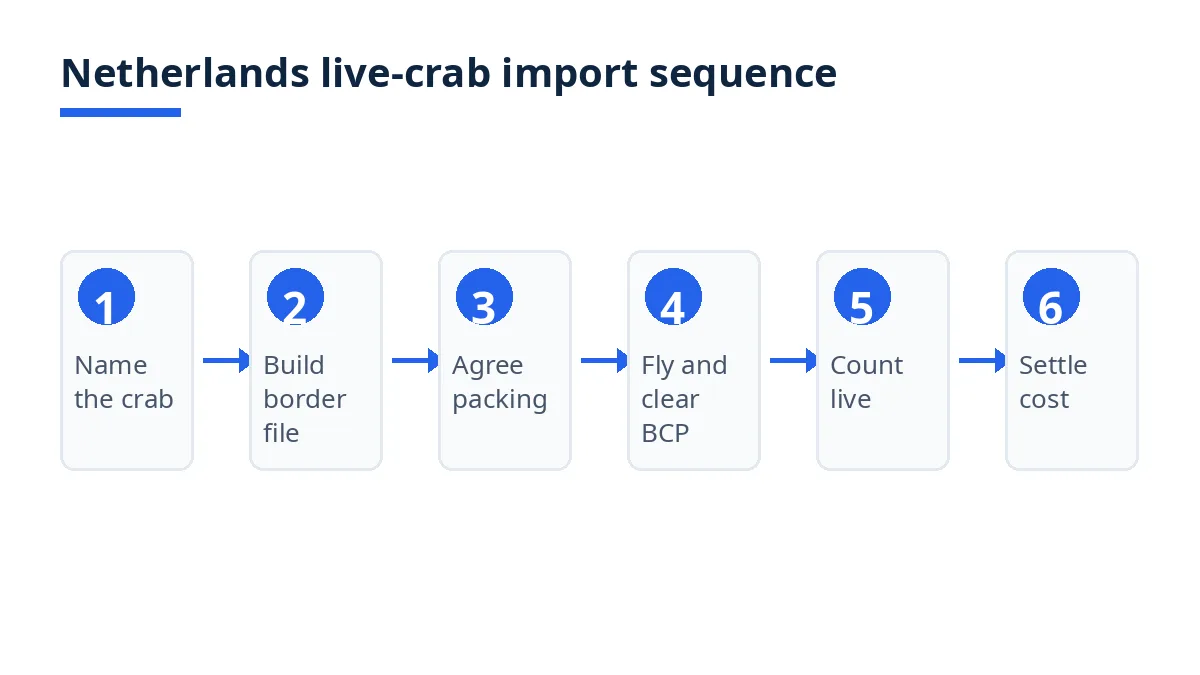
Netherlands live-crab import sequence, step by step
Name the crab by scientific name and check the Species+ result.
Confirm that Eriocheir sinensis is not the species ordered, and stop if the species cannot be identified.
Ask the broker to confirm the 10-digit line, the duty position, and the CHED model.
Check the establishment on the published non-EU list, and confirm the health certificate model and issuer.
Confirm per lot whether a catch certificate and CATCH submission are needed, or an exemption applies.
Agree label, packing, counting, and mortality settlement in writing.
Agree the MOQ per grade, the price basis on surviving weight, and the delivery term with the exact named place.
Book the flight under the IATA acceptance rules, with certification, separate waybill, and 24-hour contact.
File the CHED pre-notification at least one working day before arrival, with broker and consignee ready at the BCP.
Count the arrival carton by carton and reconcile against surviving weight before paying the balance.
How Exportain helps
Use Exportain to run the supplier search and quotation comparison around the file above, . Search Bangladeshi suppliers for crab suppliers, and post an RFQ stating the scientific name, grade and sex mix, packing specification, counting method, and delivery term, so quotations arrive on comparable terms. Read the how to import from Bangladesh guide for the general sequence and the landed cost guide for the full cost build-up. Exportain does not inspect goods, book freight, or clear customs.
What is the typical MOQ for live crabs from Bangladesh?
There is no typical MOQ stated here, because no single figure holds across species, grades, and flight routes. Each supplier sets its minimum per grade, size band, and sex, driven by the holding-tank batch, carton and flight-pallet quantity, inspection batch, and live-arrival buffer. Ask for the minimum per grade in writing, then test whether cutting a grade or accepting the supplier's size mix produces a shippable order.
How long does shipping take?
No transit time is stated, because the time depends on the flight schedule, routing, BCP inspection, and holding and packing time before departure. The fixed clock is the border clock: cargo must be reported to the BCP at least one working day before it enters the Netherlands.3
What import duty applies?
Duty depends on the exact 10-digit line and on whether an accepted statement on origin supports the EBA preference. Under EBA, Bangladesh benefits from duty-free, quota-free access for all products except arms and ammunition.11 Without an accepted statement, duty is charged at the rate the broker confirms for the exact line on the entry date, and this guide states no such rate. Confirm the REX registration and statement wording before shipment.12 Import VAT of 9 percent applies in addition to duty.1
How do I verify a supplier?
Verify in three layers: the establishment, the documents, and live performance. Check the establishment on the published non-EU list for Bangladesh under fishery products, and confirm the health certificate model, the catch certificate or exemption per lot, and the REX registration.7 Then run a small live trial on the same packing and flight path. A supplier who passes all three layers has proved the file and the flight.
Next steps on Exportain
Confirm the species, the establishment, and the broker's answers on classification and the CHED model, then post an RFQ carrying the full written specification. Compare quotations on surviving weight under one delivery term, using the HS code guide for live crabs to check classification wording and the landed cost guide to rework the example with your own figures.
Sources
- Importing fishery products. KVK (Netherlands Chamber of Commerce), (accessed )
- Import controls of food and feed Q&As. European Commission (accessed )
- Import of animals and animal products. Business.gov.nl (accessed )
- Species+. UNEP-WCMC and CITES Secretariat (accessed )
- Questions and Answers for Shipping Live Animals by Air. International Air Transport Association (accessed )
- Eriocheir sinensis. Flanders Marine Institute (VLIZ) (accessed )
- Non-EU countries authorised establishments. European Commission (accessed )
- Eliminating illegal, unreported and unregulated (IUU) fishing. EUR-Lex (accessed )
- CATCH - NEW EU SYSTEM. Sea-Fisheries Protection Authority (accessed )
- Regulation (EU) No 1379/2013 on the common organisation of the markets in fishery and aquaculture products. legislation.gov.uk, (accessed )
- EU trade relations with Bangladesh. European Commission, (accessed )
- Generalised Scheme of Preferences (GSP). European Commission (accessed )
- EU rules on the protection of animals during transport. EUR-Lex (accessed )
- Place of delivery & risk transfer in trade contracts. ICC Academy (accessed )
About the author
Sourcing from Bangladesh?
Post a request for quotation and suppliers on Exportain can send you their quotes directly.
Post an RFQ