France Live Crab Imports From Bangladesh: Gate Before You Pay
France live crab imports from Bangladesh, treated as live animals first: the SIVEP border gate, CHED-P and CATCH files, 0306.33 classification, EBA duty and 5.5% VAT, and a mortality-adjusted landed-cost example in euros.
Short answer
To import live crabs from Bangladesh to France, run the border gate before paying a deposit: confirm the designated French border control post and the CHED-P type in TRACES, prove Bangladesh and the plant are listed, and fix the wild-caught or farmed fork with a CATCH catch certificate or farm records. Agree the health certificate, 0306.33 line, French label, airline acceptance, and mortality counting in writing, then price duty and VAT on the broker-confirmed line.
On this page
Key takeaways
Live crabs are a live-animal shipment first: survival, handling, and the border file matter more than price, and a dead crab cannot be reclassified as live at the French border.
No deposit until all six gates pass in writing: French border control post designation and CHED type, country and plant listing, catch-file fork, health certificate, tariff line with duty and VAT, and the French label.
CATCH is compulsory for EU operators and authorities from 10 January 2026; the French importer files there, so the Bangladeshi side must supply a flag-State-validated catch certificate that enters exactly, or farm records for farmed lots.
Classification is heading 0306, subheading 0306.33 for live, fresh or chilled crabs; no duty rate is stated because no EU TARIC schedule for the exact line was opened, and EBA preference depends on origin rules and a REX statement on origin.
No typical MOQ, price, or transit time is stated. Every figure is labelled Example figures, including the landed-cost example at EUR 17.89 per kilogram alive at an assumed 5 percent mortality loss, before duty and VAT.
This guide explains how to import live crabs from bangladesh to france as a live-animal shipment first and cargo second. The crabs must still be alive, active, and saleable when the French border checks finish, so survival, handling, and the border file matter more than price. A frozen-fish routine does not transfer: there is no reefer leg, and a dead crab cannot be reclassified as live at the border.
Only goods of animal origin from authorised countries are admitted, subject to documentary, identity, and physical checks at designated border control posts.1 A non-compliant consignment may be refused, destroyed, re-dispatched, or given special treatment, with reinforced controls on later consignments.1 Read the general guide to importing from Bangladesh alongside this guide, and run the gate below before you pay a deposit.
Run the gate before you pay a deposit
Do not pay a deposit until every gate below shows a pass in writing. A fail at any gate stops the order, whatever the price.
Gate | What must pass | Evidence to hold |
|---|---|---|
1. French entry point | The border control post is designated for the consignment category, and the CHED type is confirmed | BCP designation and CHED type in writing |
2. Country and plant listed | Bangladesh is listed for fishery products, and the plant is on the establishment list | Annex IX entry and TRACES-NT list entry, dated |
3. Catch file fork | Wild-caught or farmed is fixed lot by lot, with the matching proof | Flag-State-validated catch certificate in CATCH, or farm records |
4. Health certificate | The certificate model and wording are agreed before packing | Model name and wording agreed in writing |
5. Classification, duty, and VAT | The full tariff line is confirmed and duty and VAT are broker-priced | Broker calculation on the exact line and entry date |
6. French label | The French designation, production method, and area agree with the lot | Label artwork approved in French, in writing |
Settle the French entry point: SIVEP, the BCP list, and the CHED fork
In France, sanitary and phytosanitary border controls are carried out by SIVEP, the veterinary and phytosanitary border inspection service. France publishes its points of entry by category, with separate border control post lists for live animals and for products of animal origin.2 Do not assume the post that handles a frozen-fish container handles live crabs: confirm its designation for this consignment category before booking the flight.
The operator responsible for the consignment must notify Part I of the Common Health Entry Document (CHED) in TRACES, and the officer at the border control post validates Part II, the decision on the consignment, after the checks.3 TRACES and TRACES-NT handle certification, pre-notification, and border-check outcomes; importers must register with the competent authority to use them.3 No deadline figure is stated here: confirm it with the French post in writing.
Resolve the CHED fork in writing. The CHED is used in different formats by consignment category: CHED-A for animals and CHED-P for products, under Article 47(1) of Regulation (EU) 2017/625.4 Live crabs for human consumption sit on the product side as fishery products, so CHED-P is the working position, subject to French confirmation. The CHED is drawn up in English and one official language of the destination country, so the French file carries French too.4 Use the confirmed type on the notification, certificate, and declaration alike.
Checks run in three stages: document checks in all cases, and identity and physical checks in all cases for live animals and on random samples for other goods, with samples for official testing where needed.5 If compliant, SIVEP issues the CHED for customs.5 Customs levy a control fee under the orders of 25 June 2012 as amended; get the amount in writing.5
Prove Bangladesh and the plant are listed before you shortlist
Annex IX to Regulation (EU) 2021/405 lists authorised third countries for certain fishery products; in the consolidated text opened here, Bangladesh appears as "BD Bangladesh (1)", meaning it can export all fishery products: finfish, products of finfish, and crustaceans.6 The text is consolidated to 15 December 2022, so re-check the current list for the entry date.
Establishment lists are proposed by listed non-EU countries, maintained by the Commission in TRACES, with accuracy resting with the non-EU authority.7 Only a listed country may propose establishments, which must meet Annex III to Regulation (EC) No 853/2004; fishery products fall in Section VIII.7 Record the name and address exactly as listed, the approval number, and the date checked, and re-check before each bulk order. A plant absent from the current list is a stop.
Name the crab and run the wildlife checks on that name
Do not order "live crabs" as a generic line. Name the species and scientific name, sex mix, size grade, and condition standard: live, active, intact, weak animals rejected before packing. The species name drives classification, wildlife checks, certificate wording, and the French label. Mixed species, sizes, or origin types need separate lines.
Species+, from UNEP-WCMC and the CITES Secretariat, holds CITES Appendix listings, quotas, suspensions, and EU Annex listings, searchable by species and location.8 Check the named species there and record the result, including a clear negative. If listed, settle the permit route before shipment. This guide states no CITES status for any crab species: no species page was opened. Ask the broker whether any invasive-species control applies, and record the answer. No traded species or production geography is asserted here.
Wild-caught or farmed: the fork that decides the catch file
Fix the origin type lot by lot. Fishery products may only be imported with a catch certificate validated by the flag State of the catching vessel, certifying lawful catches under applicable conservation measures.9 It must contain the Annex II specimen information and flag-State validation.9 If the consignment was processed or held in another third country, the processing statement or proof of non-manipulation is also required.9
Submit the validated certificate at least three working days before estimated arrival, a deadline adaptable by product, distance, or transport means.9 Verification may examine products, data, and document authenticity; release is suspended meanwhile, with storage on the operator.9 Importation must be refused where no certificate was submitted, the products differ from it, or it lacks flag-State validation.9 Vessel, species, code, and weight must agree across certificate, invoice, packing list, and air waybill.
File through CATCH, the digital catch certificate system in force from 10 January 2026, replacing the paper process.10 CATCH is compulsory for EU operators and authorities from that date and voluntary for non-EU countries; certificates validated before it may be used until 10 January 2028.11 The French importer files in CATCH, so the Bangladeshi side must supply a certificate that enters exactly.
A farmed claim takes the other fork: farm-lot traceability, not a catch certificate. Agree in writing what proves farmed origin: holding identity, rearing records, and the lot-to-carton link. Do not mix wild-caught and farmed crabs under one catch file. If the origin type is uncertain, stop: the fork cannot be resolved at the border.
Agree the health certificate model and wording before packing
Non-EU animals and animal products need an official certificate, signed by official veterinarians and always checked at border control posts.12 A single mistake suffices for rejection, including a wrong weight.12 Use the electronic form in TRACES NT wherever possible: it reduces the risk of mistakes such as an out-of-date certificate.12
Model certificates sit in three regulations: 2021/403 (live terrestrial animals), 2020/2235 (animal products, composite products, live fish), and 2020/2236 (aquaculture, live fish).12 This guide does not name the model for live crabs: the broker and French post must confirm it for the named species, presentation, and origin type. Agree wording, stamp and signature, and weight basis before packing, and check the issued certificate against the invoice, packing list, and air waybill.
Classify on 0306.33 and leave the 10-digit line to the broker
Heading 0306 covers crustaceans, in shell or not, live, fresh, chilled, frozen, dried, salted, or brined, and related forms.13 Subheading 0306.33 covers live, fresh or chilled crabs, whether in shell or not.13 Frozen crabs sit at 0306.14: do not carry that line onto a live consignment.13 The broker must confirm the full CN and TARIC line for the exact presentation, species, and entry date, because duty and controls attach to the line.
Record heading, subheading, confirmed line, species, presentation (live, in shell, uncooked), and net weight basis in the order. No EU TARIC schedule for the exact line was opened, so no duty rate is stated here. See the HS code guide for live crabs and price only on the confirmed line.
Agree the French label before the cartons are printed
For fishery products offered for sale to the final consumer or a mass caterer, labelling must show the commercial designation and scientific name, production method ("caught", "caught in freshwater", or "farmed"), catch or production area and gear category, defrosting, and minimum durability date where appropriate.14 Agree these Article 35 facts for the exact lot even where the import carton is a trade pack.
Member States must publish a list of accepted commercial designations with scientific names, in the official language or languages of the Member State.14 The broker must confirm the exact French designation from that list; this guide invents no French name. The area follows Article 38: for sea-caught products, the FAO sub-area or division in consumer-understandable words, or the FAO area name outside the Northeast Atlantic and Mediterranean and Black Sea; for aquaculture, the country where the product reached over half its final weight or stayed over half the rearing period.14
Mandatory food information must appear in a language easily understood by consumers where the food is marketed, and Member States may stipulate official EU languages.15 For France: French wording agreed in writing, artwork approved in French, facts matching the certificate and catch file. Crustaceans are listed allergens; the rules require a clear, emphasised reference to the listed name, or "contains" plus the name without an ingredients list.15 Confirm the presentation with the broker and freeze the artwork for the lot.
Find suppliers against the French file, not the price list
The supplier must show in writing that it can supply the named species in the agreed condition under the health-certificate and catch arrangements. Ask for the establishment name and address exactly as listed, the approval number, the authority behind a comparable recent certificate, and a copy with commercial details removed. A supplier who cannot name the certifying route should not receive a bulk order.
Exportain badges are document and photo reviews, not factory inspections or guarantees. Exportain is not a party to the contract, and does not inspect goods, book freight, or clear customs. Put the same written questions to every shortlisted supplier: species, origin type, holding and packing, mortality counting, routing and airline acceptance, certificate and catch routes, and listing. Drop any supplier whose answers change. See Bangladeshi suppliers and the guide to buying on Exportain. No Bangladesh export list is stated here: require the supplier to name every document for the exact line in writing, and have the broker confirm it.
MOQ, pricing, and trial shipments without a stated typical minimum
This guide states no typical minimum order quantity (MOQ), price, or transit time: no opened source stated one, and a borrowed figure would mislead the order. The minimum is set per supplier, species, grade, sex mix, packing format, and flight, and must be agreed in writing for the exact consignment. Read the live crabs MOQ guide before negotiating, and convert every minimum to cartons, kilograms, and flight loads on the same basis before comparing suppliers.
Price only on identical specifications: species, sex mix, grade, condition, packing, net weight basis, delivery term, document set, and mortality rule. Ask for a split quotation (product, packing, freight and insurance, documents, delivery), agree currency, payment, and dead-arrival treatment, and state whether the price is per kilogram shipped or per kilogram alive at the count point.
Samples mean a trial shipment, not a courier carton. Run a small trial on the intended route and post, with the intended packing and count method, recording survival, condition, document timing, and border handling. Do not start bulk holding before the trial is reviewed. Keep a counter-record: photographs, count sheet, CHED outcome. Use the live crabs quality control checklist and check each lot lot by lot.
Live transport: packing, oxygen, and airline acceptance
Air transport is the normal route, and airline acceptance decides whether the consignment flies. Any person or company shipping animals by air needs to follow the IATA Live Animals Regulations, and booking checks include the species and its handling requirements, the correct container requirements, carrier rules for the species, destination and country regulations, the most appropriate direct routing, and whether the container fits the aircraft hold.16 Confirm the container requirement for the named species in the current edition of the Live Animals Regulations, and get the airline's acceptance in writing for the species, container, and routing before packing starts.
The shipper completes the Shipper's Certification in duplicate, in English with a translation where needed; live animals need their own air waybill with a 24-hour emergency contact.16 Container and contents must be weighed or measured and compliant, the container labelled, shipper and consignee details and emergency contact attached, care instructions fixed outside, and medication recorded.16 The Acceptance Checklist must be completed and verified before acceptance, and the captain advised via the Notification to Captain.16 The carrier handles welfare, documentation review, loading, securing, and delivery; only trained people handle the animals, and sick or dead animals are removed or separated.16
Agree packing and life support as numbers: material, moisture, oxygen or air space, cooling, maximum packed time, handling, and delay contingency. No temperature, oxygen level, or packed time is stated here: no opened source gave one for this species and route. The welfare regulation covers live vertebrate animals; crabs are invertebrates, so confirm its treatment for live crustaceans with the broker and the French post.17
Delivery terms for a live air consignment: FCA, CIP, and DAP
Choose the term by who controls the live-animal risk. Incoterms 2020 allocate cost, risk, and obligations; state the rule, named place, and version, for example "CIP Paris Airport, Incoterms 2020".18 Compare delivery to the carrier at the airport, carriage and insurance to destination, and delivery to the buyer's premises bearing import risk. Do not use a maritime-only term for air freight, and do not leave the border file or onward handling unassigned.
State the mortality risk point separately from the Incoterms rule: when risk passes for dead and weak animals, who bears loss to the count point, and how insurance responds. CIF is maritime-only with Institute Cargo Clauses (C) as default cover; CIP requires the higher Clauses (A) cover.18 Confirm the policy covers live arrival, dead-on-arrival loss, and delay, and matches the count method and point: total-loss-only cover does not cover partial mortality. The FCA on-board bill of lading revision does not create an air waybill.18 16 Delivered at Terminal was renamed Delivered at Place Unloaded (DPU); the seller unloads under DPU, not under DAP.18
Duty, VAT, and the documents that travel together
Duty is decided on the confirmed tariff line, for the entry date, with the proof of origin in hand. No duty rate is stated in this guide, because no EU TARIC schedule for the exact live-crab line was opened. The broker must price duty on the exact line for the entry date, and the buyer must not carry a rate from another line, heading, or supplier quotation into the French price.
Bangladesh, as a least developed country, benefits from Everything but Arms: duty-free, quota-free access except for arms and ammunition.19 That is the scheme position, not a consignment guarantee: the product must meet the origin rules, and GSP proof is a statement on origin by a REX-registered exporter; Form A is no longer accepted after 30 June 2020.20 Require the statement and the exporter's REX number in the purchase order, before shipment. If origin is uncertain, price at the broker-confirmed duty.
The French tax administration puts foodstuffs for human consumption at the reduced VAT rate of 5.5 percent, with limited exceptions including confectionery, chocolate, margarines, caviar, and alcohol.21 Crabs are not named among them, but the import VAT base and payment route are not stated there: have the broker and tax adviser confirm rate, base, and recovery in writing. The documents must agree as one pack: CHED, health certificate, catch or farm records, statement on origin, invoice, packing list, air waybill, and label facts.
Landed cost example in euros, before duty and VAT
All figures are Example figures: not quotations or typical prices. Rework every line with confirmed figures. Duty is a broker calculation and VAT a broker and tax adviser calculation at 5.5 percent on the confirmed base, so neither is totalled here.21 20 The example uses 1 kilogram and an assumed 5 percent mortality loss; the 5 percent is an assumption, not a typical rate.
Cost line (Example figures, EUR per kg net weight) | Amount |
|---|---|
Product price | 11.00 |
Air freight and insurance to the French border | 4.80 |
Customs value | 15.80 |
SIVEP, port, clearance, and broker charges | 0.70 |
Onward delivery and holding | 0.50 |
Subtotal before duty and VAT, per kg shipped | 17.00 |
Import duty | Broker calculation |
VAT at 5.5 percent | Broker and tax adviser calculation |
Subtotal before duty and VAT, per kg alive at assumed 5 percent loss | 17.89 |
Arithmetic: 11.00 + 4.80 = 15.80; + 0.70 + 0.50 = 17.00; / 0.95 = 17.89 per kilogram alive before duty and VAT. Mortality adds EUR 0.89. See the landed cost guide for imports from Bangladesh and rework with actual invoices after shipment.
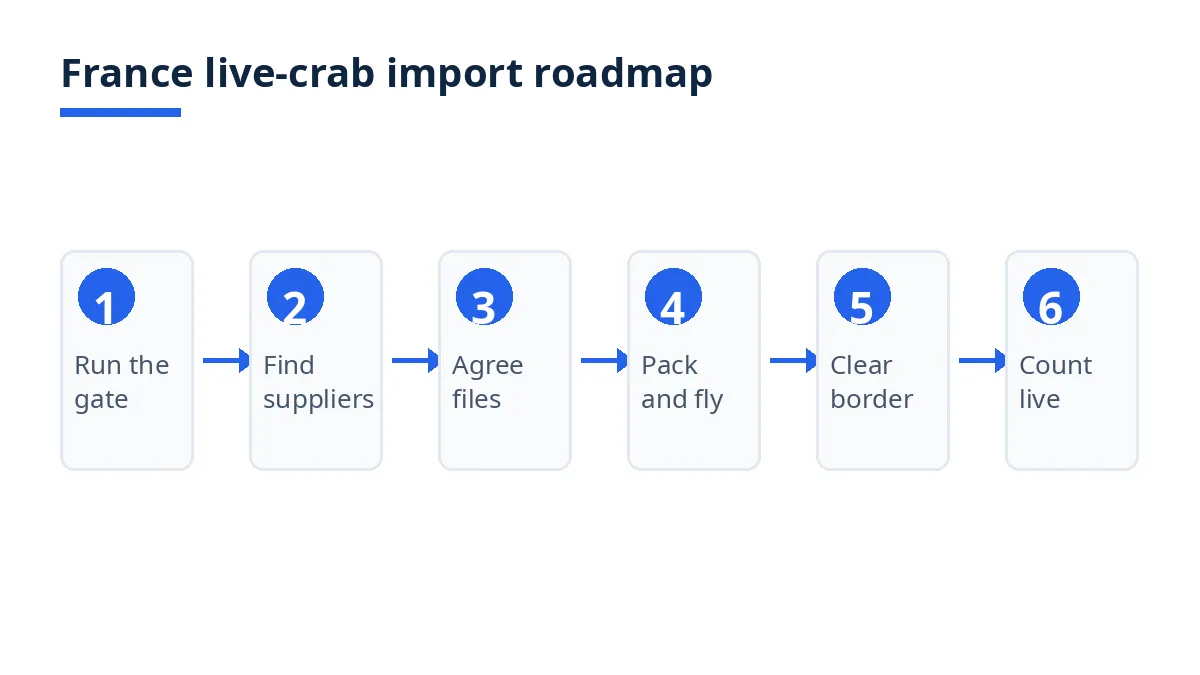
France live-crab import sequence, step by step
Name the crab, origin type, and condition standard, and run the Species+ wildlife check.
Confirm the French border control post designation and the CHED type, and confirm the pre-notification deadline in writing.
Check the country listing and the plant on the TRACES-NT establishment list, and record both with dates.
Fix the wild-caught or farmed fork lot by lot, and build the catch certificate or farm traceability file.
Agree the health certificate model and wording, and the issuing authority route, before packing.
Classify on heading 0306, confirm the full line with the broker, and settle the EBA and REX proof route.
Agree the French label facts and approve the artwork in French.
Agree MOQ, price split, mortality counting, and payment terms, and run a trial shipment.
Agree packing, moisture, oxygen, cooling, container, and routing, and get airline acceptance in writing.
Complete the Shipper's Certification, air waybill, and acceptance checklist, and submit the catch file and the CHED notification inside the deadlines.9 3
Present the consignment at the designated border control post, complete the three-stage checks, and hold the issued CHED for customs.5
Count live, weak, and dead crabs at the agreed point, record the result, and reconcile the invoice to surviving weight.
Rework the landed cost with actual figures, and file the order, certificates, CHED, catch file, and count record.
What is the typical MOQ for live crabs from Bangladesh?
No typical MOQ is stated here: no opened source stated one. The minimum depends on supplier, species, grade, sex mix, packing, and flight, and must be agreed in writing for the exact consignment. Ask how it splits across grades and packs, convert it to cartons, kilograms, and flight loads, and test it with a trial shipment.
How long does shipping take?
No transit time is stated here: no opened source stated one. Agree the door-to-door time in writing for the exact flight, including packing, acceptance, flight, transfer, border checks, and delivery, with a delay contingency. The binding clocks are the border clocks: the catch certificate at least three working days before arrival, subject to adaptation, and the CHED deadline confirmed with the French post.9
What import duty applies?
No duty rate is stated here: no EU TARIC schedule for the exact line was opened. Duty follows the broker-confirmed line. Bangladesh benefits from duty-free, quota-free access under Everything but Arms except for arms and ammunition, but a consignment's preference depends on the origin rules and a statement on origin from a REX-registered exporter.19 20 If origin is unconfirmed, price at the broker-confirmed duty. VAT is at 5.5 percent, on a base the broker and tax adviser must confirm.21
How do I verify a supplier?
Verify a supplier against the border file, not a catalogue. Ask in writing for species, origin type, establishment details, certificate and catch routes, packing and mortality counting, and airline acceptance. Check the establishment on the TRACES-NT list and record the entry and date.7 Only listed countries may propose establishments.7 Run a trial through the intended French post before a bulk order, and drop any supplier whose answers change. Badges are not a substitute for these checks.
Next steps on Exportain
Start with the gate, not the price. Use the guide to importing from Bangladesh to set the wider process, check the live crabs quality control checklist before writing the specification, and work the landed cost guide with broker-confirmed duty and VAT figures. Then post a free RFQ on Exportain with the species, origin type, grade, packing, flight route, and mortality-counting method in the requirement, so quotations arrive on identical specifications and can be compared on survival as well as price.
Sources
- Import controls of food and feed Q&As. European Commission (accessed )
- Commission Implementing Regulation (EU) 2019/1715. legislation.gov.uk (accessed )
- How should you carry out your SPS border control procedures (information systems)?. Ministry of Agriculture (France) (accessed )
- How are SPS border controls carried out?. French Ministry of Agriculture, (accessed )
- Where are SPS border controls carried out?. French Ministry of Agriculture (accessed )
- Commission Implementing Regulation (EU) 2021/405 — list of third countries authorised for fishery products. European Union (accessed )
- Non-EU countries authorised establishments. European Commission (accessed )
- Species+. UNEP-WCMC and CITES Secretariat (accessed )
- Council Regulation (EC) No 1005/2008. European Union (accessed )
- New digital certification system to tackle illegal fishing. European Commission, (accessed )
- Revised EU rules and digitalisation of fisheries control. AGRINFO (accessed )
- EU official health certificates for exports to the EU – explained. AGRINFO (accessed )
- HS 2017 Code 0306. United Nations Statistics Division (accessed )
- Regulation (EU) No 1379/2013 on the common organisation of the markets in fishery and aquaculture products. legislation.gov.uk, (accessed )
- Regulation (EU) No 1169/2011. European Union (accessed )
- Questions and Answers for Shipping Live Animals by Air. International Air Transport Association (accessed )
- Council Regulation (EC) No 1/2005. European Union (accessed )
- Incoterms® 2020. International Chamber of Commerce (ICC) (accessed )
- EU trade relations with Bangladesh. European Commission, (accessed )
- Generalised Scheme of Preferences (GSP). European Commission (accessed )
- TVA - Liquidation - Taux réduits - Produits destinés à l'alimentation humaine. BOFiP, French tax administration (accessed )
About the author
Sourcing from Bangladesh?
Post a request for quotation and suppliers on Exportain can send you their quotes directly.
Post an RFQ