Spain Knitted Underwear Imports: Valencia Entry, IVA and EBA Guide
How Spain-based buyers import knitted underwear from Bangladesh through Valencia: supplier checks, Spanish labelling, IVA, EBA duty and landed cost, with no typical price or MOQ assumed.
Short answer
To import knitted underwear from Bangladesh to Spain, specify each style by fiber mix, waistband and size range, verify the supplier on that construction, approve a pre-production sample with Spanish labels, and confirm classification, origin evidence and import VAT with your broker before bulk production. Ship to Valencia, clear the goods with the full document set, and build landed cost from your own quotations.
On this page
Key takeaways
Men's and boys' knitted underpants and briefs fall under heading 6107 and women's and girls' briefs and panties under heading 6108, each split by fiber into cotton, man-made fibers and other textile materials.
There is no single typical MOQ, price or transit time for knitted underwear from Bangladesh, so confirm each one in writing for your exact style, fiber mix, size range, route and shipment date.
Spanish labels must state the fiber composition in Spanish and match the tested fabric, and packaging placed on the Spanish market carries extended producer responsibility duties under Royal Decree 1055/2022.
No EU tariff line was opened for this guide, so every 10-digit TARIC line and duty rate is confirm with broker. The Everything But Arms preference is conditional on origin evidence and the scheme in force on the entry date.
Valenciaport handles 40 percent of Spain's imports and exports, with more than 5.6 million containers a year, and landed cost must be built from your own supplier, freight, duty and clearance quotations.
A Spanish underwear order succeeds or fails at the Valencia quay, not at the price negotiation. The decisions that fix the outcome are made before shipment: the exact style and fiber mix, the classification of each style, the proof of origin for the duty preference, labels in Spanish that match the fabric in the pack, and a landed cost built on the Valencia route. This guide is for Spain-based brands, retailers, wholesalers and sourcing teams. It states no typical price, minimum order quantity or transit time, because none has a single figure across styles, fiber mixes and shipment dates.
The Harmonized System is a multipurpose international product nomenclature developed by the World Customs Organization, with more than 5,000 commodity groups, each identified by a six-digit code.1 It is arranged in sections, chapters of two digits, headings of four digits and subheadings of six digits, and countries subdivide the six-digit categories further; the Combined Nomenclature of the European Union uses eight-digit codes.2
Why source knitted underwear from Bangladesh
Bangladesh supplies knitted underwear in cotton, man-made fibers and blends: briefs, boxer briefs, trunks, slips and panties, in single styles and in multipacks. The fit for a Spanish buyer is a construction fit before it is a price fit. Waistband knitting, elastic application, leg opening finish and size grading differ by style, so a supplier that already makes your style in your fiber mix will quote your order more reliably than a general knitwear factory that must set the style up from scratch.
Source by style, not by factory size alone. A factory that runs men's cotton briefs every week is a closer fit for a men's cotton brief program than a factory whose strength is women's lace-trimmed panties, and the reverse holds for styles knitted without side seams or with a wide jacquard waistband, which need different machines and finishing.
Underwear is a replenishment line in Spain, so the first order sets the pattern for repeats. Agree at the first order how repeats will be matched to the approved sample.
Find and verify suppliers
Where should you start the search?
Start with a specification, not with factory names. Write down every style first: men's, women's or children's; brief, trunk, boxer brief, slip or panty; fiber composition; fabric weight; waistband type and width; leg finish; size range on the size set your Spanish customers use; color or print; labeling; and packing, including pieces per polybag, per retail pack and per carton. Then shortlist suppliers whose current range already includes knitted underwear in that construction. Browse suppliers on Exportain and compare candidates on the same document.
Send every candidate the identical specification and ask for the same reply format: fabric assumed, pieces per retail unit, price inclusions, validity, and minimum per style and per color. A supplier answering on your specification can be compared directly. One answering with its own standard style cannot, even when its price looks lower, because the fabric, waistband, size range or packing behind the price is different.
How do you verify a supplier before you pay?
Verification has three layers. The first is company documents: trade license, export registration and association membership where applicable, checked so that name, address and bank account name agree across every document. The second is capability: monthly capacity, knitting or fabric sourcing route, cutting capacity across your size curve, waistband and elastic handling, dyeing and finishing, and packing capacity for your format.
The third layer is payment discipline. Keep payments to the company account named in the documents, never to a personal account, and verify any change of bank details separately through a channel you already trust. Read how supplier verification works on Exportain for what document and photo checks cover. On Exportain, supplier profiles carry document and photo review badges. A badge is a review of documents and photos, not a factory inspection or a guarantee, and Exportain is not a party to the goods contract.
MOQ, pricing and samples
What is the typical MOQ for knitted underwear from Bangladesh?
There is no single typical minimum order quantity for knitted underwear from Bangladesh. The minimum is set per style and usually per color, because yarn is dyed in batches, waistband elastic is ordered by width and color, and a cutting and sewing plan is set up per size range. Ask each supplier how its minimum splits by style, color, size range and pack composition, and get the split in writing before you compare quotes.
How is the price built, and how should you compare quotes?
Fabric is usually the main cost element, followed by knitting or fabric purchase, cutting and sewing, dyeing, waistband elastic, trims, testing, packing and the factory margin. Fabric use per piece depends on size range and style, and detail adds operations: lace trim, jacquard waistbands, printed labels and multipiece packs each cost more to process. Two quotes can differ because one assumes a lighter fabric, a narrower waistband, fewer sizes or simpler packing, so ask what each price is based on, in writing. Compare quotes on the same basis: same style, fiber mix, size range, waistband, packing, delivery term and named place, with exclusions stated, for example elastic upgrades, testing, special packing or freight to Valencia.
Which samples do you need, and how do you approve them?
Work in stages. A development sample shows whether the factory can knit or cut the style, apply the waistband evenly, finish the leg openings cleanly and grade the size range. A pre-production sample, made in the actual production fabric, color, waistband and finish, is the sample you approve for bulk. Test the samples as your customers will use them: wash and dry them following your care label, and check measurements, stretch recovery and multipack matching.
Quality control and certifications needed
What should inspection cover for next-to-skin garments?
Inspection for knitted underwear is measurement work, not a general look-over. Agree the inspection plan before production: in-process checks at cutting and waistband application where your volume justifies them, and a pre-shipment inspection of finished, packed goods. The inspection should record measurements by size, waistband recovery, seam strength and stretch at stress points, shade variation within and across cartons, label accuracy against the tested fiber composition, and pack counts against the packing list.Adapt the knitted underwear quality control checklist to your styles before you order.
Set the sampling basis, defect classification and correction process in the purchase order, including who pays for re-inspection.
Which labels, tests and certificates should you ask for?
Ask for the evidence you will actually rely on, by name: a fiber composition test from a laboratory you name, wash and colorfastness results on the production fabric and colors, dimensional stability results after washing, and the label artwork approved against the test result. Name the test scope in the purchase order.
Under Regulation (EU) No 1007/2011, fiber composition descriptions must be indicated on packaging, labels and markings in a manner that is easily legible, visible and clear, and the labeling or marking must be provided in the official language or languages of the Member State where the products are made available to the consumer, unless that Member State provides otherwise.3 For Spain, that means Spanish fiber names on the label in the pack, checked against the tested composition.If your buyer requires a specific certificate, name it in the specification and ask the supplier to show a current certificate covering the factory and product scope before you order.
What about packaging duties in Spain?
Packaging is a separate Spanish obligation that belongs in the pack specification. Under Royal Decree 1055/2022 on packaging and packaging waste, companies that put packaging on the Spanish market are subject to extended producer responsibility, and the duty reaches importers that put packaged products on the Spanish market.4 Ecoembes states that a foreign company putting packaged products on the Spanish market directly or through distance selling must have an authorized representative in Spain, be enrolled in the Register of Product Producers, and belong to a producer responsibility organization.4 Settle in writing who carries that duty, and record each packaging component, material and weight.
Incoterms, shipping and transit time
Which delivery term fits a Valencia container shipment?
Incoterms 2020 rules deal with delivery, risk transfer, cost and customs obligations between seller and buyer, and each rule states where delivery takes place in the contractual sense.5 In all but EXW the seller must carry out export formalities, and in all but DDP the buyer must carry out import formalities.5 For a container shipment to Valencia, FCA, CPT and CIP are the usual starting points, because the seller delivers the goods to the carrier and the container handover is recorded at that point. FOB, CFR and CIF require the seller to place the goods on board the vessel, and the ICC Academy summary notes that those four sea rules are only intended for port-to-port shipments and are not suitable for container shipments in their current form.5
Name the term, the Incoterms 2020 version and the named place in the purchase order, for example FCA Chattogram or DAP Valencia.Read the Incoterms guide and confirm the term with your forwarder.
How long does shipping take, and what should you confirm about Valencia?
This guide states no transit time. Sailing frequency, transshipment, port congestion and the inland leg from Valencia all move with the season and the carrier, and a figure copied from a previous shipment will mislead your launch date. Ask your forwarder for a written sailing schedule and transit estimate for your shipment date, container size and named port pair, and build your calendar from that estimate plus clearance and inland delivery time.
Valenciaport, comprising the ports of Valencia, Sagunto and Gandia, states that its facilities handle 40 percent of Spain's total imports and exports, that more than 5.6 million containers pass through its terminals each year, and that it ranks fourth among European ports for container traffic, with more than 100 regular shipping routes.6Confirm the terminal, cut-off and inland carrier with your forwarder.
Import duty, taxes and documents
What import duty applies?
Duty starts with classification, and classification starts with the garment, not the product name. Chapter 61 covers articles of apparel and clothing accessories, knitted or crocheted, and applies only to made-up knitted or crocheted articles.7 Heading 6107 covers men's or boys' underpants, briefs, nightshirts, pyjamas, bathrobes, dressing gowns and similar articles, knitted or crocheted, with underpants and briefs split into cotton, man-made fibers and other textile materials.7 Heading 6108 covers women's or girls' slips, petticoats, briefs, panties, nightdresses, pyjamas, negligees, bathrobes, dressing gowns and similar articles, knitted or crocheted, with briefs and panties split the same way by fiber.7 A mixed program can use several lines, and singlets and undershirts can fall under other headings, so classify each style separately. See the HS code guide for knitted underwear and confirm each line with your broker.
Style in this guide | Heading | Six-digit split to confirm with your broker |
|---|---|---|
Men's or boys' underpants and briefs | 6107 | 6107.11 cotton, 6107.12 man-made fibers, 6107.19 other textile materials |
Women's or girls' briefs and panties | 6108 | 6108.21 cotton, 6108.22 man-made fibers, 6108.29 other textile materials |
Nightshirts, pyjamas and similar nightwear | 6107 or 6108 | By wearer group and fiber, on the same headings |
Singlets, undershirts and other vests | Confirm with broker | May fall outside 6107 and 6108 |
The duty discipline for this guide is strict. No tariff-schedule line for the European Union was opened for this guide, so no duty rate is stated for any line. Every 10-digit TARIC line and rate is confirm with broker: ask your broker to confirm the current line and rate in force on your entry date, and never copy a rate from a supplier or a previous shipment.
The preference position is separate from the standard rate. The Everything But Arms scheme grants full duty-free and quota-free access to the EU Single Market for all products except arms and ammunition for least developed countries.8 The updated Generalised Scheme of Preferences, approved for application from 1 January 2027, continues Everything But Arms, which the Commission states will now continue indefinitely.9 Bangladesh is scheduled to graduate from least developed country status on 24 November 2026.10 Ask your broker to confirm which scheme applies on your entry date, and budget at the standard broker-confirmed rate unless the claim and its evidence are confirmed in writing.
Proof of origin is the evidence that makes a preference claim work. Proof of origin certifies where a product was made and is essential for claiming preferential treatment such as reduced or zero tariffs.11 Under the Generalised Scheme of Preferences, exporters registered in the Registered Exporter system make out a statement on origin on the invoice or another commercial document; unregistered exporters may do so for consignments up to 6,000 euros ex-works.11
What taxes apply in Spain, and what documents does customs need?
Import VAT is charged when the goods are released for circulation, and the taxable amount for imports is the value for customs purposes plus customs duties and other taxes due on importation plus supplementary costs up to the place of destination.12 The European Commission page on VAT also records that Spain, with Ceuta, Melilla and the Canary Islands, is excluded from the application of VAT in those territories, so goods for the Canary Islands follow different tax treatment and must be priced separately.12 For mainland Spain, budget import VAT at the general rate of 21 percent unless your broker or tax adviser confirms a different treatment; the Agencia Tributaria page for incoming shipments refers to 21 percent of the price of the goods payable before delivery where VAT has not already been collected.13
Document | Why Spanish customs and your broker need it |
|---|---|
Commercial invoice | Value, currency, style and fiber detail, and the basis for the customs value |
Packing list | Carton count, pieces per carton, weights and the check against the physical goods |
Bill of lading or transport document | Carriage, port pair and the handover that matches the delivery term |
Statement on origin or other proof of origin | The preference claim, if one is made, and the evidence behind it |
Contract and purchase order | Specification version, price, delivery term and named place |
Importer identification details | The EORI number and the details your representative requires for the entry |
The EORI number is an operator identification number valid throughout the European Union and a prerequisite for customs clearance in the European Union.14 Confirm with your customs representative, before shipment, which identifier and supporting details Spanish customs requires for your entry, and give the representative the full set in advance.
Landed cost example (table)
Example figures only. Build your own landed cost from your supplier quotation, your forwarder quotation, your broker duty calculation and your own clearance and delivery charges. Do not budget from the example figures in this guide. The example assumes a preference claim accepted at entry and import VAT at 21 percent. If the claim is refused, duty is added at the broker-confirmed rate and import VAT is charged on the customs value plus that duty.
Cost element — Example figures | Basis in this example | Amount |
|---|---|---|
Goods, FOB Chattogram | 12,000 pieces at 1.10 euros — Example figures | 13,200.00 euros |
Freight and insurance to Valencia | Forwarder quotation for the container — Example figures | 1,850.00 euros |
Customs value | Goods plus freight and insurance — Example figures | 15,050.00 euros |
Import duty | 0 percent, preference claim accepted — confirm with broker | 0.00 euros |
Import VAT at 21 percent | 21 percent of customs value plus duty — Example figures | 3,160.50 euros |
Clearance, port and inland delivery | Broker and carrier quotations — Example figures | 640.00 euros |
Landed total including import VAT | Customs value plus duty plus VAT plus clearance and delivery | 18,850.50 euros |
Landed cost per piece including import VAT | Total divided by 12,000 pieces — Example figures | 1.57 euros |
Landed cost per piece excluding import VAT | Total less VAT, divided by 12,000 pieces — Example figures | 1.31 euros |
See landed cost for imports from Bangladesh and build the same table with your own quoted figures.
Step-by-step import checklist
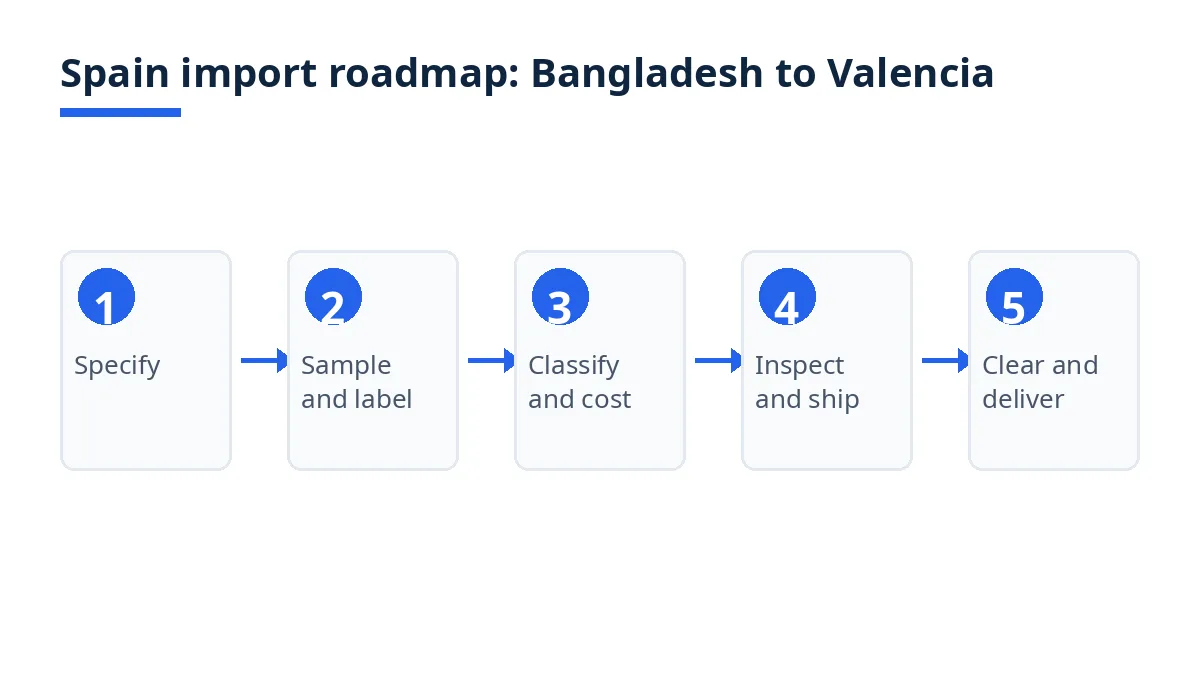
Write the specification per style: wearer group, fiber composition, fabric weight, waistband type and width, leg finish, size range, colors, Spanish label set and pack format.
Shortlist suppliers whose current production already includes your construction, and send every candidate the identical specification.
Verify company documents, capability and payment details.
Agree the minimum per style, per color and per size range, the price basis and exclusions, and the sample stages in writing.
Approve samples in stages, ending with a sealed pre-production sample in the correct fabric, colors, elastic, Spanish labels and packing.
Confirm the fiber composition test scope and laboratory, and approve the Spanish label artwork against the test result.
Confirm classification with your customs broker in TARIC, line by line, and confirm the current 10-digit line and rate in force on your entry date. Mark every unopened line confirm with broker.
Confirm the preference scheme, the origin evidence and the registered exporter position for your entry date, and confirm what happens if the claim is refused.
Place the purchase order covering the specification version, quantities, price and validity, delivery term and named place, timelines, inspection, document set, payment terms, packaging duties and the correction process.
Monitor production against the approved sample and specification, and carry out the agreed in-process checks.
Complete a pre-shipment inspection of finished, packed goods. Correct and re-inspect any failures before shipment.
Check draft documents, confirm freight, give your representative the full set before arrival, clear the goods, pay duty and VAT as assessed, and check the goods in against the packing list and approved sample.
How Exportain helps
Exportain is a B2B marketplace where buyers find Bangladeshi suppliers and post requests for quotation. Post a request for quotation with your specification attached and compare replies on the same specification. Exportain does not inspect goods, book freight or clear customs, and it is not a party to the goods contract. Read how to import from Bangladesh for the wider process.
FAQs
What is the typical MOQ for knitted underwear from Bangladesh?
There is no single typical minimum. It is set per style and usually per color. Ask each supplier for the split by style, color, size range and pack composition.
How long does shipping take?
This guide states no transit time. Ask your forwarder for a written sailing schedule and transit estimate for your shipment date, container size and port pair, plus clearance and inland delivery time.
What import duty applies?
Duty depends on the exact garment, its fiber composition, its full tariff classification and the rate in force on your entry date. Men's and boys' knitted underpants and briefs sit under heading 6107 and women's and girls' briefs and panties under heading 6108, with subheadings split by fiber.7 No EU tariff line was opened for this guide, so every 10-digit line and rate is confirm with broker.8
How do I verify a supplier?
Check company documents so name, address and bank account agree, check capability on your exact construction with a production garment, and keep payments to the company account named in the documents. On Exportain, document and photo review badges are a review of documents and photos, not a factory inspection or a guarantee.
Next steps on Exportain
Search Bangladeshi suppliers with your specification ready, then post a request for quotation that states the styles, fiber mix, size range, Spanish label set and Valencia delivery term. Before you place the order, read how to import from Bangladesh and build your landed cost with your own quoted figures using the landed cost guide.
Sources
- What is the Harmonized System (HS)?. World Customs Organization (accessed )
- Harmonised System. European Commission (accessed )
- Regulation (EU) No 1007/2011 on textile fibre names and related labelling and marking of the fibre composition of textile products. European Union, (accessed )
- FAQs - Ecoembes Companies. Ecoembes, (accessed )
- Insider thoughts: Bob Ronai on Incoterms 2020 Rules; What are they about?. International Chamber of Commerce (accessed )
- About us - Valenciaport. Port Authority of Valencia (Valenciaport) (accessed )
- Chapter 61 - National Imports Tariff Guide (2022): headings 6107 and 6108. Sri Lanka Customs (accessed )
- Trade arrangements. European Commission, Access2Markets (accessed )
- New Generalised Scheme of Preferences approved for application in 2027. European Commission, (accessed )
- Bangladesh Graduation Readiness Assessment. United Nations Office of the High Representative for the Least Developed Countries (UN-OHRLLS) (accessed )
- Proof of origin. European Commission (accessed )
- Value added tax. European Commission (accessed )
- Shipments amounting to a value of 150 euros. Agencia Tributaria (accessed )
- EORI number. German Customs (Zoll) (accessed )
About the author
Sourcing from Bangladesh?
Post a request for quotation and suppliers on Exportain can send you their quotes directly.
Post an RFQ