

Italy Knitted Underwear Imports From Bangladesh: Genoa, IVA and Fit
Italy buyers importing knitted underwear from Bangladesh: Genoa entry, Everything But Arms preference, 22 percent IVA, HS headings 6107 and 6108, fit and label checks, and an example landed cost. Every duty line is marked confirm with broker.
Short answer
To import knitted underwear from Bangladesh to Italy, specify each style by fiber, fabric weight, waistband, elastic and size curve, classify it in heading 6107 or 6108, and approve a fit sample in production materials. Claim the Everything But Arms preference with proof of origin, confirm the current 10-digit TARIC line with a broker, enter through Genoa with a valid EORI number, and budget import IVA at 22 percent as a cash cost.
On this page
Key takeaways
Knitted underwear is classified in headings 6107 for men and boys and 6108 for women and girls, split by garment type and then by fiber; confirm the current 10-digit TARIC line and preference code with a broker for every style.
Bangladesh goods that meet the origin rules enter the EU duty-free and quota-free under Everything But Arms, and the updated scheme continues that arrangement from 1 January 2027.
The standard IVA rate in Italy is 22 percent; import IVA is often recoverable for a VAT-registered buyer but remains a cash cost at clearance.
There is no single typical MOQ, price or transit time for knitted underwear; confirm each one in writing per style, color, size range and shipment date.
Approve a fit sample in production fabric, waistband and elastic, inspect to an agreed AQL plan, and hold chemical test reports and proof of origin for the actual shipment.
For an Italy buyer, importing knitted underwear from Bangladesh is a fit and paperwork exercise before it is a price exercise. The garments sit close to the skin, sizes must hold after washing, waistbands and leg elastics must keep their recovery, and every style must carry the right fiber label and the right customs code. Fix those points in the specification, and the rest follows a standard import path through Genoa.
This guide is for buyers in Italy who buy men's, women's and children's knitted underwear for retail, wholesale, e-commerce or private label. It follows the Italy route only: entry through an Italian port, Italian import VAT (IVA), and the European Union preference that applies to goods from Bangladesh. It states no typical minimum order, price or transit time, because none has a single figure across styles, sizes, fibers and shipment dates. Each one must be confirmed in writing for the exact order.
Why source knitted underwear from Bangladesh
Bangladesh is a least developed country, and the European Union's Everything But Arms arrangement grants the least developed countries duty-free, quota-free access to the EU for exports of all products except arms and ammunition.1 The same European Commission page reports that 91 percent of Bangladesh's exports to the EU enter duty- and quota-free, and that Bangladesh is the largest beneficiary under Everything But Arms, with 19 billion euros in exports benefiting from the preferences in 2024 at a 96 percent utilisation rate.1 That preference is the starting point for an Italy buyer, not a guarantee for a single shipment: the goods must meet the origin rules of the scheme, and the preference must be claimed correctly at entry. The updated Generalised Scheme of Preferences, which applies from 1 January 2027 for ten years, continues Everything But Arms, and the Commission states that it will now continue indefinitely.2 Least developed countries are automatically granted the benefits of Everything But Arms, even if they have another arrangement in place.3
Recent trade figures give useful context for timing, without setting a price. Knitwear exports from Bangladesh rose 6.88 percent to 5.96 billion dollars in the July to September quarter of the 2026-27 financial year, while ready-made garment exports to Italy fell 5.82 percent to 316 million dollars in the same quarter, according to Export Promotion Bureau data reported in New Age.4 An Italy buyer is therefore buying into a growing knitwear supply base in a quarter when Italy-bound garment shipments eased. Treat that as background for a commercial conversation, not as a promise about capacity or delivery for a specific factory.
Italy also sets a demanding benchmark at home. Carpi, in Emilia-Romagna, is described by the European Textile Collectivities Association as the European capital of textile-clothing, fast fashion, knitwear and made in Italy clothing, with a district built on small and very small businesses.5 Judge a Bangladesh supplier on the same points: consistent knitting, clean finishing, stable sizing and reliable repeat orders. Ask it to make your specification, in your sizes, with your waistband, elastic and label, and judge the sample against that specification alone.
Find and verify suppliers
Where should you start the search?
Start with the style list, not with factory names. Write down every style first: men's briefs or boxers, women's briefs or panties, children's underwear, and nightwear or bathrobes if they are in the order, with the fiber mix, fabric weight, waistband type, elastic type, gusset construction, seam type, size range, colors and packing for each one. Then shortlist knitwear exporters whose current range already includes knitted underwear in those styles. A factory that makes only T-shirts or only woven shirts is not a close substitute, because underwear cutting, waistband insertion, elastic application, gusset sewing and flat seaming use different operations and different checks.
Send every candidate the identical specification and ask for the same reply format: fabric assumed, pieces per retail pack, price inclusions, validity and minimum per style, per color and per size range. Browse suppliers on Exportain and read how to import from Bangladesh for the full process before you send the specification out.
How do you verify a supplier before you pay?
Verification has three layers. The first is company documents: trade licence, export registration and association membership where applicable, checked so that name, address and bank account name agree across every document. The second is capability: monthly underwear capacity, whether knitting is in-house or fabric is bought in, knitting gauge range, dyeing route, waistband and elastic sources, and which recent underwear styles the factory can show from current production. A finished pack from current production shows more than a catalogue photograph: waistband attachment, elastic recovery, seam flatness and size consistency across the pack.
The third layer is payment discipline. Keep payments to the company account named in the documents, never to a personal account, and verify any change of bank details separately before you act on it. Read how supplier verification works on Exportain for what document and photo checks cover. On Exportain, supplier profiles carry document and photo review badges. A badge is a review of documents and photos, not a factory inspection or a guarantee, and Exportain is not a party to the goods contract.
MOQ, pricing and samples
What is the typical MOQ for knitted underwear from Bangladesh?
There is no single typical minimum order quantity for knitted underwear from Bangladesh. The minimum is set per style and usually per color, because yarn is dyed in batches, fabric is knitted and dyed in lots, and a cutting plan is set up per size range. A plain cotton brief in three colors and a modal blend brief with a woven waistband label in eight colors will not carry the same minimum. Ask each supplier how its minimum splits by style, color, size range and pack composition, and whether a size range can be split across colors.
For a first order, keep the style count small. One or two styles, in a limited color range, with a complete size curve, are easier to sample, inspect and sell through than six styles ordered thinly.
How is the price built, and how should you compare quotes?
Fabric is usually the largest cost element in knitted underwear, followed by knitting or fabric purchase, dyeing, cutting, sewing, waistband and elastic, trims, testing, packing and the factory margin. Fabric use per piece depends on the style, the size and the fabric weight, and small differences in weight change the price more than buyers expect. Waistband construction adds operations: a knitted-in waistband, a folded elastic waistband and a woven label waistband each cost differently to produce and behave differently after washing.
Compare quotes only on the same basis: same style, fiber mix, fabric weight, waistband, elastic, size range, pack composition, delivery term and packing. Ask each supplier to state what is excluded, for example elastic, labels, hangtags, testing or special packing. A lower quote that assumes a lighter fabric, a simpler waistband or no testing is a different product, not a saving. Ask for the fabric weight and the waistband and elastic specification in writing with every quote, and keep the quote validity date beside each price.
Which samples do you need, and how do you approve them?
Work in stages. A development sample shows whether the factory can construct the style, attach the waistband evenly, apply the elastic without puckering and complete a pack to the size chart. A fit sample, in the actual production fabric, waistband and elastic, is the sample you approve for bulk. Size, waistband recovery and leg opening fit cannot be approved from a sample in substitute fabric or substitute elastic, because washing, finishing and elastic change dimensions and recovery.
Test the samples as your customers will wear and wash them. Measure every size against your size chart before and after washing to your care label instructions. Stretch the waistband and leg elastic and check recovery, check that the gusset sits flat, check seam strength at stress points, and check color match across sizes and packs. Approve in writing and keep one sealed counter-sample of each style, color and size range. The counter-sample is the reference for inspection. Without it, an inspection argument becomes a matter of opinion.
Quality control and certifications needed
Which quality checks are specific to knitted underwear?
Against the approved sample and size chart, check fabric composition and finished weight, finished measurements within your agreed tolerances, and consistency across the full size range. Then check construction piece by piece: waistband attachment and evenness, elastic width, tension and recovery, leg elastic attachment, gusset construction and position, seam type and stitch density, and label attachment and position. A pack can pass piece by piece and still fail as a pack if one size is cut from a different shade batch or the waistband sits at a different height.
Underwear is worn against the skin, so skin-contact checks carry extra weight. Agree the chemical testing scope before production and ask for the matching test report for the actual fabric, waistband, elastic and trims in the order. Certain aromatic amines that can be derived from azo dyes are restricted in Europe under REACH, Regulation (EU) No 1907/2006 Annex XVII entry 43, with the restrictions applying to dyed textiles that come into contact with the skin, and the common testing standards named for textiles are EN ISO 14362-1:2017 and EN ISO 17234-1:2024 for leathers.6 Ask the report to name the fabric and color tested, the standard used and the date. A report for a different fabric or color does not cover your order. Do not treat a general statement that dyes are compliant as a test result.
Agree the inspection method and defect limits before production. ISO 2859-1:2026 defines a system of acceptance sampling plans for inspection by attributes, and its summary states that AQL stands for acceptance quality limit, the maximum average percentage of defective items considered acceptable during random sampling, used to determine sample sizes and acceptance and rejection thresholds.7 Inspect in stages: an inline check during sewing catches a waistband or elastic drift while correction is still possible, and a final random inspection on packed goods checks quantity, workmanship, measurements, labels and packing. See the quality control checklist for knitted underwear and the pre-shipment inspection guide for the inspection sequence.
Which label rules apply in Italy?
Fiber labeling applies to every style in the order, and to the waistband and lining where they differ from the body fabric. Article 9 of Regulation (EU) No 1007/2011 states that a textile product shall be labeled or marked with the name and percentage by weight of all constituent fibers in descending order.8 Agree the wording at sampling stage and check that the percentages match the fabric you bought, because the labeled composition is also the composition your classification is built on. Where elastane is present, name it and its percentage. A label that states cotton only for a cotton and elastane blend is wrong even if the fabric feels like cotton.
Add care, size and origin marking as your market and your customer require, and check the finished label before bulk label sewing begins. Confirm whether your customer wants Italian, European or international size markings, confirm the size run for each style, and check the label on a washed sample. Pack labeling must agree with the garment label: style, color, size, quantity per pack and carton contents must match across the packing list, the carton marks and the goods inside.
Which certifications do you actually need?
No single certificate covers every underwear order. What you need follows your market and your customer: a retailer or brand may name a specific test, fiber standard or social compliance scheme in its own supplier manual. Name any such requirement in the specification, ask for the matching report or certificate, and check its scope, product covered, issuing body and date. A certificate for a different factory or a different fabric does not cover your order.
Be careful with organic and recycled fiber claims. If you sell a style as organic cotton or recycled fiber, the claim must be supported by the chain of custody documents for the yarn and fabric in that order, and the wording on the label and the sales listing must match the documents. If you cannot obtain the documents for a specific lot, do not make the claim for that lot.
Incoterms, shipping and transit time
Which delivery term should a first order use?
The Incoterms 2020 rules set out, for each rule, where delivery takes place, and risk passes from seller to buyer at the same point and time as delivery.9 Under FOB, CFR and CIF the seller must place the goods on board the vessel, while under FCA the seller delivers the goods to the carrier.9 In all rules but EXW the seller must carry out export formalities, and in all rules but DDP the buyer must carry out import formalities.9 The same ICC Academy summary notes that the four sea rules, FAS, FOB, CFR and CIF, are only intended for port-to-port bulk or break-bulk shipments and are not suitable for container shipments, because a container is handed to the carrier before it is on board.9
For a first order shipped in containers, weigh FOB at the Bangladesh port against FCA at the named terminal. Under FOB, the factory delivers the goods on board and your forwarder handles the sea leg. Under FCA, delivery happens when the goods are handed to your carrier, which matches how containerized cargo moves. State the named place and the version of the rules in the contract, for example FCA Chattogram terminal, Incoterms 2020. Whichever term you choose, confirm who books the freight, who pays each local charge and who arranges insurance, in writing, before shipment. Only in CIP and CIF is there an obligation by the seller to provide insurance for the buyer.9
Which Italian port should the goods enter through?
Genoa is the practical default for most Italy buyers, because it serves northern Italy directly and connects onward by road and rail to Milan and the northern distribution centers. The Western Ligurian Sea Port Authority reported an upward trend in the first quarter of 2025, with total cargo throughput of 15,820,730 tons and container traffic of 725,344 TEU across the Ports of Genoa and Savona-Vado Ligure.10 The same report notes that disruption from the Red Sea crisis diverted vessels from the Suez Canal to the Cape of Good Hope and bolstered transshipment traffic in the first quarter of 2025.10 Routing can therefore change between quote and shipment. Confirm the routing, the transshipment port if any, and the expected arrival window with your forwarder at booking, and again at loading.
Other Italian ports, including La Spezia, Gioia Tauro and Trieste, may suit a buyer whose warehouse or customer base sits closer to them, or whose carrier offers a better service on a given sailing. Choose the port on the forwarder's current service and the onward delivery cost, not on habit. Confirm carton dimensions and weight in the specification, because underwear is light for its volume and carton volume can limit a shipment before weight does.
How long does shipping take?
There is no single typical transit time for knitted underwear from Bangladesh to Italy. Sea freight is the standard route for bulk orders and it takes weeks rather than days, varying by port, routing, transshipment and season. Plan from your forwarder's current sailing schedule, add clearance and onward delivery, and keep a buffer for inspection rework. If a customer date is fixed, work backward from that date through clearance, transit, inspection and production, and fix the shipment date in the order before production starts. Air freight is an option for samples and for a small urgent replenishment, but it is not a routine route for bulk underwear orders.
Import duty, taxes and documents
How are knitted underwear styles classified for duty?
Duty follows the classification of each style in the destination tariff, not the supplier's product name. The Harmonised System is an international classification of approximately 5,000 six-digit product categories, organized by chapters, headings and subheadings, and countries subdivide the six-digit categories further for their own tariffs.11 The Combined Nomenclature of the European Union uses eight-digit codes.11 For Italy, confirm the current 10-digit TARIC line in force on the entry date for each style, together with the preference code, and have your broker confirm the line before you price or ship.
The central headings are 6107 and 6108. Heading 6107 covers men's or boys' underpants, briefs, nightshirts, pyjamas, bathrobes, dressing gowns and similar articles, knitted or crocheted, and heading 6108 covers women's or girls' slips, petticoats, briefs, panties, nightdresses, pyjamas, negliges, bathrobes, dressing gowns and similar articles, knitted or crocheted.12 Within each heading the first split is by garment type, then by fiber: underpants and briefs in 6107.11 for cotton, 6107.12 for man-made fibers and 6107.19 for other textile materials, and briefs and panties in 6108.21 for cotton, 6108.22 for man-made fibers and 6108.29 for other textile materials, with matching splits for nightwear and for the other group.12 A cotton brief, a man-made fiber brief and a nightshirt in one order can therefore sit on three different lines. Confirm the full code for each style before you price or ship, and keep knitted and woven styles apart: woven underwear sits outside Chapter 61. Read the HS code guide for knitted underwear beside your broker's classification.
Style in the order | Heading | Six-digit split by fiber |
|---|---|---|
Men's or boys' underpants and briefs | 6107 | 6107.11 cotton, 6107.12 man-made fibers, 6107.19 other |
Men's or boys' nightshirts and pyjamas | 6107 | 6107.21 cotton, 6107.22 man-made fibers, 6107.29 other |
Women's or girls' briefs and panties | 6108 | 6108.21 cotton, 6108.22 man-made fibers, 6108.29 other |
Women's or girls' nightdresses and pyjamas | 6108 | 6108.31 cotton, 6108.32 man-made fibers, 6108.39 other |
Slips, petticoats and other styles | 6107 or 6108 | Confirm with broker: 6107.91 to 6107.99, 6108.11 to 6108.19, 6108.91 to 6108.99 |
What import duty applies?
Your rate depends on the confirmed classification of each style, the origin and any preference in force on the entry date, so there is no single rate for a whole underwear order. Under Everything But Arms, Bangladesh goods that meet the origin rules enter the EU duty-free and quota-free, as set out above.1 The updated scheme continues that arrangement from 1 January 2027.2 A preference depends on the goods meeting the origin rules of the scheme, so agree the proof of origin at order stage: the exporter must be able to issue the proof the scheme requires for that shipment, the origin criterion must be recorded, and the proof must name the goods as they appear on the invoice.
Do not budget a duty rate from memory or from another country guide. No duty rate from an opened tariff-schedule line is stated in this guide for any 6107 or 6108 line. Every line is marked confirm with broker: ask your broker to confirm the current 10-digit TARIC line, the preference code, the duty rate in force on the entry date and the documents needed to claim the preference, in writing, before the goods ship. If the preference cannot be claimed for a style, ask the broker for the duty at the standard rate for that line, and rework the landed cost before you commit to a selling price.
What about IVA and other taxes at import?
Import IVA is separate from duty. The standard IVA rate in Italy is 22 percent, with reduced rates for several supplies of goods and services, such as 4 percent for listed food, drinks and agricultural products and 10 percent for electric power supplies for listed uses and listed drugs.13 Underwear is not in those reduced-rate examples, so budget on the standard rate and have your tax adviser confirm the treatment for your business. Import IVA is often recoverable for a VAT-registered buyer, but it is still a cash cost at clearance, and the timing of recovery depends on your VAT position.
The taxable amount for imported goods is based on the value for customs purposes plus the cost of other charges, taxes and duties incurred by the importation itself, and IVA is payable to customs at importation unless the member state allows it to be included in the periodic VAT return.14 Ask your broker and your tax adviser, before shipment, whether your import IVA is paid at the border or accounted for in your return, and what proof you must hold. Keep the customs value, the duty, the freight and insurance elements and the IVA treatment on one calculation sheet, so that the figure you use for pricing and the figure you use for the VAT return agree.
Which documents do you need for clearance?
You need an EORI number for customs purposes. Any economic operator established in the customs territory of the Union needs an EORI number, available from member states' authorities, and businesses must use it as an identification number in all customs procedures when exchanging information with customs administrations.14 If your company is not established in the EU, you can still get an EORI number from the member state where you will first perform customs formalities, but for certain formalities you need to be established in the EU, and in such cases you must appoint a representative who can carry out the formalities on your behalf.14 For Italy, work through the Italian Customs and Monopolies Agency (Agenzia delle Dogane e dei Monopoli) or your broker, and check that the EORI number is registered and valid before the goods arrive. A customs declaration must be submitted electronically, or a broker appointed to do it, and goods entering the EU must generally be covered by an entry summary declaration with safety and security information lodged in advance of arrival.14
The standard import set is the commercial invoice, packing list, bill of lading or air waybill, and proof of origin where a preference is claimed. The invoice should name each style plainly, for example knitted cotton brief with elastic waistband, with composition, waistband type, pieces per pack, quantities, unit prices and the delivery term, on its own line. Keep men's, women's and children's styles, and cotton, man-made fiber and blend styles, on separate lines matching their classifications. Quantities, weights and carton counts must agree across every document.
Landed cost example
A landed cost is the full cost of one piece, ready to sell. Every number below is an example figure only, not a quote. Example figures: 20,000 cotton briefs, FCA Chattogram terminal, sea freight to Genoa, duty at the example preference only.
Cost element | Example figures (per piece) | How to obtain your figure |
|---|---|---|
Product price, FCA | $0.85 | Confirmed pro forma invoice |
International freight | $0.07 | Forwarder quote divided by pieces shipped |
Insurance | $0.01 | Policy or forwarder quote |
Duty | $0.00 | Broker calculation from confirmed codes, preference and rates; confirm with broker |
Port, clearance and broker fees | $0.04 | Broker invoices divided by pieces |
Local delivery to warehouse | $0.03 | Local carrier quote divided by pieces |
Total landed cost, excluding IVA | $1.00 | Sum of all lines above |
Import IVA is not included in the total, because its treatment depends on your VAT position. As an example calculation only, on an example customs value of $0.93 per piece, made up of the $0.85 product price plus $0.07 freight plus $0.01 insurance, with duty at the example figure of $0.00, IVA at 22 percent is $0.20 per piece. Work the calculation twice: at quote stage, style by style, and again after shipment with the actual invoices. See landed cost for imports from Bangladesh for the full method.
Step-by-step import checklist
Write the specification style by style: men's, women's or children's, fiber mix and fabric weight, waistband and elastic, gusset and seam type, size range, colors, labels and packing.
Classify every style, starting from headings 6107 and 6108, then the six-digit split by garment type and fiber, and confirm each current 10-digit TARIC line, preference code and duty rate with your broker. Confirm with broker for every line.
Shortlist knitwear exporters whose range includes knitted underwear, and request comparable quotes on the identical specification and delivery term.
Verify the chosen supplier: company documents, underwear capacity, knitting and dyeing route, waistband and elastic sources, and a check of current production for a first order.
Order samples in stages, measure and wash them, test waistband and elastic recovery, and approve a fit sample of each style in production fabric, waistband and elastic.
Confirm the order in writing: purchase order, pro forma invoice, delivery and payment terms, inspection plan with AQL and defect limits, labeling, packing and shipment date.
Agree the chemical testing scope and the proof of origin at order stage, and hold the test report and the origin proof for the actual fabric, colors and shipment.
Inspect during production and again on packed goods against the approved samples, checking size consistency, waistband and elastic, shade consistency and pack completeness.
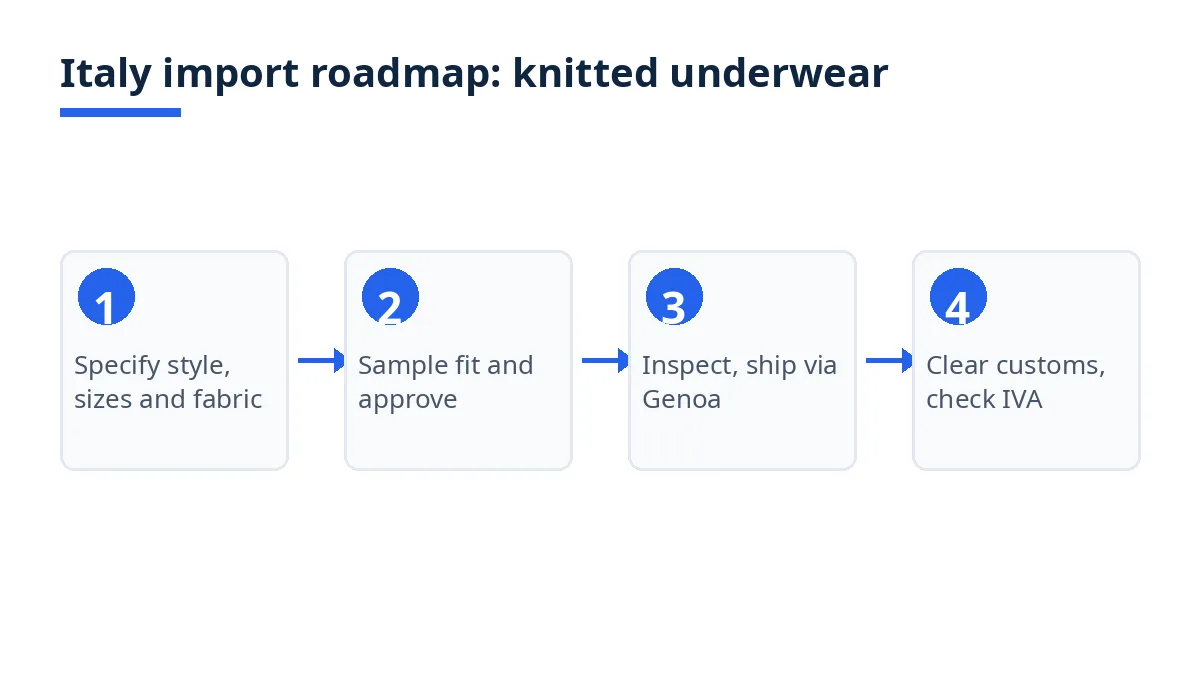
Ship through the confirmed Italian port, clear customs with the confirmed code for each style and the EORI number, and reconcile the actual landed cost and IVA treatment.
How Exportain helps
Browse suppliers for Bangladeshi knitwear exporters and compare their ranges against your style list. Then post your specification and target quantity as an RFQ and compare replies on the same terms before you choose a factory for sampling. Exportain is a B2B marketplace where buyers post RFQs, receive quotations and message suppliers. It does not inspect goods, book freight or clear customs. Use the marketplace to find and compare suppliers, and use your own specification, sample approval and inspection plan to decide whether to order.
FAQs
What is the typical MOQ for knitted underwear from Bangladesh?
There is no single typical minimum. It is set per style and usually per color, because yarn is dyed in batches, fabric is knitted and dyed in lots, and a cutting plan is set up per size range. Ask each supplier how its minimum splits by style, color, size range and pack composition, and keep the style count small on a first order.
How long does shipping take?
Production time and transit time are separate, and neither has a single typical figure. Sea transit takes weeks rather than days and varies by port, routing, transshipment and season. Plan from your forwarder's current sailing schedule for the Genoa route, add clearance and onward delivery, and fix the shipment date in the order before production starts.
What import duty applies?
Duty follows the confirmed classification of each style, the origin and the preference in force on the entry date. Knitted underwear sits in headings 6107 and 6108, split by garment type and fiber.12 Under Everything But Arms, Bangladesh goods that meet the origin rules enter the EU duty-free and quota-free.1 No duty rate from an opened tariff-schedule line is stated in this guide. Confirm with broker the current 10-digit TARIC line, preference code and rate in force on the entry date for every style, before the goods ship.
How do I verify a supplier?
Check company documents first, so that name, address and bank account agree across the trade licence, export registration and invoices. Then check capability: underwear capacity, knitting and dyeing route, waistband and elastic sources and recent underwear production. Keep payments to the company account named in the documents, and approve a fit sample of each style in production fabric, waistband and elastic before bulk production.
Next steps on Exportain
Read how to import from Bangladesh for the full process, then work through the landed cost method with your broker's confirmed codes. When ready, post an RFQ on Exportain with your style list, size curve and delivery term, and compare quotes on the same terms.
Sources
- EU trade relations with Bangladesh. European Commission, (accessed )
- New Generalised Scheme of Preferences approved for application in 2027. European Commission, (accessed )
- Generalised Scheme of Preferences. European Commission (accessed )
- RMG exports to major markets grow in July-September. New Age, (accessed )
- Comune di Carpi - ACTE. European Textile Collectivities Association (accessed )
- Azo dyes in consumer products. SATRA (accessed )
- ISO 2859-1:2026 - Sampling procedures for inspection by attributes — Part 1: Sampling schemes indexed by acceptance quality limit (AQL) for lot-by-lot inspection. International Organization for Standardization (accessed )
- Regulation (EU) No 1007/2011 on textile fibre names and related labelling and marking of the fibre composition of textile products, Article 9: Multi-fibre textile products. legislation.gov.uk (accessed )
- Insider thoughts: Bob Ronai on Incoterms 2020 Rules; What are they about?. International Chamber of Commerce (accessed )
- Container and bulk traffic boost overall port volumes in 1st quarter 2025. Autorità di Sistema Portuale del Mar Ligure Occidentale (accessed )
- Harmonised System. European Commission (accessed )
- Chapter 61: Articles of apparel and clothing accessories, knitted or crocheted. World Customs Organization (accessed )
- VAT in Italy. Agenzia delle Entrate (accessed )
- European Commission FAQ. Agenzia delle Dogane e dei Monopoli (accessed )
About the author
Sourcing from Bangladesh?
Post a request for quotation and suppliers on Exportain can send you their quotes directly.
Post an RFQ


