Australia Buyers: How to Import Knitted Underwear From Bangladesh
Import knitted underwear from Bangladesh to Australia: ABF entry, HS 6107 and 6108 classification, duty-free origin, GST, care and origin labeling, MOQ, samples, shipping and landed cost for Australian buyers.
Short answer
To import knitted underwear from Bangladesh to Australia, confirm the Australian tariff line for each style under headings 6107 and 6108, confirm the duty-free origin position with your broker, and settle care, fiber, and origin labeling before bulk production. Approve a pre-production sample, agree the delivery term and inspection plan in writing, lodge a full Import Declaration for consignments over AUD 1,000, and build the landed cost style by style before you commit to a selling price.
On this page
Key takeaways
Men's and boys' knitted underwear sits in heading 6107 and women's and girls' knitted underwear in heading 6108. Confirm the full Australian tariff line for each style with your broker.
The Australian Department of Foreign Affairs and Trade states that products from Bangladesh enter Australia duty-free and quota-free, and will continue to do so when Bangladesh graduates from Least Developed Country status. Confirm the origin rule with your broker before you price at zero duty.
GST on a taxable importation is 10 percent of the value of the taxable importation: customs value plus any duty, transport, and insurance to Australia.
Consignments valued over AUD 1,000 need a full Import Declaration (N10) and payment of all duties, taxes, and charges, including an import processing charge, before release.
There is no single typical MOQ, price, or transit time. Confirm each in writing for your fabric, size curve, colors, route, and shipment date.
To import knitted underwear from Bangladesh to Australia, start with the Australian entry requirements, not with a supplier list. Confirm the tariff classification for each style, the origin position for duty, the GST calculation, and the labeling that must be on the garment before you agree a price or a delivery date. This guide is for Australian buyers, retailers, brands, and wholesalers buying men's, women's, and children's knitted underwear from Bangladesh for resale in Australia. Knitted underwear is a fit order before it is a price order, so treat the first order as a controlled test with one supplier, one or two fabrics, and a narrow size and color range.
Australia import at a glance
Men's and boys' knitted underwear sits in heading 6107 and women's and girls' knitted underwear in heading 6108. Confirm the full Australian tariff line for each style with your broker.
The Australian Department of Foreign Affairs and Trade states that products from Bangladesh enter Australia duty-free and quota-free, and will continue to do so when Bangladesh graduates from Least Developed Country status. Confirm the origin rule with your broker before you price at zero duty.
GST on a taxable importation is 10 percent of the value of the taxable importation: customs value plus any duty, transport, and insurance to Australia.
Consignments valued over AUD 1,000 need a full Import Declaration (N10) and payment of all duties, taxes, and charges, including an import processing charge, before release.
There is no single typical MOQ, price, or transit time. Confirm each in writing for your fabric, size curve, colors, route, and shipment date.
Why source knitted underwear from Bangladesh
Bangladesh has a knitwear sector organized around its own trade body. The Bangladesh Knitwear Manufacturers and Exporters Association describes itself as an apex trade body representing the knitwear sector of Bangladesh, established in 1996, and states that it represents approximately 2,540 knitwear member factories.1 A supplier that already makes knitted underwear will already hold the machines, elastic application methods, and size curves the order needs. A factory that makes heavy knitwear or T-shirts is not automatically a good underwear factory, because underwear work turns on small-piece cutting, elastic application, narrow seams, and consistent sizing across a wide size curve.
The range in one program is wide: men's briefs, trunks, and boxer briefs, women's briefs and hipsters, and boys' briefs, in cotton, cotton blends, and man-made fibers. Keep the first order narrow: one fabric in three colors, in a single waistband style. Chattogram is the port your order will almost certainly leave from: it handled more than 92 percent of Bangladesh's export and import cargo and 98 percent of its containers in 2025, according to Chittagong Port Authority figures reported in the press.2
Find and verify suppliers
Where do you start the search?
Start with a written specification for every style: fiber blend, fabric weight, waistband type and width, rise, leg opening, size curve and ratio, colors, labeling, and packing. Then shortlist factories whose current range already includes knitted underwear in the same fibers and constructions. Send every candidate the identical specification and ask for the same reply format: fabric and waistband assumed, price inclusions and validity, minimum per style and per color, and sample and production lead times. Browse suppliers on Exportain and read how to import from Bangladesh before you send the specification out.
How do you verify a supplier before you pay?
Verification has three layers. First, company documents: trade license, export registration, and association membership where applicable, checked so name, address, and bank account agree across every document. Check BKMEA membership where claimed, and treat it as a starting point, not proof of capability. Second, capability: monthly underwear capacity, whether knitting and dyeing are in-house or bought in, fabric and elastic sources, and recent underwear styles from current production.
Third, payment discipline. Keep payments to the company account named in the documents, never to a personal account, and verify any change of bank details separately through a known contact. On Exportain, supplier profiles carry document and photo review badges: a review of documents and photos, not a factory inspection or a guarantee, and Exportain is not a party to the goods contract.
MOQ, pricing and samples
What is the typical MOQ for knitted underwear from Bangladesh?
There is no single typical MOQ. The minimum is set per style and usually per color, because knit fabric is dyed in batches, elastic is bought by color and width, and a cutting plan is set up per size curve. Ask each supplier how its minimum splits by style, color, fabric, and size curve, and whether a smaller first order is possible at a higher unit price.
How is the price built, and how should you compare quotes?
Fabric is usually the main cost element, followed by cutting and sewing, elastic and waistband, dyeing, labeling, testing, and packing. Two quotes can differ because one assumes a lighter fabric, a simpler waistband, fewer sizes, or a different pack composition. Compare quotes on the same basis: same style, fiber blend, and fabric weight, same size curve and ratio, same waistband and trim, same pack composition, same delivery term, and same packing. Ask what is excluded, and re-confirm the price if the fabric, waistband, or size curve changes.
Which samples do you need, and how do you approve them?
Work in stages: a development sample, a fit sample in production fabric and middle sizes, and a pre-production sample in the actual fabric, color, elastic, and trim, which is the sample you approve for bulk. Fit, shade, and elastic recovery cannot be approved from substitute fabric. Measure the samples against your size chart after washing, check waistband recovery and shade consistency, approve in writing by style and color, and keep one sealed counter-sample. No bulk cutting should start before the pre-production sample is approved in writing.
Quality control and certifications needed
Which quality checks are specific to knitted underwear?
Check fabric composition and weight, measurements for every size, and consistency across colors and packs, then waistband attachment and logo alignment, elastic tension and recovery, seam strength, and stitch density. Agree the inspection method and defect limits before production: sampling or 100 percent checks, what counts as a critical, major, or minor defect, and what happens when a lot fails. Inspect in stages, with an inline check during sewing and a final random inspection on packed goods.
Which label rules apply in Australia?
Settle three label questions at sampling stage: care labeling, fiber content, and country of origin. The mandatory standard for care labeling for clothing and textiles applies to clothing, household textiles, and apparel, among other products, and allows care instructions written in English or the use of the five internationally recognized care symbols, or both.3 Suppliers must meet the standard, but may add extra information such as care instructions in other languages.3 Settle the care wording before bulk label sewing begins, and test the label after washing.
For fiber content, agree the wording at sampling stage and check that the percentages match the fabric bought, including any different-fiber waistband or gusset. A stated fiber percentage must be accurate: goods bearing a false trade description can be forfeited under the Commerce (Trade Descriptions) Act 1905, subject to correction where the contravention was not intentional or reckless.4 Trade description markings must be in English, in prominent and legible characters, on a principal label in a prominent position in as permanent a manner as practicable, and must include the country where the goods are made or produced.5 Put "Made in Bangladesh" on the principal label, confirm the wording with your broker, and check the finished label before bulk sewing begins.
Which certifications do you actually need?
No single certificate covers every order. Name any retailer requirement in the specification, ask for the matching report or certificate, and check its scope, products, issuing body, and date. A report for a different fabric or waistband does not cover your finished garment. For OEKO-TEX Standard 100, Product Class II covers textiles in direct contact with the skin, including underwear, and the certificate is only awarded if all components meet the criteria, including threads, dyes, finishes, prints, and accessories.6 Name Product Class II where you require it, and check that the certificate is current and covers your exact styles.
Incoterms, shipping and transit time
Which delivery term should a first order use?
Under the Incoterms 2020 rules, risk passes from seller to buyer at the same point and time as delivery.7 Under FOB, CFR, and CIF the seller must place the goods on board the vessel; in all rules but EXW the seller carries out export formalities, and in all rules but DDP the buyer carries out import formalities.7 The four sea rules (FAS, FOB, CFR, CIF) are only intended for port-to-port bulk or break-bulk shipments and are not suitable for container shipments, because a container is handed to the carrier before it is on board.7
For a first order shipped in containers, weigh FOB at Chattogram against FCA at the named terminal. Under FOB, the factory delivers the goods on board and your forwarder handles the sea leg. Under FCA, delivery happens when the goods are handed to your carrier, which matches how containerized cargo moves. The ICC Academy notes that FCA is the appropriate rule when goods are transported in containers or pallets and multiple modes of transport are used, while FOB is the appropriate rule when goods are transported in bulk between ports.8 Read how to buy on Exportain and write the rule, the named place or port, and "Incoterms 2020" into the contract in full. Under CFR and CIF, the seller pays freight to the destination port, but risk still passes when the goods are on board at origin, so arrange insurance from that point; under CIF the seller must also arrange insurance at minimum cover. Under DDP, the seller carries out import formalities and pays duty and GST, so use it only where the seller shows, in writing, how Australian clearance will be handled.
How long does shipping take?
There is no single typical transit time for knitted underwear from Bangladesh to Australia. Sea freight is the standard route for bulk orders and takes weeks rather than days, varying by discharge port, routing, transshipment, and season. Plan from your forwarder's current sailing schedule and keep production time separate from transit time.
Import duty, taxes and documents
How are knitted underwear styles classified for duty?
Duty follows the classification of each style in the Australian tariff, not the supplier's product name. Heading 6107 covers men's or boys' knitted or crocheted underpants, briefs, and similar articles, and heading 6108 covers women's or girls' knitted or crocheted slips, petticoats, briefs, panties, and similar articles. Underpants and briefs split by fiber into 6107.11 (cotton), 6107.12 (man-made fibers), and 6107.19 (other textile materials), and briefs and panties into 6108.21, 6108.22, and 6108.29 on the same fiber split.9 Treat those subheadings as indicative and verify the full Australian tariff line for each style, since the Australian schedule adds its own digits.
What import duty applies?
Your duty position depends on the confirmed classification, the origin of the goods, and the preference in force on the entry date. The Australian Department of Foreign Affairs and Trade states that, as a Least Developed Country, products from Bangladesh enter Australia duty-free and quota-free, and will continue to do so when Bangladesh graduates from Least Developed Country status.10 A duty-free entry still depends on the goods meeting the origin rule and on the origin documentation your broker specifies, so ask your broker to confirm the origin rule, the documentation, and the duty line for each style before you commit to a selling price. If the origin position is not confirmed, price with a duty figure your broker supplies rather than assuming zero duty.
What taxes and charges apply at the border?
GST is payable on most goods imported into Australia, whether or not the importer is registered for GST, although a GST-registered business importing goods as part of its activities may be able to claim a GST credit.11 GST is 10 percent of the value of the taxable importation: customs value, any duty payable, transport to the place of consignment in Australia, insurance, and any wine tax payable.11 The Australian Border Force states the same formula and rate.12 GST is generally payable before release, unless the importer is registered under the deferred GST scheme.11 To claim a GST credit, hold documentation showing the goods were imported and GST was paid or deferred, including a finalised import declaration and the matching receipt.11 Budget also for the import processing charge (AUD 50 electronically for consignments over AUD 1,000 and under AUD 10,000; AUD 152 at AUD 10,000 or more) and the biosecurity charge (AUD 48 air, AUD 71 sea, on full import declarations over AUD 1,000).13
Which documents do you need for clearance?
A commercial order over AUD 1,000 needs a full Import Declaration. The Australian Border Force states that you must complete an Import Declaration when goods have a combined value over AUD 1,000 and are being cleared into home consumption, and must pay all applicable duties, taxes, and charges before release.14 The declaration, made by the importer or a licensed customs broker in the Integrated Cargo System, states the goods, the importer, the transport, and the tariff classification and customs value.14 For goods at AUD 1,000 or less arriving by air or sea cargo, a Self-Assessed Clearance Declaration is used instead, and first-time importers are encouraged to use a licensed customs broker.14 Keep all relevant documents for five years after the declaration.14 The standard import set is the commercial invoice, packing list, bill of lading or air waybill, and origin documentation where a preference is claimed. Name each style plainly on its own invoice line and confirm with your broker whether any further permit applies.
Landed cost example (table)
A landed cost is the full cost of one piece, ready to sell in Australia. Every number below is an example figure only, not a quote. Example figures: 5,000 pieces, FOB Chattogram, sea freight to Sydney, duty at zero if the broker confirms the origin position.
Cost element | Example figures (total) | Example figures (per piece) | How to obtain your figure |
|---|---|---|---|
Product price, FOB | AUD 7,000 | AUD 1.40 | Confirmed pro forma invoice |
International freight and insurance | AUD 900 | AUD 0.18 | Forwarder quote |
Duty | AUD 0 | AUD 0.00 | Broker calculation from confirmed codes and origin position; confirm with broker |
Import processing charge and biosecurity charge | AUD 121 | AUD 0.02 | ABF charges for the consignment value and cargo channel |
Broker, port, and clearance fees | AUD 329 | AUD 0.07 | Broker and port invoices |
Local delivery to warehouse | AUD 250 | AUD 0.05 | Local carrier quote |
Total landed cost, excluding GST | AUD 8,600 | AUD 1.72 | Sum of all lines above |
GST at 10 percent of the value of the taxable importation | AUD 790 | AUD 0.16 | Broker calculation; creditable for a GST-registered buyer with the right documentation |
GST is shown separately because a GST-registered buyer may claim it as a credit, while a buyer who is not GST-registered carries it as a cost. Work the calculation twice: at quote stage and again after shipment with the actual invoices. See landed cost for imports from Bangladesh for the full method.
Step-by-step import checklist
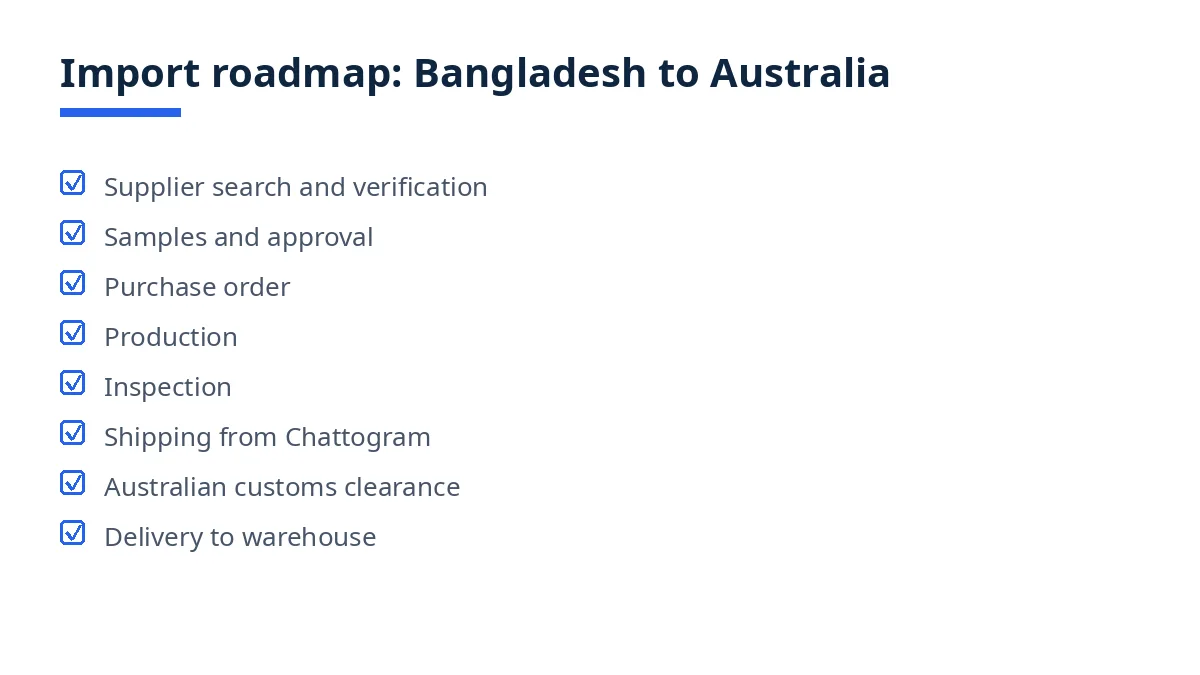
How to import knitted underwear from Bangladesh to Australia in eight steps
Write the specification style by style: fiber blend, fabric weight, waistband, rise, leg opening, size curve and ratio, colors, labeling, and packing.
Classify every style from headings 6107 and 6108, and confirm each tariff line, duty position, and origin documentation with your broker.
Shortlist factories whose current range already includes knitted underwear, and request comparable quotes on the identical specification and delivery term.
Verify the chosen supplier: company documents, underwear capacity, fabric and elastic sources, and a video walkthrough or third-party visit for a first order.
Order samples in stages, measure and wash-test them, then approve a pre-production sample of each style in production fabric, color, elastic, and trim.
Confirm the order in writing: purchase order, pro forma invoice, delivery and payment terms, inspection plan, labeling, packing, and shipment date.
Inspect during production and again on packed goods against the approved samples.
Ship, lodge the Import Declaration with the confirmed code for each style, pay duty, GST, and charges or defer GST if eligible, and reconcile the actual landed cost.
How Exportain helps
Browse suppliers on Exportain and compare their current ranges against your style list before you send a specification. Then post your specification and target quantity as an RFQ and compare replies on the same terms before you choose a factory for sampling. Exportain is a B2B marketplace where buyers post RFQs, receive quotations, and message suppliers. It does not inspect goods, book freight, or clear customs, and a document and photo review badge is not a factory inspection or a guarantee.
FAQs
What is the typical MOQ for knitted underwear from Bangladesh?
There is no single typical MOQ. It is set per style and usually per color, because knit fabric is dyed in batches and a cutting plan is set up per size curve. Ask how the minimum splits by style, color, fabric, and size curve.
How long does shipping take?
Production time and transit time are separate, and neither has a single typical figure. Sea transit takes weeks rather than days and varies by discharge port, routing, transshipment, and season. Plan from your forwarder's current sailing schedule.
What import duty applies?
Duty follows the confirmed classification, origin, and preference in force on the entry date. Knitted underwear sits in headings 6107 and 6108, split by fiber into cotton, man-made fibers, and other textile materials.9 The Department of Foreign Affairs and Trade states that products from Bangladesh enter Australia duty-free and quota-free, and will continue to do so after graduation from Least Developed Country status.10 Confirm the origin rule with your broker before you price at zero duty. GST is separate: 10 percent of the value of the taxable importation.11
How do I verify a supplier?
Check company documents first, so name, address, and bank account agree across the trade license, export registration, and invoices. Then check capability: underwear capacity, fabric and elastic sources, and recent production. Keep payments to the company account named in the documents, verify any change of bank details separately, and approve a pre-production sample of each style before bulk production.
Next steps on Exportain
Read how to write an RFQ to set out your style list and size curve, then check the landed cost guide. When ready, post an RFQ and compare quotes on the same specification, delivery term, and packing.
Sources
- BKMEA at a Glance. BKMEA (accessed )
- Ctg Port breaks all previous records in 2025. The Financial Express (accessed )
- Care labelling for clothing and textiles mandatory standard. Australian Competition and Consumer Commission (accessed )
- Commerce (Trade Descriptions) Act 1905. Federal Register of Legislation (accessed )
- Import Product Labelling Australia. WWCF (accessed )
- OEKO-TEX STANDARD 100 for textiles tested for harmful substances. Hohenstein (accessed )
- Insider thoughts: Bob Ronai on Incoterms 2020 Rules; What are they about?. International Chamber of Commerce (accessed )
- FCA & FOB Incoterms 2020 explained: Key differences. ICC Academy (accessed )
- Chapter 61 - National Imports Tariff Guide (2022): headings 6107 and 6108. Sri Lanka Customs (accessed )
- Bangladesh country brief. DFAT (accessed )
- GST and imported goods. Australian Taxation Office (accessed )
- GST and other taxes when importing. Australian Border Force (accessed )
- Import Processing Charges. Australian Border Force (accessed )
- Import declarations. Australian Border Force (accessed )
About the author
Sourcing from Bangladesh?
Post a request for quotation and suppliers on Exportain can send you their quotes directly.
Post an RFQ