

Importing Hotel Linen From Bangladesh to Australia: Step-by-Step Guide
Import hotel linen from Bangladesh to Australia: Australian duty under heading 6302, 10 percent GST, biosecurity, samples, laundry trials and landed cost for one room set.
Short answer
To import hotel linen from Bangladesh to Australia, confirm the tariff line for each piece under heading 6302 and the 10 percent GST on the value of the taxable importation with a licensed customs broker, then specify the linen by room, size and laundry route, approve pre-production samples through a laundry trial, and clear the goods on an import declaration. Every duty rate in this guide is indicative and must be confirmed with the broker before pricing or shipping.
On this page
Key takeaways
Hotel linen falls in heading 6302: bed, table, toilet and kitchen linen, split by construction, fibre and item type; every rate in this guide is indicative and must be confirmed with a broker.
GST is 10 percent of the value of the taxable importation: customs value plus duty, transport and insurance to the place of consignment in Australia.
Biosecurity concerns the packing: declare timber and bamboo packaging, use ISPM 15 treated and marked timber, and keep containers clean and free from contamination.
Approve pre-production samples through the actual laundry route, keep a sealed counter-sample of each item, and inspect bulk production against it.
To import hotel linen from Bangladesh to Australia, start at the Australian border, not at the catalogue. Confirm the tariff line for each piece under heading 6302, the 10 percent GST on the value of the taxable importation, and the biosecurity conditions for the packing, then build the specification around the rooms the linen will serve. The specification, the samples and the laundry trial decide whether it survives first service.
Start at the Australian border: duty, GST and biosecurity before you order
Three border matters shape the price before any supplier is contacted: customs duty by tariff line, GST on the value of the taxable importation, and biosecurity, which concerns the packing and the container rather than the linen itself. Settle all three with a broker while the specification is still open.
GST on a taxable importation is payable at 10 percent of the value of the taxable importation, and the Department of Home Affairs collects it.1 The value of the taxable importation is the sum of the customs value of the goods, any customs duty payable, the amount paid or payable to transport the goods to their place of consignment in Australia, the insurance cost for that transport, and any wine tax payable.1 GST is generally payable before the goods are released. A GST-registered business that imports goods as part of its activities may be able to claim a GST credit for GST paid, and may be able to defer GST under the deferred GST scheme, subject to eligibility criteria.1 The Australian Border Force states the same position: GST must be paid to it at the time of clearance unless the importer is approved for GST deferral.2
Biosecurity is the check most first-time linen importers overlook, because clean folded linen looks low risk. The risk sits in the packing. Import conditions published through the Department of Agriculture, Fisheries and Forestry biosecurity import conditions system require the consignment to be free from unacceptable packing materials, require bamboo packaging to be declared, require timber and bamboo packaging and dunnage to be declared, and require solid wood components of timber packaging and dunnage to be treated offshore in compliance with ISPM 15, with treatment and marking evidenced on the packing declaration.3 Containers must also be clean before loading and free from animal and plant contamination.3 Specify cartons only, or ISPM 15 treated and marked timber where timber is used.
Build the hotel specification around Australian rooms and laundry
A hotel specification starts with the rooms, not with a supplier catalogue. Write down the property type, the room count, the bed mix in Australian sizes, the laundry route and the standard the brand or owner will accept. Name the approver for the specification and the date the linen must be in service, then work backward through sampling, production, shipping and clearance.
Write one specification document with one row per item, and send the identical document to every supplier. The item groups are bed linen, bath linen and table linen: flat sheets, fitted sheets, pillowcases, quilt covers, bath towels, hand towels, washcloths or face washers, bath mats, tablecloths and napkins. For each item state the finished size in centimetres with the tolerance accepted after washing, the fibre composition in the words to appear on the label, the weave or construction, the finished weight where it applies, the colour or white shade, and the construction details: hem width and stitching, fitted-sheet pocket depth including any mattress topper, elastic coverage, closures, and towel and table linen hems. Add logo treatment and packing by item.
The reason to source hotel linen from Bangladesh is capability rather than any single figure. Bangladesh has an established home textile chain in which sheeting fabric, terry towelling, dyeing, bleaching and finishing sit close together, so a mill can hold shade and construction across bed, bath and table groups in one programme. Ask whether weaving is in house, what widths are covered, and which hotel programmes the factory can show. A supplier whose current range is retail sheet sets only, or apparel only, is not a close substitute for a hotel programme.
Find suppliers who already make hotel linen for export
Shortlist mills and exporters whose current range already includes hotel or institutional linen in bed, bath and table groups. Browse suppliers on Exportain and read each profile against the room specification, then shortlist three or four suppliers and send each one the identical specification document. Ask every candidate for the same reply format: fabric assumed for each item, items per pack, price inclusions, validity, and the minimum per item and per colour. See the guide to importing from Bangladesh and the HS code guide for hotel linen.
Verification has three layers, each checked before payment. The first is company documents: trade licence, export registration and association membership where applicable, checked so that name, address and bank account name agree across every document, including the pro forma invoice. The second is capability: monthly capacity by item group, weaving route, fabric width, terry loom capacity, dyeing and bleaching route, and recent bed, bath and table linen from current production. The third is payment discipline: keep payments to the company account named in the documents, never to a personal account, and verify any change of bank details through a separate channel before paying. On Exportain, supplier profiles carry document and photo review badges, and the Trust and Safety Center explains what each badge covers.4 A badge is a review of documents and photos, not a factory inspection or a guarantee, and Exportain is not a party to the goods contract.4
Samples, par stock and the laundry trial
Work in stages, and approve each stage in writing. A development sample shows whether the factory can construct the item to the size chart. A pre-production sample, made in the actual production fabric, colour, finish and construction, is the sample approved for bulk. Size, colour and hand feel cannot be approved from a sample in substitute fabric, because washing, finishing and construction change dimensions, shade and feel.
There is no single typical minimum order quantity for hotel linen from Bangladesh. The minimum is set per item and usually per colour, because fabric is woven, dyed or finished in batches and a cutting plan is set up per size range. Ask each supplier how its minimum splits by item, colour, size and pack, and whether the minimum applies to the order total or to each item. Fabric often accounts for a large share of the cost. Compare quotes only on the same specification, pack composition and delivery term, and ask what is excluded, for example logo work or testing.
Par stock is a buyer decision, not a supplier figure: set it from the room count, the laundry turnaround and the time linen spends out of service. The laundry trial is the gate that decides bulk approval. Wash the pre-production samples through the actual laundry route for the number of cycles agreed in writing, then measure finished size, check shade, absorbency and pile, and check hems and seams. Keep one sealed counter-sample of each item, approved and signed, and inspect bulk production against it.
Quality checks and certificates that survive commercial laundry
Agree the inspection method and defect limits before production. ISO 2859-1 defines a system of acceptance sampling plans for inspection by attributes, indexed by acceptance quality limit (AQL), and AQL is the maximum average percentage of defective items considered acceptable during random sampling.5 Inspect inline during production and again on packed goods, checking quantity, workmanship, measurements, labels and packing. See the hotel linen quality control checklist for the item-level checks.
Check each item against the approved sample and chart: fibre composition and finished weight, finished size within the agreed tolerances after washing, and consistency across the size matrix. Then check construction item by item: sheet hems and seams, fitted-sheet pocket depth and elastic, quilt cover closures, towel hems and pile, bath mat backing where specified, table linen hems and corners, logo placement and stitch quality, and shade matching across the set and across repeat lots.
Certificates are checked, not collected. OEKO-TEX STANDARD 100 testing covers substances prohibited or restricted by law, known chemicals of health concern and other substances that pose a potential health risk, and the criteria and limit values depend on the product and above all on its intended use, with stricter requirements where skin contact is more direct.6 The standard distinguishes four product classes: Class I for babies and young children, Class II for textiles whose surface comes into direct contact with the skin, including bed linen and towels, Class III for textiles with only limited direct skin contact, and Class IV for furnishing materials for decorative purposes, including table linen.6 A certificate is awarded only if all components of an item meet the criteria without exception.6 Ask for the certificate itself, and check that the product class and scope match the item and that it is current.
Classify each hotel piece under heading 6302 and confirm the Australian duty line
Hotel linen is classified in heading 6302, which covers bed linen, table linen, toilet linen and kitchen linen.7 The Australian schedule splits the heading by construction, fibre and item type, so classify each piece separately. Every rate below is indicative only, and must be confirmed with the broker for the exact line, the entry date and any preferential treatment.7
Australian tariff line | Goods | Indicative general rate |
|---|---|---|
6302.10.00 | Bed linen, knitted or crocheted | Free |
6302.21.00 | Other bed linen, printed, of cotton | 5 percent |
6302.22.00 | Other bed linen, printed, of man-made fibres | 5 percent |
6302.29.00 | Other bed linen, printed, of other textile materials | 5 percent |
6302.31.00 | Other bed linen, of cotton | 5 percent |
6302.32.00 | Other bed linen, of man-made fibres | 5 percent |
6302.39.00 | Other bed linen, of other textile materials | 5 percent |
6302.40.00 | Table linen, knitted or crocheted | Free |
6302.51.10 | Other table linen, of cotton, hand-embroidered or hand-appliqued | Free |
6302.60.00 | Toilet linen and kitchen linen, of terry towelling or similar terry fabrics, of cotton | 5 percent |
6302.91.10 | Other toilet linen and kitchen linen, of cotton, tea towels | Free |
6302.91.20 | Other toilet linen and kitchen linen, of cotton, facewashers and towels | 5 percent |
6302.93.00 | Other toilet linen and kitchen linen, of man-made fibres | Free |
Ask the broker to confirm each line, check tariff concession orders, and check any preferential rate and origin evidence.
Incoterms, shipping and the Australian port of entry
Incoterms 2020 has 11 rules that allocate cost, risk and obligations between seller and buyer, and the rule, the named place or port and the version must all be written into the contract.8 For containerised hotel linen, the rules for any mode of transport are usually the practical choice: FCA (Free Carrier), CPT (Carriage Paid To), CIP (Carriage and Insurance Paid To), DAP (Delivered at Place), DPU (Delivered at Place Unloaded) and DDP (Delivered Duty Paid), with EXW (Ex Works) placing the most on the buyer.8 The sea and inland waterway rules, FAS, FOB, CFR and CIF, are written for goods delivered alongside or on board a vessel, and they fit container shipments less neatly where the container is handed to the carrier at a terminal before loading.8 Under the C rules, the seller pays freight to the destination but risk passes at origin, and under CIF the seller must arrange minimum insurance cover while under CIP the cover is higher.8
Choose the Australian entry point before fixing the delivery term. Sydney buyers clear at Port Botany, Melbourne buyers at the Port of Melbourne, Brisbane buyers at the Port of Brisbane, and Perth buyers at Fremantle. Ask the forwarder for transit time, cut-off, terminal free time and demurrage in writing, and build the in-service date backward from delivery. Treat DDP with care: under DDP the seller clears the goods and pays duty and taxes, which changes who the importer is. Ask for the DDP price broken down into goods, freight, insurance, duty, GST and delivery, and ask the broker to check it.
Documents, labelling and the import declaration
An import declaration is required when imported goods have a combined value of over AUD 1,000 and are being cleared into home consumption, and all applicable duties, taxes and charges must be paid before the goods can be released.9 The import declaration is a statement by the importer, as owner of the goods, or by their agent, a licensed customs broker, covering the goods, the importer details, the transport and the tariff classification and customs value, and it may be submitted in the Integrated Cargo System or lodged as a completed document at an Australian Border Force counter.9 A hotel linen order will normally exceed the AUD 1,000 threshold, so plan on an import declaration for every commercial shipment, and give the broker the document set in good time: commercial invoice, packing list, bill of lading or air waybill, origin evidence where a preference is claimed, and the packing declaration. Check that the invoice describes each item specifically, with fibre composition, size and quantity.
Labelling is agreed at sampling stage, not at the warehouse. Country of origin claims in Australia must be true, accurate and based on reasonable grounds, and the Australian Consumer Law concepts of grown in, produced in, made in and packed in provide safe harbour defences when used correctly.10 A made in claim should only be made where the goods were last substantially transformed in that country, and goods can be considered made in a country if they meet the grown in or produced in criteria or if, through one or more processes, they are fundamentally different in identity, nature or essential character from all of the ingredients or components imported to create them.10 Agree the origin wording, fibre composition, care instructions and any brand mark, checked against the actual fibre and place of manufacture. Where linen is for in-house use rather than retail sale, ask the broker or a legal adviser whether the same labelling position applies.
Landed cost for one Australian hotel room set
The landed cost is built piece by piece, not from a single rate. The example below uses example figures throughout for one hotel room set, made up of bed, bath and table items for one room. It is an illustration only: no figure in it is a market figure, and the duty line uses an example rate the broker must replace. GST is calculated on the value of the taxable importation, which is the customs value plus duty plus transport and insurance to the place of consignment in Australia.1
Cost element | Basis | Example figure, AUD |
|---|---|---|
Goods, FOB Chattogram | Room set, example figures | 120.00 |
International freight to Port Botany | Example figures | 18.00 |
Marine insurance | Example figures | 2.00 |
Customs duty | Example rate, 5 percent of customs value | 6.00 |
Value of taxable importation | Goods plus duty plus freight plus insurance | 146.00 |
GST at 10 percent | Example figures | 14.60 |
Broker, port and inland delivery | Example figures | 25.00 |
Landed cost per room set | Example figures | 185.60 |
The total is 120.00 plus 18.00 plus 2.00 plus 6.00 plus 14.60 plus 25.00, which is 185.60. Build the same table for the actual order, with broker figures in the duty and GST rows and forwarder figures in the freight and insurance rows, and compare it with the landed cost guide before ordering.
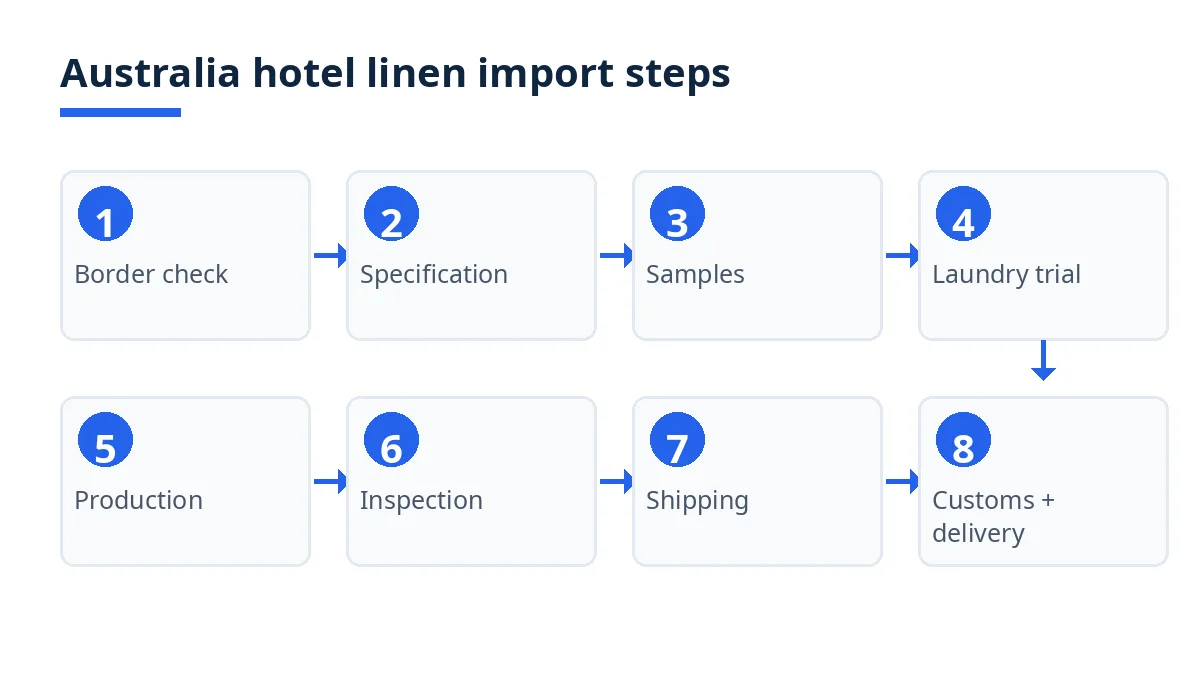
Ordering sequence: import hotel linen from Bangladesh to Australia
Do not start bulk production until the step before it is signed off.
Ask the broker for the classification, duty, GST and biosecurity position, and record the answers.
Write the room specification, name the approver, and set the in-service date.
Shortlist three or four suppliers with current hotel linen programmes, send each the identical specification, and compare replies on the same format.
Check company documents, capability evidence and payment details, and read the badge meanings on Exportain before relying on them.
Order development samples, then pre-production samples, and run the laundry trial.
Approve the samples in writing, keep a sealed counter-sample of each item, and agree inspection, defect limits and packing, including the biosecurity declaration.
Place the purchase order with the specification, delivery term, inspection plan, packing instruction and document set all written in.
Run inline inspection during production and a final random inspection on packed goods, against the counter-sample and the size chart.
Ship on the agreed sailing and send the document set to the broker before arrival.
Clear the goods, pay duty and GST or confirm deferral, and run the first housekeeping issue as a trial.
What is the typical MOQ for hotel linen from Bangladesh?
There is no single typical minimum order quantity for hotel linen from Bangladesh. The minimum is set per item and usually per colour, because fabric is woven, dyed or finished in batches and cutting plans are set up per size range. Get the figure for the exact specification in writing.
How long does shipping take?
Shipping time is confirmed in writing for the actual shipment, not taken from a general figure. Ask the forwarder for the sailing schedule, the transhipment point, the transit time to the named Australian port, the terminal free time and the clearance and delivery time, and build the in-service date backward from delivery to the property.
What import duty applies?
The duty that applies is the general rate for the exact Australian tariff line for each piece, unless a preferential rate is confirmed for the goods, and every rate in this guide is indicative and must be confirmed with a licensed customs broker.7 Hotel linen falls in heading 6302, and the schedule lines in the classification table carry indicative general rates of Free or 5 percent depending on construction, fibre and item type.7 Do not price on a preferential rate until the broker confirms it.
How do I verify a supplier?
Verify a supplier in three layers before payment: company documents, capability evidence and payment discipline. Check that name, address and bank account name agree across the trade licence, export registration, association membership and pro forma invoice, check current production evidence for hotel linen, and keep payments to the company account named in the documents. On Exportain, read the Trust and Safety Center for what document and photo review badges cover.4
Next steps on Exportain
Search suppliers against the room specification, read the guide to importing from Bangladesh and the landed cost guide, then post a request for quotation on RFQs that states the room set, the sizes, the fibre and construction, the delivery term and the in-service date. Read how to buy on Exportain for the steps from quotation to order.
Sources
- GST and imported goods. Australian Taxation Office (accessed )
- GST and other taxes when importing. Australian Border Force (accessed )
- BICON - Import Conditions. Department of Agriculture, Fisheries and Forestry (accessed )
- Trust & Safety Center. Exportain (accessed )
- ISO 2859-1:2026 - Sampling procedures for inspection by attributes — Part 1: Sampling schemes indexed by acceptance quality limit (AQL) for lot-by-lot inspection. International Organization for Standardization (accessed )
- OEKO-TEX STANDARD 100 for textiles tested for harmful substances. Hohenstein (accessed )
- Chapter 63 - Other made up textile articles; sets; worn clothing and worn textile articles; rags. Australian Border Force (accessed )
- Incoterms 2020: The 11 Rules Explained. GCE Logistics (accessed )
- Import declarations. Australian Border Force (accessed )
- Country of origin claims. ACCC (accessed )
About the author
Sourcing from Bangladesh?
Post a request for quotation and suppliers on Exportain can send you their quotes directly.
Post an RFQ


