Importing Frozen Shrimp From Bangladesh to Spain: Costs, Duties and Suppliers
Frozen shrimp from Bangladesh to Spain, planned gateway-first: Algeciras or Valencia entry, the TRACES file, indicative EBA duty, channel specification, supplier checks and a worked landed-cost example per kilogram.
Short answer
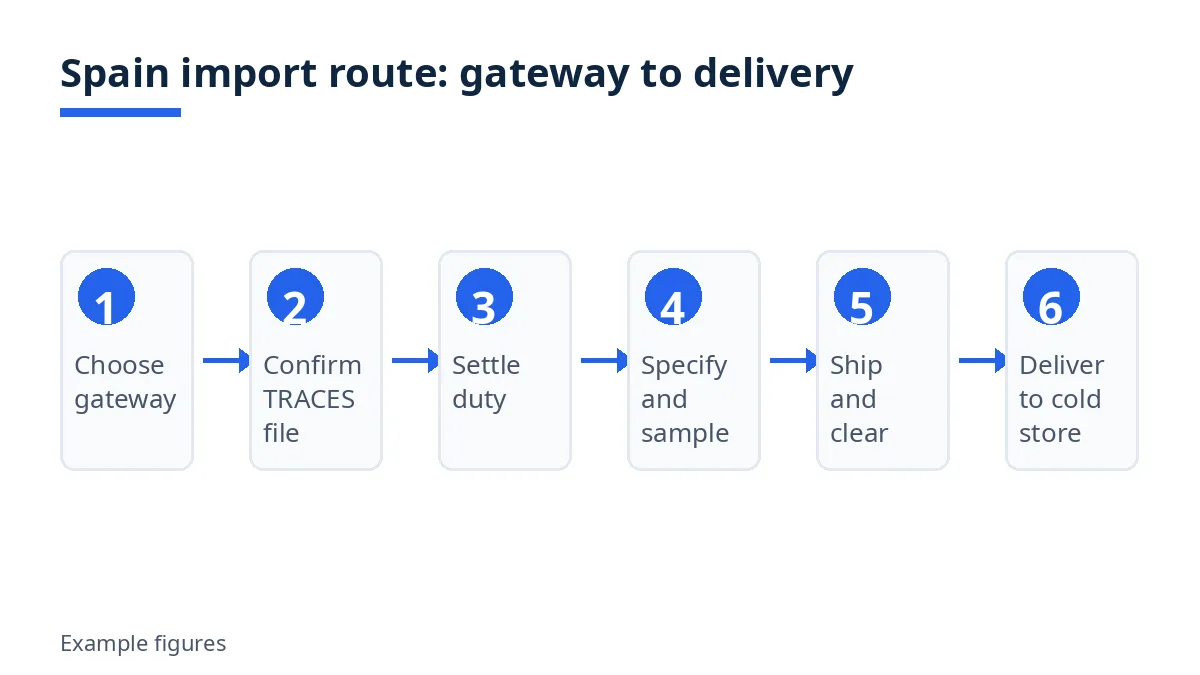
To import frozen shrimp from Bangladesh to Spain, fix the gateway and buyer channel first: Algeciras or Valencia, then processing, wholesale, retail or food service. Confirm the border control post and TRACES NT entry file, check the processing establishment listing, settle the EBA duty position and CN code with a broker, specify species, form, count and glaze, approve a pre-production sample, and work the landed cost per kilogram before bulk production.
On this page
Key takeaways
Fix the gateway and channel first: Algeciras, Valencia or Barcelona, and processing, wholesale, retail or food service. Each combination changes the specification, label and inland leg.
Frozen shrimp enters the EU through a designated border control post with documentary, identity and physical checks, and the Spanish entry file runs through TRACES NT.
Treat every duty line as indicative: confirm the CN code, the Everything But Arms preference position and the origin proof with a broker, and work the landed cost with and without the preference.
Specify species, form, count, glaze and net weight in one document sent unchanged to every supplier, and approve a pre-production sample before bulk production.
All prices and landed-cost figures in this guide are example figures; replace every line with a confirmed figure for the exact shipment, gateway and entry date.
A Spanish frozen shrimp order is shaped by two decisions made before any price is compared: which Spanish gateway the reefer container enters through, and which Spanish channel will take the shrimp after clearance. A container cleared at Algeciras for a processor faces a different inland leg and label set than the same shrimp cleared at Valencia for retail-ready packing. Fix the gateway and the channel first, and one specification, one entry file and one landed cost can match all three.
This guide is for Spanish buyers importing frozen shrimp from Bangladesh: processors, wholesalers, distributors, retailers and food service buyers, and the brokers filing their entries. It works in Spanish order: gateway and channel, entry file, duty position, specification, suppliers, samples, quality and cold chain, delivery terms, tax and documents, and a worked landed cost. Every cost figure is an example figure, and every duty line is indicative, to be confirmed with a broker for the exact code, origin position and entry date.
Choose the Spanish gateway and the buyer channel first
Spain offers more than one workable entry point for a reefer container from Bangladesh. Algeciras sits at the southern Strait gateway, close to the main east-west shipping lanes. Valencia sits on the east coast, with its own border control post and cold chain facilities serving the eastern and central markets. Barcelona is a further option on the north-east coast. Name the gateway in the order plan, confirm its border control post is authorized for frozen products of animal origin, and price the inland leg to the receiving cold store or plant.
The buyer channel decides the specification just as firmly. A processor who will peel, cook or repack needs bulk raw material, with count, glaze and net weight set for the processing line. A wholesaler needs case sizes and labels that move through cold storage without repacking. A retailer needs retail-ready packs, barcodes and consumer labeling agreed before production. A food service buyer needs portion control and consistent count. Write the channel into the first page of the specification, send the same document to every supplier, and fix the onward route at the same time: receiving address and hours, inland carrier, delivery window and temperature record handover.
Work the Spanish entry file backwards from the channel
Frozen shrimp is a product of animal origin, so entry into the European Union runs through designated border control posts (BCPs), where consignments face documentary, identity and physical checks.1 Only goods from authorized countries are admitted, accompanied by official certificates from the competent authority of the exporting country.1 The legal basis is Regulation (EU) 2017/625 on official controls, applied the same at all EU border control posts.1
The documentary check verifies the official certificates and other documentation.1 The identity check ensures that the nature and labeling of the goods, including seals and means of transport, correspond to the documents.1 The physical check involves direct examination, including sampling and laboratory testing if needed.1 Seafood is subject to systematic controls.1 Certificates, labels, seals and carton marks must agree word for word and number for number.
In Spain, the entry file runs through TRACES NT, the online tool that notifies, certifies and controls trade in animals and products of animal origin entering the national territory and the Union from third countries.2 Operators submit the required documentation electronically, and border authorities share data with customs authorities through the system.2 Ask your broker, before ordering, which TRACES NT steps apply at your gateway, who files each part, and what deadline applies before arrival.
Two file points need settling before production. First, the establishment that processed the shrimp must be on the list communicated to the European Commission and published in TRACES-NT.1 Check it before the purchase order, and do not accept a substitute plant without repeating the check. Second, traceability must run from origin to point of export under Regulation (EC) 178/2002.1 A non-compliant consignment may be refused entry, destroyed, re-dispatched, or given special treatment, with reinforced controls possible on future consignments from the same origin.1
Settle the duty position: EBA, the CN line and the broker check
Duty follows the classification, the origin position and the preference route claimed, not the word shrimp on the invoice. The European Union scheme of generalised tariff preferences (GSP) allows developing countries to pay lower tariffs, with three strands: standard GSP, GSP+ for countries that ratify and implement specified conventions, and Everything But Arms, giving full tariff and quota-free imports for all goods from United Nations-defined least developed countries, except for arms.3 Lower tariffs may be suspended for human and labour rights violations, unfair trading practices and customs control shortcomings, and preferences can be withdrawn from competitive sectors under graduation.3
For a Bangladesh origin shipment, ask the broker: does an Everything But Arms preference apply to your exact goods, have the origin rules and proof of origin been met, and is the preference still available on the entry date. Do not price duty at zero on a general statement. The GSP rules offer stability, with transition periods of at least one year where the beneficiary list changes.3 Check the position for each shipment, because suspension, graduation and origin failures operate at product and consignment level.
Classification is the second half of the duty position. The CN code must be confirmed line by line: species, in shell or not, cooked or raw, and presented for processing or direct sale can each move the code. Treat every code quoted before the broker check as indicative, to be verified against the tariff schedule for the entry date. Ask the broker to confirm the full CN code, the duty rate, the preference or quota route, and the value base. Work the landed cost with and without the preference, and record the confirmed code, preference claimed and origin proof with the specification.
Specify the shrimp so the file, the label and the price agree
A frozen shrimp specification is a contract document, not a catalogue description. Write one specification with one row per item, and send the identical document to every supplier. For each item, fix the species by scientific and commercial name, the form, the count, the glaze, the net weight, the treatment, the packaging and the label. The file, the certificate and the label must name the same species: a substitute species is a different product for control purposes.
State the form in the same words on the purchase order, the invoice, the packing list and the label: head-on shell-on, headless shell-on, peeled and deveined, peeled tail-on, or another form. State the count range, the tolerance, and how count is checked on arrival. State the glaze percentage, whether weights are net of glaze, and how net weight is verified, because the buyer pays for shrimp, not for ice. State in writing whether any treatment is used, and if so, name it and the limit agreed.
Packaging follows the channel fixed earlier. For each pack, fix the net weight, inner units, carton dimensions and maximum weight, and the carton marks: item, count, net weight, lot code, production date, establishment details and purchase order number. Keep counts, weights and quantities identical across the packing list, invoice and bill of lading, because the identity check compares the goods and their labeling against the documents.1 Agree labeling at the sampling stage, including whether the label must carry Spanish as well as English. No Spanish labeling mandate is stated here; the broker and buyer must confirm the applicable particulars before bulk packing.
Find and verify suppliers against the Spanish file
Shortlist processors and exporters whose current range already includes frozen shrimp for the European Union, in the form and channel you need. Browse suppliers on Exportain against your specification, not headline price. Shortlist three or four suppliers, send each one the identical specification, and ask for the same reply format: species and form, count and glaze, net weight basis, items per carton, price inclusions, validity, and the minimum per item and count. Ask about shipments to Spain or another European Union member state, and about the TRACES-NT listing.
Verification has three layers, all before any payment. First, company documents: trade licence, export registration and association membership, checked so name, address and bank account agree. Second, capability: freezing and cold storage capacity, processing capacity for your form and count, raw material source, and recent European Union programmes. Third, payment discipline: pay only the company account named in the documents, and verify any bank detail change separately.
On Exportain, supplier profiles carry document and photo review badges: a review of documents and photos, not a factory inspection or a guarantee. Exportain is not a party to the contract for the goods, does not inspect goods, book freight or clear customs. For a first order, add a video or in-person factory and cold store check, and confirm with the broker that the health certificate model and establishment details match the entry file before production.
MOQ, pricing and samples
There is no single typical minimum order quantity for frozen shrimp from Bangladesh. The minimum is set per item, and usually per species, form, count and treatment, because raw material is bought in lots and freezing and packing runs are set up per form and format. Ask how the minimum splits by item, count, form and pack format, and get the split in writing before comparing quotes.
Compare pricing on the same basis. State the delivery term, the named place and the version in every quotation request, and require each supplier to state what the price includes. Compare prices per kilogram net of glaze, not per carton, unless every carton carries the same net weight and glaze. Ask for price validity in writing, and for the conditions that would change the price before shipment.
Samples work in stages. A development sample shows whether the plant can produce the form and count to the specification. A pre-production sample, made in production conditions, is the sample you approve for bulk. Approve each sample in writing, keep one sealed counter-sample per item, and test count, glaze and net weight, thaw behavior, and label and carton agreement. Do not approve bulk until the sample record is signed. Agree payment terms in the same document, and never change payment details on the strength of a single message.
Quality control, cold chain and certifications needed
Settle quality control before production, in a written plan naming the checks, the sampling, the limits and the decision for each result. Agree the stages: during processing, on packed goods, and on arrival in Spain. Fix what is checked at each stage: species and form, count, glaze and net weight, temperature records, carton and label agreement, lot coding, and pack condition. Fix the defect classes, and name who inspects and who can stop a shipment. Require continuous temperature records from freezing through loading, and check the record against the agreed holding temperature before unloading.
Check certification evidence by scope, not by logo. If a scheme is named, check the certificate scope, product, establishment and validity, confirm it covers the processing plant, and agree any label claim wording before packing. Agree laboratory tests, laboratory, sampling, limits and payer before production.
Delivery terms, reefer shipping and the Chattogram to Spain leg
Sea freight in reefer containers is the standard route for bulk frozen shrimp, taking weeks rather than days, varying by service, routing, transshipment and season. Plan from the forwarder current sailing schedule, add border control, clearance and inland delivery, and keep production time separate from transit time.
Settle the delivery term, the named place and the version in every document, and confirm who books the reefer container, who sets the temperature, who loads and seals it, who insures the goods and to what value, and who clears the goods in Spain. State the reefer requirements in the shipping instructions: container type, temperature setting, pre-cooling, loading order by lot, seal numbers, and handover of temperature records. Check seal numbers on arrival, because the identity check compares seals and means of transport with the documents.1
Import VAT, the customs declaration and documents
Import VAT and customs duty are separate charges, settled on the customs value and the classification confirmed by the broker. VAT is charged on import; the rate and base must be confirmed with the broker and tax adviser for the exact product, channel and entry date. No VAT rate is stated as fact here. The landed cost example uses an assumed rate for illustration only, to be replaced with the broker-confirmed rate before any figure is used as a budget.
The customs declaration is filed with the broker on the basis of the entry file: classification, value, origin, preference claimed, and supporting documents. Confirm which declaration form and procedure apply at your gateway, and keep the declaration consistent with the invoice, packing list, bill of lading and certificate of origin, because the documentary check verifies the accompanying certificates and documentation.1 Correct any difference between documents before the declaration is filed.
Agree the document set before production: commercial invoice, packing list, bill of lading, certificate of origin, official health certificate, and the catch or origin documentation your broker confirms. Ask the broker, for farmed and wild caught shrimp separately, which catch or origin documents apply. Ask which official-control fees apply at your gateway: the Spanish authorities publish information on the amount and method of payment of such fees by product type.2
Landed cost example
A landed cost is the full cost of one kilogram of shrimp, ready at the receiving cold store or plant in Spain. Every number below is an example figure only, not a quote, for one reefer container shipped from Chattogram to Valencia, cleared in Spain and delivered to a cold store, with duty on the Everything But Arms assumption and VAT at an assumed rate for illustration only. Confirm every charge with the broker before using any figure as a budget.
Example figures: one kilogram of frozen shrimp, net of glaze, Valencia gateway.
Cost element | Example figures (per kg) | How to obtain your figure |
|---|---|---|
Product price, FOB Chattogram | EUR 8.40 | Pro forma invoice |
Freight and insurance, per kg | EUR 0.55 | Forwarder quote |
CIF value, per kg | EUR 8.95 | Price plus freight and insurance |
Duty, Everything But Arms assumed, in this example | EUR 0.00 | Broker confirmation |
Import VAT, assumed rate in this example | EUR 0.90 | Broker and tax adviser |
Port, border control, clearance and broker fees, per kg | EUR 0.28 | Broker and port invoices |
Delivery to cold store or plant, per kg | EUR 0.22 | Inland carrier quote |
Total landed cost, per kg | EUR 10.35 | Sum of all lines above |
Work the calculation twice: at quote stage, with the broker-confirmed duty and VAT position, and again after shipment with the actual invoices. If the preference is refused, add the broker-confirmed duty and rework VAT. If the gateway changes to Algeciras, rework freight, port, border and inland lines together.
Step-by-step import checklist for Spain
Fix the gateway and buyer channel in writing, with the receiving site, carrier and delivery window named.
Confirm the border control post, TRACES NT steps and filing responsibilities with the broker.
Check the establishment against the published TRACES-NT list, and confirm the health certificate model.
Settle the duty position: CN code, preference route, origin proof, landed cost with and without the preference.
Write one specification, one row per item, and send it unchanged to every supplier.
Shortlist three or four suppliers, verify documents and capability, and check the factory and cold store.
Order samples in stages, approve a pre-production sample in writing, and keep a sealed counter-sample.
Confirm the order in writing: purchase order, pro forma invoice, delivery term, payment terms, inspection plan, labeling, packing and shipment date.
Agree the quality plan, sampling, defect limits, temperature records and tests before production.
Inspect during processing and on packed goods, and hold shipment where inspection fails.
Ship on the agreed reefer instructions, holding the declaration number, seal numbers and as-shipped documents.
Clear the border with the confirmed code and agreeing documents.
Reconcile the actual landed cost per kilogram net of glaze, and use the gap to price the next order.
How Exportain helps
Browse suppliers on Exportain for Bangladeshi frozen shrimp exporters and compare their ranges against your Spanish specification. Then post your specification, gateway, channel, quantities and delivery window as an RFQ, and compare replies on the same terms. Exportain is a B2B marketplace where buyers post RFQs, receive quotations and message suppliers. It does not inspect goods, book freight or clear customs. Post a free RFQ and get quotes at post an RFQ.
What is the typical MOQ for frozen shrimp from Bangladesh?
There is no single typical minimum. The minimum is set per item, usually per species, form, count and pack format, because raw material is bought in lots and freezing and packing runs are set up per form and format. Ask how the minimum splits by item, count, form and pack format, and get the split in writing before comparing quotes.
How long does shipping take?
Production time and transit time are separate, and neither has a single typical figure. Sea transit from Bangladesh to Spain takes weeks rather than days and varies by service, routing, transshipment and season, so plan from the forwarder current sailing schedule and add border control, clearance and inland delivery.
What import duty applies?
Duty follows the confirmed classification, the origin position and the preference route claimed. Everything But Arms gives full tariff and quota-free imports for all goods from United Nations-defined least developed countries, except for arms,3 but whether it applies depends on the origin rules, proof of origin and position on the entry date. Treat every duty figure as indicative, confirm the full CN code and rate with your broker, and work the landed cost with and without the preference. Frozen shrimp codes in the 0306 range are indicative only, to be verified against the tariff schedule.
How do I verify a supplier?
Check company documents first, so name, address and bank account agree across the trade licence, export registration and invoices. Then check capability: freezing and cold storage capacity, processing capacity for your form and count, raw material source, and recent European Union programmes. Then check the entry file: the establishment on the published TRACES-NT list, and the health certificate model confirmed with the broker.1 Add a factory and cold store check for a first order, and approve a pre-production sample before bulk production.
Next steps on Exportain
Read the general guide to importing from Bangladesh for the full process from enquiry to delivery, the frozen shrimp quality control checklist to build the inspection plan, and the landed cost guide for imports from Bangladesh to work the full cost per kilogram. When the gateway, channel and specification are fixed, post a free RFQ on Exportain with the gateway, quantities and delivery window.
Sources
- Import controls of food and feed Q&As. European Commission (accessed )
- Import. Ministry of Agriculture, Fisheries and Food (Spain) (accessed )
- Preferential European Union import tariffs for developing countries. EUR-Lex (accessed )
About the author
Sourcing from Bangladesh?
Post a request for quotation and suppliers on Exportain can send you their quotes directly.
Post an RFQ