

UK Frozen Fish Imports From Bangladesh: Costs, Duties, Suppliers
Frozen fish from Bangladesh to the UK, file-first: the 72-hour IUU catch file, the IPAFFS and border control post entry, 0303 29 duty and DCTS, lot traceability and labeling, and a per-kilogram landed-cost example in pounds.
Short answer
To import frozen fish from Bangladesh to the UK, settle two files before ordering: the IUU catch file, submitted to the port health authority 72 hours before arrival by sea, and the IPAFFS notification through a designated border control post, with a health certificate if the BTOM risk category requires one. Classify the lot, confirm the duty and any DCTS preference with a broker, keep one lot identity, and agree the UK label before packing.
On this page
Key takeaways
Run two files in parallel: the IUU catch file, submitted to the port health authority 72 hours before arrival by sea, and the IPAFFS notification through a BCP designated for the commodity.
Classify on the exact line and confirm the duty with a broker: line 0303 29 00 00 shows an indicative 8 percent third country duty and a VAT zero rate, and any DCTS preference needs a valid proof of origin.
Keep one lot identity from pond or vessel to the UK cold store: one species, one presentation, one area, one vessel group or production unit, with the MMO lot labeling items traveling with the cartons.
No typical MOQ is stated: the minimum is set per species, form, size, and pack format, and every price and landed-cost figure in this guide is an example figure to be replaced with confirmed figures.
This guide covers Great Britain; Northern Ireland follows different fishery product rules, so confirm the Northern Ireland position separately with your broker before planning a delivery there.
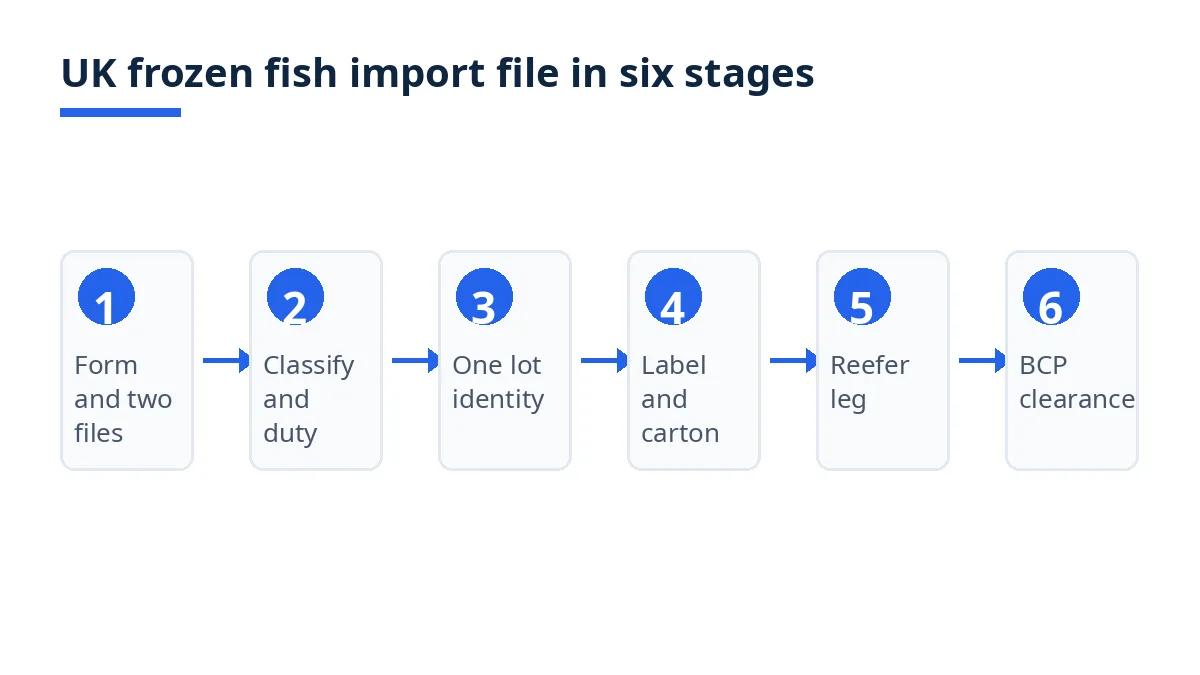
A frozen fish order for the United Kingdom is won or lost in two files that run side by side. One proves where the fish was caught and that it was caught legally. The other proves the fish may enter Great Britain as a product of animal origin, through the right border control post.
This guide is for UK buyers importing frozen fish from Bangladesh: wholesalers, processors, retailers, and food service buyers. It covers Great Britain; Northern Ireland follows different rules. Every cost figure is an example figure, and every duty figure is indicative until your broker confirms it on the exact tariff line.
Start with the product form: whole fish, fillets, or fish meat
Frozen fish is not one product at the UK border. Whole fish, fillets, and other fish meat fall under different headings, changing classification, duty line, and documents. Fix the form first, in the same words on every document: whole, headless, gutted, filleted, skinned, minced, or another presentation, with species named by commercial designation and scientific name.
Farmed or wild-caught is the second fork, settled before the order, not at the border. To import most fish to the UK from another country, excluding EU fish into Northern Ireland, you need a validated catch certificate from the competent authority of the country where the fishing vessel is registered or licensed.1 It asks for vessel details, species code and commodity code, and weight.1 If the fish was processed or stored elsewhere, you also need an endorsed processing statement, proof of storage, or both.1
The form also decides what the buyer pays for: prices cannot be compared per kilogram without yield, trim, and glaze basis. Put presentation, size range, trim, and glaze basis in one specification, send it unchanged to every supplier, and require replies in the same format.
Build the two UK files before you order: IUU and IPAFFS
Work the UK entry as two files, owned by different people and checked by different authorities: the illegal, unreported, and unregulated (IUU) file, and the sanitary and phytosanitary (SPS) file run through the Import of Products, Animals, Food and Feed System (IPAFFS). Either file can hold the container, so neither is left to the shipping week.
The IUU file runs to a deadline measured from arrival. Submit the catch certificate, processing statement, or proof of storage to the relevant port health authority 72 hours in advance for sea imports, 4 hours for rail and air, and 2 hours for road.1 Port health authorities charge a fee for checking IUU documents, set by each authority.1 For a container from Chattogram, the 72-hour rule governs: documents must be checked against invoice and packing list and submitted before the deadline. Fish caught by vessels flagged to Comoros, Cambodia, or Saint Vincent and the Grenadines cannot be imported; check with the Food Standards Agency (FSA) and the border control post (BCP) before importing.1
The SPS file runs through IPAFFS and the BCP. Importers of most fish and fishery products, as products of animal origin, must submit an import notification in IPAFFS, upload IUU documents and enter the required information into IPAFFS, check the Border Target Operating Model (BTOM) risk category, upload a health certificate if the goods are medium or high BTOM risk, and meet customs requirements.1 All goods face documentary checks at entry; some face physical and identity checks.1 Low BTOM risk goods need no health certificate and must come with a commercial document.1 Health certificates must be signed by an authorized certifying officer.1 Do not guess the category: it determines which SPS rules and checks apply, while IUU rules apply regardless.1 Histamine-forming species are medium risk.1
Name who owns each file. You must use IPAFFS to notify authorities in Great Britain before products of animal origin arrive, and you are responsible for the consignment from entry until checks are complete.2 Upload documents before submitting the notification, in electronic format, for example PDF.2 Confirm in writing whether your customs agent also handles the SPS side.
Classify on 0303 29 and settle the DCTS position before pricing
Classification comes before price, because the duty route follows the code, species, presentation, and origin proof. The worked example is commodity code 0303 29 00 00: tilapias, catfish including pangasius species, carp, eels, Nile perch, and snakeheads, excluding edible fish offal of subheadings 0303 91 to 0303 99, under the heading for frozen fish excluding fish fillets and other fish meat of heading 0304.3 Fillets and fish meat fall under heading 0304, and other species under other 0303 lines. Treat headings here as indicative; have the broker confirm the full code.
The third country duty shown for line 0303 29 00 00 is 8.00 percent, with veterinary control for all third countries.3 Treat 8 percent as the indicative standard-duty figure for that line only, confirmed by the broker on the exact line for the entry date. The same page shows a VAT zero rate, additional code VATZ, at 0.00 percent, and no excise duty chargeable.3 The landed-cost example therefore carries VAT of GBP 0.00 on that zero rate, subject to broker confirmation.
The preference route is the price fork, settled as a broker check, not assumed. The Developing Countries Trading Scheme (DCTS) replaces the Generalised Scheme of Preferences, applies to qualifying countries, and offers lower tariffs and simpler rules of origin.4 It covers 65 countries in three tiers; the Comprehensive Preferences tier covers least developed countries, which continue to benefit from duty-free, quota-free trade on everything but arms.4 Bangladesh is listed among the Comprehensive Preferences beneficiaries.4 Claiming DCTS preference requires a valid proof of origin, a GSP Form A or an origin declaration, and businesses can self-certify with no official stamp required.4 Have the broker confirm the preference and proof in writing. Work the landed cost both ways.
Keep one lot identity from pond or vessel to the UK cold store
Traceability ties the two UK files to the physical cartons. It means tracing fish products from catching or harvesting through to retail sale, evidencing that fish are legally caught and fully reported, and it is a legal requirement under retained EU legislation that commercial fisheries products are fully traceable.5 Every operator must be able to identify the immediate supplier and buyer, except on sale to the final consumer.5
A lot is the unit the chain must respect: a quantity of products of a specific species, the same presentation, from the same relevant geographical area and the same fishing vessel or group of vessels, or the same aquaculture production unit; a fish box or bag meeting that definition is an example of a lot.5 Keep it intact: one lot number, one species, one presentation, one area, one vessel group or production unit. Combining two ponds or areas into one carton breaks the lot.
The Marine Management Organisation (MMO) considers this an adequate level of lot labeling: lot identification number; external identification number and name of the fishing vessel, or name of the aquaculture production unit; FAO alpha-3 code, commercial designation, or scientific name of each species; date of catches or production; quantities in kilograms net weight, or number of individuals where appropriate; supplier name and address; relevant geographical area; production method; fishing gear category; date of minimum durability, or best before date; and whether the products have previously been frozen.5 Trip dates or landing date and port of landing should also be included for accurate first-sale records.5 Build the carton label and lot record from that list, and check each item against health certificate, catch file, and commercial documents before loading.5
Agree the UK label and carton before packing
The lot label keeps the fish traceable. The consumer label sells the fish in the UK, and the two must agree. Agree the full consumer label text with buyer and broker before the first carton is printed, approve the finished artwork, and keep one approved proof in the order file. Confirm the particulars a retail pack must carry, including commercial designation, production method, catch area or origin wording, and allergen or storage wording, with the broker and the buyer's trading standards contact: this guide states no consumer-labeling mandate beyond the traceability list above.
Fix carton marks with the label. Every carton should carry species and presentation, size or count, net weight basis, lot number, production date or date of minimum durability as agreed, establishment identification, and purchase order number, matching the packing list word for word. State whether weights are net of glaze and how net weight is verified, since the buyer pays for fish, not ice, and the traceability list requires quantities in net weight.5
Why Bangladesh fits a UK frozen fish order
Bangladesh fits a UK order when the buyer needs farmed freshwater fish in defined sizes and presentations, packed for a defined channel, from plants that already work to an export file. The fit is between the order's needs, a species and presentation specification, a glaze and net weight specification, a catch or origin file, a health file, and a UK label, and what a plant can show before ordering: current production of the same species, size range, and pack format, with the file the BCP will check.
The channel shapes the specification as firmly as the species: a processor needs bulk raw material set for the line, a wholesaler needs case sizes that move through cold storage, a retailer needs retail-ready packs, and a food service buyer needs portion control. Write the channel into the first page of the specification.
Specify the fish so the file, the label, and the carton agree
One specification document carries the whole order. Write it before requesting prices, send the identical document to every supplier, and require replies in the same format, so quotes compare line by line.
Specification part | Fix in writing before quoting |
|---|---|
Species and origin | Species, scientific name, farmed/wild, unit or vessel group, area wording |
Form and size | Whole, filleted, or other fish meat; trim, size range, uniformity rule |
Glaze and weight | Glaze percentage, net weight basis, weighing method |
Pack and carton | Pack and carton weights, marks, lot number, artwork approval |
File | Catch file, health certificate if required, IPAFFS data, BCP designation |
Shipment | Reefer, temperature range and record, sailing plan |
Find and check suppliers against the UK file
Shortlist suppliers whose current range already includes frozen fish in the species, form, and presentation needed, packed for export. Browse suppliers on Exportain and read each profile against the UK specification, not a headline price. Shortlist three or four suppliers, send each the identical specification, and ask for the same reply format: species and form, size range and glaze basis, pack format, price inclusions, validity, and minimum. Ask about UK shipments and whether the supplier can provide the catch file, health certificate, lot record, and label artwork. Learn how to buy on Exportain before the first enquiry.
Checking has three layers, all before payment. First, company documents: trade licence, export registration, and association membership where applicable, checked so name, address, and bank account agree across every document. Second, capability: current production of the specified species and form, and freezing and cold storage capacity. Third, payment discipline: pay only the company account named in the documents, never a personal account, and verify any bank detail change separately, through a different channel. On Exportain, supplier profiles carry document and photo review badges, a review of documents and photos, not a factory inspection or a guarantee, and Exportain is not a party to the contract, does not inspect goods, book freight, or clear customs. For a first order, confirm the health certificate model and catch file with the broker before production.
MOQ, pricing, and samples
There is no single typical minimum for frozen fish from Bangladesh, and this guide states none. The minimum is set per species, form, size range, and pack format. Ask how it splits, and get the split in writing. Read the frozen fish MOQ guide before comparing minimums, and compare only on the identical specification.
Ask for the price on the identical specification, with inclusions stated line by line: product price, packing, labeling, inspection where agreed, and delivery term with named place and version. Ask what the price excludes, and how glaze, size, trim, and weight basis affect it. Compare prices per kilogram net of glaze, not per carton, unless every carton carries the same net weight and glaze. Samples work in stages: a product sample shows whether the supplier can meet the specification, and a pre-shipment sample shows whether the production lot matches the approved sample. Approve each sample in writing, keep one sealed counter-sample per presentation, and note size range, glaze basis, trim, and lot number.
Quality control, cold chain, and the reefer leg
Quality control is agreed before production, not discovered at the BCP. Agree the inspection method, defect classes, and acceptance limits in writing, and state who inspects, when, and on what sample. Agree what happens when inspection fails, who bears the cost, and whether the lot is reworked, rejected, or held. Agree the lot identity system, so every carton traces to its production lot, raw material lot, and health and catch file, and agree the frozen temperature range, pre-cooling of the reefer, and a temperature record traveling with the consignment. Use the frozen fish quality control checklist for the inspection plan.
Sea freight in reefer containers is the standard route for bulk frozen fish, planned from the forwarder's current schedule, not a general transit figure. Plan in three blocks: production time, sea transit, and UK clearance and delivery. No transit figure is stated here. State the delivery term in full in every document, rule, named place, and version, with cost and risk positions confirmed by forwarder and broker. Ask in writing who books the reefer, clears the UK import, pays duty and any VAT, and bears the cost of a BCP delay. Send the as-shipped documents to the broker and BCP contact before arrival.
Landed cost example in pounds
A landed cost is the full cost of one unit of fish, ready at the UK cold store or plant. Every number below is an example figure only, not a quote, for frozen fish under line 0303 29 00 00, shipped by sea from Chattogram to a UK cold store. Confirm duty rate, customs value base, VAT treatment, and every fee line with your broker. The standard-duty column uses the indicative 8 percent third country duty for that line.3 The preference column assumes a DCTS preference at zero duty, subject to the broker check above, with a valid proof of origin.4
Example figures, per kilogram net weight.
Cost element | Standard duty (per kg) | DCTS assumed (per kg) | How to obtain your figure |
|---|---|---|---|
Product price, FOB Chattogram | GBP 6.10 | GBP 6.10 | Pro forma invoice |
Freight and insurance | GBP 0.72 | GBP 0.72 | Forwarder quote |
Customs value | GBP 6.82 | GBP 6.82 | Price plus freight and insurance |
Duty | GBP 0.55 (indicative 8%) | GBP 0.00 (DCTS assumed) | Broker calculation |
Import VAT | GBP 0.00 (zero rate) | GBP 0.00 (zero rate) | Broker and tax adviser |
BCP, port, cold store, broker fees | GBP 0.31 | GBP 0.31 | Broker, BCP, and port invoices |
Delivery to cold store or plant | GBP 0.24 | GBP 0.24 | Local carrier quote |
Total landed cost | GBP 7.92 | GBP 7.37 | Sum of all lines above |
Work the calculation twice: at quote stage with the broker-confirmed duty and VAT position, and again after shipment with actual invoices. If the preference is refused, the standard-duty total applies, and the GBP 0.55 per kilogram difference must be funded. If gateway, BCP, or species changes, rework freight, port, BCP, and inland lines together, and recheck classification.
UK fish import sequence, step by step
Fix form, species, and farmed or wild-caught position; record channel and receiving cold store.
Name broker, forwarder, BCP, and port health authority; confirm who owns each file.
Confirm BTOM risk category, health certificate need, classification, duty rate, and DCTS position.
Write one specification, send it unchanged to every supplier, and compare quotes on the same terms.
Check supplier documents, capability, and payment details.
Agree lot record, UK label, and carton marks; approve artwork; keep one proof in the file.
Order samples in stages; approve a pre-production sample in writing; keep a sealed counter-sample.
Agree inspection, glaze and net weight rules, cold chain range, and temperature recording before production.
For wild-caught lots, submit the validated catch certificate and any processing statement or proof of storage at least 72 hours before arrival by sea.1
File the IPAFFS notification from agreed documents; confirm the BCP designation.2
Ship on the agreed term, clear BCP and customs entries, and reconcile the actual landed cost.
What is the typical MOQ for frozen fish from Bangladesh?
There is no single typical minimum, and no figure is stated here. The minimum is set per species, form, size range, and pack format. Ask how it splits, get the split in writing, and compare only on the identical specification.
How long does shipping take?
Production time, sea transit, and UK clearance and delivery are separate blocks, and none has a single typical figure here. Plan from the forwarder's current sailing schedule, and build backwards from the 72-hour IUU deadline for sea imports.1
What import duty applies?
Duty follows classification, species, presentation, and the preference route claimed. The worked example is 0303 29 00 00, covering tilapias, catfish including pangasius species, carp, eels, Nile perch, and snakeheads, with a third country duty of 8.00 percent.3 Treat 8 percent as indicative for that line only, and confirm the exact line with your broker. Under DCTS, least developed countries continue to benefit from duty-free, quota-free trade on everything but arms, and Bangladesh is listed among the Comprehensive Preferences beneficiaries, but a claim needs a valid proof of origin, a GSP Form A or an origin declaration.4
How do I verify a supplier?
Check company documents first, so name, address, and bank account agree across trade licence, export registration, and invoices, and payment goes to the company account named in them. Then check capability: current production, freezing and cold storage capacity, and the lot record and label artwork the plant can supply before the order. Then check the UK file: catch file where it applies, health certificate where the BTOM category requires it, and BCP designation confirmed with the broker.
Next steps on Exportain
Read the general guide to importing from Bangladesh and the landed cost guide for imports from Bangladesh before you price, and use the classification guide for frozen fish to check the heading with your broker. When the form, the two UK files, and the specification are fixed, post a free RFQ on Exportain with species, form, gateway, and delivery date.
Sources
- Importing or moving fish to the UK. GOV.UK (accessed )
- Import of products, animals, food and feed system (IPAFFS). GOV.UK (accessed )
- Commodity code 0303290000: Other - UK Integrated Online Tariff. GOV.UK (accessed )
- What is DCTS and why is it important for international trade?. GOV.UK (accessed )
- Traceability and labelling information for fisheries products. GOV.UK (accessed )
About the author
Sourcing from Bangladesh?
Post a request for quotation and suppliers on Exportain can send you their quotes directly.
Post an RFQ


