Typical MOQ for Frozen Fish in Bangladesh (and How to Negotiate It Down)
Frozen fish MOQ in Bangladesh, explained by the mechanics: how MOQs are set by species, cut, grade, pack format and container load, and how buyers negotiate them down by trading batch changes, not just asking for a lower number.
Short answer
A frozen-fish MOQ is set per species, cut, size grade, pack format and container load, not as one category-wide number. Ask for the MOQ on each basis separately, convert every quotation to cartons, kilograms and container loads, and test each grade against your own sales. Negotiate the batch, not just the number: fewer grades, one carton format or a full container load can earn a lower MOQ, and the agreed change must be recorded in the order.
On this page
Key takeaways
A frozen-fish MOQ is never one number: it is set per species, cut, size grade, pack format and container load, and quotations on different bases cannot be compared until converted to cartons, kilograms and container loads.
Whole frozen fish and frozen fillets sit on different customs lines — heading 0303 covers frozen fish excluding fillets and other fish meat of heading 0304 — so confirm the code and the MOQ for each cut, not just each species.
Negotiate the batch, not just the number: fewer grades, one carton format, a standard inner pack or a full container load gives the seller a real saving in return for a lower MOQ.
Settle the net weight and glaze basis in writing before agreeing the quantity, because a MOQ in kilograms delivers different fish depending on how glaze is treated and checked at loading.
Record the change behind any lowered MOQ in the order — the grade dropped, the pack format merged or the run joined — or the next order may revert to the original MOQ.
A frozen-fish minimum order quantity (MOQ) is rarely one number. A Bangladeshi processor may quote one MOQ for whole block-frozen fish, a different MOQ for fillets of the same species, and a third for a retail pack — each set per species, per size grade, per pack format, or per container load. A buyer who asks only "what is your MOQ?" gets an incomparable answer.
This guide covers the mechanics behind that number and how to negotiate it down. It covers frozen fish only — whole fish, fillets and other fish meat — not shrimp, prawns, crab or other seafood. It explains what drives each MOQ, how to read a quotation, and which levers move a supplier: pack consolidation, grade flexibility, container arithmetic and order timing. Every quantity illustration here is labelled "Example figures" and shows structure only; it is not a market rate, and no typical MOQ is claimed.
Start from the specification, not the quantity. A supplier cannot give a usable MOQ until it knows the species, cut, grade, freezing method, glaze position, inner pack, master carton and delivery term. Change any one of those and the MOQ can change with it.
Why this matters for buyers and sellers
For the buyer, the MOQ decides how much capital sits in a cold store and how much risk a first order carries. Cold storage, insurance and working capital run while stock waits to be sold, and a slow-moving grade can tie up a container slot a faster grade could have used.
For the seller, the MOQ protects the production run. Freezing, grading, packing and loading are batch operations: a plant sets up a line for one species and cut, runs it, packs it into one carton format, and loads it into a refrigerated container.
That shared logic is why negotiation works. A buyer who reduces the seller's burden — fewer grades, one carton format, or a full container load — gives the seller something real in return for a lower MOQ. A buyer who only asks for a lower number asks the seller to absorb the same batch cost over fewer kilograms.
Classification comes first. Heading 0303 covers fish, frozen, excluding fish fillets and other fish meat of heading 0304, while fillets and other fish meat sit under heading 0304.1 A whole frozen fish and a frozen fillet are therefore different customs lines, with different MOQs. Confirm the line for each cut, not just for the species.
Step-by-step: how it works
Work through the MOQ in this order. A quotation agreed before the specification is settled is not comparable.
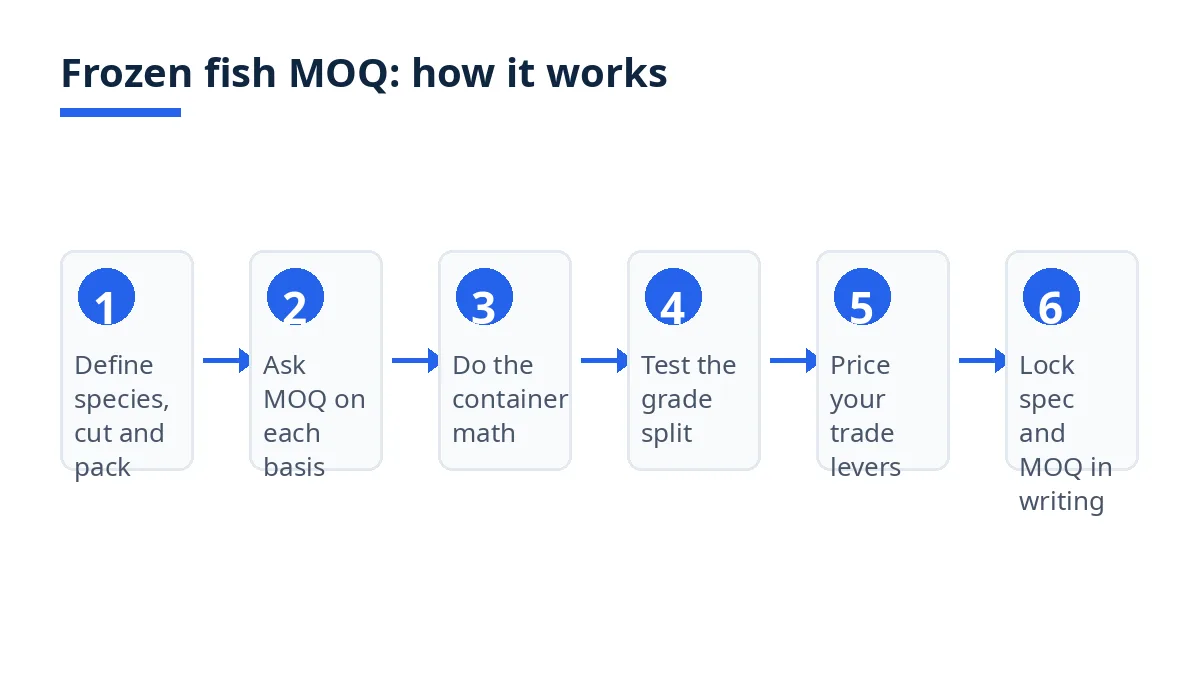
Define the product in full. Species, cut, size grade, freezing method, glaze treatment, inner pack weight, and master carton weight.
Ask for the MOQ on each basis, separately. Per species, cut, grade, pack format, and container load. A supplier quoting only a total has not said whether each grade inside it is itself acceptable.
Do the container arithmetic. Convert every MOQ into cartons, then kilograms, then container loads. Example figures: if a carton holds 10 kg and a load holds 1,000 cartons, the load is 10,000 kg; a MOQ of 500 cartons is half that load. The arithmetic shows structure only.
Test the grade split against your sales. For each grade, ask how long that grade alone would take to sell through your channel. If one grade would sit for months while the others move in weeks, that grade is the problem, not the total.
Price the levers before you ask. List what you can offer for a lower MOQ: fewer grades, one carton format, a standard inner pack, a longer delivery window, or a repeat-order commitment.
Negotiate the batch, not just the number. Ask which change lets the plant run the order as one batch: dropping a grade, merging pack formats, or joining an existing production run. Record the agreed change, not just the quantity.
Lock the specification and MOQ basis in writing. The purchase order should state species, cut, grade, pack format, carton count, net weight basis, delivery term and MOQ basis per line.
Costs, timelines and documents
Cost follows the batch, not the kilogram alone. What moves with the MOQ is production setup, grading labour, packing materials for each format, cold storage while the batch accumulates, and documentation and inspection. A MOQ per size grade multiplies grading and packing steps; a MOQ per container load concentrates them.
Freight treatment follows the load. A full refrigerated container load and a part load are priced and handled differently, and the delivery term decides who carries freight cost and risk at each stage. Incoterms 2020 sets out 11 rules, seven for any mode of transport and four for sea and inland waterway transport only.2 Compare quotations only on the same rule and named place or port. For containerised fish, check whether a sea-only rule matches the actual handover point, since a container is handed to a carrier before loading.
Do not compare on unit price alone. Two quotations at the same price per kilogram are not the same offer if one is a full load, one carton and one grade, while the other is a part load split across three grades and two pack formats. Compare on the same specification, MOQ basis, carton count, net weight basis and delivery term.
Timelines run in stages. Ask for separate dates for specification confirmation, production scheduling, freezing and packing, checking, loading, documentation, and departure. A MOQ lowered by joining an existing run may move faster than a standalone small run; one split across two runs may move slower. Season and catch timing also affect scheduling.
The order file should hold the specification sheet, the agreed MOQ basis per line, the itemised quotation, the purchase order, the packing specification, the net weight and glaze statement, and the inspection or testing plan. The export set is separate: goods may not be loaded unless an export declaration, the Bill of Export or Shipping Bill, is submitted to Customs and approved, with the export contract or purchase order where there is no export letter of credit, the commercial invoice, the packing list, the EXP form certified by an authorized dealer, and a certificate of origin issued by the EPB or a Chamber of Commerce and Industry.3
Add the market documents. For the United States, the importer must have written verification procedures ensuring the fish was processed under the seafood HACCP requirements, including product specifications and affirmative steps such as obtaining the foreign processor's HACCP and sanitation records for the lot, a certificate from a foreign government inspection authority or competent third party, or regular inspection of the processor's facilities.4 For the European Union, imports of fishery products for human consumption must meet requirements covering authorised country status, an approved establishment, health certificates and health control.5
Bangladesh-specific rules and tips
Confirm the plant's licensing position first. Under Bangladesh's Fisheries and Fish Products (Inspection and Quality Control) Act, 2020, no person may export fish and fish products, or operate a factory for fish production and processing, without a licence, and the central competent authority sets the standards for fish and fish products.6 Check that the plant named on the quotation is the plant that holds it.
Code each cut, not just each species. Heading 0303 covers frozen fish excluding fillets and other fish meat of heading 0304, and the subheadings split by species, including carp under 030325.1 A whole frozen carp, a carp fillet and a fish-meat product can sit on different lines, each with its own MOQ. Keep the code per cut in the order file.
Settle the net weight and glaze basis. Frozen fish is commonly sold with a glaze, and the difference between gross, glazed and net drained weight changes what a MOQ in kilograms actually delivers. State in writing whether quantity, carton weight and price are on a net weight basis, how glaze is treated, and how net weight is checked at loading.
Treat the approved-establishment point as a market question. For the EU, the establishment dispatching the product and the third country of dispatch must each appear on the applicable list of establishments and countries from which imports of that product are permitted.7 Ask the supplier to name the establishment that will appear on the health certificate, and confirm it matches the plant that will process your order.
Check the US verification burden before pressing for a very small trial. The US importer verification duty applies to the lot offered for import, and the affirmative steps — records, certificates, inspections or testing — cost time whether the lot is large or small.4 A trial so small it cannot carry its share of that work may be refused, or may need a sample-shipment structure. Ask which structure applies first.
Mistakes and red flags
Negotiating the total while ignoring the grade split. A total meeting the MOQ can still fail if one grade inside it exceeds what your market can absorb. Negotiate grade by grade.
Comparing MOQs quoted on different bases. A MOQ per load, per grade and per pack format are not comparable numbers. Convert every quotation to cartons, kilograms and loads on the same specification first.
Accepting a lower MOQ without recording what changed. If the supplier lowered the MOQ by dropping a grade, changing the pack format or joining another run, that change is part of the deal. If it is not in the order, the next order may revert to the original MOQ.
Treating a net weight figure as a gross weight figure. A MOQ in kilograms means different delivered fish depending on glaze and weight basis. Settle the basis before agreeing the quantity, and check it at loading.
Reading a profile or a badge as a capacity guarantee. Exportain verification is a document and photo review, not a factory inspection, and a badge is not a guarantee of capacity, quality or delivery. Your protection is the specification, the MOQ basis in writing, the inspection plan and the market documents.8
Red flags in a supplier reply. A reply that will not state the MOQ basis, name the processing plant, confirm the net weight basis, or say which change would lower it is a reply to pause on. So is one that lowers the MOQ sharply without changing any specification, pack format or production plan: ask what changed.
Checklist
Before you confirm a frozen-fish order, every line should be answered in writing.
Species, cut, grade, freezing method, glaze, inner pack and carton specified per line.
MOQ stated per species, cut, grade, pack format and container load — not as one unexplained total.
Every MOQ converted to cartons, kilograms and loads on the same basis.
Grade split tested against your own sales: each grade can be sold through in reasonable time.
Net weight basis and glaze treatment stated, with the loading check agreed.
Delivery term stated once, on every quotation, on the same term.2
Production window confirmed, with the missed-window consequence stated.
Processing plant named, licensing position confirmed.6
Market documents agreed: US importer verification steps,4 EU authorised country, approved establishment and health certificate.7 5
Export set agreed: Bill of Export, commercial invoice, packing list, EXP form, certificate of origin.3
HS code confirmed per cut, not per species alone.1
The change behind any lowered MOQ recorded in the order.
Inspection plan agreed, including who checks packed goods and net weight before loading.
How Exportain helps
On Exportain, browse suppliers and post a request for quotation (RFQ) on the RFQ board with your species, cut, grade, pack format and delivery term, and ask each reply to state its MOQ on each basis — per grade, per pack format and per container load — so quotations can be compared on the same specification. Ask each reply to name the processing plant and state the net weight basis.
Read the badges for what they record. Exportain Verified means Exportain has checked identity, phone, email and business registration, and Export Verified means it has checked the Export Registration Certificate (ERC).8 Factory Verified means it has reviewed photos of the manufacturer factory, while Trading Company Verified means it has reviewed photos of the trading company office or warehouse.8 Verification is a document review by staff, free, and never granted by membership plans.9 It is not a factory inspection,8 9 so specification and inspection decisions stay with you.
FAQs
What should I know first about frozen fish?
Start with the specification, not the quantity. Frozen fish MOQs are set by species, cut, grade, pack format and container load, and a whole frozen fish and a frozen fillet sit on different customs lines: heading 0303 covers fish, frozen, excluding fish fillets and other fish meat of heading 0304.1 Until species, cut, grade, freezing method, glaze basis, inner pack and carton are written down, no MOQ quotation can be compared with another.
What are the typical costs and timelines?
There is no typical MOQ cost or timeline for frozen fish, because both follow the batch: species and cut, grade split, pack formats, container load and delivery term. Costs move with setup, grading, packing, cold storage and documentation, and freight follows the load and delivery term — Incoterms 2020 sets out 11 rules, seven for any mode of transport and four for sea and inland waterway transport only.2 Timelines run in stages, so ask for a date per stage. Example figures here show structure only, never market rates.
Which documents are needed?
The order file holds the specification sheet, MOQ basis per line, quotation, purchase order, packing specification, net weight and glaze statement, and inspection plan. The export set is the Bill of Export, commercial invoice, packing list, EXP form certified by an authorized dealer, and a certificate of origin issued by the EPB or a Chamber of Commerce and Industry.3 Market documents sit alongside them: US importer verification procedures and lot records under the seafood HACCP rules,4 and, for the EU, the authorised country and approved establishment position with the health certificate.7 5
What are the most common mistakes?
The most common mistakes are negotiating the total while ignoring the grade split, comparing MOQs quoted on different bases, accepting a lower MOQ without recording what specification change produced it, confusing gross and net weight where glaze is involved, and reading a badge as a capacity guarantee. A further mistake is pressing for a very small trial without checking whether the market verification work for that lot — US importer verification steps,4 or EU establishment and certificate checks7 5 — makes a sample structure more appropriate. Fix each in writing before the order.
Next steps on Exportain
Browse suppliers, then post your species, cut, grade and pack format on the RFQ board and ask each reply for its MOQ per grade, per pack format and per container load. Before you confirm, read the general MOQ guide.
Sources
- Classification Detail — HS Code 030325. United Nations Statistics Division (accessed )
- Incoterms® 2020. International Chamber of Commerce (ICC) (accessed )
- Customs Clearance Procedures for Export. Bangladesh Customs, National Board of Revenue (accessed )
- 21 CFR 123.12 — Special requirements for imported products. GovRegs (accessed )
- Health and consumer protection for animal and plant product. European Commission, Access2Markets (accessed )
- The Fisheries and Fish Products (Inspection and Quality Control) Act, 2020. InforMEA (accessed )
- Regulation (EC) No 853/2004 laying down specific hygiene rules for food of animal origin. European Union (accessed )
- Trust & Safety Center. Exportain (accessed )
- Supplier verification: Earn trust badges buyers can see. Exportain (accessed )
About the author
Sourcing from Bangladesh?
Post a request for quotation and suppliers on Exportain can send you their quotes directly.
Post an RFQ