UAE Frozen Fish Imports From Bangladesh: Registration-First Guide
Frozen fish from Bangladesh to the UAE, registration first: the emirate and channel decision, the FIRS and label file, 0303/0304 classification, 5% duty and 5% VAT working figures, and an AED 37.79 per kilogram landed-cost example.
Short answer
To import frozen fish from Bangladesh to the UAE, fix the emirate and channel first, then register the supplier, product, and Arabic label in the emirate file before production. Classify by form under heading 0303 or 0304, price Dubai duty at 5 percent of CIF and VAT at 5 percent on CIF plus duty as working figures, confirm the Bangladesh export file for the exact line, and rework the AED 37.79 per kilogram example with broker-confirmed figures before ordering.
On this page
Key takeaways
Fix the emirate, channel, and onward route first: the entry emirate decides the customs file, the registration system, and the VAT treatment, and the Dubai 5 percent of CIF duty figure must not be carried into another emirate.
Register the supplier, product, and Arabic label in the emirate file before production: FIRS for Dubai, FIEMIS for Abu Dhabi, with label assessment before bulk packing.
Classify by form on the full GCC line: whole frozen fish under heading 0303, fillets and fish meat under heading 0304, confirmed per presentation, species, and form.
Price duty at 5 percent of CIF and VAT at 5 percent on CIF plus duty only as working figures for a mainland Dubai entry, confirmed by the broker and tax adviser on the exact line, emirate, and date.
Rework the AED 37.79 per kilogram example landed cost with broker-confirmed figures; no typical MOQ, transit time, price, or holding-temperature figure is stated.
To import frozen fish from Bangladesh to UAE, settle the emirate, the channel, and the food registration file before you discuss price. Customs runs by emirate, food registration runs through the emirate food authority, and value added tax (VAT) runs through the Federal Tax Authority, so the entry point you choose changes the duty file, the registration system, and the VAT treatment.
Settle the emirate, channel, and onward route before you register anything
Fix three decisions, in writing, before any supplier is asked for a price. First, the emirate of entry. Government tariffs in the UAE range from 0 to 5 percent, and in Dubai the customs tariff is 5 percent of the cost, insurance, and freight (CIF) value, except for alcohol and cigarettes.1 Do not carry the Dubai figure into an Abu Dhabi or Sharjah entry: confirm the rate for your emirate and entry date with the broker.
Second, the channel: mainland sale, movement into a free zone or designated zone, re-export, or transfer to another emirate. Certain free zones have been specified as designated zones for VAT purposes, and special rules apply to supplies made in them.2 Fix the choice before building the registration file.
Third, the port of entry and the onward route. Jebel Ali is the Dubai gateway named in this guide: DP World describes it as serving over 80 weekly services connecting more than 150 ports, with sea, air, and land access.3 Name the port of entry in the file, agree who clears the goods there, and record the onward route to the cold store.
Register the supplier, product, and label in the emirate file first
For Dubai, registration comes before the reefer sails. Dubai Municipality lists two services that frame the file: "Apply to Register and Assess a Food Item" and "Apply to Release Imported Food Consignments for Sale in Local Market," alongside services to transfer a consignment to and from other emirates and to approve release for re-export.4
The Food Safety Department regulates food product registration through the Food Import Re-export Service (FIRS) portal, and the supplier should first be registered as an authorized foodstuff supplier through FIRS.5 New products need detailed registration first, with a description of the packaging type and a clear image of the label and the food item.5 Build the file in order: supplier registration, product registration with the exact species, form, and pack, label assessment, then the consignment application. Company guidance puts approval at around 10 working days where there are no issues.5
For Abu Dhabi, the channel is different. The Abu Dhabi Agriculture and Food Safety Authority (ADAFSA) runs the Food Import and Export Management Information System (FIEMIS) as a single window to submit and track orders, and it provides release of imported food shipments before arrival at the port.6 If the entry emirate is Abu Dhabi, build the FIEMIS file instead of the Dubai file. At the federal level, the Ministry of Climate Change and Environment (MOCCAE) lists release of imported agricultural product consignments among its most used services.7
Classify the fish by form first: whole frozen fish under 0303, fillets and fish meat under 0304
Form decides the heading, and the heading decides the line the broker prices. Heading 0303 covers fish, frozen, excluding fish fillets and other fish meat of heading 0304.8 Heading 0304 covers fish fillets and other fish meat, whether or not minced, fresh, chilled, or frozen.9 A whole frozen fish and a frozen fillet of the same species are therefore different tariff entries, even from the same plant.
The Harmonized System (HS) uses numeric codes of up to six digits, with extensions added at the national level or within the Gulf Cooperation Council (GCC).1 Work the classification to the full GCC line the broker will declare. Subheading 030354 covers frozen mackerel, excluding fillets, livers, roes, and other fish meat of heading 0304, and subheading 030481 covers frozen salmon fillets.8 9 Read the classification guide for frozen fish alongside the tariff, and confirm the line per presentation, species, and form.
Price the Dubai duty and VAT working figures: 5 percent of CIF, then 5 percent on CIF plus duty
Duty and VAT are separate lines, calculated in sequence, and both rest on the CIF value. For a mainland Dubai entry, use 5 percent of the CIF value as the duty working figure, from the official portal page attributing the Dubai tariff to Dubai Customs.1 No preference, exemption, or reduced rate is claimed here: the broker must confirm the rate on the exact GCC line for the entry emirate and date before pricing. VAT was introduced on 1 January 2018 at 5 percent; registration is mandatory above AED 375,000 of taxable supplies and imports per annum, and optional above AED 187,500.2 Import VAT is calculated on the value inclusive of any customs duty and excise tax due, so the example charges VAT at 5 percent on CIF plus duty.10 Non-registered importers pay before clearing, through the VAT301 form; registered importers pay through their VAT return; designated-zone and duty-suspension movements follow separate scenarios, including an e-guarantee or cash deposit.10
Build the Arabic label from the assessment, not from the carton printer
Label decisions belong before production, because cartons printed in Bangladesh cannot be corrected cheaply at the port. Arabic is the official language for verifying label information, other languages are treated as translation, and mandatory information must always appear in Arabic.5 Stickers may translate a label into Arabic, but the mandatory information must still be present and legible.5 The mandatory list covers the brand name, ingredients in descending order, production and expiration dates, manufacturer, packer, distributor, or importer, net weight or volume, country of origin as the specific country, barcode, lot number, Arabic language, storage conditions, allergens, instructions for use where required, and halal and genetically modified marking where they apply; nutrition information is optional.5 Common FIRS rejection reasons include unreadable labeling, banned ingredients, a duplicated barcode, and ingredients declared incorrectly or in a language other than Arabic or English.5 Hold artwork approval until the assessment result is in the file, and revisit the label file if the name, origin, weight, trademark, pack, or storage condition changes.
Settle the halal question in writing before any mark is printed
Do not print a halal mark, and do not leave one off, on an assumption. The labeling list includes halal marking where it applies, and genetically modified marking with prescribed wording where it applies.5 What that means for a particular frozen fish product, pack, and channel must be answered by the emirate food authority or the broker, in writing, before artwork is approved. The Ministry of Industry and Advanced Technology publishes a list of approved accreditation bodies for halal, including the Emirates National Accreditation System (ENAS), the Emirates International Accreditation Center (EIAC), and the GCC Accreditation Center (GAC).11 That list names accreditation bodies, not certification bodies, and does not by itself answer whether a given product needs a halal certificate. Ask in writing whether a certificate is required, which accredited route applies, and what mark, if any, the label must carry.
Get the Bangladesh export file in order for the exact line
The Bangladesh file has two layers: the general export declaration, and the product-specific file for the exact tariff line. Section 131 of the Customs Act, 1969 requires customs clearance for export, and goods must not be loaded unless an export declaration, known as the Bill of Export, is submitted and approved.12 Enclosed documents are the export letter of credit or approved contract, purchase order, or guarantee; signed commercial invoice; packing list; AD-certified EXP form; certificate of origin; VAT registration certificate; and taxpayer identification number.12 A quality control certificate by the Department of Fisheries is necessary as per destination requirements for frozen fish.12 The product-specific file is stated here for one line only. On HS 03044410, for fish of the families Bregmacerotidae, Euclichthyidae, and related families, wrapped or canned up to 2.5 kilograms, the hub records a license for export, a no objection certificate, and a salubrity certificate, all before export, through the Deputy Director, Fish Inspection and Quality Control, under the Fish and Fish Products (Inspection and Quality Control) Act, 2020.13 Where fish was extracted from marine sources, an illegal, unreported, and unregulated fisheries certificate is also required, and where fish was produced on a registered farm, farm registration applies, with the plant managed under a HACCP-based Quality Assurance Programme.13 Ask the supplier to name every document for the exact line, in writing, and hold loading until the list is confirmed.
Why Bangladesh fits a UAE frozen fish order
Bangladesh fits a UAE frozen fish order where the plant, the product form, and the file line up, rather than where the headline price looks lowest. A plant running whole frozen fish under heading 0303, fillets and fish meat under heading 0304, or both, must hold the presentations apart in production, packing, labeling, and documents, because the tariff line, the registration entry, and the label all follow the presentation.8 9 A plant that already runs the license, no objection certificate, and salubrity certificate route for its line, with a HACCP-based Quality Assurance Programme, starts the UAE file from documents it already produces.13 Buy for the file first: one plant, one species and form, one pack format, one label, one certificate lot per order line.
Specify the fish so the label, carton, certificate, and declaration describe one product
Write one specification and send the identical document to every supplier, fixing species and scientific name, form, size grade, glaze basis and percentage, net weight basis, pack format and carton count, label text, lot and barcode, delivery term and named place, and the document set. State whether the fish is wild-caught or farmed, and if marine-extracted, how the illegal, unreported, and unregulated fisheries certificate position will be evidenced.13 State the holding temperature as a number agreed in writing; this guide states no temperature figure, because no opened UAE source sets one for frozen fish generally. Agree the weight basis in the same document: drained weight after deglazing, glaze percentage, and size and count tolerance.
Find and check suppliers against the UAE file, not the price list
Browse suppliers on Exportain and read each profile for the species, forms, and pack formats it actually runs. Shortlist three or four suppliers and send each the identical specification, including the emirate and channel, the registration and label position, the tariff line, the delivery term, and the document set. Verification has three layers, all before any payment beyond an agreed sample charge. First, registration readiness: the supplier must support the FIRS supplier and product registration for the exact product, or the Abu Dhabi FIEMIS file where that is the entry emirate.5 6 Second, document discipline: ask for a sample document set from a recent comparable shipment, with names and prices removed, and check that the certificate, invoice, packing list, and bill of lading agree. Third, Bangladesh-side readiness for the exact line, with the hub caveat that the list may not be exhaustive.13 On Exportain, profiles carry document and photo review badges, not a factory inspection or guarantee, and Exportain is not a party to the contract for the goods. Read the general guide to importing from Bangladesh before the first supplier call.
MOQ, pricing, and samples without a stated typical minimum
There is no single typical minimum for frozen fish from Bangladesh, and this guide states none. The minimum is set per species, form, presentation, size grade, and pack format, because raw material is bought and processed in lots. Ask how the minimum splits, in writing, and convert every minimum to cartons, kilograms, and container loads on the same basis before comparing. Read the frozen fish MOQ guide first, compare only on the identical specification, and record the change behind any lowered minimum, such as a dropped grade or a merged pack format. Compare prices only on the identical specification, delivery term, and document set, with the net or glazed weight basis stated. Samples settle the specification, not the price: approve each sample in writing, keep one sealed counter-sample per presentation, and do not start bulk production before the pre-production sample is approved.
Quality control, cold chain, and the reefer leg
Quality control is cold chain discipline, weight discipline, and lot identity, checked lot by lot. Agree the container temperature record, the data logger position, and the arrival check in writing, and agree how net weight is verified at loading and at arrival. Use the frozen fish quality control checklist, adapted to the UAE file: label and lot identity against the assessed artwork, certificate and declaration agreement, glaze and drained-weight checks, and size and count tolerance. Sea freight in reefer containers is the standard route for bulk frozen fish; plan from the forwarder's current sailing schedule in three separate blocks: production, sea transit, and UAE clearance, inspection, and delivery. Ask in writing who books the reefer, clears the import, and pays duty, VAT, and charges.
Delivery terms: FCA for containers, the CIF and CIP insurance split, and the DDP burden
The Incoterms 2020 rules number eleven: seven for any mode of transport and four for sea and inland waterway transport only, namely FAS, FOB, CFR, and CIF.14 The four sea-only rules are intended for port-to-port bulk or break-bulk shipments and are not suitable for container shipments in their current form.14 For containerized fish, weigh FCA at the named terminal against FOB at the load port: under FCA the seller delivers to the carrier named by the buyer, while under FOB the seller must place the goods on board the vessel.14 Risk passes at the same point and time as delivery in every rule, and only CIP and CIF oblige the seller to provide insurance; the C and D rules place the freight contract with the seller, the E and F rules with the buyer.14 In all rules except EXW the seller carries out export formalities, and in all rules except DDP the buyer carries out import formalities.14 Under CIF the default cover remains Institute Cargo Clauses (C), while CIP requires the higher all-risks cover under Institute Cargo Clauses (A) or similar clauses.15 Under DDP the seller clears for import and pays duty and tax, a burden to accept only where the seller has shown it can perform it in the entry emirate.
Landed cost example in UAE dirhams
A landed cost is the full cost of one kilogram of frozen fish, cleared and delivered to the buyer's cold store. Every number below is an example figure only, for 1,000 kilograms net weight of whole frozen fish on an indicative heading 0303 line, shipped by sea in a reefer container, entered for mainland Dubai sale, with duty at the 5 percent of CIF working figure and VAT at 5 percent on CIF plus duty.1 2 10
Example figures: per kilogram, net weight, UAE dirhams.
Cost element | Example figures (per kg) | How to obtain your figure |
|---|---|---|
Product price, FOB load port | 28.00 AED | Pro forma invoice |
Freight and insurance, per kg | 4.50 AED | Forwarder quotation |
CIF value, per kg | 32.50 AED | Product price plus freight and insurance |
Duty at 5 percent of CIF, in this example | 1.63 AED | Broker calculation on the exact GCC line |
CIF plus duty, per kg | 34.13 AED | CIF value plus duty |
VAT at 5 percent of CIF plus duty, in this example | 1.71 AED | Broker and tax adviser |
Customs, clearance, and broker fees, per kg | 1.10 AED | Broker and clearance invoices |
Delivery to cold store, per kg | 0.85 AED | Local carrier quotation |
Total landed cost including duty and VAT, per kg | 37.79 AED | Sum of all lines above |
Duty is 5 percent of AED 32.50, or AED 1.625, rounded to AED 1.63; VAT is 5 percent of AED 34.13, or AED 1.7065, rounded to AED 1.71. If the broker confirms a different duty rate, zone treatment, or VAT treatment, rework the CIF-plus-duty base first, because VAT is calculated on the value inclusive of customs duty.10 Use the landed cost guide for imports from Bangladesh to rework the example with broker-confirmed figures.
UAE fish import sequence, step by step
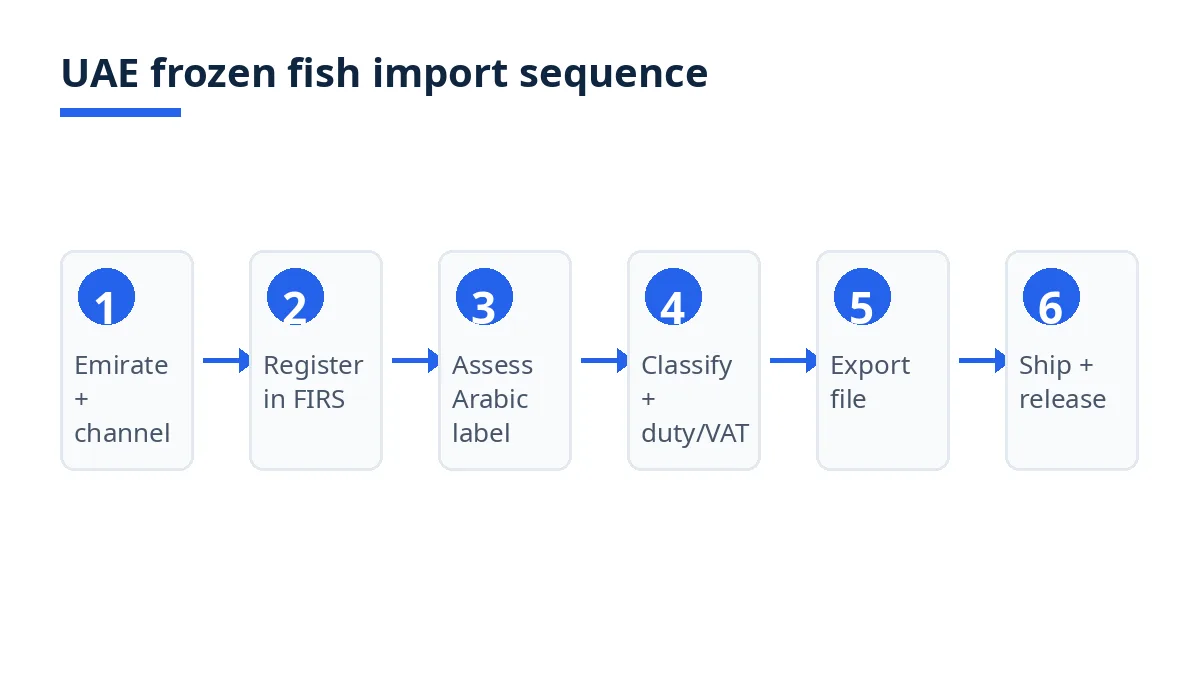
Fix the emirate, channel, and onward route, and record the duty and VAT file that follows.1 2
Register the supplier and product in the emirate file, and obtain the label assessment.4 5
Settle the halal question in writing and keep the answer with the label file.11
Classify by form on the exact GCC line, and confirm the duty working figure.8 9 1
Confirm the Bangladesh export file in writing for the exact line.12 13
Send one specification to every supplier; compare on the same delivery term and weight basis.
Verify: registration readiness, document discipline, Bangladesh-side readiness.
Approve samples in writing; keep a sealed counter-sample.
Agree inspection, sampling, and weight verification before production.
Ship on the agreed delivery term, certificate checked, lot identity intact.14
File the declaration, pay duty and VAT as assessed, and complete consignment release.10 4
Deliver to the cold store, check lot and weight on arrival, and keep the file together.
What is the typical MOQ for frozen fish from Bangladesh?
There is no single typical minimum, and no figure is stated here. The minimum splits per species, form, grade, and pack format. Ask for the split in writing, convert every minimum to cartons, kilograms, and container loads on the same basis, and compare only on the identical specification.
How long does shipping take?
Production, sea transit, and UAE clearance, inspection, and delivery are separate blocks. Plan from the forwarder's current sailing schedule and build backwards from the registration, label assessment, and certificate dates. Company guidance puts Dubai registration and label approval at around 10 working days where there are no issues; confirm the current timing with Dubai Municipality or your broker.5 No transit figure is stated here.
What import duty applies?
Duty follows the confirmed classification, entry emirate, entry date, and any exemption, suspension, or preference route. For a mainland Dubai entry, the working figure is 5 percent of the CIF value, with government tariffs across the UAE ranging from 0 to 5 percent.1 The broker must confirm the rate on the exact GCC line. VAT is separate: 5 percent on the value inclusive of customs duty, with recovery questions for the tax adviser.2 10
How do I verify a supplier?
Check registration readiness first, then document discipline on a recent comparable shipment, then Bangladesh-side readiness for the exact line, with the hub caveat that the list may not be exhaustive and has no legal purpose.5 6 13
Next steps on Exportain
When the emirate, channel, registration file, and tariff line are fixed, post a free RFQ with the species, scientific name, form, grade, glaze basis, and delivery term. Use the landed cost guide for imports from Bangladesh to rework the example with broker-confirmed figures, and see how to buy for the buying journey.
Sources
- Customs duty and tariff. UAE Government (accessed )
- Register for VAT. The Official Portal of the UAE Government (accessed )
- Jebel Ali Port | Port Operations. DP World (accessed )
- Our Services. Dubai Municipality (accessed )
- How do I register food products for import into the UAE under Dubai Municipality?. Pro Partner Group (accessed )
- Abu Dhabi Agriculture and Food Safety Authority - Food Security. Abu Dhabi Agriculture and Food Safety Authority (accessed )
- UAE Ministry of Climate Change and Environment. Ministry of Climate Change and Environment (accessed )
- Classification Detail - HS Code 030354. United Nations Statistics Division (accessed )
- HS, 2012 - Code 030481. United Nations Statistics Division (accessed )
- VAT Import Declaration User Guide. UAE Federal Tax Authority (accessed )
- Approved Accreditation Bodies for Halal. Ministry of Industry and Advanced Technology (accessed )
- Customs Clearance Procedures for Export. Bangladesh Customs, National Board of Revenue (accessed )
- Fish of the families Bregmacerotidae, Euclichthyidae, Wrapped/canned upto 2.5 Kg: export requirements, HS Code 03044410. Bangladesh Customs, National Board of Revenue, (accessed )
- Insider thoughts: Bob Ronai on Incoterms 2020 Rules; What are they about?. International Chamber of Commerce (accessed )
- Incoterms® 2020. International Chamber of Commerce (ICC) (accessed )
About the author
Sourcing from Bangladesh?
Post a request for quotation and suppliers on Exportain can send you their quotes directly.
Post an RFQ