Spain Frozen Fish Imports From Bangladesh: Costs, Duties, Suppliers
A Spain cost-first guide to frozen fish from Bangladesh: the duty line, Spanish IVA, the catch certificate and CATCH deadlines, the health certificate and listed establishment, the Spanish label, supplier checks, and a EUR 7.15 per kilogram landed-cost example.
Short answer
To import frozen fish from Bangladesh to Spain, classify the fish by form and species on the tariff line, confirm the indicative duty and Spanish IVA with a broker and a tax adviser, and build the entry file before ordering: a flag-State-validated catch certificate for wild-caught lots, a health certificate from a listed establishment, and TRACES NT notification at the border post. Compare suppliers on one specification, agree the Spanish label before production, and price from a landed cost.
On this page
Key takeaways
Build the price line by line: duty follows the exact tariff line, with freshwater fish shown at an indicative 8 percent, and Spanish IVA at 10 percent for food products — both subject to broker and tax adviser confirmation.
Submit the validated catch certificate at least three working days before arrival; CATCH is compulsory for EU importers since 10 January 2026 for wild-caught Chapter 3 products subject to IUU controls, while farmed and exempt lots differ — confirm lot by lot.
Use a listed establishment only, and check the health certificate line by line: a single mistake can mean rejection, and an incorrect weight leads to rejection.
Agree the Spanish label before production: commercial designation and scientific name, production method, catch or farm area and gear, defrosted status, and durability date, in Spanish.
The example landed cost is EUR 7.15 per kilogram including IVA (EUR 6.54 excluding reclaimable IVA; EUR 6.65 with a broker-confirmed zero-duty preference) — example figures only, to be reworked with confirmed rates.
A Spanish buyer who starts with a supplier price starts in the wrong place. The price that decides whether an order works in Spain is the euro-per-kilo figure after duty, Spanish IVA, border charges, and delivery, most of it fixed by the customs line, the tax treatment, and the entry file before any supplier is chosen.
This guide explains how to import frozen fish from Bangladesh to Spain, for Spain-based importers, wholesalers, processors, retailers, and food service buyers. It builds the price line by line, then covers the file, label, supplier checks, and shipping terms. Every duty figure is indicative until a broker confirms it on the exact tariff line; every cost figure is an example figure only; every IVA figure needs tax adviser confirmation before pricing. No typical minimum order quantity, transit time, or holding temperature is stated: each is set per order and must be confirmed in writing.
Build the Spanish price line by line before you choose a supplier
Seven lines make up the Spanish landed cost, each with a different owner: product price (supplier), freight and insurance (forwarder or seller), duty (broker and tariff line), IVA (tax adviser), border and clearance charges (Spanish border control post, port, and broker), delivery (local carrier), and inspection (inspection plan).
Only goods of animal origin from countries authorized to export to the EU are admitted, and consignments face documentary, identity, and physical checks at designated BCPs under Regulation (EU) 2017/625.1 Spain runs border notifications through TRACES NT, which notifies, certifies, and controls trade in animals and products of animal origin and lets BCP authorities share data with customs.2 Name the designated Spanish BCP, the filing broker, and the TRACES NT notifier, in writing, before ordering.
Landed-cost line | Who confirms the figure |
|---|---|
Product price, on a stated delivery term | Supplier pro forma invoice |
Freight and insurance | Forwarder quotation, or the seller under a C or D rule |
Duty | Broker, on the exact tariff line for the entry date |
Spanish IVA | Tax adviser, including whether it is reclaimable |
BCP, port, clearance, and broker charges | Spanish BCP, port, and broker fee schedules |
Delivery to the cold store | Local carrier quotation |
Inspection and testing | Inspection plan and laboratory quotations |
What Bangladesh adds to a Spanish frozen fish order
Bangladesh adds value where one plant can run a stated species and form, in stated packs, with the Spanish entry file already in routine use. The test is plant by plant: this species, form, size grade, glaze basis, and carton, with a matching health certificate and catch or farm file. A plant running retail-ready packs, bulk cartons, and processing raw material will not run all three on the same line, pack, or label.
Read the general guide to importing from Bangladesh before comparing suppliers, and fix the Spanish channel first: processing, wholesale, retail-ready, or food service.
Classify first: whole fish under 0303, fillets and fish meat under 0304
Classification comes before price, because the duty line, the certificate, and the label all follow the form of the fish. Heading 0303 covers frozen fish excluding fillets and other fish meat of heading 0304; heading 0304 covers fillets and other fish meat. A whole frozen fish, a headed and gutted frozen fish, a frozen fillet, and frozen minced fish meat are four different entries, even from the same species and plant.3 See the classification guide for frozen fish.
Loins count as fillets where head, guts, fins, and bones are removed: cod 0304 71, tuna 0304 49/87, swordfish 0304 45/84, marlin, sailfish, and spearfish 0304 49/89.3 Put presentation, size, trim, and glaze basis in one specification and require replies in the same format.
The worked example uses line 0303 89 10 00 (freshwater fish), shown at an indicative 8.00 percent on a tariff page dated 1 January 2023.3 The same subheading ranges from 0.00 percent (Euthynnus for industrial manufacture of heading 1604 products) to 22.00 percent (other Euthynnus), with redfish at 7.50 percent, Orcynopsis unicolor at 10.00 percent, and the sea bream group at 15.00 percent.3 Have the broker confirm the rate on the exact TARIC line for the entry date.
Prove the catch or the farm lot by lot, through CATCH where it applies
Wild-caught and farmed fish prove origin differently; settle the distinction lot by lot, before ordering. For wild-caught fish subject to the catch certification scheme, IUU-caught fishery products may not be imported; import requires a catch certificate validated by the flag State, with the Annex II information.4
The validated certificate must be submitted at least three working days before the estimated time of arrival at the place of entry into EU territory, subject to adaptation for product type, distance, or transport means.4 Verification suspends release, with storage costs on the operator; a missing, unvalidated, or mismatched certificate leads to refusal.4
For indirect routes, add the required evidence: for a consignment moved in the same form through a third country other than the flag State, evidence of no operations beyond unloading, reloading, or preservation under surveillance there; for fish processed there, the endorsed processing plant statement.4
Since 10 January 2026, CATCH is compulsory for EU importers submitting catch certificates and related documents for Chapter 3 and heading 1604/1605 products subject to IUU controls.5 CATCH is part of TRACES NT; the Irish authority notes no change for exempt produce, naming aquaculture and freshwater species.5 Confirm the scheme position lot by lot, and how a paper certificate from Bangladesh enters CATCH.
Health certificate and the listed establishment: check TRACES-NT twice
The health certificate is the second gate document. Animals and animal products from non-EU countries can only enter the EU market with an official certificate, subject to narrow exceptions, carrying a public health attestation and, for certain fishery products, an animal health attestation.6 It must be signed by the non-EU country's official veterinarians, may be paper or electronic through TRACES NT, and is always checked at BCPs; the electronic form reduces the risk of out-of-date models.6 A single mistake is sufficient for rejection, and an incorrect weight will lead to rejection even though it is not a sanitary issue.6 Check the certificate line by line before shipment against the invoice, packing list, and bill of lading.
The processing establishment must be listed. Animals and derived goods can only enter the EU from listed non-EU countries (Regulation (EU) 2021/404, animal health; Regulation (EU) 2021/405, public health), and only a listed country may propose establishments.7 Establishments must comply with Annex III to Regulation (EC) No 853/2004 (Section VIII, fishery products), as checked and guaranteed by the non-EU country's competent authority.7 Check the plant on the current list before ordering and recheck before shipment; if it cannot be found, stop.
Label in Spanish for the Spanish buyer: Article 35 facts and the Spanish commercial designation
Agree the label before production, not at the Spanish BCP. Products offered to the final consumer or a mass caterer must be marked or labelled with the commercial designation and scientific name, production method ("caught", "caught in freshwater", or "farmed"), catch or farm area and gear category, defrosted status, and durability date where appropriate.8
The commercial designation is a Spanish question. Member States publish accepted designations, with scientific names, in their official language or languages.8 Confirm the accepted Spanish designation for the exact species, with its scientific name, before artwork is approved; do not carry another EU market's designation into Spain. Area wording follows the production method: FAO sub-area or division for sea-caught fish, body of water for freshwater fish, and country of majority weight gain or rearing for aquaculture products.8 Approve the artwork in writing, in Spanish.
The Bangladesh-side file: every document for the exact line, in writing
The Bangladesh-side file for a fish line is specific and must be confirmed for the exact line. On one line, HS 0304 44 10, the Bangladesh Customs hub records, before export, a license for export, a no objection certificate, and a salubrity certificate, plus an IUU certificate for marine-extracted fish, farm registration for farmed fish, and HACCP-based Quality Assurance Programme plant management.9 That page covers one line only, and the hub states its list may not always be exhaustive and has no legal purpose: ask the supplier to name every document for the exact line, in writing.9 The page also records an EU preferential tariff of 0 percent under Regulation (EU) No 978/2012 for that line: a pointer to the broker check, not a rate for the order.9
Choose suppliers on the Spanish file, not the headline price
Browse suppliers on Exportain and read each profile for the species, forms, and pack formats it actually runs, against the Spanish specification, not a headline price. Shortlist three or four suppliers and send each the identical specification: species and scientific name, form, size grade, glaze basis, pack, Spanish label facts, delivery term and place, certificate and catch or farm documents, and inspection terms.
Verification has three layers, all before any payment. First, listing: the plant must appear on the current TRACES-NT list for fishery products, with no excluding restriction, and the country must be listed.7 Second, document discipline: check a redacted sample document set from a recent EU shipment for agreement across the health certificate, catch or farm documents, invoice, packing list, and bill of lading, including weights.6 Third, Bangladesh-side readiness for the exact line, in writing.9 On Exportain, supplier profiles carry document and photo review badges, not a factory inspection or a guarantee, and Exportain is not a party to the contract for the goods.
MOQ, pricing, and samples: compare one specification only
There is no single typical minimum for frozen fish from Bangladesh, and this guide states none. The minimum is set per species, form, presentation, and pack format, because raw material is bought and processed in lots. Ask for the split in writing: per order, species, form, size grade, and pack format. Read the frozen fish MOQ guide before comparing minimums, and compare only on the identical specification.
Compare prices only on the identical specification, delivery term, and document set, with inclusions and the net or glazed weight basis in writing. Convert every quotation to the landed-cost lines before ranking: a lower product price with a higher freight, duty, or border line is not the cheaper order. Approve each sample in writing, keep one sealed counter-sample per presentation, and do not start bulk production on a verbal sample approval.
Quality control, cold chain, and the reefer leg
Quality control for frozen fish is cold chain and weight discipline, checked lot by lot. Agree the holding temperature as a number, the container record, and the arrival check, including the data logger reader and the hold trigger. Agree net weight verification — drained weight, glaze percentage, size and count tolerance — in the purchase order, so loading and arrival checks use the same method. Use the frozen fish quality control checklist for the inspection plan.
Sea freight in reefer containers is the standard route for bulk frozen fish. Plan in three blocks from the forwarder's current sailing schedule: production, sea transit, and Spanish BCP inspection, clearance, and delivery. No transit figure is stated here. Ask in writing who books the reefer, files the TRACES NT notification, clears the import, and pays duty and IVA. Check each certificate lot by lot: plant, species, scope, and expiry. A certificate for a different plant or product does not cover the consignment.
Delivery terms and the reefer leg: FCA, CIF, CIP, and DDP
The Incoterms 2020 rules number eleven: seven for any mode of transport and four for sea and inland waterway transport only.10 They decide carriage, customs clearance, delivery, and risk transfer; they do not transfer title, set the price, or cover defective goods.10 Cost and risk transfer points differ: under CIF the seller pays freight and insurance to the destination port, but risk passes on loading at origin.10
For containerised frozen fish, weigh FCA at the named terminal against FOB at Chattogram: under FCA the seller clears for export and hands the goods to the buyer's named carrier, matching how container cargo moves, while under FOB risk stays with the seller until loading on board.10 For containers, FCA is the correct choice.10 Under CIF the seller buys minimum cover under Institute Cargo Clauses (C); CIP requires higher all-risks cover under Clauses (A).11 If all-risks cover is needed under a sea rule, say so or choose CIP. Under DDP the seller clears for import and pays duty and tax, suiting a seller with a Spanish presence and registration, and not one without it.10
Import duty, Spanish IVA, and the documents that travel together
Duty follows the confirmed classification, entry date, and origin claim: the example line (freshwater fish, 0303 89 10 00) is shown at an indicative 8.00 percent on a 1 January 2023 tariff page, while other lines in the subheading range from 0.00 to 22.00 percent.3 Treat every rate as indicative. Under Everything But Arms, the EU grants full tariff and quota-free imports for all goods from United Nations-defined least developed countries, except for arms, under Regulation (EU) No 978/2012.12 That is the mechanism only; the broker must confirm origin rules, proof of origin, and status on the entry date. The example claims no preference.
Confirm Spanish IVA with a tax adviser before pricing: rate, base, and reclaimability. The standard rate is 21 percent; the 10 percent reduced rate covers food products and the 4 percent super-reduced rate covers basic food items, on the opened tax page.13 Have the adviser confirm the 10 percent line and the base: for imports, IVA is due at customs clearance, so even reclaimable IVA is paid at the border and recovered through the return.13
The documents travel as one pack and must agree on species, form, quantity, weights, and marks: TRACES NT notification, catch certificate at least three working days before arrival, health certificate checked before shipment, commercial invoice, packing list, and bill of lading.2 4 6 Confirm the TRACES NT notification timing with the broker, since this guide states no Spain-specific notification deadline from an opened Spanish source, and confirm the MAPA fees note and customs value definition through the broker.2
Landed cost example in euros: one kilo, every line
A landed cost is the full cost of one kilogram, cleared and delivered to the buyer's cold store in Spain. Every number below is an example figure only, for 1,000 kilograms net weight of freshwater fish (0303 89 10 00), shipped by sea from Chattogram, at the indicative 8 percent duty rate and 10 percent IVA on CIF plus duty.3 13
Example figures: per kilogram, net weight, euros.
Cost element | Example figures (per kg) | How to obtain your figure |
|---|---|---|
Product price, FOB Chattogram | 4.90 euros | Pro forma invoice |
Freight and insurance, per kg | 0.71 euros | Forwarder quotation |
CIF value, per kg | 5.61 euros | Price plus freight and insurance |
Duty at indicative 8 percent of CIF | 0.45 euros | Broker calculation on the TARIC line |
Spanish IVA at 10 percent of CIF plus duty, in this example | 0.61 euros | Tax adviser, broker |
Spanish BCP, port, clearance and broker fees, per kg | 0.29 euros | BCP, port and broker invoices |
Delivery to cold store, per kg | 0.19 euros | Local carrier quotation |
Total landed cost, per kg | 7.15 euros | Sum of all lines above |
If the buyer can reclaim IVA, remove the 0.61 euro line: the total excluding reclaimable IVA is 6.54 euros per kilogram. With a broker-confirmed zero-duty preference: duty 0.00 euros, IVA 0.56 euros, total 6.65 euros including IVA, or 6.09 euros excluding reclaimable IVA — an example only until the broker confirms it in writing.12
Spain import sequence, step by step
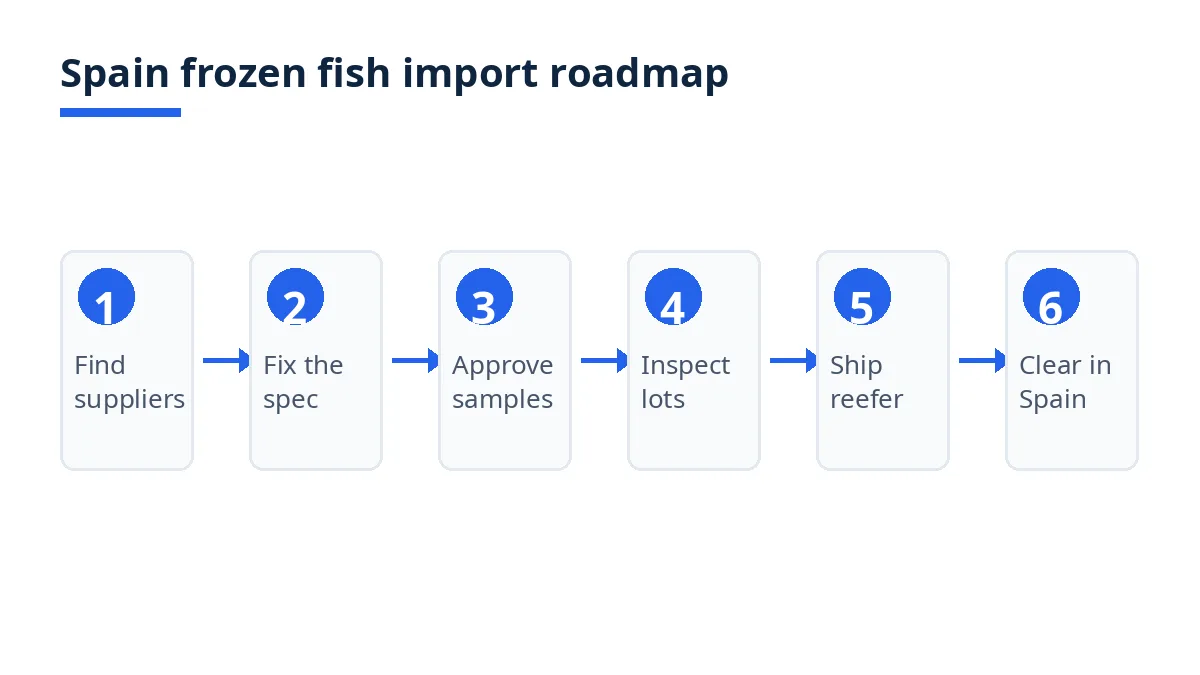
Fix the channel and pack; name the Spanish BCP and filing broker.
Classify on the exact line and confirm the TARIC rate with the broker.3
Agree who submits the TRACES NT notification and confirm its timing with the broker.2
Agree the catch or farm documents per lot, including the CATCH route and the three-working-day deadline.4 5
Check the plant on the current TRACES-NT list, and recheck before shipment.7
Agree the label facts and the Spanish commercial designation, and approve the Spanish artwork.8
Confirm the Bangladesh export file in writing for the exact line.9
Send one specification to every supplier; compare on the same terms.
Verify the supplier in three layers: listing, document discipline, and Bangladesh-side readiness.
Agree inspection, weight checks, and holding temperature in writing before production.
Ship on the agreed delivery term, with the catch deadline met and the document pack in agreement.4 10
Clear the Spanish BCP checks, pay duty and IVA on the confirmed bases, and reconcile the actual landed cost.1 13
What is the typical MOQ for frozen fish from Bangladesh?
There is no single typical minimum, and no figure is stated here. The minimum is set per species, form, presentation, and pack format, Ask how the minimum splits, get the split in writing, and compare only on the identical specification.
How long does shipping take?
Production, sea transit, and Spanish clearance are separate blocks. Plan from the forwarder's current sailing schedule, and build backwards from the catch certificate deadline: at least three working days before the estimated time of arrival.4 Confirm the TRACES NT notification timing with the broker.
What import duty applies?
Duty follows the confirmed classification, entry date, and origin claim. The example line is freshwater fish on line 0303 89 10 00, shown with a third country duty of 8.00 percent on a 1 January 2023 tariff page, while other lines under the same subheading range from 0.00 percent to 22.00 percent.3 Treat every rate as indicative and confirm any preference claim with the broker. Under Everything But Arms, the European Union grants full tariff and quota-free imports for all goods from United Nations-defined least developed countries, except for arms,12 Spanish IVA is 21 percent at the standard rate, with food products under the 10 percent reduced rate on the opened tax page, subject to tax adviser confirmation.13
How do I verify a supplier?
Check the listing first: the plant must appear on the current TRACES-NT list, with no excluding restriction, and the country must be listed.7 Then check document discipline on a recent EU shipment, with the health certificate, catch certificate or farm documents, invoice, packing list, and bill of lading in agreement, including weights.6 Then check Bangladesh-side readiness for the exact line, confirmed in writing.9
Next steps on Exportain
When the Spanish BCP, the form, and the entry file are fixed, post a free RFQ with the species, form, glaze basis, and delivery term. Use the landed cost guide for imports from Bangladesh to rework the example with broker-confirmed figures, and see how to buy for the buying journey on Exportain.
Sources
- Import controls of food and feed Q&As. European Commission (accessed )
- Import. Ministry of Agriculture, Fisheries and Food (Spain) (accessed )
- Other - Subheading 030389, Northern Ireland Online Tariff. GOV.UK (accessed )
- Council Regulation (EC) No 1005/2008, Chapter III: Catch certification scheme for importation and exportation of fishery products. legislation.gov.uk, (accessed )
- CATCH - NEW EU SYSTEM. Sea-Fisheries Protection Authority (accessed )
- EU official health certificates for exports to the EU – explained. AGRINFO (accessed )
- Non-EU countries authorised establishments. European Commission (accessed )
- Regulation (EU) No 1379/2013 on the common organisation of the markets in fishery and aquaculture products. legislation.gov.uk, (accessed )
- Fish of the families Bregmacerotidae, Euclichthyidae, Wrapped/canned upto 2.5 Kg: export requirements, HS Code 03044410. Bangladesh Customs, National Board of Revenue, (accessed )
- Incoterms 2020 Explained: All 11 Rules. Blue Ocean Academy (accessed )
- Incoterms® 2020. International Chamber of Commerce (ICC) (accessed )
- Preferential European Union import tariffs for developing countries. EUR-Lex (accessed )
- Spanish VAT rates and VAT compliance. Avalara (accessed )
About the author
Sourcing from Bangladesh?
Post a request for quotation and suppliers on Exportain can send you their quotes directly.
Post an RFQ