Canada Frozen Fish Imports From Bangladesh: Admissibility-First Checklist
Canada frozen fish imports, admissibility-first: the AIRS check, SFC licence and preventive control plan, the IID declaration, Canadian tariff lines, GST, bilingual labelling, and a CAD 8.26 per kilogram landed-cost example.
Short answer
To import frozen fish from Bangladesh to Canada, check the requirement in AIRS for the exact species and form, hold an active SFC licence issued for importing food and the commodities, and file an Integrated Import Declaration with the licence number exactly as issued. Classify the fish on the Canadian 10-digit tariff line, confirm duty and GST with a broker, and agree the Fish List names and bilingual label before production. The CBSA accepts or rejects the declaration.
On this page
Key takeaways
Prove admissibility before pricing: the AIRS check, the SFC licence and preventive control plan, and an Integrated Import Declaration that the CBSA accepts decide whether the shipment enters.
Classify on the exact Canadian 10-digit line: freshwater fish on line 0303.89.00, suffix 80, and fillets on line 0304.89.00, suffix 80, are shown Free on the archived T2023 schedule, while livers, roes, and milt on line 0303.91.00 are shown at 3 percent MFN. Treat every rate as an indicative working figure.
Declare the SFC licence number exactly as issued in the IID Registration Number field; a rejected declaration denies entry until the error is corrected and the declaration is resubmitted.
Label with the Fish List common name in English and French, the country of last substantial transformation, and a lot code, and keep one-step-forward, one-step-back traceability records for two years.
Rework the CAD 8.26 per kilogram example landed cost with broker-confirmed duty and adviser-confirmed GST; no preference is claimed, and no typical MOQ, transit time, or temperature figure is stated.
To import frozen fish from Bangladesh to Canada, prove the shipment can enter before you agree a price. The Canadian decision is an admissibility decision: the importer checks the requirement in the Automated Import Reference System (AIRS), holds a valid Safe Food for Canadians (SFC) licence for the exact commodities, and files an import declaration that the Canada Border Services Agency (CBSA) accepts or rejects. This guide works the order in that sequence.
Prove admissibility before you price: the decision that governs the order
The commercial importing process runs in a fixed order: find the import requirements in AIRS, have the broker validate the commodity codes through the AIRS Verification Service (AVS), hold the licence the commodity requires, and submit an import declaration through the single window portal for an electronic admissibility decision. The Canadian Food Inspection Agency (CFIA) reviews the declaration and gives a recommendation to the CBSA, and the CBSA makes the final decision to accept or reject the shipment.1 Treat that decision as the gate for the whole order: do not place a purchase order, approve artwork, or book a reefer until the broker has run the AIRS check for the exact species, form, and pack and confirmed that the importer file is ready. A declaration can be submitted up to 90 days in advance, so the file can be tested early, while changes are still cheap.1 The National Import Service Centre (NISC) advises importers on how to use AIRS, but it cannot advise on Harmonized System (HS) classification, so classification stays with the broker.1
Run the AIRS check lot by lot: species, form, and the code that decides the file
AIRS identifies the import requirements for CFIA-regulated commodities, and the importer is responsible for consulting it regularly so the broker provides all the information and documentation required for release into Canadian commerce.2 Run the check for each lot, not once for the programme: a whole frozen fish, a frozen fillet, and frozen fish meat can carry different requirements even from the same species and plant, because the form changes the code and the code changes the file. The broker must declare the most appropriate HS code and Other Government Department (OGD) extension, and AIRS is the tool used to determine the requirements, the HS code, and the OGD extension.2 Use the AVS to validate that coding, since it reduces rejected electronic data interchange requests caused by incorrect entries or missing or invalid AIRS coding.2
Build the importer file: SFC licence, preventive control plan, and recall procedure
A licence is required to import food into Canada; apply through My CFIA, after checking whether a licence is needed with the CFIA licensing interactive tool.2 Commercial importers of fish and seafood have been required to hold an SFC licence since the Safe Food for Canadians Regulations (SFCR) came into force on January 15, 2019, and verification of the licence before import has been in place for these commodities since March 2021.3 Businesses must obtain the licence before presenting the shipment at the border, because a licence cannot be obtained at the border, and applications can take up to 15 business days, longer if complex.3 Before applying, build the two documents the licence rests on: a preventive control plan (PCP), a written document setting out the measures and controls that ensure the imported food is safe and complies with Canadian requirements, developed and implemented before applying and before importing; and a complaints and recall procedure, whose recall part must describe how a recall will be conducted and name the person responsible for maintaining it and the person responsible for conducting it.2 Simulate a recall once every 12 months using the written procedure and keep the details and results for two years.2 Check an existing licence against three tests before every shipment: it is active, it is issued for "Importing food," and it is issued for the commodities being imported.1 SFC licences are valid for two years, so diary the renewal before expiry.1
Classify the fish on the Canadian 10-digit line: 0303, 0304, and the 3 percent exception
Canada uses the Harmonized System as the basis of its classification, and the tariff classification number has 10 digits: the first six are the shared international code, and the next four are unique to Canada and set the duty rate and gather statistics.4 Heading 0303 covers fish, frozen, excluding fish fillets and other fish meat of heading 0304, and heading 0304 covers fish fillets and other fish meat, whether or not minced, fresh, chilled, or frozen.5 Read the classification guide for frozen fish before comparing quotations, and confirm the line with the broker: all headings here are indicative and must be verified against the current tariff for the entry date. The worked example uses line 0303.89.00, statistical suffix 80, other frozen fish, freshwater, measured in kilograms (KGM), shown with a Most-Favoured-Nation (MFN) tariff of Free on the archived T2023 schedule; the fillet counterpart, line 0304.89.00, suffix 80, is also shown as Free.5 Treat both as indicative working figures only, since the schedule page states that it is archived and unaltered since archiving, and have the broker confirm the rate on the current schedule for the exact line and the entry date. Line-by-line confirmation matters because the schedule is not uniformly Free: line 0303.91.00, livers, roes, and milt, is shown with an MFN tariff of 3 percent, with the Least Developed Country Tariff (LDCT) shown as Free.5 Put presentation, species, scientific name, size range, trim, and glaze basis in one specification and require replies in the same format.
Settle duty and GST on the broker's line: MFN working figure, LDCT, and the GST question
Duty follows the classification number and the country of origin. Once the correct 10-digit number is fixed, check which tariff treatment applies, because the rate of duty depends on the treatment.4 The MFN tariff applies to goods originating from all countries except Belarus, North Korea, and Russia, while preferential tariffs give reduced rates only when the goods qualify, with proof of origin on hand, and the claim must also meet the shipping requirements for that treatment, such as direct shipment.4 For Bangladesh, the mechanism to confirm is the LDCT, which provides duty-free treatment for virtually all goods from least developed countries (LDCs), except over-access, supply-managed dairy, poultry, and egg products, renewed in legislation to December 31, 2034.6 Bangladesh appears on both the General Preferential Tariff (GPT) and LDCT beneficiary lists on the Department of Finance page, which also records prospective United Nations graduation in 2026 with a stated intent to apply a three-year transition period retaining full tariff benefits.6 The broker must confirm, for the exact line and the entry date, the origin rules under Memorandum D11-4-4, the proof of origin, the shipping requirements, and whether the LDCT or GPT treatment applies. The landed-cost example claims no preference, since it uses the MFN Free working figure. GST is calculated on the total value of the goods plus applicable duties.4 The CBSA worked example converts US$100 at CAN$1.37 to a value for duty of CAN$137.00, applies 4 percent duty (CAN$5.48), adds duty to reach a value for tax of CAN$142.48, and applies 5 percent GST (CAN$7.12).4 Use that method as the model, declare the value for duty in Canadian currency only, and have the broker or tax adviser confirm whether an exemption code applies to the exact fish line: the CBSA notes that some goods, including basic groceries and agriculture and fishing products, are exempt from taxes, and a tax-exempt import must carry the correct exemption code on the commercial accounting declaration in CARM.4 This guide does not state that any frozen fish line is exempt.
File the import declaration: the IID, the licence number exactly as issued, and rejection handling
Provide the CFIA with information about each shipment, and submit the import declaration as much in advance as possible: an electronic declaration can be submitted up to 90 days before the shipment arrives at the border.2 Confirm that the licence, permit, or registration number is entered correctly on the declaration and submitted early to avoid delays at the border.1 The licence number must be declared exactly as issued: enter it in the "Registration Number" field in the Integrated Import Declaration (IID) exactly as it was issued, without any additional words, characters, or spaces, in the 8-digit alphanumeric format, for example A12B3CD4.2 All food importers that require an SFC licence must include a valid licence number on their import declaration, and importers that do not declare a valid licence may have shipments delayed or refused entry and may face enforcement action.3 If the transaction is rejected, the importer or broker receives one or more reject messages describing the reason, and the shipment will be denied entry until the error is corrected and the declaration is resubmitted; all import requirements must be met before the declaration can be accepted.2 Agree in writing, before booking, who files the IID, who holds the My CFIA account, who checks the reject messages, and who resubmits. No Canadian port is named in this guide, because no opened source supports a port choice for this route: choose the arrival point with the broker and forwarder on the inland destination and the inspection route, not on a headline freight rate.
Name the fish the Canadian way: Fish List common names, country of origin, and traceability labelling
Fish and fish products must be labelled with information necessary for public health and consumer protection, including the common name of the fish, net quantity, ingredients list, Nutrition Facts table, lot code or other unique identifier, and principal place of business where the food was manufactured.7 For imported prepackaged fish, the country of origin must be clearly identified on the label, as the country where the fish product was last substantially transformed, for example filleted or frozen, and additional information such as the location of catch, the type of fishing gear used, or sustainability-related claims can be included voluntarily, provided it is not false or misleading.7 Use only the common name listed for the species: the CFIA Fish List collects the French and English common names recognized by legislation or by which the fish is generally known, and only the listed name or names should be used for the species being sold or processed in Canada.8 The list also gives a Taxonomic Serial Number for each species, with scientific names verified against the Integrated Taxonomic Information System.8 Send the supplier the scientific name and the exact Fish List English and French names before artwork is approved, and require written confirmation that no other name will appear on the pack or carton. Keep traceability records one step forward and one step back for all foods imported, tracing to the immediate customer and the immediate supplier, with names, addresses, and dates, clear, readable, and accessible in Canada for two years, in English or French, and provided to the CFIA on request.7 2
Label in English and French for the channel that will sell it: retail packs and shipping containers
Mandatory information on consumer prepackaged food must be shown in both official languages, French and English, including core labelling requirements such as the common name and prescribed words or expressions for specific foods, while the name and principal place of business may be shown in either English or French.9 Agree the label for the channel before production: a retail pack and a shipping container follow different rules, and artwork approved for one channel does not automatically suit the other. Shipping containers destined to a commercial or industrial enterprise or an institution are generally exempt from bilingual labelling, provided they are not resold to consumers at retail and all mandatory information for shipping containers is provided in one official language, but if the same shipping container is offered for sale to consumers at retail, for example at a warehouse outlet, bilingual labelling requirements apply.9 Do not assume a specialty-food exemption: a specialty food must meet every condition in the regulatory definition, and the CFIA notes that the majority of imported foods are not considered specialty foods and are therefore not eligible for the exemption.9 Quebec has additional requirements concerning the use of French on products marketed in Quebec, so confirm the French-language position with a labelling adviser before artwork is approved if any pack will be sold there.9
Protect the lot in transit and leave prohibited fish out of the order
Frozen fish has its own rule in the SFCR. Section 108 provides that a licence holder storing frozen fish on a conveyance must protect all frozen fish from dehydration and oxidation, because dehydration can change the appearance of the fish and make it tough, dry, and less flavourful, and oxidation can lead to rancidity with undesirable flavour, colour, and texture.10 Common methods named in the guidance are appropriate packaging materials, glazing the fish, controlling the relative humidity of the storage room, or a combination of those methods.10 Write the protection method into the specification: the pack type, the glaze basis, and who controls humidity in the container, and agree the holding temperature in writing as a number with the supplier and the carrier, with the temperature record for the container required. No temperature figure is stated in this guide. Two imports are not permitted at all, and the AIRS check must screen for them before the order is placed: under section 105, live freshwater mitten crab of the genus Eriocheir and puffer fish of the family Tetraodontidae must not be imported, including for personal use.10 The shellfish rules in section 106, which restrict live or raw shellfish to countries and establishments under a recognized inspection system, govern shellfish, not finfish, so do not apply shellfish establishment lists to a finfish order or borrow a shrimp or shellfish document list for a fish line.
The Bangladesh-side file for the exact line: export licence, NOC, salubrity, and farm registration
The Bangladesh-side file must be confirmed for the exact line being ordered, in writing, before loading. On one fish line, HS 0304 44 10, the Bangladesh Customs hub records an export licence from the regional Department of Fisheries authority, a no objection certificate (NOC) for export, and a salubrity certificate, all before export, plus a certificate for illegal, unreported, and unregulated fisheries where the fish was extracted from marine sources, and permission from the Ministry of Environment, Forest and Climate Change where the fish is genetically modified.11 The same hub page records farm registration for fish produced on a registered farm, and plant management under a Quality Assurance Programme based on HACCP.11 That hub page covers one line only, and its own notes state that the information has no legal purpose and that the list of documents and compliances may not always be exhaustive.11 Ask the supplier to name every document applying to the exact line being ordered, and have the broker confirm the list before loading; the hub page also lists an agroproducts exporter licence under the Agricultural Marketing Act for the line it covers, so confirm whether that item applies to the ordered line rather than assuming a document from one line transfers to another.
Why Bangladesh fits a Canadian frozen fish order
Bangladesh fits a Canadian order where one plant can run a stated species and form, in stated packs, with the Canadian file already in routine use. The tariff structure rewards precision: the freshwater suffix on lines 0303.89.00 and 0304.89.00, the separate treatment of livers, roes, and milt on line 0303.91.00, and the LDCT mechanism all turn on the exact line and the exact lot.5 6 A supplier who can answer, lot by lot, with the scientific name, the form, the glaze basis, and the Fish List names is easier to put into a PCP than a supplier who answers with a headline price. Fix the channel first, then the specification, then the supplier search.
Find and check suppliers against the Canadian file
Browse suppliers on Exportain and read each profile for the species, forms, and pack formats it actually runs, against the Canadian specification, not a headline price. Shortlist three or four suppliers and send each the identical specification, including the AIRS code, the tariff line, the Fish List names, the label channel, and the protection method. On Exportain, supplier profiles carry document and photo review badges, not a factory inspection or a guarantee, and Exportain is not a party to the contract for the goods. The importer is responsible for ensuring the foreign supplier manufactures, prepares, stores, packages, or labels the food under the same conditions required in Canada, and the supplier must be aware of Canadian requirements and able to provide the information needed to demonstrate that food safety controls are in place.2 The documentation needed depends on the supplier type: a supplier under a CFIA recognition arrangement, a supplier under an internationally recognized third-party certification programme, or a supplier under neither, where written confirmation of the preventive controls, a product and process description, and a signed statement from the process authority or technically competent person are required.2 Ask which type applies, get the answer in writing, and file the evidence in the PCP. Check document discipline on a recent shipment, with names and prices removed, confirming that the invoice, packing list, and label agree on species, form, quantity, weights, and marks.
MOQ, pricing, and samples without a stated typical minimum
There is no single typical minimum for frozen fish from Bangladesh, and this guide states none: the minimum is set per species, form, presentation, and pack format, because raw material is bought and processed in lots. Ask how the minimum splits in writing, per species, per form, per size, and per pack. Read the frozen fish MOQ guide before comparing minimums, and compare only on the identical specification, delivery term, and document set, with price inclusions in writing and the net or glazed weight basis stated. Know the food before pricing: the type of food, its common name, the quantity, and the packaging, plus the hazards reasonably expected to occur and how the supplier addresses them.2 Approve each sample in writing, keep one sealed counter-sample per presentation, and confirm that the sample label carries the Fish List names and the lot code the bulk shipment will carry.
Quality control, cold chain, and the reefer leg
Agree the holding temperature in writing as a number, the temperature record for the container, and the check on arrival, plus how net weight is verified: drained weight, glaze percentage, and size and count tolerance. Use the frozen fish quality control checklist for the inspection plan, and keep the supplier documents that demonstrate the PCP is effective for two years after the day each document is prepared.2 Plan from the forwarder's current sailing schedule in three blocks kept separate: production time, sea transit, and Canadian declaration, inspection, clearance, and delivery. No transit figure is stated here. Ask in writing who books the reefer, who files the IID, who clears the Canadian import, who holds the SFC licence, and who pays duty and GST, and protect the fish on the conveyance as section 108 requires, by the packaging, glazing, and humidity method written into the specification.10 If a complaint arrives after delivery, keep a record, decide whether the food represents a risk to health or a failure to meet SFCR requirements, notify the CFIA if it does, and keep the complaint and follow-up records for two years.2
Delivery terms: FCA for containers, the CIF and CIP insurance split, and the D-group choice
The Incoterms 2020 rules number eleven and give a clear allocation of cost, risk, and obligations, in use globally since 1936 and updated in 2020.12 They decide who arranges carriage, who clears customs, where delivery happens, and where risk passes, and they say nothing about the price of the goods, the payment method, or when title transfers.13 Seven rules apply to any mode of transport: EXW, FCA, CPT, CIP, DAP, DPU, and DDP. Four apply only to sea and inland waterway transport: FAS, FOB, CFR, and CIF.13 For containerised frozen fish, weigh FCA at the named terminal against FOB at Chattogram, since containers are usually handed over at an inland depot rather than at the ship's rail, and FCA is the workhorse term for containerised freight, including frozen food.13 Under FCA for carriage by sea, the parties can agree that the buyer instructs the carrier to issue an on-board bill of lading to the seller once the goods have been loaded.12 Under CIF, reserved for maritime trade, Institute Cargo Clauses (C) remains the default level of cover, while CIP requires the higher all-risks cover under Clauses (A), and both must cover at least 110 percent of the contract value.12 13 In the C-group rules the seller pays freight to the destination but risk passes to the buyer at origin, so a buyer who reads a CIF price as seller's risk until arrival is reading it wrong.13 Under DAP the seller carries cost and risk to the named destination and the buyer handles import clearance; under DPU the seller also unloads; under DDP the seller clears for import and pays duty and tax, which means the seller must be able to perform the Canadian import file, including the SFC licence position. Name the rule, the named place, and the edition in the contract, and agree the reefer booking, the IID filing, and the insurance top-up in the same document.
Landed cost example in Canadian dollars
A landed cost is the full cost of one kilogram of frozen fish, cleared and delivered to the buyer's cold store in Canada. Every number below is an example figure only, for 1,000 kilograms net weight of freshwater fish on line 0303.89.00, statistical suffix 80, shipped by sea from Chattogram, with duty at the indicative MFN Free working figure from the archived T2023 schedule and GST at 5 percent on the value for duty plus duty, and no preference claim.5 4
Example figures: per kilogram, net weight, Canadian dollars.
Cost element | Example figures (per kg) | How to obtain your figure |
|---|---|---|
Product price, FOB Chattogram | 6.20 CAD | Pro forma invoice |
Freight and insurance, per kg | 0.85 CAD | Forwarder quotation |
Value for duty, per kg | 7.05 CAD | Price plus freight and insurance |
Duty at indicative MFN Free working figure | 0.00 CAD | Broker calculation on the current tariff line |
CBSA, CFIA, clearance, and broker fees, per kg | 0.48 CAD | Broker and carrier invoices |
Delivery to cold store, per kg | 0.38 CAD | Local carrier quotation |
Total landed cost before GST, per kg | 7.91 CAD | Sum of all lines above |
GST at 5 percent of value for duty plus duty, in this example | 0.35 CAD | Broker or tax adviser |
Total landed cost including GST, per kg | 8.26 CAD | Sum of all lines above |
If the broker confirms an exemption code or a zero-rated treatment for the exact line, remove the 0.35 CAD GST line and use 7.91 CAD per kilogram as the total, as an example only until the broker confirms the treatment in writing.4 Read the general guide to importing from Bangladesh and the landed cost guide for imports from Bangladesh to rebuild the example with broker-confirmed figures for your lot.
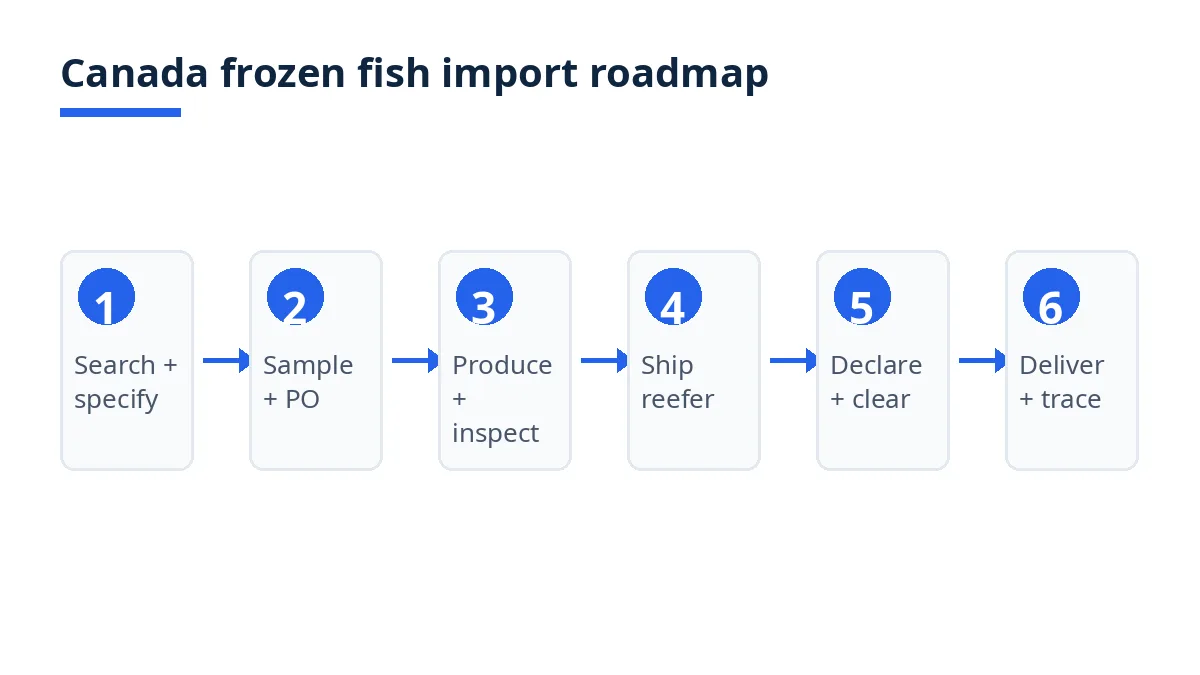
Canada fish import sequence, step by step
Fix the Canadian channel and pack, and name the label channel.
Run the AIRS check for the exact species, form, and pack; record the HS code and OGD extension.1 2
Classify on the exact 10-digit line; confirm the current-schedule rate with the broker.5 4
Build the importer file: PCP, complaints and recall procedure, and SFC licence checks.3 2
Agree the Fish List names and country-of-origin wording; approve the artwork.7 8
Confirm the Bangladesh export file for the exact line in writing.11
Send one specification to every supplier; compare quotations on the same terms.
Verify the supplier under the PCP foreign-supplier rules; check document discipline.2
Agree inspection, weight verification, and the section 108 protection method.10
File the IID early, licence number exactly as issued; clear any reject message.1 2
Ship on the agreed delivery term, reefer, insurance, and declaration duties in writing.12 13
Clear the CBSA decision, reconcile the landed cost, and file traceability records for two years.1 2
What is the typical MOQ for frozen fish from Bangladesh?
There is no single typical minimum, and no figure is stated here. The minimum is set per species, form, presentation, and pack format. Ask how the minimum splits, get the split in writing, and compare only on the identical specification.
How long does shipping take?
Production, sea transit, and Canadian declaration, inspection, clearance, and delivery are separate blocks. Plan from the forwarder's current sailing schedule, and build backwards from the declaration: the IID can be submitted up to 90 days before arrival, and a rejected declaration denies entry until the error is corrected and resubmitted.1 2 No transit figure is stated in this guide.
What import duty applies?
Duty follows the confirmed classification, entry date, and origin claim. The example line is freshwater fish on line 0303.89.00, suffix 80, shown with an MFN tariff of Free on the archived T2023 schedule, while line 0303.91.00 for livers, roes, and milt is shown at 3 percent MFN.5 Treat every rate as an indicative working figure, verify it on the current Canadian tariff line, and confirm any LDCT or GPT claim with the broker.4 6 GST is calculated on the value for duty plus duty, at 5 percent in the CBSA worked example, subject to confirmation of any exemption code.4
How do I verify a supplier?
Check the importer's own file first: the PCP, the recall procedure, and the SFC licence must be ready, and the supplier must demonstrate in writing that the food is prepared under conditions providing at least the same level of protection as the SFCR.2 Then check which foreign-supplier assurance type applies, and check document discipline on a recent shipment, with the invoice, packing list, and label in agreement, and confirm the Bangladesh-side file for the exact line.2 11
Next steps on Exportain
When the AIRS check, the tariff line, and the label channel are fixed, post a free RFQ with the species, scientific name, form, glaze basis, and delivery term. Use the landed cost guide for imports from Bangladesh to rework the example with broker-confirmed figures, and see how to buy for the buying journey on Exportain.
Sources
- Commercial importing process: at a glance. Canadian Food Inspection Agency, (accessed )
- Importing food to Canada: a step-by-step guide. Canadian Food Inspection Agency (accessed )
- Customs Notice 24-03: Safe Food for Canadians (SFC) licence to import food to Canada. Canada Border Services Agency, (accessed )
- Select the duties and taxes that apply. Canada Border Services Agency (accessed )
- Chapter 3: T2023 — Fish and crustaceans, molluscs and other aquatic invertebrates. Canada Border Services Agency (accessed )
- Canada's unilateral tariff preference programs for imports from developing countries. Department of Finance Canada (accessed )
- Fish and seafood labelling and traceability requirements. Canadian Food Inspection Agency, (accessed )
- Guidance on determining the common names for fish sold or processed in Canada. Canadian Food Inspection Agency (accessed )
- Bilingual food labelling. Canadian Food Inspection Agency (accessed )
- Regulatory requirements: Fish. Canadian Food Inspection Agency (accessed )
- Fish of the families Bregmacerotidae, Euclichthyidae, Wrapped/canned upto 2.5 Kg: export requirements, HS Code 03044410. Bangladesh Customs, National Board of Revenue, (accessed )
- Incoterms® 2020. International Chamber of Commerce (ICC) (accessed )
- Incoterms 2020 Explained: Complete Guide (2026 Update). Inecta (accessed )
About the author
Sourcing from Bangladesh?
Post a request for quotation and suppliers on Exportain can send you their quotes directly.
Post an RFQ