Australia Frozen Fish Imports From Bangladesh: BICON-First Guide
Australia frozen fish imports from Bangladesh, BICON-case first: the pathway the form and family decide, Free duty on the tariff line, IFIS testing by species and form, the certificate, labelling, and an AUD 6.89 per kilogram landed-cost example.
Short answer
To import frozen fish from Bangladesh to Australia, run the current BICON case first: the answers on form, family, and origin decide the pathway, the permit answer, and the certificate wording. Classify the fish on the exact 0303 or 0304 tariff line and statistical code, answer the three IFIS testing forks, and confirm Free duty as indicative and the GST treatment with a broker and tax adviser before ordering.
On this page
Key takeaways
Run the current BICON case before pricing: form, family, origin, and processing answers decide the pathway, the import permit answer, and the certificate wording, and conditions must not be carried from one pathway to another.
Form decides classification: whole frozen fish falls under heading 0303 and fillets and fish meat under heading 0304, with statistical codes and farmed or not-farmed splits that must be confirmed line by line; every line read shows Free duty, treated as indicative.
Answer all three IFIS forks lot by lot: Listeria testing for ready-to-eat finfish, histamine limits for the seven susceptible families, and antimicrobial residue testing with no detectable amount for farmed species.
The government certificate on the eviscerated pathway must carry five statements, the establishment name, address, and approval number, and the consignor and consignee, and the label must meet Standard 1.2.1 and country-of-origin requirements before production.
Rework the AUD 6.89 per kilogram example landed cost including GST (AUD 6.31 excluding GST) with broker-confirmed duty and adviser-confirmed GST; no typical MOQ, transit time, price, or holding-temperature figure is stated.
This guide explains how to import frozen fish from Bangladesh to Australia by settling the Australian biosecurity pathway first, before any discussion of price. Australia runs two gates in sequence: biosecurity import conditions under the Biosecurity Act 2015, checked through the Biosecurity Import Conditions system (BICON), and then food safety inspection under the Imported Food Control Act 1992 through the Imported Food Inspection Scheme (IFIS).1 Every duty and tax figure here must still be confirmed by a broker and tax adviser for the exact line and entry date.
Run the BICON case before you price: form, family, and origin decide the pathway
Australia does not apply one finfish rule to every shipment. BICON asks a sequence of questions, and the answers fix which conditions apply: bony fish or cartilaginous fish, consumer-ready form or not, personal or non-personal use, caught in international waters or not, an approved competent authority or not, eviscerated or not, and dried or frozen.2 Do not carry conditions from one pathway into another.
The finfish case here excludes fish from the family Salmonidae and the genus Plecoglossus, so salmon and trout need a separate BICON run.2 It covers whole fish, gilled or gutted fish, fillets, consumer-ready products, caviar, roe, viscera, maw, and fish sauce, for end uses including human consumption, and applies only to the finfish component of a composite product, so a mixed product needs a run for each ingredient.2 Bangladesh appears in the case table as not on the non-permitted list for one stated pathway: bony fish, not consumer-ready, non-personal use, not caught in international waters, from a country other than New Zealand or a country with an approved competent authority, not eviscerated, not farmed, and dried.2 That entry settles only that pathway. A commercial order answering eviscerated and frozen needs its own run, on the day the specification is fixed, since BICON cases are session-based and change over time.
On the pathway the writer opened in full, for eviscerated bony fish with an approved competent authority, no Department of Agriculture, Fisheries and Forestry (DAFF) import permit is required.2 That is a pathway result, not a general rule: fish not processed to an acceptable level can require a permit.2 Confirm the permit answer for your pathway in writing from the current BICON run before you order.
Classify the fish on the Australian tariff line: 0303, 0304, and the statistical code
Form decides the heading. Heading 0303 covers fish, frozen, excluding fish fillets and other fish meat of heading 0304, and heading 0304 covers fish fillets and other fish meat, whether or not minced, fresh, chilled, or frozen.3 A whole frozen tilapia and a frozen tilapia fillet are therefore different tariff entries, even from the same pond and plant. Inside heading 0303, the Australian schedule splits by family and species group: tilapias at 0303.23.00, catfish at 0303.24.00, carp at 0303.25.00, flat fish at 0303.31.00 to 0303.39.00, tunas at 0303.41.00 to 0303.49.00, the cod family at 0303.63.00 to 0303.69.00, and other fish at 0303.89.00.3 Inside heading 0304, frozen fillets sit at 0304.61.00 to 0304.69.00, 0304.71.00 to 0304.79.00, and 0304.81.00 to 0304.89.00, with other frozen fish meat at 0304.91.00 to 0304.99.00.3 Read the classification guide for frozen fish alongside the tariff, and confirm the line per presentation, not per species alone.
Every line the writer read, from 0303.11.00 through 0304.99.00, shows a rate of Free, including whole frozen tilapia at 0303.23.00 (statistical code 51) and other fish at 0303.89.00 (statistical code 80).3 Treat Free as indicative until the broker confirms it on the exact line, statistical code, and entry date. Fillet lines split further by farmed and not farmed at 0304.89.00 and 0304.99.00, so an entry omitting that split is incomplete even with the right six-digit subheading.3
Pass the second gate: which IFIS tests your species and form attract
Biosecurity clearance comes first. DAFF states that all biosecurity requirements must be met before IFIS requirements apply, and that BICON is the place to check the biosecurity conditions.1 IFIS then inspects imported food for public health and safety, compliance with the Australia New Zealand Food Standards Code, and compliance with the Country of Origin Food Labelling Information Standard 2016.1 Three testing forks can apply to frozen fish. Answer all three lot by lot, before production.
IFIS fork | When it applies | Test and permitted result |
|---|---|---|
Ready-to-eat finfish | Cooked, cured, or smoked finfish needing refrigeration, no further cooking before eating | Listeria monocytogenes; supports growth: not detected in 25 g; does not support growth: 100 cfu/g |
Histamine-susceptible fish | Seven named families, or products over 300 g per kg of those fish | Histamine; maximum 200 mg/kg |
Fish from aquaculture production | Species identified as used in aquaculture, fresh, chilled, or frozen | Antimicrobial residue test; no detectable amount permitted |
The first fork covers ready-to-eat finfish only: cooked, cured, or smoked finfish, excluding dried, pickled, salted, fermented, and retorted shelf-stable products, and excluding food from New Zealand.4 DAFF refers finfish that supports the growth of Listeria monocytogenes for testing at an initial rate of 100 percent of consignments until compliance is shown, and finfish that does not support growth at 5 percent, with a visual and label assessment in both cases.4 At declaration, the importer must answer whether the goods are cooked, cured, or smoked finfish requiring refrigeration and needing no further cooking before consumption.4
The second fork covers histamine-susceptible fish, classified as risk food: all fish in the families Carangidae, Clupeidae, Coryphaenidae, Engraulidae, Pomatomidae, Scomberesocidae, and Scombridae, and products containing more than 300 grams per kilogram of any of those fish, whole, fillet, or portion, raw or processed.5 The declaration question asks whether the goods are or contain more than 300 grams per kilogram of fish of those families, and the test limit is 200 milligrams per kilogram.5 Certification arrangements named on the page cover Canada and Thailand only, so do not assume a reduced testing rate for a Bangladesh lot.5
The third fork covers fish from aquaculture production, fresh, chilled, or frozen, excluding food from New Zealand.6 DAFF refers certain species for antimicrobial residue testing at 5 percent, with a visual and label assessment, and the permitted result is no detectable amount for the listed residues, including malachite green, fluoroquinolones, and quinolones.6 The species table names pangasius including basa, catfish, tilapia, carp including catla and rohu, milkfish, snakehead, barramundi, Nile perch, eel, and salmon and trout.6 A farmed pangasius or tilapia order therefore attracts residue testing that a wild-caught order of a different species may not.
Get the government certificate worded to the BICON pathway
The certificate must match the pathway, not a generic health certificate template. On the eviscerated pathway the writer opened, compliance must be shown on an official government certificate carrying five statements: the fish were processed in premises approved by and under the control of a competent authority; the fish were eviscerated; the fish were subjected to an inspection system supervised by a competent authority; the head and gills were removed and internal and external surfaces thoroughly washed; and the product is free from visible lesions associated with infectious disease.2 The certificate must also bear the name, address, and approval number of the processing establishment, and the name and address of the consignor and consignee, and the competent authority is found on the department's list for finfish and seafood.2 Ask for a sample certificate, with commercial details removed, showing all five statements and the establishment block, and check it against the current pathway before production.
The five statements belong to one stated pathway. A consumer-ready, cartilaginous, international-waters, or not-eviscerated pathway carries different conditions, so re-check the wording whenever the BICON answers change. Commercial documents must identify the consignment and all the goods in it.2 Agree who obtains the certificate, from which authority, and by what date, and hold loading until it has been checked line by line.
Label for the Australian sale: Food Standards Code contents and country of origin
Label decisions belong before production, because a carton printed in Bangladesh cannot be relabelled cheaply in Australia. For food for retail sale in a package, Standard 1.2.1 of the Australia New Zealand Food Standards Code requires the label to carry the name of the food, lot identification, the name and address of the supplier, advisory and warning statements and declarations where required, a statement of ingredients, date marking, storage conditions and directions for use, and nutrition information where required.7 Formed or joined fish carries an additional requirement under the same standard, so a minced, formed, or joined product needs a separate label check before artwork is approved.7 Agree the full label text, including lot identification tying the pack to the certificate lot, in writing.
Country of origin labelling is checked separately: IFIS checks compliance with the Country of Origin Food Labelling Information Standard 2016, alongside the Food Standards Code.1 Confirm the current statement, format, and placement for the selling channel with the broker or a labelling adviser, and record it in the specification. Do not copy a European designation or a United States mark into this order. The label, certificate, invoice, and packing list must agree on species, form, and origin before the container is sealed.
Where Bangladesh supply meets the Australian tests
Bangladesh supply fits an Australian order where the species, form, and production system line up with the forks above, rather than where the headline price looks lowest. The aquaculture species table reads like a Bangladesh production list: pangasius, tilapia, carp, catfish, milkfish, and snakehead are all named.6 That overlap means Bangladesh plants routinely run the species Australia tests, and a farmed lot should be bought with residue testing in mind from the first enquiry, with the farm, feed and treatment history, and test record as part of the specification. Wild-caught lots need the opposite discipline: the wild-caught position must be stated in terms the certificate and declaration can use.
With Free shown across the 0303 and 0304 lines the writer read, duty does not decide the supplier choice on the opened schedule.3 The choice turns on whether the plant can run the stated species and form, meet the five certificate statements, and hold cold chain and weight discipline. Buy for the file first: one plant, one species and form, one pack format, one certificate lot per order line.
The Bangladesh-side file for the exact line: licence, NOC, salubrity, and farm registration
The Bangladesh export file is specific to the tariff line, and this guide states it for one line only. On HS 0304 44 10, for fish of the families Bregmacerotidae and Euclichthyidae and related families, wrapped or canned up to 2.5 kilograms, the Bangladesh Customs hub records a licence for export, a no objection certificate, and a salubrity certificate, all before export, each through the Deputy Director, Fish Inspection and Quality Control, Department of Fisheries, under the Fish and Fish Products (Inspection and Quality Control) Act, 2020.8 Where the fish was extracted from marine sources, an IUU certificate is also required under the Marine Fisheries Rules, 2023, and where the fish was produced on a registered farm, farm registration applies, with the plant managed under a Quality Assurance Programme based on HACCP.8 The hub states that its list may not always be exhaustive and has no legal purpose.8 Ask the supplier to name every document for the exact line of your order, in writing, and do not transfer the 0304 44 10 list to a 0303 line or a different 0304 line without confirmation.
Find and check suppliers against the Australian file, not the price list
Browse suppliers on Exportain and read each profile for the species, forms, and pack formats it actually runs. Shortlist three or four suppliers and send each the identical specification, including the BICON answers, tariff line and statistical code, IFIS fork answers, certificate statements, label text, and delivery term.
Verification has three layers, all before any payment beyond an agreed sample charge. First, the pathway: the plant must meet the five certificate statements on the current BICON pathway, with the establishment details that will appear on the certificate.2 Second, document discipline: ask for a sample document set from a recent Australian or comparable shipment, with names and prices removed, and check that the certificate, invoice, packing list, and bill of lading agree on species, form, quantity, weights, lot, and marks. Third, Bangladesh-side readiness for the exact line, with the hub caveat that the list may not be exhaustive.8 On Exportain, profiles carry document and photo review badges, not a factory inspection or guarantee, and Exportain is not a party to the contract for the goods. See how to buy, and read the general guide to importing from Bangladesh before the first supplier call.
MOQ, pricing, and samples without a stated typical minimum
There is no single typical minimum for frozen fish from Bangladesh, and this guide states none. The minimum is set per species, form, presentation, size grade, and pack format, because raw material is bought and processed in lots. Ask how the minimum splits, in writing, per species, form, grade, and pack format, and convert every minimum to cartons, kilograms, and container loads on the same basis before comparing. Read the frozen fish MOQ guide first, and compare only on the identical specification. Record the change behind any lowered minimum, such as a dropped grade or a merged pack format, in the order.
Compare prices only on the identical specification, delivery term, and document set, with inclusions in writing and the net or glazed weight basis stated. Samples settle the specification, not the price: approve each sample in writing against species, form, grade, glaze, pack, and label, keep one sealed counter-sample per presentation, and do not start bulk production before the pre-production sample is approved.
Quality control, cold chain, and the reefer leg
Quality control is cold chain discipline, weight discipline, and lot identity, checked lot by lot. Agree the holding temperature in writing as a number, the container temperature record, the data logger position, and the arrival check, and agree how net weight is verified: drained weight after deglazing, glaze percentage, and size and count tolerance. This guide states no holding temperature figure, because no opened Australian source here sets one for frozen fish generally. Use the frozen fish quality control checklist, adapted to the Australian forks: histamine history and temperature control for the seven susceptible families, residue records for farmed lots, and the Listeria position for cooked, cured, or smoked product.5 6 4 Agree the inspection point, sampling plan, and acceptance rule before production, and hold any failing lot until the evidence is reviewed.
Sea freight in reefer containers is the standard route for bulk frozen fish. Plan from the forwarder's current sailing schedule in three blocks kept separate: production, sea transit, and Australian clearance, inspection, and delivery. No transit figure is stated here. Ask in writing who books the reefer, files the import declaration, answers a DAFF or IFIS inspection request, clears the import, and pays duty, GST, and charges.
Delivery terms and the Chattogram to Australia leg: FCA, CIF, CIP, and DDP
The Incoterms 2020 rules number eleven: seven for any mode of transport and four for sea and inland waterway transport only, namely FAS, FOB, CFR, and CIF.9 The four sea-only rules are intended for port-to-port bulk or break-bulk shipments and are not suitable for container shipments in their current form, since a container is handed to a carrier long before it reaches the ship.9 For containerised fish, weigh FCA at the named terminal against FOB at Chattogram: under FCA the seller delivers to the carrier named by the buyer, while under FOB the seller must place the goods on board the vessel.9 Risk passes at the same point and time as delivery in every rule, and only CIP and CIF oblige the seller to provide insurance; the C and D rules place the freight contract with the seller, the E and F rules with the buyer.9 In all rules except EXW the seller carries out export formalities, and in all rules except DDP the buyer carries out import formalities.9
Under CIF, the default cover remains Institute Cargo Clauses (C), with the option to agree higher cover, while CIP now requires the higher all-risks cover under Institute Cargo Clauses (A) or similar clauses.10 Under DDP the seller clears for import and pays duty and tax, placing the N10 declaration and GST position on a seller in Bangladesh, a burden to accept only where the seller has shown it can perform it. Under DAP the seller delivers to the named place without unloading; DPU, the renamed DAT, is the rule where the seller unloads.10 State the rule, named place or port, and Incoterms 2020 edition in the contract, and convert every quotation to the same delivery term before comparing prices.
Import duty, GST, and the N10 declaration: Free duty, VoTI, and the basic-food question
Duty follows the confirmed classification, entry date, and origin claim. Every line the writer read in Chapter 3, including whole frozen tilapia at 0303.23.00 and the frozen fillet blocks, shows Free, so the example carries duty at zero, labelled indicative until the broker confirms the line, statistical code, and any tariff concession order.3 No preference, quota, or concession route is claimed, and no duty figure from another country's tariff is transferred into this calculation.
GST turns on whether the importation is taxable. GST is payable on most goods imported into Australia, at 10 percent of the value of the taxable importation, collected by the Department of Home Affairs, and generally payable before release unless the importer is registered under the deferred GST scheme.11 The value of the taxable importation is the customs value, plus any customs duty payable, plus transport to the place of consignment in Australia, plus insurance for that transport, plus any wine tax payable.11 The Australian Border Force states the same formula as the value of the taxable importation, or VoTI.12 A GST-registered business importing goods as part of its activities may be able to claim a GST credit, and the deferred scheme allows an eligible importer to defer payment until the first activity statement lodged after importation.11
Whether GST is payable at all on frozen fish is for the broker and tax adviser, not a conclusion of this guide. Importations of goods that would have been GST-free if supplied in Australia are non-taxable importations, and basic food is named as an example.12 The same page warns that numerous definitions and criteria apply to food under GST legislation, and that the legislation must be checked to decide whether a specific commodity is taxable or exempt.12 This guide therefore shows the landed cost on the GST-payable basis and states the excluding-GST total alongside it, so a confirmed non-taxable treatment changes the total by exactly the GST line. Do not price on the excluding-GST total until the treatment is confirmed in writing for the exact product and form.
The declaration is the Import Declaration, form N10. It must be completed when imported goods have a combined value over AUD 1,000 and are cleared into home consumption, and all applicable duties, taxes, and charges must be paid before release.13 The declaration is a statement by the importer, the owner, or their agent, a licensed customs broker, covering the goods, importer details, transport, tariff classification, and customs value, submitted in the Integrated Cargo System or lodged as a signed document at an Australian Border Force counter.13 The importer remains responsible for it, the Border Force cannot complete it, and first-time or infrequent importers are encouraged to use a licensed customs broker.13 Keep all relevant documents for five years after the declaration.13
Landed cost example in Australian dollars
A landed cost is the full cost of one kilogram of frozen fish, cleared and delivered to the buyer's cold store. Every number below is an example figure only, for 1,000 kilograms net weight of whole frozen tilapia on line 0303.23.00, shipped by sea from Chattogram, with duty at the indicative Free rate, GST on the GST-payable basis at 10 percent of the value of the taxable importation, and no preference claim.3 11 The customs value is the FOB price, transport and insurance are added to reach the VoTI, and the GST line is rounded from AUD 0.575 to AUD 0.58 so the table adds up.
Example figures: per kilogram, net weight, Australian dollars.
Cost element | Example figures (per kg) | How to obtain your figure |
|---|---|---|
Product price, FOB Chattogram | 4.80 AUD | Pro forma invoice |
Freight and insurance, per kg | 0.95 AUD | Forwarder quotation |
Customs value, per kg | 4.80 AUD | FOB price in this example |
Duty at indicative Free rate | 0.00 AUD | Broker calculation on the tariff line |
Value of the taxable importation, per kg | 5.75 AUD | Customs value plus duty plus freight and insurance |
GST at 10 percent of the value of the taxable importation, in this example | 0.58 AUD | Broker and tax adviser |
Border, clearance, and broker fees, per kg | 0.32 AUD | Broker and clearance invoices |
Delivery to cold store, per kg | 0.24 AUD | Local carrier quotation |
Total landed cost including GST, per kg | 6.89 AUD | Sum of all lines above |
Total landed cost excluding GST, per kg | 6.31 AUD | Total above less the GST line |
If the broker and tax adviser confirm a non-taxable treatment, use AUD 6.31 per kilogram and keep the confirmation with the order file.12 If the broker confirms a duty position, rework the VoTI, because GST is charged on customs value plus duty plus transport and insurance.11 Use the landed cost guide for imports from Bangladesh to rework the example with broker-confirmed figures, and recalculate for every order.
Australia frozen fish import sequence, step by step
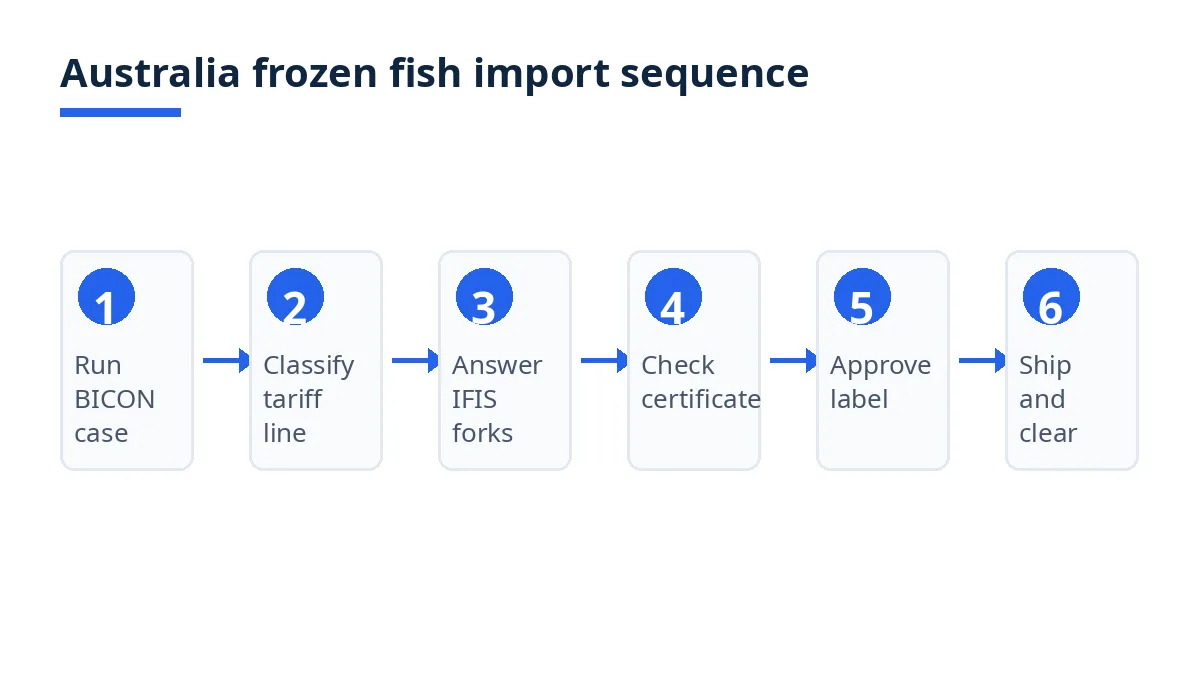
Fix the species, scientific name, form, and channel, and answer the BICON questions for that combination.2
Run the current BICON case, print the pathway, and confirm the import permit answer in writing.2
Classify on the exact tariff line and statistical code, and confirm the Free rate as indicative with the broker.3
Answer the three IFIS forks: ready-to-eat Listeria, histamine families, and aquaculture residues.4 5 6
Agree the certificate wording, with the five statements and establishment block, and check it before loading.2
Agree the label contents and country of origin statement, and approve the artwork.7 1
Confirm the Bangladesh export file in writing for the exact line, including the hub caveat.8
Send one specification to every supplier and compare quotations on the same delivery term and weight basis.
Verify the supplier in three layers: pathway, document discipline, and Bangladesh-side readiness.
Agree inspection, sampling, and weight verification, including the IFIS fork tests, before production.
Ship on the agreed delivery term, with the certificate checked and lot identity intact.9
Lodge the N10 declaration over AUD 1,000, pay duty, GST, and charges as assessed, and keep the file for five years.13
What is the typical MOQ for frozen fish from Bangladesh?
There is no single typical minimum, and no figure is stated here. Ask how the minimum splits per species, form, grade, and pack format, convert every minimum to cartons, kilograms, and container loads, and compare only on the identical specification. The frozen fish MOQ guide explains the batch logic behind the number.
How long does shipping take?
Production, sea transit, and Australian clearance, inspection, and delivery are separate blocks. Plan from the forwarder's current sailing schedule, build backwards from the certificate and declaration dates, and allow time for a DAFF or IFIS inspection referral on arrival. No transit figure is stated here.
What import duty applies?
Duty follows the confirmed classification, entry date, and origin claim. Every line the writer read in Chapter 3, including whole frozen tilapia at 0303.23.00, shows Free, so the example carries duty at zero, labelled indicative until the broker confirms the line, statistical code, and any tariff concession order.3 GST is separate: 10 percent of the value of the taxable importation where taxable, on customs value plus duty plus transport and insurance, with the basic-food question left to the broker and tax adviser.11 12
How do I verify a supplier?
Check the pathway first: the plant must meet the five certificate statements on the current BICON pathway, with the establishment details that will appear on the certificate.2 Then check document discipline on a recent comparable shipment, with certificate, invoice, packing list, and bill of lading in agreement. Then check Bangladesh-side readiness for the exact line, with the hub caveat.8
Next steps on Exportain
When the BICON pathway, tariff line, and IFIS forks are fixed for your species and form, post a free RFQ with the species, scientific name, form, grade, glaze basis, and delivery term. Use the landed cost guide for imports from Bangladesh to rework the example with broker-confirmed figures, and see how to buy for the buying journey on Exportain.
Sources
- Imported food legislation. Department of Agriculture, Fisheries and Forestry (accessed )
- BICON - Import Conditions: Finfish (excluding Salmonid) for human consumption. Department of Agriculture, Fisheries and Forestry (accessed )
- Chapter 3: Fish and crustaceans, molluscs and other aquatic invertebrates, Australian Customs Tariff. Australian Border Force (accessed )
- Processed finfish. Department of Agriculture, Fisheries and Forestry (accessed )
- Histamine susceptible fish. Department of Agriculture, Fisheries and Forestry (accessed )
- Fish from aquaculture production. Department of Agriculture, Fisheries and Forestry (accessed )
- Australia New Zealand Food Standards Code - Standard 1.2.1 Requirements to have labels or otherwise provide information. Food Standards Australia New Zealand (accessed )
- Fish of the families Bregmacerotidae, Euclichthyidae, Wrapped/canned upto 2.5 Kg: export requirements, HS Code 03044410. Bangladesh Customs, National Board of Revenue, (accessed )
- Insider thoughts: Bob Ronai on Incoterms 2020 Rules; What are they about?. International Chamber of Commerce (accessed )
- Incoterms® 2020. International Chamber of Commerce (ICC) (accessed )
- GST and imported goods. Australian Taxation Office (accessed )
- GST and other taxes when importing. Australian Border Force (accessed )
- Import declarations. Australian Border Force (accessed )
About the author
Sourcing from Bangladesh?
Post a request for quotation and suppliers on Exportain can send you their quotes directly.
Post an RFQ