USA Electrical Cable Imports From Bangladesh: Step-by-Step Guide
Cable construction, NRTL and NEC checks, supplier evidence, shipping and a broker-confirmed duty file for importing electrical cables from Bangladesh to the USA, with a worked landed-cost example.
Short answer
Importing electrical cables from Bangladesh to USA succeeds when the cable is defined on paper first: conductor, insulation and voltage rating fixed in one specification, NRTL listing evidence and NEC permitted use checked for the exact construction, classification under heading 8544 settled with the broker, and price set on a worked landed cost with duty confirmed in writing.
On this page
Key takeaways
Fix conductor metal, construction, insulation family, voltage rating, cores, armour and sheath in one specification before asking for a price, and state the sizing system used.
Hold the NRTL listing or certification record for the exact cable construction in the certification database, and confirm the NEC cable type and permitted use with the installer or authority having jurisdiction.
IEC 60502 proves construction and test performance; it does not by itself place a cable on the United States market, so hold the IEC file and the United States listing file for the same construction.
Heading 8544 separates winding wire, coaxial cable, conductors up to 1,000 V fitted or not fitted with connectors, conductors over 1,000 V and optical fiber cables; the broker confirms the ten-digit line and duty in writing.
File the ISF elements named in 19 CFR 149.2 no later than 24 hours before the cargo is laden aboard the vessel, and price on a worked landed cost reworked with broker-confirmed duty.
Importing electrical cables from Bangladesh to USA succeeds when the cable is defined on paper first and the United States file is settled before price is discussed. A cable is not one product. Conductor metal, conductor construction, insulation, voltage rating, number of cores, armour and sheath change the standard that applies, the test evidence a buyer must hold, the customs subheading and the way the cable may be installed. This guide works through those decisions in the order a buyer should make them, for power and control cables shipped in reels and containers from Bangladesh to a United States port, and it leaves duty to broker confirmation because no United States tariff schedule for heading 8544 was opened in this run.
Start with the cable on paper, not the catalogue price
Write one description and use the same words in the enquiry, the quotation, the sample request, the purchase order, the inspection instruction and the customs file. Start with the job the cable will do: fixed installation in a building, fixed installation outdoors or buried, control wiring inside equipment, or a flexible cord that will move. Then fix the electrical facts: rated voltage, number of cores, conductor metal and cross-sectional area, insulation material, and whether the cable needs armour, a screen or a sheath for the place it will run.
Conductor choice is the first fork. IEC 60228:2023 covers conductors of insulated cables in metric sizes from 0.5 mm2 to 3,500 mm2, including solid, stranded and Milliken copper, aluminium and aluminium alloy conductors for fixed installations and flexible copper conductors, and it sets nominal cross-sectional areas together with wire numbers, sizes and resistance values.1 That matters for a buyer in two practical ways. First, copper and aluminium conductors of the same nominal area do not behave the same way, so a quotation that swaps metal without changing area, termination and price basis is a different cable. Second, United States practice sizes many building wires in AWG and kcmil, while IEC-based supply is sized in square millimetres, so the specification must state the sizing system, the exact area or gauge, and the conductor class or construction, and must not let a supplier convert silently between systems.
Insulation is the second fork. The common families a buyer will meet are PVC (polyvinyl chloride, a thermoplastic) and XLPE (cross-linked polyethylene, a thermoset), with rubber compounds in some constructions. Do not accept a trade name or a catalogue code in place of the insulation family, the rated voltage and the temperature rating stated in the test evidence. A cable sold for a 600 V building circuit, a 1 kV distribution run and a medium-voltage run at 6 kV and above are different products even when they look alike on a reel.
Classification follows the same facts. Heading 8544 covers insulated wire, cable and other insulated electric conductors, whether or not fitted with connectors, and optical fiber cables made up of individually sheathed fibers, and it separates winding wire of copper (8544.11) from winding wire of other materials (8544.19), coaxial cable (8544.20), ignition wiring sets (8544.30), other conductors for a voltage not exceeding 1,000 V fitted with connectors (8544.42) or not fitted with connectors (8544.49), other conductors for a voltage exceeding 1,000 V (8544.60), and optical fiber cables (8544.70).2 The broker settles the ten-digit United States line from the exact construction, voltage, connector fitting and end use, so the specification must give the broker those facts rather than a single code copied from a catalogue.
The United States electrical file: NRTL certification, the NEC and the installer
A cable that will be used in a workplace or installed under an electrical code in the United States needs safety evidence that a United States authority will accept, and that evidence is separate from an IEC test report. Under the Occupational Safety and Health Administration (OSHA) Nationally Recognized Testing Laboratory (NRTL) program, an NRTL must, with limited exception, certify products requiring approval under OSHA standards, and the OSHA standards addressing electrical hazards define approved equipment as equipment accepted, certified, listed, labeled or otherwise determined to be safe by an NRTL recognized under 29 CFR 1910.7, with narrow alternatives where no NRTL covers the equipment or for custom-made equipment.3 Ask which NRTL, which standard, which product category and which exact cable construction the certification covers, and hold the listing or certification record for that construction, not a general statement that a factory holds a mark.
UL Solutions is one NRTL, and its wire and cable work shows how the checking should be done. UL Solutions states that it evaluates more than 70 wire and cable categories to national and international standards, that buyers and authorities can identify compliant cable through the UL Mark, and that certification details can be confirmed in Product iQ, its certification database.4 For appliance wiring material, UL Solutions describes testing and certification to ANSI/UL 758, with thousands of AWM styles available by material, voltage, temperature, environment and flame rating through Product iQ, and it distinguishes that component route from finished cable.4 The lesson for a buyer is direct: a mark on a reel is a claim to check, and the check is the certification record for the exact cable type, read in Product iQ or the equivalent database of the NRTL named, together with the tag on the reel or smallest unit container. UL Solutions states that the listing or certification tag on the reel, flange or smallest unit container should be checked and details confirmed in Product iQ, that surface printing is supplemental, and that the tag is the primary evidence of certification.4 It also distinguishes UL Listed, UL Classified, UL Certified and UL Verified, with Listed meaning a product evaluated for all reasonably foreseeable safety-related hazards for its intended use, Classified addressing specific risks or conditions, Certified as an enhanced mark that can bundle certifications, and Verified applying to performance programs such as transmission performance for communications cable.4 Require the supplier to state in writing whether the cable offered is Listed, Recognized as a component, Classified or Verified, and for which construction and use, and reject any offer that answers with the letters UL alone.
The second United States gate is installation. NFPA 70, the National Electrical Code (NEC), provides the benchmark for safe electrical design, installation and inspection to protect people and property from electrical hazards and has been adopted in all 50 states, according to the Building America Solution Center record for the standard.5 Adoption does not mean one edition everywhere, and it does not mean a cable type is permitted in every installation. Confirm with the installer, the engineer of record or the authority having jurisdiction which NEC edition and local amendments govern the job, which cable types that edition permits for the wiring method, location and voltage in question, and whether the cable offered is listed for that use. A cable that is soundly made to an IEC construction standard can still be the wrong cable for a United States installation if its listing, type designation and permitted use do not match the NEC chapter that governs the job, so the specification must name the United States cable type and use alongside the IEC construction, and both must be supported by evidence for the same product.
IEC construction standards and where they stop at the United States border
IEC standards describe how a cable is built and tested. They do not, by themselves, place a cable on the United States market. IEC 60502-2:2014 specifies the construction, dimensions and test requirements of power cables with extruded solid insulation from 6 kV up to 30 kV for fixed installations such as distribution networks or industrial installations, and it states that cables for special installation and service conditions are not included, giving overhead networks, the mining industry, nuclear power plants in and around the containment area, submarine use and shipboard application as examples.6 Its companion Part 1 covers cables for rated voltages of 1 kV and 3 kV. A buyer ordering a medium-voltage XLPE cable should therefore name the IEC part, the rated voltage in the U0/U form the standard uses, the insulation compound, the conductor material and class, armour and sheath, and the routine and type tests to be reported, and should treat any offer that names only IEC 60502 without the part, voltage and construction as incomplete.
Keep the two files separate in the purchase order. The IEC file proves construction and test performance for the construction ordered. The United States file proves listing or certification to the standard the NRTL applied, for the cable type and use the NEC will judge. Where a supplier offers a cable built to IEC dimensions with a United States listing, require both sets of evidence for the same construction. Where a supplier offers only IEC evidence, do not assume United States acceptance: ask the NRTL or the laboratory, in writing, what further evaluation the exact construction needs, and price and schedule that evaluation before committing to a delivery date.
Supplier evidence: four files to hold before a deposit
Judge a supplier on documents that can be checked, not on a catalogue or a price list. Hold four files before paying a deposit. The first is identity: legal name, factory address, export registration and business documents, and a named signatory, with the same name and address on the quotation, the test reports, the commercial invoice and the packing list. A mismatch across documents is a reason to pause, because the customs and ISF files will carry the manufacturer or supplier name and the broker will need it to match.
The second file is product evidence for the exact cable: the NRTL listing or certification record, the IEC test reports, the print legend and reel marking that will appear on the goods, and any flame, smoke or environmental test evidence the installation requires, each for the construction on the order. The third file is production control: how the factory keeps a tested construction unchanged, what counts as a change that needs fresh testing or a fresh listing check, how changes are notified before shipment, and how reels are traced to test reports and raw-material lots. The fourth file is commercial standing: checkable references for the same cable family and a comparable market, a trial lot on full paperwork, and a written remedy for failures found on arrival, including replacement, rework or credit and the time allowed for each.
Ask for references the buyer can contact, and contact them. A reference for a different cable family, a different voltage band or a different market does not support this order. Ask if the supplier will accept a third-party inspection scope written by the buyer, whether it will hold shipment when inspection finds a mismatch, and how quickly it replaces a rejected reel.
Write a specification that a laboratory and an inspector can both use
One specification document should govern the quotation, the sample, the purchase order, production, inspection, labelling and the customs file. Fix the conductor first: metal, class or construction, nominal cross-sectional area or gauge, number of strands where the construction requires it, and the resistance requirement the laboratory will apply under the standard named. IEC 60228 sets nominal areas, wire numbers and sizes and resistance values for the conductors it covers, so the specification should cite the edition and the class relied on rather than a bare area figure.1
Fix the insulation and construction next: insulation family and compound, nominal insulation thickness or the standard table relied on, rated voltage, temperature rating as stated in the test evidence, number of cores and their identification, screen or armour where required, sheath material and colour, and overall diameter limits where the installation or the reel size constrains them. Fix the marking next: the print legend to appear on the cable sheath, the information to appear on the reel tag, the length marking method, and the language and units to be used. The print legend is part of the product for an inspector and an installer, so it must carry the cable type, voltage, conductor size, standard and listing information the evidence supports, and nothing the evidence does not support.
Fix the tests and acceptance rules in the same document: routine tests on every reel or length, type tests on the construction, the sampling rule, pass and fail limits, and the retest rule when a reel fails. Name the laboratory for any test required outside the factory, state whether reports must accompany each reel or each shipment, and require written notice before any change to conductor, insulation compound, armour, sheath, marking or factory that could affect a test result or a listing. Exportain does not take part in the contract for the goods. It does not carry out goods inspections, arrange freight or handle customs clearance, so the buyer must arrange each of those checks directly.
Samples, order size and price parts: agree the counting basis first
This guide does not give a typical minimum order quantity. The sources opened for it contained no minimum figure for electrical cables from Bangladesh. Agree the minimum for each supplier and each shipment in writing, and state the counting basis in the same sentence: metres, feet, reels, or a stated number of reels of a stated length. Cable is sold and shipped by length, so a minimum stated only as a number of reels means nothing until reel length, tolerance on length, and the rule for short lengths are fixed. Agree the short-length rule, the tolerance on total length, and the price treatment for any reel that falls short of the ordered length, and write the reel-length schedule into the purchase order.
Samples must be the cable to be sold, not a similar cable. Order the exact construction, conductor, insulation, voltage rating, cores, armour and sheath, in the length needed for the laboratory and installation checks the buyer plans, and with the same print legend and reel marking as bulk supply. Test the sample against the specification and the test report, including termination behaviour with the connectors or lugs the installer will use.
Read every quotation in parts. Price is driven first by conductor metal and weight, so a quotation must separate the goods price from freight, insurance, inspection, testing, packing and any other charge to the agreed point, and must state currency, price per metre or per reel, the Incoterms rule, the named place and the version, and the validity period. Where conductor metal is priced by reference to a metal price, the quotation must state the reference, the date and the adjustment rule, and the purchase order must repeat them, because a cable price agreed without a metal-price rule can move between quotation and shipment. Tie each payment to a document that can be checked: the signed specification and test evidence before production, the inspection report before shipment, and shipment documents that agree with the purchase order. Do not pay a final balance on a shipping document alone when inspection evidence is still outstanding.
Inspection: reel, length, marking and test evidence, lot by lot
Inspect against the specification, not against a photograph of a reel. Set the inspection scope in writing before production starts, name who inspects, and state the sampling rule, the tests to be run, and the pass and fail rules for each check. An outside inspection company can add an independent view, but the buyer still has to define the work: which reels to open, which lengths to measure, which markings to read, which tests to witness, and what happens to a reel that fails.
Check identity first: cable type, conductor metal and size, insulation family, voltage rating, cores and armour against the specification and the test reports, and the print legend and reel tag against the listing or certification record. UL Solutions guidance quoted earlier makes the reel tag the primary evidence for certification, with surface printing supplemental, so the inspector must read the tag and compare it with the certification record for the same construction.4 Check length next: measure the lengths the scope requires, record short lengths by reel, and reconcile total length with the packing list and the invoice before the container is sealed. Check condition next: reel and sheath damage, moisture protection, end sealing and reel marking, and photograph each reel, its tag and its markings with the reel number visible.
Check the paperwork as part of the inspection, not after it. Test reports must name the construction, the standard and edition, the laboratory, the date and the result for each test relied on, and they must be for the construction shipped. Where a report covers a range of sizes, the inspector must confirm the size on the order is inside the range and the construction matches. Where inspection finds a mismatch, hold the affected reels until it is corrected and rechecked, and record the hold, the correction and the recheck in writing.
Delivery terms and the container move to a United States port
Choose the Incoterms rule for the physical move, not for familiarity. Only four Incoterms 2020 rules belong to sea and inland waterway transport: FAS, FOB, CFR and CIF. CPT, DPU and DDP work with any mode of transport. DDP puts import clearance and duty on the seller, and unloading stays with the buyer.7 The ICC Academy guidance on delivery and risk transfer explains the groups in the same terms: FAS is maritime only, with delivery and risk transfer when the goods are placed alongside the vessel; FOB is maritime only, with delivery and risk transfer when the goods are on board; for containers, FCA is typically the better choice even for maritime transport, because a container is handed to the carrier before it is loaded on board.7 In the C rules (CFR, CIF, CPT and CIP), the seller arranges and pays for transport to the named destination but risk passes earlier, when the goods are handed to the carrier or placed on board, and CIP and CIF add a seller obligation to take out insurance against the buyer's risk.7 Under DAP, DPU and DDP, the seller carries the goods to the named destination and risk passes there. DPU adds unloading by the seller. DDP adds import clearance and duty payment by the seller.7
For reel freight, that distinction decides who bears risk while a container waits at a terminal and who pays if a reel is damaged before loading. State the rule, the named place or port, and Incoterms 2020 in the contract, and state who arranges the main carriage, who arranges insurance, who clears export and import, and who unloads, in the same clause. Do not use FOB for a containerised reel shipment without understanding that risk may pass at a different point from handover to the carrier, and do not accept DDP from a seller that cannot show how it will clear import and pay duty in the United States. Agree the packing and stowage rule for reels in the same document: reel orientation, securing, protection against moisture and sheath damage, container loading photographs, and the party responsible for any damage found at unloading.
Transit time is left out of this guide on purpose: the sources opened for it gave no sailing or routing time for cable shipments on this lane. Ask the carrier to confirm the routing, the scheduled sailing, the transhipment points and the scheduled arrival in writing, and ask the broker how long entry, examination and any partner-agency checks may add at the United States port. Plan installation dates around the longest realistic time, not the scheduled sailing date, and keep a buffer for a reel that fails inspection and must be replaced before shipment.
The advance filing for ocean cargo is a hard deadline, not a document to send with the ship. Under 19 CFR 149.2, for cargo arriving by vessel, the Importer Security Filing (ISF) Importer or authorised agent must submit the ISF elements through a CBP-approved electronic system, with seller, buyer, importer of record number and consignee number, and manufacturer or supplier, ship-to party, country of origin and commodity HTSUS number, no later than 24 hours before the cargo is laden aboard the vessel at the foreign port, while container stuffing location and consolidator information must be sent as early as possible and no later than 24 hours before arrival in a United States port.8 The party that submitted the ISF must update it if information changes or more accurate information becomes available before the goods enter the limits of a United States port.8 Give the broker or filer the manufacturer name and address, the HTSUS number and the stuffing details early enough to meet the 24-hour rule, and confirm the filing in writing before loading. A late or inaccurate ISF is a problem created at origin, and it follows the container to the United States port.
Duty, fees and documents at the United States border
Do not budget duty from a catalogue, a search result or a rate remembered from another product. The United States tariff schedule was not opened in this run, so no duty rate for heading 8544 is stated in this guide. Have the broker confirm, for the exact ten-digit line, the entry date and the origin, the General rate, any special-programme rate that may apply, and any Chapter 99 addition or other additional duty that applies on the entry date, and have the broker put the confirmation in writing before the purchase order is priced. The classification facts the broker needs are the facts fixed in the specification: conductor metal, winding wire or other conductor, coaxial or other construction, fitted with connectors or not, voltage not exceeding 1,000 V or exceeding 1,000 V, and optical fiber or electric conductor, following the subheading structure of heading 8544.2 A change in any of those facts can change the subheading, so any specification change after the broker confirmation must be sent to the broker for a fresh check.
Entry itself runs through the Automated Commercial Environment (ACE), which CBP describes as the United States centralised digital system for processing imports and exports, through which CBP and partner government agencies require importers and exporters to provide detailed information, and which CBP also calls the United States Single Window because it provides a single centralised access point connecting CBP, partner government agencies and the business community.9 The broker files the entry and entry summary through ACE, and the importer of record remains responsible for the accuracy of the entry even when a broker files it, so the buyer must give the broker complete and consistent documents and must check the entry summary against the invoice, packing list and test evidence before it is filed.
Hold the document set as one file: commercial invoice, packing list with reel numbers and lengths, bill of lading, certificate of origin where the broker or a programme requires it, test reports and the listing or certification record for the construction shipped, the ISF confirmation, and the broker confirmation of classification and duty. State the country of origin marking rule with the broker before shipment, confirm the marking on reels and packing matches the origin stated in the entry, and keep the file for the period the broker advises, with the specification, the inspection report and the correspondence that supports every figure in the entry. Duty, broker fees, freight, insurance and port charges are separate lines in the landed cost, and none of them should be folded into the goods price without a label.
Landed cost example in United States dollars
The example below uses example figures only. Every figure is illustrative, duty is excluded because no schedule rate was opened, and the buyer must rework the example with broker-confirmed duty and with freight, inspection and port figures quoted for the actual shipment. The cable in the example is 10,000 metres of a three-core XLPE-insulated cable, shipped in reels from Chattogram to New York on an FOB basis, with the buyer arranging freight and insurance.
Cost line | Example figures (USD) | Basis |
|---|---|---|
Goods, FOB Chattogram, 10,000 metres at USD 2.85 per metre | 28,500.00 | Example figures |
Ocean freight and marine insurance to New York | 2,400.00 | Example figures |
Pre-shipment inspection and laboratory retest | 850.00 | Example figures |
Customs broker, entry and bond charges | 650.00 | Example figures |
Port, terminal and drayage to the warehouse | 980.00 | Example figures |
Duty | To be inserted | Broker-confirmed rate, not included in the total |
Total before duty | 33,380.00 | Sum of the five lines above |
Cost per metre before duty | 3.338 | Total before duty divided by 10,000 metres |
The arithmetic is: USD 28,500.00 plus USD 2,400.00 is USD 30,900.00; plus USD 850.00 is USD 31,750.00; plus USD 650.00 is USD 32,400.00; plus USD 980.00 is USD 33,380.00; and USD 33,380.00 divided by 10,000 metres is USD 3.338 per metre before duty. Add the broker-confirmed duty as a separate line, rework the total and the per-metre cost, and do not quote a selling price until duty, any Chapter 99 addition and any further CBP fees are in the total. If the broker confirms a different customs value, a different ten-digit line or a different duty treatment, the goods line, the duty line and the per-metre cost must all be reworked together. Rebuild the same table for every quotation, using the landed-cost method for Bangladesh shipments, so quotations from different suppliers can be compared on the same lines rather than on a single goods price.
Run the order in this sequence
Take the steps in the order shown. Finish each step and file its evidence before moving to the next one. The diagram below summarises the sequence on a single page.
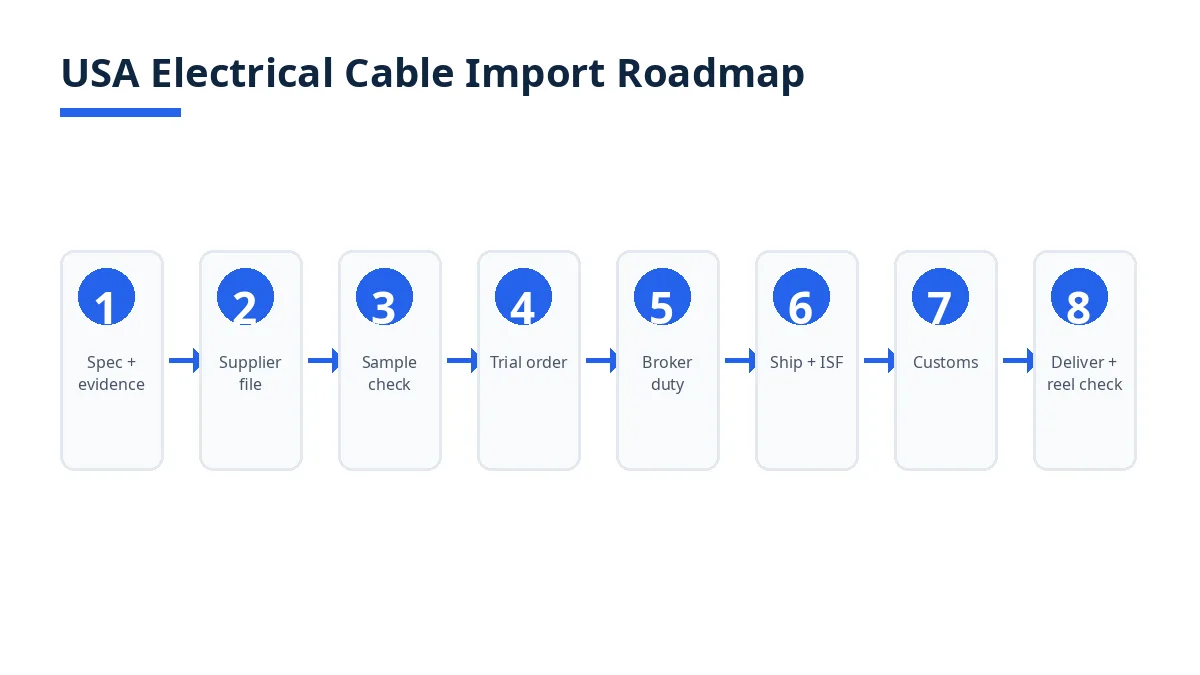
Fix the cable in one specification document: job, voltage, cores, conductor metal and area, insulation family, armour and sheath, marking, reel lengths and tests.
Hold United States evidence for the exact construction: the NRTL listing or certification record, the NEC cable type and permitted use, and the IEC test reports for the same construction.
Check the supplier on the four files: identity, product evidence, production control and commercial standing, with checkable references for the same cable family.
Order a sample of the exact construction, compare it with the specification and the test evidence, and confirm termination and handling with the installer.
Agree quantity, counting basis, reel-length schedule, price parts, metal-price rule, Incoterms rule and payment tied to documents, and place the purchase order on the specification.
Inspect lot by lot against the specification: identity, marking and reel tag, length, condition and test evidence, and hold any reel that does not match until it is corrected and rechecked.
File the ISF on time, ship on the agreed rule, and keep the document set consistent across invoice, packing list, bill of lading and entry.
Clear entry through the broker in ACE, pay the broker-confirmed duty and fees, and check reels, lengths and markings again on arrival before the cable is released to the job.
How many metres of electrical cable should a first United States order cover?
This guide gives no typical minimum. The sources opened for it contained no minimum figure for electrical cables from Bangladesh, so a first order should be sized by the job, not by a catalogue minimum: the length the installation needs, the reel lengths the site can handle, and the length needed for laboratory and installation checks. Set the minimum with each supplier, for each shipment, in writing, in metres and reels, with the reel-length schedule and short-length rule fixed, and run a trial lot using the full document set before committing to a full order. A trial lot that uses the same specification, the same inspection scope and the same documents as a full order is the cheapest way to learn whether a supplier can hold a construction unchanged.
How long should a United States buyer allow for cable to reach a United States port from Bangladesh?
This guide gives no transit figure. The sources opened for it contained no sailing or routing time for cable shipments from Bangladesh to the United States. Time depends on the sailing, the routing and transhipment points, port handling, examination and any partner-agency checks at the United States port, and the time needed to replace a reel that fails inspection before shipment. Ask the carrier to confirm routing and scheduled times in writing, ask the broker how long entry and checks may add, and plan installation dates around the longest realistic time. Build the ISF deadline into the schedule, because the filing must be made no later than 24 hours before the cargo is laden aboard the vessel at the foreign port for the elements named in the regulation.8
What import duty will a United States buyer pay on electrical cables from Bangladesh?
No rate appears in this guide, because the United States tariff schedule for heading 8544 was not opened in this run. The broker must confirm the ten-digit line, the General rate, any special-programme rate and any Chapter 99 addition that applies to the construction, voltage, connector fitting and entry date, and must put the confirmation in writing before the order is priced. The subheading structure that the broker works from separates winding wire of copper from winding wire of other materials, coaxial cable, ignition wiring sets, conductors for a voltage not exceeding 1,000 V fitted with connectors or not fitted with connectors, conductors for a voltage exceeding 1,000 V, and optical fiber cables.2 Duty is separate from broker fees, freight, insurance and port charges, and it must appear as its own line in the landed-cost table. Do not use a rate from another cable, another country or another entry date.
How does a United States buyer check an electrical cable supplier in Bangladesh before ordering?
Check the supplier against the United States file, not against a price list. Hold the identity file, the product evidence for the exact construction, the production-control file and the commercial file described in this guide, and check each one. For product evidence, read the NRTL listing or certification record in the certification database for the exact cable type and construction, and compare the reel tag with that record, because the tag is the primary evidence of certification and surface printing is supplemental.4 For the installation, confirm the NEC cable type and permitted use with the installer or the authority having jurisdiction, using the benchmark the NEC provides for safe electrical design, installation and inspection.5 Require written notice before any change to conductor, insulation, armour, sheath, marking or factory, run a trial lot using the full document set, and test on arrival. A supplier that cannot produce the record for the exact construction, or that will not accept a buyer-written inspection scope, has not passed the check.
Next steps on Exportain
Start with the general import sequence for Bangladesh, then rebuild your landed-cost table from broker-confirmed figures using the landed-cost method rather than the example figures above. Use the supplier listings to screen makers, check the cable classification guide with your broker when the subheading is in doubt, and follow the buying walkthrough when you send enquiries with the specification enclosed.
Post a free RFQ on Exportain and get quotes from verified Bangladeshi suppliers.
Sources
- IEC 60228:2023 - Conductors of insulated cables. International Electrotechnical Commission, (accessed )
- HS Explanatory Notes: Heading 85.44 - Insulated wire, cable and other insulated electric conductors. World Customs Organization (accessed )
- OSHA's Nationally Recognized Testing Laboratory (NRTL) Program - FAQ. Occupational Safety and Health Administration (accessed )
- Wire and Cable. UL Solutions (accessed )
- NFPA 70: National Electric Code. Pacific Northwest National Laboratory (accessed )
- IEC 60502-2:2014 RLV — Power cables with extruded insulation and their accessories for rated voltages from 1 kV up to 30 kV. International Electrotechnical Commission (IEC) (accessed )
- Place of delivery & risk transfer in trade contracts. ICC Academy (accessed )
- 19 CFR 149.2 - Importer security filing, requirement, time of transmission. Cornell Law Institute (accessed )
- ACE: The Import and Export Processing System. U.S. Customs and Border Protection, (accessed )
About the author
Sourcing from Bangladesh?
Post a request for quotation and suppliers on Exportain can send you their quotes directly.
Post an RFQ