UK Electrical Cable Imports From Bangladesh: Duty and Suppliers
Great Britain product checks, cable construction, supplier evidence, shipping and a broker-confirmed duty file for importing electrical cables from Bangladesh to the UK, with a worked landed-cost example in pounds.
Short answer
Importing electrical cables from Bangladesh to the UK succeeds when the Great Britain product file, one written cable specification and the customs file are settled before price is discussed. Settle UKCA or CE marking, EMC scope and RoHS evidence for the exact construction, fix conductor, insulation and voltage in one specification, and have the broker confirm the heading 8544 line, duty and any DCTS preference.

On this page
Key takeaways
Settle the Great Britain product file first: product-safety marking under UKCA or recognised CE marking, the EMC position for the construction, and RoHS evidence with the declaration of conformity for the exact cable.
Fix the cable in one specification before asking for a price: job, rated voltage, cores, conductor metal and area, insulation family, armour or screen, sheath, drum lengths and the standard with its edition.
Product conformity is not installation approval: the installer or designer must confirm the cable type and installation method against BS 7671 for the job, and any fire class the project requires must be named in the order.
Heading 8544 separates winding wire, coaxial cable, conductors fitted or not fitted with connectors by voltage band, and optical fibre cables; the broker confirms the current 10-digit line, the rate and any DCTS preference in writing.
Inspect the drums before loading, hold lot-matched test certificates and marking photographs, and price on a worked landed cost reworked with broker-confirmed duty, VAT treatment and the customs file ready before sailing.
Buying electrical cables from Bangladesh for the UK market works when the paperwork is settled in the right order: the Great Britain product file first, then a single written description of the cable, then the customs file with the broker's duty position. Every choice about the cable itself — which metal carries the current, how the conductor is built, what insulates it, the voltage it is rated for, how many cores it has, and what protects it outside — changes the rules that apply, the papers you need, the tariff line it falls under and where it can be fitted. The pages below take those choices in turn, for power and control cables that travel on drums in containers to a UK port.
Settle the Great Britain product file before you discuss price
Start with the law that governs the cable as a product, separate from the law that governs the building it will be installed in. Electrical equipment placed on the market in Great Britain falls under the Electrical Equipment (Safety) Regulations 2016, which apply to electrical equipment designed for use within a voltage range of 50 to 1,000 volts AC or 75 to 1,500 volts DC, subject to the exclusions in Regulation 3(2).1 Under those regulations the manufacturer must meet the safety objectives, prepare technical documentation, carry out a conformity assessment, draw up a declaration of conformity and apply the required marking, and must keep the documentation and the declaration for 10 years. The importer must check that the assessment was done, that the documentation exists and that the marking is present, must add their own name and address, and must also keep the documentation for 10 years.1
Marking is where many cable orders go wrong, because the mark follows the market, not the factory. In Great Britain, CE marking continues to be recognized indefinitely for products covered by the regulations where the EU requirements are met, and UKCA marking is the alternative route, with dual marking allowed where the requirements of both markets are met.1 Ask the supplier which route the cable offered takes, and hold the declaration of conformity that matches that route for the exact construction you are buying. A declaration written for another cable, or a broad claim that a factory holds a mark, does not cover your order. Where marking cannot be placed on the equipment itself, or is not warranted, it may go on the packaging or the accompanying documents, and a UKCA-by-label easement runs until 31 December 2027.1 Components placed on the market separately may need their own assessment and marking, so a cable sold as a component for incorporation into other equipment needs the same question asked, not an assumption.1
Next, ask whether electromagnetic compatibility rules touch your cable at all. The Electromagnetic Compatibility Regulations 2016 apply to electrical and electronic equipment that is liable to generate electromagnetic disturbance or whose performance is liable to be affected by it, with exceptions that include equipment incapable of generating electromagnetic disturbance that could cause harm.2 A passive power cable may fall inside that exception, and a cable assembly with active electronics may not. Do not accept an EMC assessment for every cable, and do not skip the question for a cable that carries control electronics. Ask the supplier to state in writing whether the construction offered is in scope, and if it is, hold the same file you hold for product safety: technical documentation, a conformity assessment, a declaration of conformity and marking, with the importer checks and 10-year retention that the regulations place on the importer.2 CE marking is recognized indefinitely in Great Britain for these regulations as well, with a Fast-Track UKCA route and dual marking where both sets of requirements are met.2
The third part of the product file is the restriction of hazardous substances. The Restriction of the Use of Certain Hazardous Substances in Electrical and Electronic Equipment Regulations 2012 apply to electrical and electronic equipment, defined as equipment dependent on electric currents or electromagnetic fields to work, up to 1,000 volts AC or 1,500 volts DC, and the guidance states plainly that all such equipment, including its cables and spare parts, is in scope unless specifically excluded.3 That sentence matters for a cable buyer: the cable is not outside the rules because it is a component of a larger installation. At the same time, component parts supplied business to business that are not themselves placed on the market fall outside the scope, while the full assembly that includes them must comply.3 Ask which side of that line your cable falls on, and get the answer in writing.
RoHS compliance is measured substance by substance against maximum concentration values in homogeneous materials. The limits are 0.1 percent by weight (1,000 parts per million) for lead, mercury, hexavalent chromium, polybrominated biphenyls, polybrominated diphenyl ethers, DEHP, BBP, DBP and DIBP, and 0.01 percent (100 parts per million) for cadmium.3 Hold test evidence or a supplier declaration that names the construction, the substances tested and the limits applied, and hold the declaration of conformity that covers RoHS alongside the product-safety declaration: a single declaration may list more than one regulation, and dual marking needs either two declarations or one declaration that refers to both.3 Time-limited exemptions exist for specific uses, and the Great Britain exemptions system now runs independently of the EU system, so an exemption claimed for a cable must be the current Great Britain exemption for that use, not a remembered EU listing.3
One more marking question belongs in the product file. The RoHS guidance notes that the majority of electrical and electronic equipment is also covered by the Waste Electrical and Electronic Equipment Regulations 2013, with the crossed-out wheeled-bin symbol as its marking.3 Whether your cable order carries any producer obligation under those regulations depends on how the cable is placed on the market and who counts as the producer, so ask your broker or compliance adviser before the order ships rather than discovering the question at the border.
Write the cable down: conductor, insulation, voltage and construction
Put the cable in writing before you ask anyone for a price, and keep that wording fixed from the first enquiry to the final customs papers. Begin from the duty the cable must perform: permanent wiring inside a building, permanent wiring outside or underground, wiring that stays inside a machine or panel, or a lead that flexes in use. Then pin down the numbers that define it: the voltage rating, how many cores it carries, what the conductor is made of and how big it is, what insulates each core, and what protection the outside of the cable needs where it will run — armour, a metallic screen, a sheath, or a combination of those.
For low-voltage PVC cables, the construction standard buyers meet most often is IEC 60227. Part 1 of that standard covers rigid and flexible cables with PVC insulation and sheath, if any, of rated voltages Uo/U up to and including 450/750 volts, used in power installations of nominal voltage not exceeding 450/750 volts AC.4 Its general requirements cover marking, core identification, conductor construction and insulation, and its particular types are set out in the later parts for non-sheathed fixed wiring, sheathed fixed wiring and flexible cables.4 For larger power cables, IEC 60502-1 covers power cables with extruded solid insulation for rated AC voltages of 1 kV (Um = 1.2 kV) and 3 kV (Um = 3.6 kV) for fixed installations such as distribution networks or industrial installations, including cables with reduced flame spread, low smoke emission and halogen-free gas emission properties, and it excludes special conditions such as overhead networks, mining, nuclear containment, submarine and shipboard use.5 A 1 kV cable designed and tested under IEC 60502-1 may also be used, if the manufacturer declares it, in DC distribution systems up to 750 volts DC between a live conductor and neutral or earth, or up to 1,500 volts DC between two live conductors.5 Name the standard, the part and the edition in the specification, and require the test evidence to match that edition for the construction offered.
Settle the conductor before anything else. In the PVC range IEC 60227-1 covers, conductors must be annealed copper, plain or tinned, apart from tinsel cords, and their build is checked against IEC 60228 for the conductor class.4 Outside that range, larger power cables may use aluminium, so the metal must be named wherever the standard does not fix it, with test evidence for the metal named. Two conductors with the same nominal size but different metals are not interchangeable: the termination, the price basis and the area all change with the metal, so any offer that changes the metal while leaving the rest of the description untouched is an offer for another cable. Record the sizing basis too — exact cross-sectional area, conductor class or build, and the Uo/U voltage rating — and do not allow a silent switch between sizing systems.
Next, the insulation. Buyers most often meet two families: PVC, polyvinyl chloride, which is a thermoplastic, and XLPE, cross-linked polyethylene, which is a thermoset; rubber-based compounds turn up in other builds. Insist on the family name, the voltage rating and the temperature rating exactly as the test evidence states them — a brand name or a supplier's catalogue number is not a substitute for any of the three. Voltage is what separates lookalike drums: a 450/750 volt fixed-wiring cable, a 1 kV distribution cable and a 3 kV cable follow different standards, different tests and different prices, even when the drums beside them look the same.
Construction details decide whether the cable survives the place it will run. State the number of cores, the core identification, the screen or armour, the inner covering and the outer sheath, and the drum length. IEC 60227-1 requires cables to carry an indication of the manufacturer, by identification thread or repeated marking of the name or trade mark, and treats a mark as continuous when the gap between identical marks does not exceed 550 millimetres on the outer sheath or 275 millimetres on insulation or tape within a sheath.4 It also requires each core to be identified, by colour for up to five cores and by number above five, with green-and-yellow reserved for the protective core and blue for neutral.4 Require the supplier to confirm those markings in the sample and on every drum, because a drum that cannot be identified at the reel cannot be checked at the border or on site.
BS 7671 decides the installation, not the product
Product conformity and installation suitability are two different questions, and a UK buyer needs both answered. BS 7671, the IET Wiring Regulations, is the UK national standard for the design, erection and verification of electrical installations, covering installations up to 1,000 volts AC and 1,500 volts DC in domestic, commercial and specialised environments.6 Amendment 4:2026 was published on 15 April 2026 and supersedes the earlier amended edition, which was withdrawn on 15 October 2026.6 The standard is described as the most widely accepted way to demonstrate compliance with UK electrical safety legislation, including the Electricity at Work Regulations 1989.6
A cable can therefore hold a sound product file and still be the wrong cable for a particular installation. The installer, the designer or the electrician of record must confirm that the cable type, voltage rating, installation method and location match BS 7671 for the job, including the external influences on the route the cable will take. Ask that question before the order ships, and keep the answer with the order file. If the cable will run where the installation standard imposes a fire-performance or environmental demand, that demand belongs in the specification as well, and the next section explains how to handle it.
Cables in buildings: ask which fire class the project needs
Cables that will be incorporated permanently into construction works raise a separate question about reaction to fire. Under the Construction Products Regulation as it applied in the EU, power, control and communication cables fell within scope as construction products, and manufacturers could make a Declaration of Performance against the harmonised standard EN 50575 and apply CE marking under that regulation, with seven classes of reaction to fire ranging from Aca down to Fca.7 The choice of which class a particular installation needs was not the manufacturer's decision: it rested with the commissioning authority, for example a local council or hospital trust, or with the building designer.7
The Great Britain position on construction products has moved since that announcement, and this guide does not state a current Great Britain requirement for a cable class. Ask the project specifier or designer whether the cable needs a Declaration of Performance and a reaction-to-fire class for its end use, which class the project requires, and which body assessed it. If the project states a class, write it into the purchase order with the standard and the declaration reference, and hold the declaration for the exact construction. If the project states no class, record that fact and do not let a supplier sell you a class as a substitute for the product-safety and RoHS file.
Find suppliers and hold the evidence before paying a deposit
Search for suppliers by the cable, not by the catalogue. A factory that makes flexible cords may not make armoured power cable, and a trader that lists every cable type may make none of them. Start with the construction you wrote down, and ask each supplier for the same evidence pack: business registration and factory details, the product-safety declaration of conformity for the exact construction, the RoHS evidence, the test reports that match the standard and edition named in your specification, photographs of the marking on the cable and the drum, and the names of reference customers you may contact.
Use the supplier listings on Exportain to build the shortlist, and read each listing against the evidence pack: the declaration, the test reports and the sample are what settle the order. For the wider import process, the guide to bringing goods in from Bangladesh sets out the steps that sit around the cable decisions in this guide.
Pay no deposit until the evidence pack is in hand and the sample matches it. The deposit question is not about trust; it is about sequence. Once money moves, your control over the specification moves with it. Agree in writing what the deposit covers, what happens if the sample fails, and what happens if production test evidence does not match the sample. If a supplier will not put the construction, the standard, the marking and the test evidence in writing before a deposit, treat that as the answer and move to the next supplier on the shortlist.
Samples, order size and the parts of the price
Order the sample as the bulk cable, not as a showpiece. The sample must be the same construction, the same conductor metal and area, the same insulation family, the same voltage rating and the same marking as the production order, cut from the same type of drum the bulk order will ship on. Test the sample against the specification: check the marking and the core identification, measure the length, and have the test evidence read by someone who can spot a report written for a different construction. A sample that passes on looks and fails on paper has failed.
Order size follows the construction, not a rule of thumb. No single minimum order quantity applies to every cable, because drum lengths, conductor area and production runs differ by construction. Agree the counting basis before you agree the price: metres per drum, number of drums, and total metres, with the tolerance on drum length stated in the order. A price quoted per metre means nothing until the drum length, the number of drums and the tolerance are fixed, and a price quoted per drum means nothing until the metres on the drum are fixed. For a first order, size the quantity to the job plus a stated allowance for offcuts, testing and spares, and write that allowance into the order.
Price the order in parts, and keep the parts separate in every quotation. The parts are the cable price on the agreed Incoterm, drum and packing charges, any testing or inspection charges, international freight, insurance, import duty, import VAT, broker charges and inland delivery to your site. Copper and aluminium prices move, so agree the price basis and the date it is fixed, and state in writing what happens if the metal price moves between quotation and production. A quotation that gives one total with no parts cannot be compared with another quotation, and cannot be reworked when duty or freight changes.
Inspect the reels before they leave Bangladesh
Inspection is cheapest at the factory and most expensive at your site. For a first order, or for any order where the cable type is new to you, arrange inspection before the drums are loaded. The inspection instruction should repeat the specification word for word: construction, conductor metal and area, insulation family, voltage rating, cores, armour and sheath, drum lengths and marking. The inspector checks the drums against that instruction, not against the catalogue.
At the reel, four checks catch most problems. First, length: measure or witness the measurement of each drum against the order tolerance, and record the length per drum on the packing list. Second, marking: check the manufacturer indication, the cable identification and the continuity of the marks against the standard named in the specification, and check that the drum label names the same construction as the order. Third, condition: look for drum damage, sheath damage and signs of moisture, and record any drum that will not survive the sea move. Fourth, papers: hold the test certificates for the production lot, and check that the lot numbers on the certificates match the lot numbers on the drums. Photograph each drum label and each mark, and keep the photographs with the order file. If a drum fails, the order should state in advance whether it is reworked, replaced or held, and who pays for the delay.
Delivery terms and the sea move to a UK port
Agree the delivery term before you agree the price, because the term decides who arranges each leg, who carries the risk on each leg and who pays for it. FAS, FOB, CFR and CIF are the four Incoterms 2020 rules confined to sea and inland waterway transport. The remaining five rules — CPT, CIP, DAP, DPU and DDP — apply whatever the mode of transport, and DDP adds the seller clearing import customs and paying duty.8 Under DPU the seller delivers the goods unloaded at the named place of destination, while under DDP the seller clears import customs and pays duty but the buyer unloads the goods.8 Under every Incoterms 2020 rule, delivery and risk transfer happen at the same point, but under the C rules the place of delivery is not the same as the place of destination, so the named places in the contract must be read carefully.8
For containerised cable on drums, that mode point has a practical consequence. FAS and FOB deliver alongside the vessel or on board the vessel, which fits cargo handed over at the port, while FCA delivers at a named place and is often the better fit for containerised cargo even when the onward move is by sea, because the container is handed to the carrier before the port.8 CFR and CIF also deliver on board, with the seller arranging carriage and, under CIF, insurance as well; CPT and CIP deliver when the goods are handed to the carrier the seller has contracted, with CIP adding seller-arranged insurance.8 DAP delivers when the goods are available for the buyer to unload at the named destination, and DDP adds the seller's import clearance and duty payment to that delivery.8 Choose the term that matches who will actually handle the container, the drums and the customs file, and name the places in full: the factory or depot, the port of loading, and the UK delivery point.
Agree the container and drum handling in the same conversation. Drums are heavy, they roll, and they are damaged by poor stowage. State the container type, the number of drums per container, the stowage and securing method, and who loads and who unloads. Get the sailing schedule and the forwarder's written transit estimate for the specific sailing, and build the order timetable from the production date, the inspection date, the sailing date and the UK arrival date, with the customs file ready before the vessel sails rather than after it docks.
Duty, VAT and the customs file at the UK border
The broker settles classification from the cable facts, and that step comes before any rate is discussed. Heading 8544 covers insulated wire, cable and other insulated electric conductors, including coaxial cable and optical fibre cables, and it separates winding wire, coaxial cable, conductors fitted with connectors, other conductors and optical fibre cables into different subheadings.9 The UK Integrated Online Tariff page for heading 8544, dated 1 January 2023, shows a third-country duty rate of 2.00 percent on most of the lines displayed, including winding wire, coaxial cable, conductors fitted with connectors other than for telecommunications, and other conductors at various voltage bands, with a 0.00 percent rate shown for conductors fitted with connectors of a kind used for telecommunications and for optical fibre cables.9 Treat that page as the structure of the heading, not as the current rate for your cable: the page is dated 1 January 2023, and your broker must confirm the current 10-digit commodity code and the current rate for the exact construction on the import date. Do not budget a duty rate from a heading page without that confirmation.
A preference may change the rate to zero, and Bangladesh is the country to check. Under the Developing Countries Trading Scheme, Bangladesh is listed under Comprehensive Preferences, the tier for least developed countries, and least developed countries benefit from duty-free, quota-free trade on everything but arms and ammunition.10 The scheme replaced the Generalised Scheme of Preferences, covers 65 countries in three tiers, and applies simpler rules of origin for least developed countries, with a non-originating content threshold of up to 75 percent.10 Proof of origin is an origin declaration or a GSP Form A, and businesses can self-certify origin without an official stamp, using the declaration text and data elements the scheme sets out.10 That does not promise zero duty for every cable. The broker must confirm the product-specific origin rule for your commodity code, the graduation position of the goods, and whether any suspension applies, and must hold the origin evidence in the customs file before claiming the preference.10
Customs clearance itself follows the step-by-step process GOV.UK sets out: check whether the process applies, set the business up with a GB EORI number and the right declaration systems and software, check for faster routes and for restricted goods, check licences and certificates and the marking and labelling rules, arrange any inspection, submit and manage the declaration, pay VAT and duty, and deal with goods held at the border.11 Goods may be held where the duty or VAT paid is wrong, where licences are missing, where inspection fails, or where a shipment has been combined with a held shipment.11 Build the file to that list: commercial invoice, packing list with drum lengths, bill of lading, origin evidence, the declaration of conformity and test evidence, and insurance documents where the term requires them. The full-cost working in the next section follows the same file, so the duty and VAT figures in your budget and the figures in your declaration come from one set of papers.
Value added tax sits alongside duty and must be confirmed separately. The tariff heading page shows a 20 percent VAT rate in its table header for the lines displayed, but VAT treatment depends on the goods, the importer and the accounting route, so ask your broker or accountant to confirm the VAT figure for your import before you budget it.9 Do not treat a tariff-page header as a VAT ruling for your order.
Worked landed cost in pounds, with two duty cases
The table below works one example order through to a landed cost at your site, so you can see where each charge lands and what changes if the broker confirms a preference. Example figures throughout. The order is 10,000 metres of three-core PVC-insulated cable, priced at 0.85 pounds per metre, shipped on drums from Bangladesh to a UK port.
Cost item | Case A: 2.00% duty | Case B: 0% preference |
|---|---|---|
Cable, 10,000 m at 0.85 pounds per metre | 8,500.00 pounds | 8,500.00 pounds |
International freight | 1,150.00 pounds | 1,150.00 pounds |
Insurance | 95.00 pounds | 95.00 pounds |
Customs value (CIF basis) | 9,745.00 pounds | 9,745.00 pounds |
Import duty | 194.90 pounds | 0.00 pounds |
VAT at 20% on duty-paid value | 1,987.98 pounds | 1,949.00 pounds |
Broker charges | 180.00 pounds | 180.00 pounds |
Inland delivery to site | 240.00 pounds | 240.00 pounds |
Total landed cost | 12,347.88 pounds | 12,114.00 pounds |
Landed cost per metre | 1.23 pounds | 1.21 pounds |
The arithmetic is straightforward and worth checking line by line. In Case A, duty at 2.00 percent of the 9,745.00 pound customs value is 194.90 pounds, giving a duty-paid value of 9,939.90 pounds; VAT at 20 percent of that value is 1,987.98 pounds; adding freight, insurance, broker charges and inland delivery to the cable price gives 12,347.88 pounds, or 1.23 pounds per metre rounded. In Case B, duty is zero, so VAT at 20 percent of the 9,745.00 pound customs value is 1,949.00 pounds, and the total is 12,114.00 pounds, or 1.21 pounds per metre rounded. The difference between the two cases is 233.88 pounds on this order, which is the duty plus the VAT on the duty. Rework the table with your broker's confirmed commodity code, duty rate, preference position and VAT treatment before you commit a price to a customer, because a different subheading, a failed preference claim or a different VAT route moves every line below the cable price.
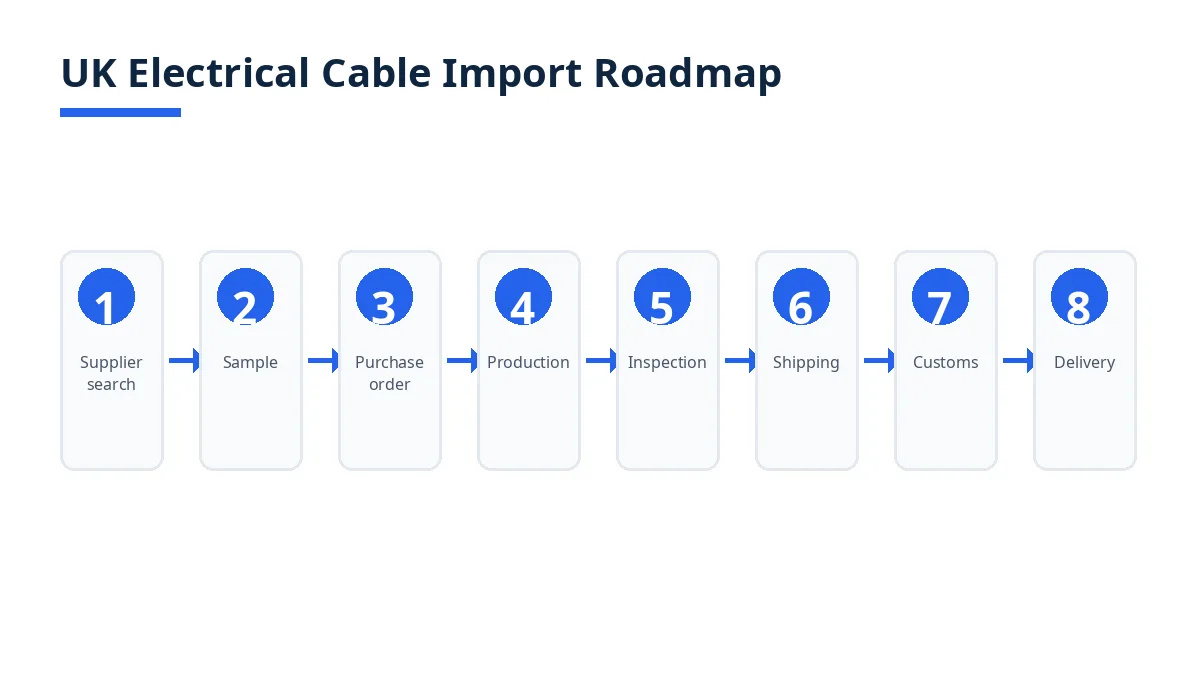
The order, step by step, from first enquiry to delivery
Write the one-page cable specification: the duty it must perform, voltage rating, core count, conductor make-up, insulation family, outer protection, drum lengths, and the standard with its edition.
Settle the Great Britain product file: product-safety declaration, EMC position, RoHS evidence and marking, for the exact construction.
Shortlist suppliers against the evidence pack, and hold the declaration, test reports and marking photographs before any deposit.
Order the sample as the bulk cable, check it against the specification, and confirm the counting basis and the price parts in writing.
Place the purchase order with the specification, the standard, the marking, the delivery term with named places, the inspection instruction and the failure and remedy terms.
Inspect the drums before loading: length, marking, condition and lot-matched test certificates, with photographs in the order file.
Ship on the agreed term with the customs file ready: invoice, packing list, bill of lading, origin evidence, declaration and test evidence, and the broker's confirmed commodity code and duty position.
Clear customs, pay duty and VAT as declared, check the drums on arrival against the packing list, and file the order papers for the 10-year retention the importer duties require.
For the steps that sit around the cable decisions, the HS classification notes for electrical cables explain how heading 8544 is structured, and the supplier and buying pages linked at the end of this guide explain how to run the enquiry.
What size should a first UK cable order be?
Size a first order to the job, not to the catalogue. Work out the route lengths, add the stated allowance for offcuts, testing and spares, and convert the total into drums at the drum length the supplier offers. A first order that is too small costs more per metre and leaves no spare length when a drum is short or a length is damaged; a first order that is too large ties up cash in a construction you have not yet installed. Agree the drum length and the tolerance in the order, and check the first drums against that tolerance before the balance ships. If the job is phased, order the first phase, install it, and confirm the cable and the supplier before committing the later phases.
How long does a cable shipment from Bangladesh take to reach the UK?
No single transit time applies, and this guide gives none. The time from order to delivery is production time plus inspection time plus the sea move plus customs clearance, and each part varies with the construction, the sailing schedule, the route, transshipment, port congestion and the readiness of your customs file. Ask the forwarder for a written transit estimate for the specific sailing, ask the supplier for a production timetable tied to the purchase order date, and add time for inspection and for any hold at the border. A timetable built from the sailing date backwards, with the customs file ready before the vessel sails, is worth more than any average transit figure quoted without a sailing attached.
What duty does a UK buyer pay on electrical cables from Bangladesh?
The duty depends on the commodity code, the rate in force on the import date, and whether a preference is claimed and accepted. The tariff heading page dated 1 January 2023 shows 2.00 percent on most heading 8544 lines displayed, with zero shown for two narrow lines, and Bangladesh may qualify for zero under the Developing Countries Trading Scheme where the origin rule is met and the evidence is held.9 10 Your broker must confirm the 10-digit code, the current rate and the preference position for the exact construction before you budget or quote. Budget Case A in the table above until that confirmation arrives, and treat any supplier statement of a duty rate as unconfirmed until the broker confirms it in writing.
How does a UK buyer check a Bangladeshi cable supplier before ordering?
Check the evidence, not the claims. Hold the declaration of conformity for the exact construction, the test reports that match the standard and edition in your specification, the RoHS evidence, photographs of the marking on the cable and the drum, and the names of reference customers you may contact. Check the marking and the core identification on the sample against the standard, and check the test report lot numbers against the drums at inspection. Ask the supplier to state the delivery term, the counting basis, the price parts and the failure and remedy terms in writing. A supplier that provides that file, answers the Great Britain questions directly and accepts inspection before loading has given you something to check; a supplier that answers with a price alone has not.
Next steps on Exportain
Start with the specification, then build the shortlist. Read the supplier listings on Exportain against the evidence pack in this guide, check how buying on Exportain works before you send an enquiry, and keep the customs file and the product file together from the first quotation to the final delivery. When the specification is written, send it to more than one supplier and compare the evidence packs, not only the prices.
Post a free RFQ on Exportain and get quotes from verified Bangladeshi suppliers → https://exportain.com/rfqs
Sources
- Electrical Equipment (Safety) Regulations 2016: Great Britain. GOV.UK (accessed )
- Electromagnetic Compatibility Regulations 2016: Great Britain. GOV.UK (accessed )
- RoHS Regulations 2012 (as amended): Great Britain. GOV.UK (accessed )
- IEC 60227-1:2007 - Polyvinyl chloride insulated cables of rated voltages up to and including 450/750 V - Part 1: General requirements. International Electrotechnical Commission (accessed )
- IEC 60502-1:2021 - Power cables with extruded insulation and their accessories for rated voltages from 1 kV (Um = 1,2 kV) up to 30 kV (Um = 36 kV) - Part 1: Cables for rated voltages of 1 kV (Um = 1,2 kV) and 3 kV (Um = 3,6 kV). International Electrotechnical Commission, (accessed )
- BS 7671:2018+A4:2026 - Requirements for Electrical Installations (IET Wiring Regulations). BSI (accessed )
- British Cables Association public announcement. Electrical Review, (accessed )
- Place of delivery & risk transfer in trade contracts. ICC Academy (accessed )
- Heading 8544 - Insulated wire, cable and other insulated electric conductors; optical fibre cables. GOV.UK (accessed )
- What is DCTS and why is it important for international trade?. GOV.UK (accessed )
- Get UK customs clearance when importing goods into the UK: step by step. GOV.UK (accessed )
About the author
Sourcing from Bangladesh?
Post a request for quotation and suppliers on Exportain can send you their quotes directly.
Post an RFQ